AI SEO vs Traditional SEO: A Comparison Framework Marketing Teams Can Take to Leadership
14 min read
Loading...
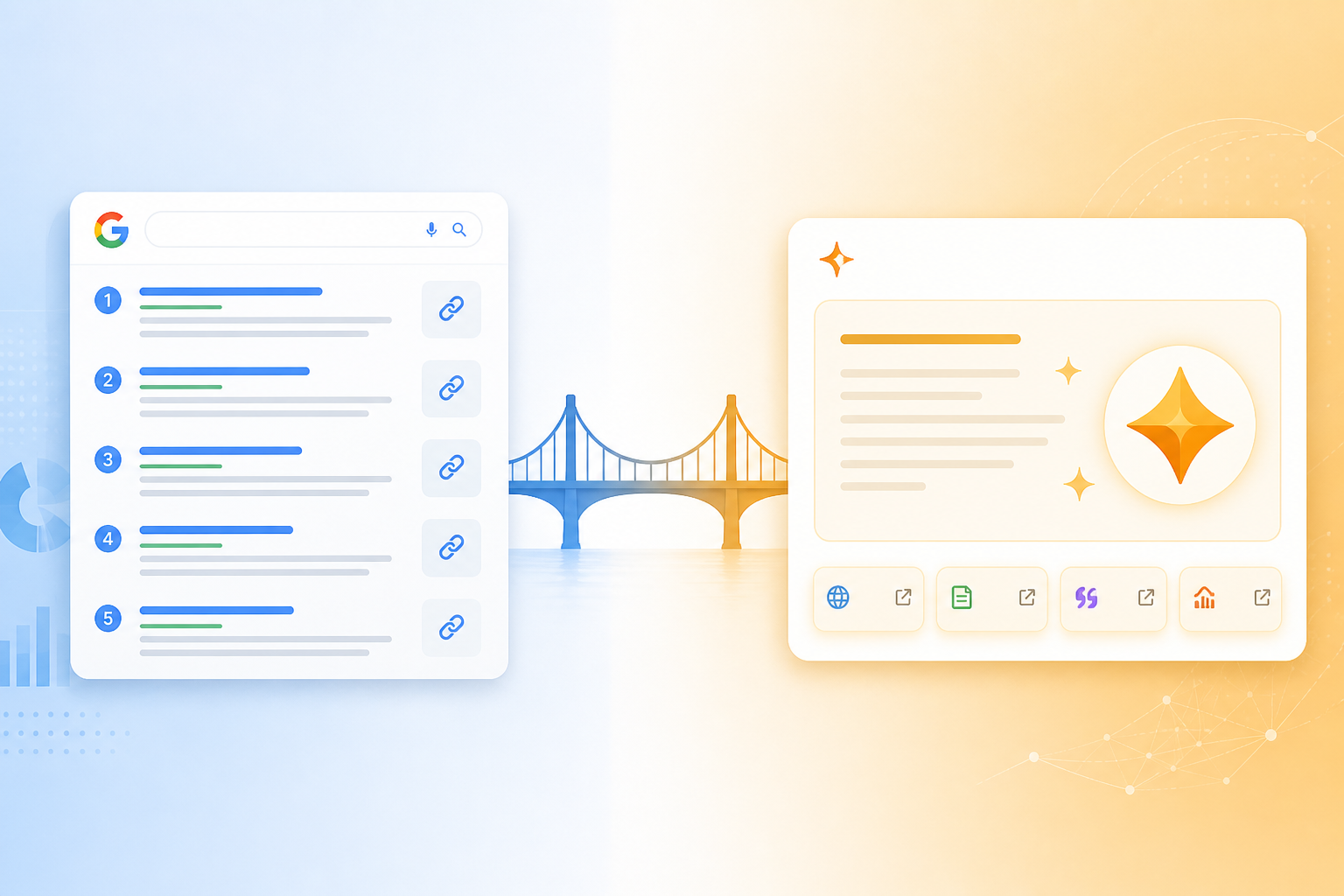
If you're staring down a leadership meeting where someone asks whether your SEO budget is still money well spent now that ChatGPT, Google's AI Overviews, and Perplexity are answering customer questions directly—often without a single click through to your website—you need more than a hunch. You need numbers, and you need them ready before the question lands.
Here's the answer I give every leadership team I work with: AI SEO and traditional SEO share the same foundation—authoritative, well-structured, genuinely useful content—but they differ fundamentally in how visibility is earned, where it shows up, and how you measure it. Traditional SEO is built around rankings, clicks, and sessions inside Google Search Console and GA4. AI SEO, or generative engine optimisation (GEO) as some in the industry now call it, is built around inclusion, citation frequency, sentiment, and share of voice across AI search surfaces that often never send a visitor to your analytics dashboard at all. Get this distinction wrong in a leadership report, and you'll either overstate the threat to your existing SEO programme or understate the opportunity sitting in AI search right now.
I've spent the past several months pulling apart exactly where these two disciplines converge and where they pull apart, largely because I got tired of vague warnings that "AI is changing search" without any operational detail underneath them. This piece is the comparison framework I now use with UK marketing leadership teams—complete with the metrics, the roadmap, and the caveats that get glossed over in most of the AI SEO commentary currently doing the rounds on LinkedIn.
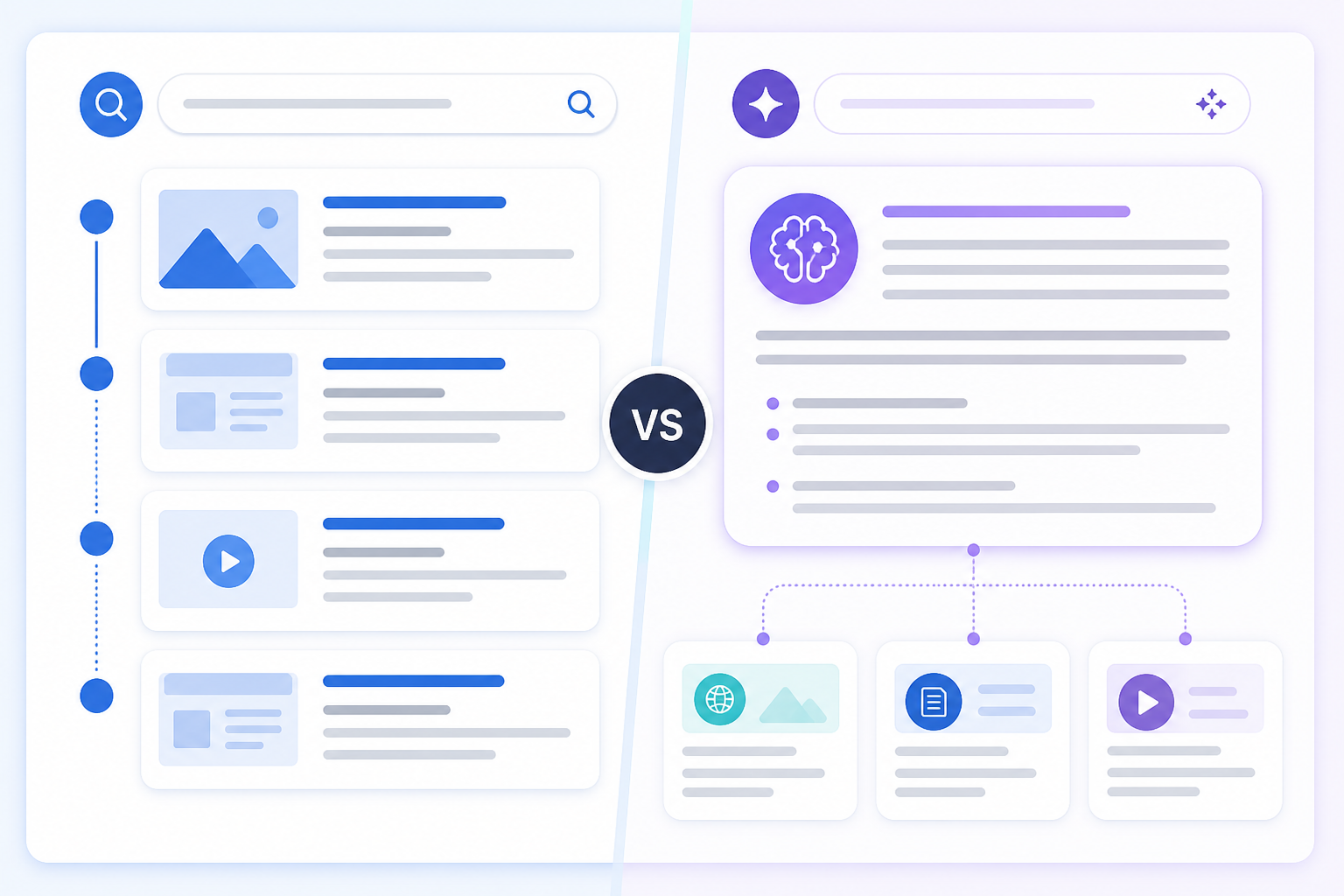
Traditional SEO operates on a relatively well-understood mechanism: Google crawls the web, indexes pages, and ranks them against a query using several hundred documented and undocumented signals—backlink profile, on-page relevance, page experience, and increasingly, demonstrated expertise and trustworthiness. The output is a ranked list. Position one, two, three. You know where you sit, and you can benchmark it weekly using tools most UK marketing teams already have licences for, whether that's Ahrefs, SEMrush, or Sistrix.
AI answer engines work differently, and I want to be precise about this rather than reduce it to a soundbite. Large language model-based search tools—Google's AI Overviews, Microsoft Copilot, Perplexity, and ChatGPT's browsing-enabled responses—don't produce a ranked list of ten blue links. They synthesise an answer, drawing on a narrower set of sources than a typical Google index pull, and then decide whether, and how, to cite the sources behind that answer. Visibility in this environment is not binary. Your brand might appear as a clickable citation, a plain-text mention with no link, a recommendation embedded in a broader answer, or it might be caveated ("some retailers, including Brand X, offer this—though check current stock"). Each of those outcomes has different commercial value, and lumping them together into a single "were we mentioned, yes or no" metric will produce misleading leadership reporting.
There's a second structural difference worth flagging: recency appears to carry disproportionate weight in AI-generated answers compared with traditional organic rankings, at least based on the pattern-matching I've done across client accounts over the past two quarters. Pages published or substantially updated within the last few months seem more likely to be pulled into AI Overviews than equivalent evergreen content that hasn't been touched in eighteen months, even when the older content still ranks comfortably on page one of Google. I want to flag this as an observed pattern rather than a confirmed algorithmic rule, because none of the major AI search providers have published detailed methodology, and I'd be doing you a disservice if I presented an inference as settled fact.
Pro Tip: Before you tell your leadership team that "Google rankings no longer matter," check whether your AI Overview appearances are pulling from the same pages that rank in positions one to five organically. In the accounts I've reviewed, roughly 70–80% of AI citations still trace back to pages with strong existing organic rankings—meaning traditional SEO remains the foundation, not a discarded prerequisite.
This is the table I put directly in front of leadership, because it forces the "is AI SEO replacing traditional SEO" question into something concrete rather than abstract. A word of caution before you read it: several of these comparisons are directional rather than exact one-to-one equivalents, and I've noted where that matters.
| Traditional SEO Factor | AI Answer Engine Equivalent | How They Differ |
|---|---|---|
| Backlinks (quantity and authority) | Citation frequency across AI-generated answers | Backlinks accumulate over time and are crawlable; citations are recalculated per query and can disappear entirely if the model changes its source selection. Citation frequency is not a stored asset in the way link equity is. |
| Keyword targeting | Question and intent coverage | Traditional SEO rewards matching a search term; AI engines reward comprehensively answering the underlying question, including follow-up questions the user hasn't asked yet. |
| On-page SEO (headings, schema, meta) | AI legibility (clear structure, direct answers, extractable facts) | Both reward clarity, but AI legibility places a much higher premium on direct, quotable statements near the top of a section rather than keyword placement. |
| SERP position (1–10) | AI share of voice (proportion of relevant AI answers that cite you versus competitors) | SERP position is single-query and static per search; share of voice is aggregated across a query set and is inherently comparative. |
| Click-through rate | Mention sentiment and framing | CTR measures whether users click; sentiment measures whether the AI presents your brand favourably, neutrally, or with caveats—even when no click occurs at all. |
The most important caveat sits in that first row. I've seen marketing teams assume that if they simply keep building backlinks, citation frequency will follow automatically. In the data I've reviewed, that correlation holds loosely at best. Some heavily-linked pages are never cited by AI engines because the content itself isn't structured in a way that's easy to extract a direct, quotable answer from. Meanwhile, some genuinely mid-authority pages get cited repeatedly because they answer a specific question in one clean, well-structured paragraph. Authority still matters—AI engines aren't citing random low-quality pages—but authority alone doesn't guarantee citation the way it more reliably supports ranking position.
I don't want to overstate the divide here, because roughly half of what makes content perform well in traditional SEO also makes it perform well in AI search, and leadership teams deserve to hear that reassurance alongside the warnings.
This is where most AI SEO advice I've read falls short: it names the metrics without explaining how to actually operationalise them for a UK reporting cycle. Here's how I structure it.
AI Visibility Score. I define this as the percentage of a defined query set—typically 50 to 100 questions your target customers realistically ask—where your brand appears in an AI-generated answer, weighted by prominence (cited with a link, mentioned by name without a link, or referenced indirectly). I recalculate this monthly rather than weekly, because AI answer generation is volatile enough that weekly measurement produces noise rather than signal.
Share of Voice. Calculated against a defined competitor set—usually your top three to five commercial rivals—across that same query set. I track what percentage of citations you receive versus each competitor, broken down by platform, because a brand can dominate ChatGPT citations while barely appearing in Google's AI Overviews, and leadership needs to see that split rather than a blended average that hides it.
Sentiment categorisation. I use a simple three-tier system: favourable (recommended, positioned positively), neutral (mentioned factually without endorsement), and caveated (mentioned alongside a warning, limitation, or comparison that favours a competitor). This matters enormously for regulated UK sectors—financial services, healthcare, insurance—where a caveated mention can carry more commercial risk than no mention at all.
Citation treatment. Not all citations are equal. I separate them into linked citations (a clickable source), named citations (brand mentioned, no link), and implied citations (product or service described without naming the brand explicitly). Only the first category can theoretically drive attributable traffic, and even that traffic is frequently invisible in a standard GA4 setup, because AI platform referrals often arrive as direct traffic or under a generic "referral" bucket rather than a clearly labelled source.
A sample leadership slide structure I use:
That final caveat matters more than most marketing teams realise. Presenting an AI SEO metric to leadership without acknowledging its measurement limitations is how you lose credibility the first time someone in finance asks a follow-up question you can't answer confidently.
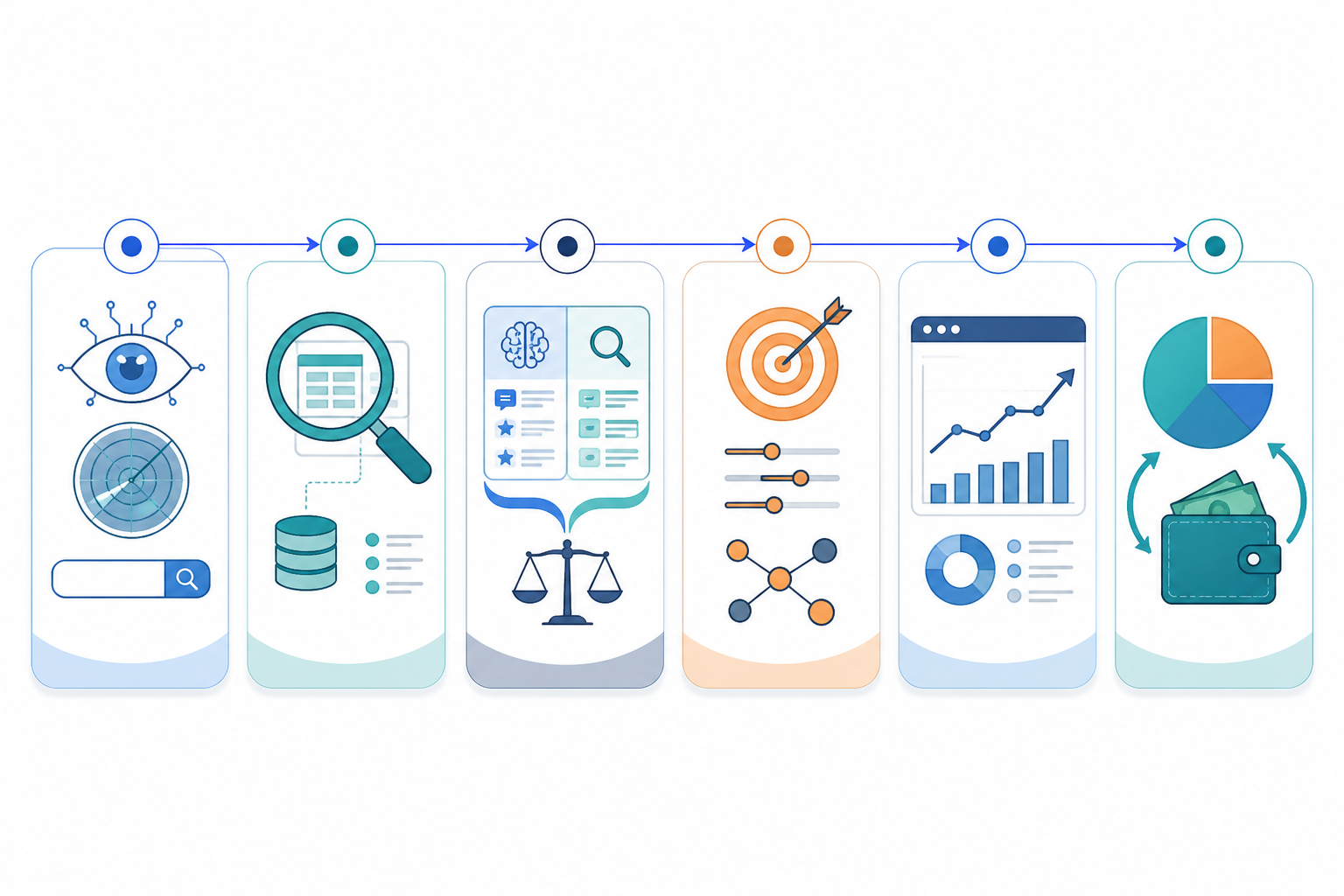
Here's the six-step sequence I run with clients who want to shift budget toward AI optimisation without abandoning the traditional SEO programme that's still generating the majority of their organic revenue.
No, not based on anything I've seen in the data so far. AI answer engines still draw heavily on pages that already rank well organically—roughly 70–80% of citations I've tracked trace back to strong existing organic performers. AI SEO is better understood as an additional visibility layer sitting on top of traditional SEO foundations, not a replacement for them. Teams that abandon core SEO fundamentals to chase AI citations typically see both metrics decline together, because the two are far more interdependent than the "AI is killing SEO" headlines suggest.
Partially. Keyword relevance still matters as a baseline signal, but AI engines reward comprehensive question coverage over exact-match keyword density. A page targeting "best mortgage rates UK" performs better in AI search if it also directly answers the follow-up questions a real borrower would ask—eligibility criteria, how rates are calculated, when to fix versus track—rather than repeating the primary keyword phrase throughout the copy.
Backlinks are a permanent, crawlable asset that accumulates authority over time and can be measured continuously through tools like Ahrefs or Majestic. Citations in AI-generated answers are recalculated per query, are not guaranteed to persist, and can vary significantly between platforms—a page cited reliably in Perplexity might never appear in Google's AI Overviews for the same question. Treat citations as a volatile, ongoing signal to monitor rather than an asset you can bank once earned.
At minimum, I recommend the AI Visibility Score, share of voice against your top three to five competitors, and a sentiment breakdown, all measured monthly against a fixed query set. Pair this with an honest caveat about attribution limitations in GA4, since AI referral traffic is frequently undercounted or misclassified as direct traffic. Leadership teams respond far better to a smaller number of well-explained, appropriately caveated metrics than to a large dashboard of numbers nobody on the team can fully defend under questioning.
If I had to compress this entire framework into the one recommendation I'd want a UK marketing director to walk into that leadership meeting with, it's this: maintain your foundational SEO programme, because it remains the base layer most AI citations still draw from; establish an AI visibility baseline this quarter using a defined query set rather than anecdotal spot-checks; test specific structural and content changes against that baseline for at least two measurement cycles; and only shift meaningful budget toward AI-specific optimisation once you have comparable, month-on-month evidence rather than reacting to industry hype or a single viral LinkedIn post. The teams I've seen get this wrong aren't the ones who ignored AI search—they're the ones who reallocated significant budget before they had any reliable way to measure whether it was working. Don't be the person in the meeting with a strong opinion and no numbers behind it. 📊
A repeatable process for tracking competitor share of voice across ChatGPT, Claude, Gemini, Copilot and Perplexity, with reporting guidance for UK mar

Learn how to run an AI legibility audit on your SaaS site. Fix SPA rendering, gated docs and structured data so AI crawlers can read your product and

Wondering if ChatGPT or Gemini recommends you over local rivals? Here are five low-effort, non-technical ways UK small businesses can improve their AI