Content Marketing Without Hiring a Writer: A Practical Guide for Solopreneurs

You don't need to hire a writer to run effective content marketing. With a lean strategy, a handful of repeatable topic ideas, and AI tools to help with drafting, most solo business owners can publish useful, SEO-friendly content consistently, at a fraction of the time and cost of hiring a freelancer or agency. The key is having a system, not a full-time employee.
In this guide, I'll walk through the workflow I use for content marketing without hiring a writer: how to choose topics, draft with AI, edit what comes out, and decide if and when hiring finally makes sense. It's a realistic, budget-conscious approach to content marketing on a budget, built for UK solo business owners who need content to generate enquiries, not just traffic.
If you've been putting off content marketing because you assumed it meant hiring a freelance writer, I get it. That's the default assumption for a lot of solopreneurs, and it's part of why content marketing keeps getting pushed to "next quarter" indefinitely. But you can build an effective solo content operation without hiring anyone, as long as you have a repeatable process.
Why hiring a writer isn't always the first answer
Hiring a writer isn't a bad idea. It's just not the whole solution, and it's rarely the first problem worth solving. A writer, even a very good one, only takes care of drafting. Strategy, topic selection, fact-checking, subject-matter accuracy, editing, and distribution still need your involvement, no matter who types the words. Hand someone a blog brief and never look at it again, and you'll get generic content that could belong to any business in your sector.
Cost is a real factor too, though it's worth being precise about it. Freelance writers in the UK typically charge somewhere between £100 and £300+ per blog post, depending on length, research depth, and experience. That's before you count the time you'll spend briefing them, reviewing drafts, and correcting anything that doesn't match how your business actually talks about its work.
If you're publishing weekly or fortnightly, that adds up to a meaningful monthly cost, one that many early-stage solo businesses simply haven't got the consistent revenue to justify yet. It's not that a writer is bad value. It's that the value only shows up once you already have a working system for briefing and editing them, which is exactly what this guide helps you build for yourself first.
There's a credibility angle here too, though it's a trade-off rather than a knockout blow. Google's guidance on helpful content emphasises original information, first-hand expertise, and a clear sense of who you're writing for. A generic article from someone who's never spoken to your customers can struggle to compete with a post built from your actual sales calls, support tickets, and product knowledge, simply because it lacks specific detail.
That said, a skilled writer who interviews you properly can absolutely produce strong, expert-backed content. The real point isn't that writers can't do good work; it's that when you're solo and budget-conscious, the fastest way to get first-hand expertise onto the page is to start from your own knowledge rather than paying someone else to extract it from you.
There's also research suggesting founder-level insight carries real weight with readers. Edelman and LinkedIn's 2024 B2B Thought Leadership Impact Report found that 73% of decision-makers said thought leadership content gave them a more trustworthy basis for judging a company's capabilities than standard marketing materials. That report focused on B2B buyers generally rather than UK solopreneurs specifically, so treat it as directional rather than gospel. Still, it matches something I've seen directly: posts built around a specific client problem I've actually solved consistently outperform generic "industry overview" content in both time-on-page and enquiries.
So what's the real bottleneck for most solopreneurs? It's rarely writing talent. It's time and structure. You already know your business and your customers better than any writer you'd hire. What's usually missing is a repeatable process for turning that knowledge into published content without it eating your whole week.
What does a lean content strategy look like?
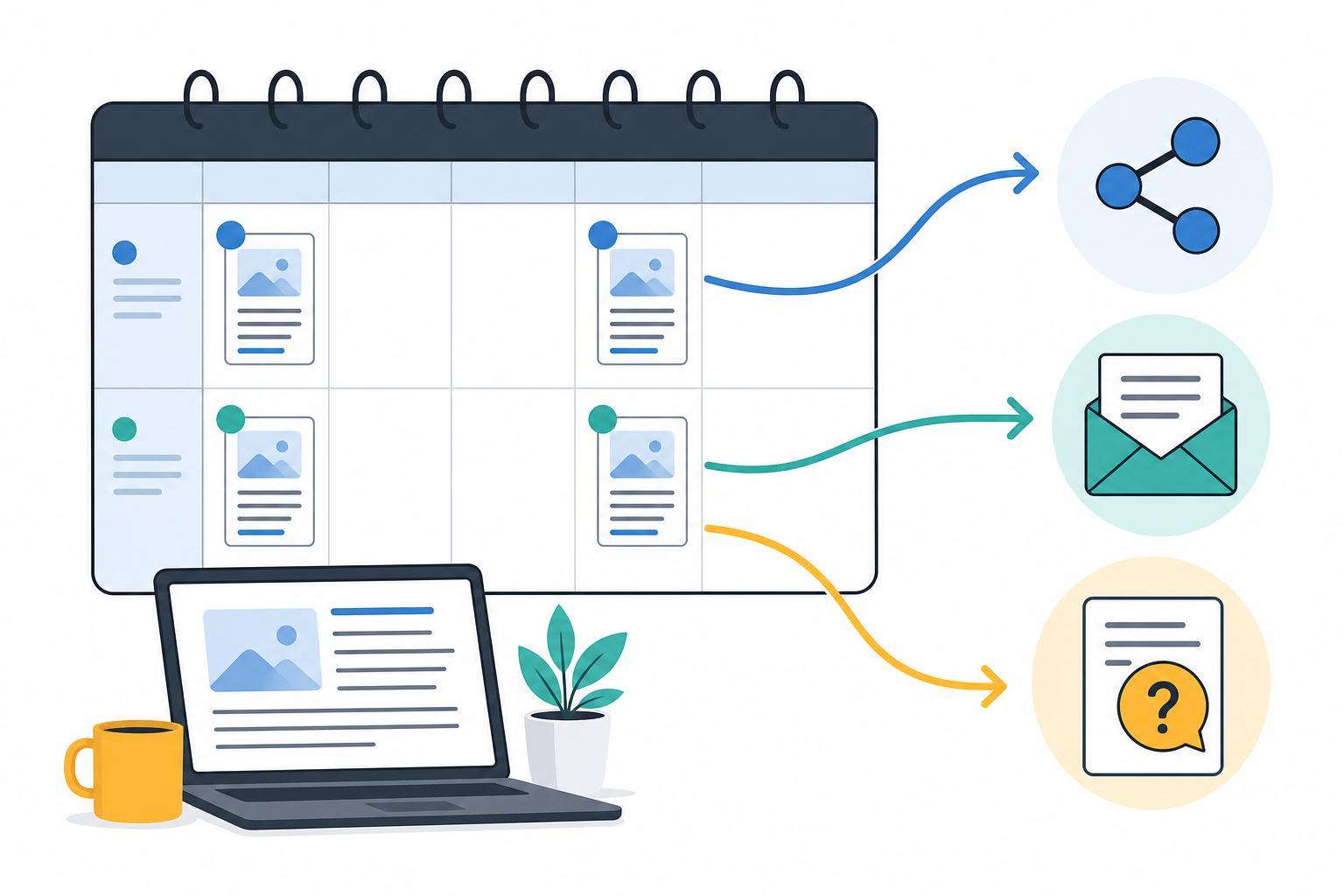
A lean strategy isn't about doing less well. It's about doing fewer things very deliberately, with a clear line from each post back to something you sell. Here's what that looks like as an actual two-week cycle, rather than just a list of principles:
- One core topic cluster, tied directly to what you sell. Don't try to cover your entire industry. Narrow it down to the handful of problems your product or service actually solves. If you're a bookkeeper, that might be "getting VAT returns right as a sole trader," not "all things finance."
- A fixed, sustainable publishing cadence. One solid post every two weeks, done consistently over six months, tends to build more compounding organic traffic than five posts published in a rush followed by silence. That's not because search engines reward calendar consistency directly. It's because regular publishing keeps you doing the underlying work: topic research, internal linking, and updating older posts, which is what actually drives rankings over time.
- Repurpose everything you publish. A single blog post can become a social caption, an email newsletter section, and an update to your FAQ page. You're not writing four pieces of content; you're writing one and slicing it four ways. Budget roughly 30 minutes for repurposing per post, done straight after publishing while the content is fresh in your head.
- Track a small set of metrics, and read them together, not in isolation. Organic traffic tells you if people are finding the post. Time on page is a useful engagement signal, but it's affected by page length and layout too, so don't treat it as a standalone verdict on quality. Add enquiries or sign-ups generated from the post if you can, since that's the number that actually pays your bills.
- A simple content calendar. A spreadsheet with columns for topic, target keyword, publish date, linked offer, and repurposing status is genuinely fine at this stage. You're not running a newsroom; you're running a system that keeps you consistent and connects each post to a commercial outcome.
This two-week model also reflects a bigger truth about content marketing on a budget: publishing more isn't automatically better. One widely cited Ahrefs study of over a billion web pages found that more than 90% receive no organic traffic from Google at all, largely because they target overly competitive terms, lack real depth, or duplicate content that already ranks well elsewhere.
That statistic doesn't prove fewer posts beat more posts on its own, but it does suggest that unfocused volume is a poor use of limited solo time. You're generally better off publishing twelve genuinely useful, narrowly targeted posts over six months than forty generic ones.
How to choose content topics without a strategist
You don't need a strategist on payroll to figure out what to write about. You already have the raw material. It's just scattered across your inbox, DMs, and sales calls. Here's the process I use to turn that into a running topic bank.
- Start with questions customers already ask you. Every email thread, DM, and sales call where someone asks the same question is a blog post waiting to be written. Keep a running note (a single spreadsheet tab is fine) and log the question word for word, along with which stage of the sales process it came up in.
- Check Google's "People Also Ask" and related searches. Type your logged question into Google and see what related queries appear. This tells you how people phrase the same problem, which helps you cover it more completely and include long-tail keyword variations naturally.
- Look at what competitors aren't covering well. Search your core topic cluster and skim the top-ranking posts. If they're all shallow, generic, or missing a practical example, that's your gap. You don't need a paid SEO tool for this, just twenty minutes of reading with a critical eye.
- Prioritise by commercial intent, not just search volume. A topic that answers "how much does X cost?" or "is X worth it for a small business?" is closer to a buying decision than a broad "what is X?" post. Rank your topic bank so the highest-intent, closest-to-purchase questions get written first.
- Map each topic to a specific next step. Before you write, decide what you want the reader to do after reading: book a call, download a template, or reply to an email. If a topic doesn't have an obvious next step, it might still be useful background content, but don't expect it to drive revenue directly.
As a worked example, a UK freelance graphic designer might log "how much should a logo cost?" from three separate client calls, notice "logo design cost UK" as a related search, spot that competing posts don't include real price ranges, and prioritise it above a vaguer post like "why branding matters." It's closer to a buying decision and easier to link directly to a pricing page.
How to edit your own AI-generated content
This is the section that makes the whole system workable, because AI tools let a solo business owner draft content quickly without hiring anyone. Tools like ChatGPT, Claude, and other AI writing assistants can turn a topic and a rough outline into a full first draft in minutes. That's genuinely useful.
What they can't do is replace your judgement, first-hand experience, or legal responsibility for what you publish. Be sceptical of any tool claiming it can produce a fully polished, fact-checked, image-rich article with zero human input. In practice, every AI draft needs a proper editing pass before it's fit to publish.
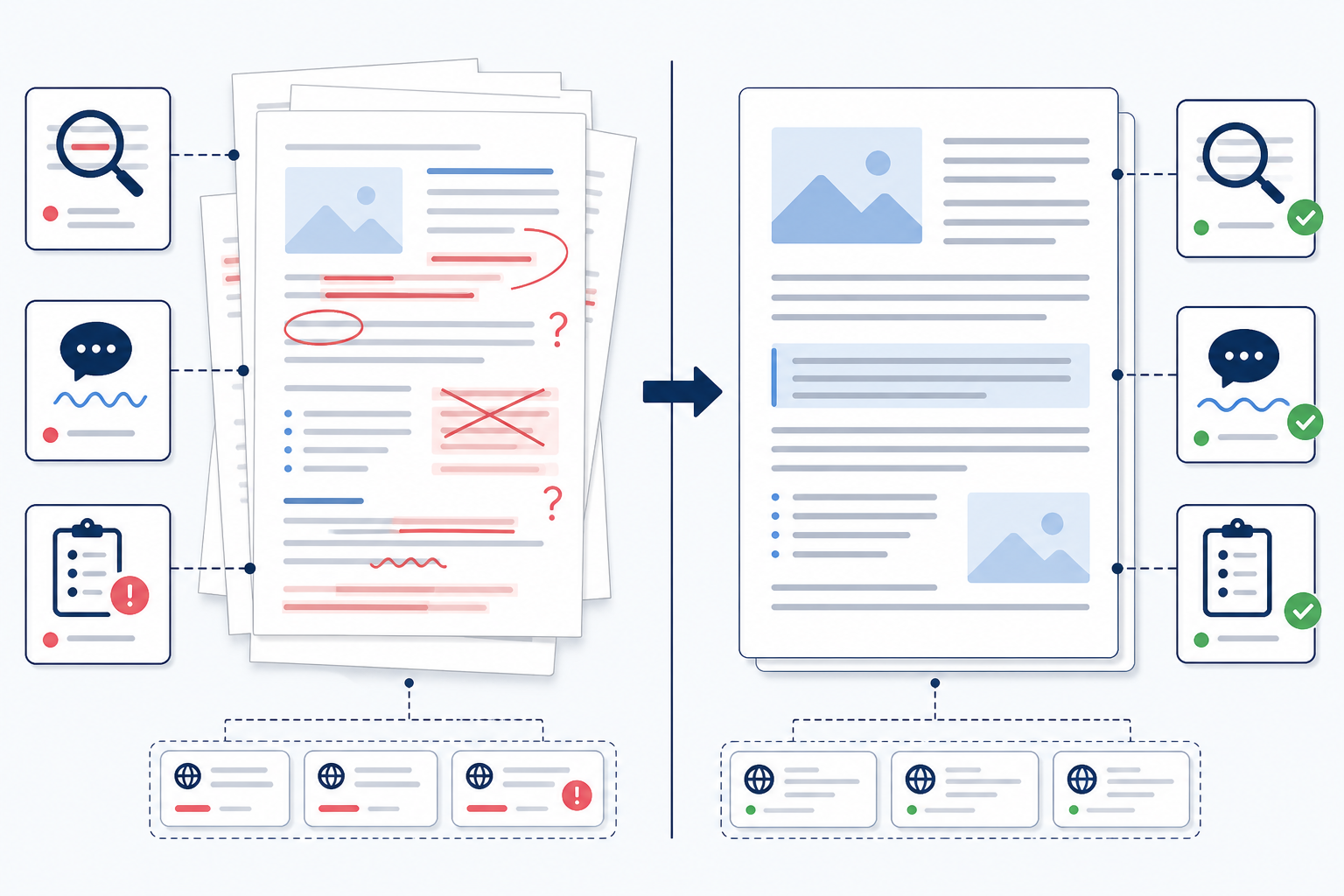
Here's the checklist I run through before anything AI-drafted goes live:
- Fact-check every specific claim, statistic, and named source. AI models can generate confident-sounding numbers and citations that don't actually exist, a known issue called hallucination. If a draft cites a study or statistic, verify it against the original source before publishing, or cut it.
- Add first-hand detail the AI couldn't know. This is where your actual expertise goes: a real client scenario, a specific number from your own pricing, or a mistake you've seen clients make. It's also what separates your post from every other AI-assisted article on the same topic.
- Check for originality and tone. Run the draft through a plagiarism checker if you're at all unsure, and rewrite any section that sounds like it could belong to a competitor. Adjust the phrasing so it sounds like you, not a generic AI house style.
- Flag anything that touches regulated advice. If you're in finance, health, law, or another regulated space, treat AI-drafted claims about regulations or compliance as a starting point for your own research, not a finished answer. Getting this wrong can carry real legal and reputational risk.
- Protect client and customer confidentiality. Never paste identifiable customer details into an AI tool when drafting. Anonymise examples and change specific figures where necessary.
- Check image and diagram rights. If you're using AI-generated images, confirm that the tool's licensing terms allow commercial use before publishing.
Budget 20 to 30 minutes per post for this editing pass. That's still dramatically less time than writing a post from scratch, but it's not nothing. This is the step that makes AI-assisted content trustworthy rather than risky.
When should you hire a writer or editor?
This system works well for a solo business publishing one or two posts a month. It starts to strain in a few specific situations, and it's worth recognising them rather than grinding through on principle.
If you're trying to publish weekly across multiple topic clusters, the editing and fact-checking load alone can eat ten-plus hours a month, time that might be better spent on client work. If your topic requires deep technical or regulated expertise you don't have time to research properly yourself, a specialist writer or editor can reduce real risk.
And if you've been running this system for three to six months and can see it's driving enquiries, hiring an editor to handle the fact-checking and polishing pass, while you keep doing topic selection and providing first-hand input, is often a smarter next hire than a full ghostwriter.
The clearest signal it's time to hire isn't running out of ideas. It's running out of hours to do the editing and distribution work properly.
Frequently asked questions about content marketing without hiring
Do I need to hire a writer to have a good blog?
No. A good blog needs accurate, useful, first-hand content published consistently. A solo business owner using AI for drafting, combined with their own editing and expertise, can produce that without hiring anyone. A writer can help once you have the volume or complexity to justify a retainer, but it isn't a prerequisite for good content.
How much should content marketing cost for a solo business?
If you're doing it yourself with AI-assisted drafting, expect mostly time costs rather than cash costs: roughly two to four hours per post covering topic research, drafting, editing, and repurposing, plus whatever you're already paying for an AI tool subscription, typically £0 to £25 a month.
Hiring a freelancer instead typically costs £100 to £300+ per post in the UK, before your own briefing and review time. That makes a structured, AI-assisted workflow a practical option for content marketing on a budget, particularly when your business is still building consistent revenue.
What's the minimum viable content strategy for one person?
One topic cluster tied to what you sell, one post every two weeks, a simple spreadsheet calendar, a short topic bank built from real customer questions, and a fact-checking and editing pass on every AI-assisted draft before it goes live. That's enough to build genuine momentum without burning out.
Getting started with content marketing on a budget
Content marketing without hiring anyone isn't about cutting corners. It's about recognising that the parts only you can do, choosing topics, supplying first-hand expertise, fact-checking, and deciding what actually matters to your customers, were never things a hired writer could fully take off your plate anyway.
Start small: log five real customer questions this week, pick the one closest to a buying decision, draft it with an AI tool, then run it through the editing checklist before you publish. Do that every two weeks for three months, and you'll have a working system, not just a list of good intentions.
Create content like this automatically
Scribe uses AI to generate high-quality blog posts that engage your audience and drive traffic.