Holiday Content Planning: How to Stay Ahead With Automation (Without the Christmas Scramble)

Holiday Content Planning: How UK E-commerce Brands Can Stay Ahead Without the November Scramble
Meta description: A practical guide to holiday content planning for UK e-commerce brands, covering seasonal calendars, AI-assisted production, seasonal SEO, and review checks that keep automated content safe to publish.
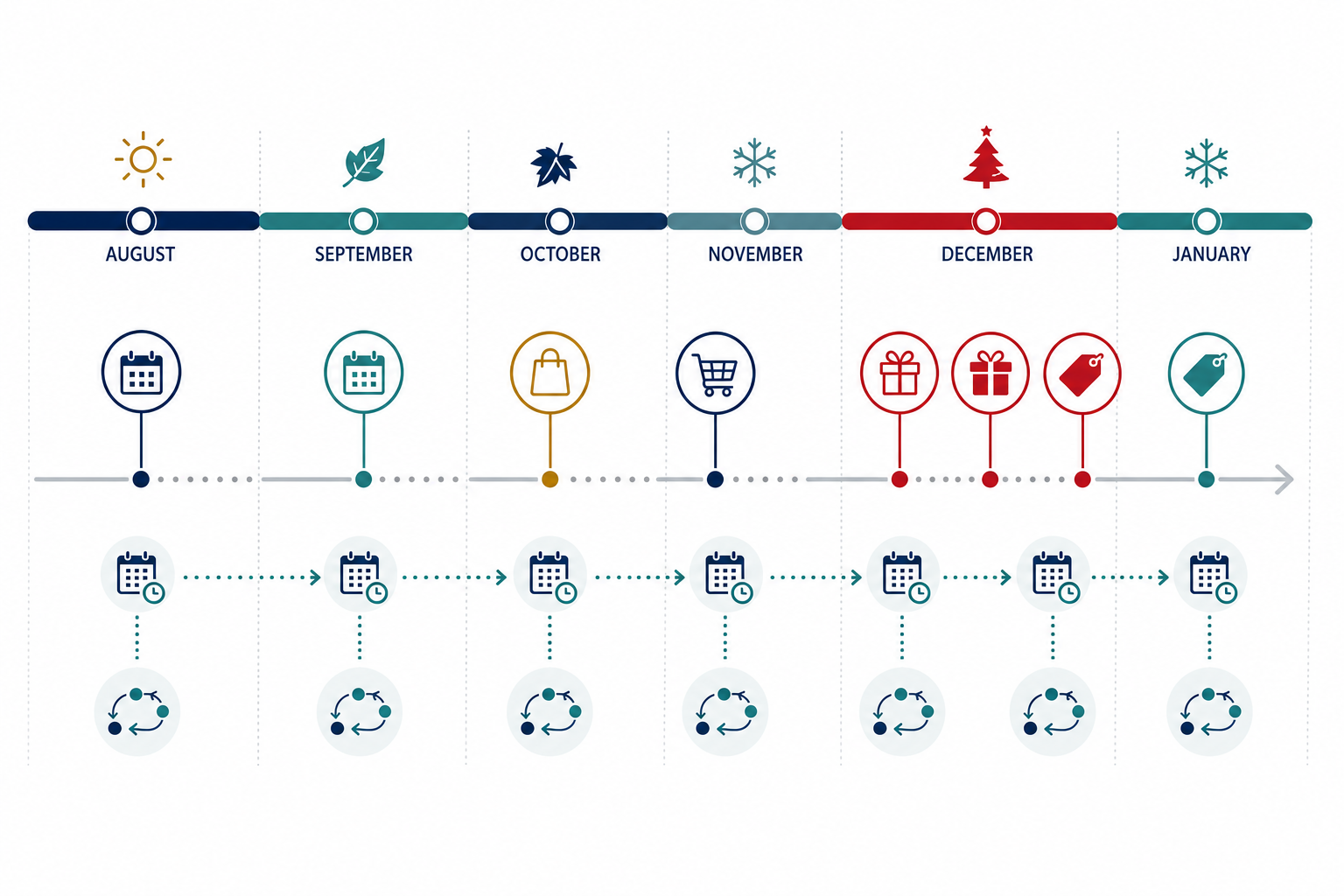
The brands that win organic traffic over the holidays are usually publishing in September and October, not scrambling in November. Here's the short version: start planning in August, aim to have evergreen gift guides live 8 to 10 weeks before peak search demand, get comparison and deals content live 4 to 6 weeks ahead of the event, and build your automation and review process around a calendar you've already agreed rather than a plan you're inventing on the fly. Everything below expands on that: a sample UK holiday content calendar you can adapt, what to automate versus what needs a human, the SEO decisions that matter more than most articles admit, and the compliance checks that keep fast content safe to publish.
I know that sounds obvious when you say it out loud. But every year I watch the same pattern play out with e-commerce brands: October arrives, everyone's still finalising Black Friday product ranges, and content planning gets pushed to "next week" until it's the second week of November and there's no gift guide, no comparison post, and no Boxing Day content anywhere near ready. This post is about breaking that cycle, with actual numbers attached rather than vague reassurance to "start early."
Why holiday content planning needs to start early
Here's the uncomfortable truth about holiday SEO: seasonal search interest for terms like "Christmas gifts" and "Black Friday deals" tends to start climbing from late September through October in the UK market. Pull up Search Console for last year's Black Friday hub page and you'll usually see the same shape: impressions start rising three to four weeks before the event, and clicks lag a week or two behind that. If your gift guide goes live in the second week of November, you're not just late, you're competing against pages that already have several weeks of crawling, indexing and link accumulation behind them.
As a starting point, use these lead times rather than "as early as possible": evergreen gift guides and cornerstone content do best published 8 to 10 weeks before peak demand; comparison and deals content needs 4 to 6 weeks; and time-sensitive content like shipping cutoffs should only go live once dates are confirmed, though the page structure itself should be built weeks in advance so you're only slotting in numbers at the last minute. These are starting estimates, not guarantees. A well-established page updated from last year might rank within days. A brand-new page on an unfamiliar domain competing for "best Christmas gifts for her" could need the full window and then some. Check your own historical performance in Search Console where you can, and treat the numbers above as the baseline to adjust from.
The retail calendar itself doesn't do you any favours either. Think about everything you need content for in a single quarter:
- Black Friday deals and early-bird offers
- Cyber Monday follow-ups
- Core Christmas gift guides
- Last-minute shipping deadline reminders
- Boxing Day and post-Christmas sales
- January clearance and New Year content
Each of these needs its own lead time, its own keyword research, and often its own visual assets. Try to produce all of that in November alongside your regular content workload, and something has to give. Usually it's quality, sometimes it's your team's sanity, and occasionally it's both.
Shoppers generally do a fair amount of research and comparison before major events like Black Friday rather than during them, which means discovery content, comparison posts and gifting inspiration need to exist well before the discounts go live. Teams that treat the holiday season as a single November-to-December sprint tend to get outpaced by brands that treat it as a staged campaign starting in early autumn.
How to build a UK seasonal content calendar
Once you accept that early planning matters, the practical question is how to structure it. The easiest way I've found is to work backwards from key retail dates rather than forwards from "today." Worth noting: Black Friday and Cyber Monday move every year. In 2025 they fall on 28 November and 1 December, so the example calendar below is built around that year. Shift the dates to match whichever season you're planning for.
- Start with your key retail dates and work backwards. Using the 8-to-10-week and 4-to-6-week baselines above, that means evergreen gift guides for a late-November Black Friday should be live by early September, and comparison or deals content by mid-to-late October. Adjust based on how quickly similar pages have ranked for you in past seasons.
- Identify content types for each phase. Early autumn suits inspiration and gift guides. Late October into November suits comparison posts and "best deals" round-ups. Early December shifts to urgency content like shipping deadlines. Late December and January need post-Christmas sale and clearance content.
- Group content by theme. Cluster posts around gifting, deals, and trends so they can link to each other and build topical authority instead of existing as isolated pages.
- Assign publish dates, owners and keyword targets before you write a single word. This turns a wish list into an actual production schedule, and it's what makes handing work off to a writer, freelancer, or automation tool possible without confusion later.
- Leave a buffer for trending topics or last-minute product launches, and build in an update trigger for anything tied to delivery cutoffs, pricing, or promotional terms that might change closer to the date.
UK holiday content calendar example for 2025 and 2026
The table below covers the 2025/26 season: Black Friday and Christmas content targets late 2025, and January clearance content naturally targets early 2026 searches like "January sale 2026." That's not an inconsistency, it's just the calendar crossing a year boundary the way it does every winter.
| Content type | Sample topic | Brief & research due | Draft complete | Review & sign-off by | Publish/update by | Owner | Update trigger |
|---|---|---|---|---|---|---|---|
| Gift guide (evergreen) | "Gift Guide for New Parents" | Early July | Late July | Mid August | Early September | Content lead | Annual refresh |
| Category inspiration | "10 Cosy Home Gifts for Winter" | Late July | Mid August | Early September | Late September | Writer + SEO review | Trend check |
| Comparison post | "Best Wireless Headphones Under £100" | Mid August | Early September | Late September | Mid October | Writer + product team | Price/stock check |
| Black Friday deals hub | "Black Friday Deals 2025: Full Guide" | Early September | Late September | Mid October | Early November | Content lead + legal/compliance | Promo terms confirmed |
| Shipping deadlines | "Last UK Order Dates for Christmas Delivery 2025" | Mid October | Early November | Mid November | Late November | Ops team sign-off | Courier cutoff confirmed |
| Boxing Day preview | "What to Expect in the Boxing Day Sale 2025" | Early November | Late November | Early December | Mid December | Content lead | Sale terms confirmed |
| Clearance content | "January Sale 2026: What's Reduced and Why" | Late November | Mid December | Just before Christmas | Just after Christmas | Writer + product team | Stock levels |
Adapt the categories and dates to your own catalogue, but the principle holds: know who owns each piece, know the deadline for the brief and the draft as well as publish day, and know what event would force an update before it goes live.
UK consumer protection rules mean delivery cutoffs, promotional terms and returns policies can change during the season, so plan your content in modules that can be updated centrally rather than rewritten from scratch every time a shipping date shifts. This isn't legal advice, but for context: pricing and "was/now" discount claims fall under UK pricing and consumer protection rules, delivery promises are covered by the Consumer Contracts Regulations, and misleading claims about stock or savings can attract ASA scrutiny. Whoever owns your terms and pricing should sign off before anything goes live, not after a customer complains.
How to automate seasonal blog posts safely
Writing 15 to 20 seasonal posts manually, on top of your regular content schedule, on top of everything else happening in Q4, is a genuinely heavy lift for most e-commerce teams. AI content generation can help here, provided you treat it as an execution layer for a plan you've already made rather than a replacement for the plan itself.
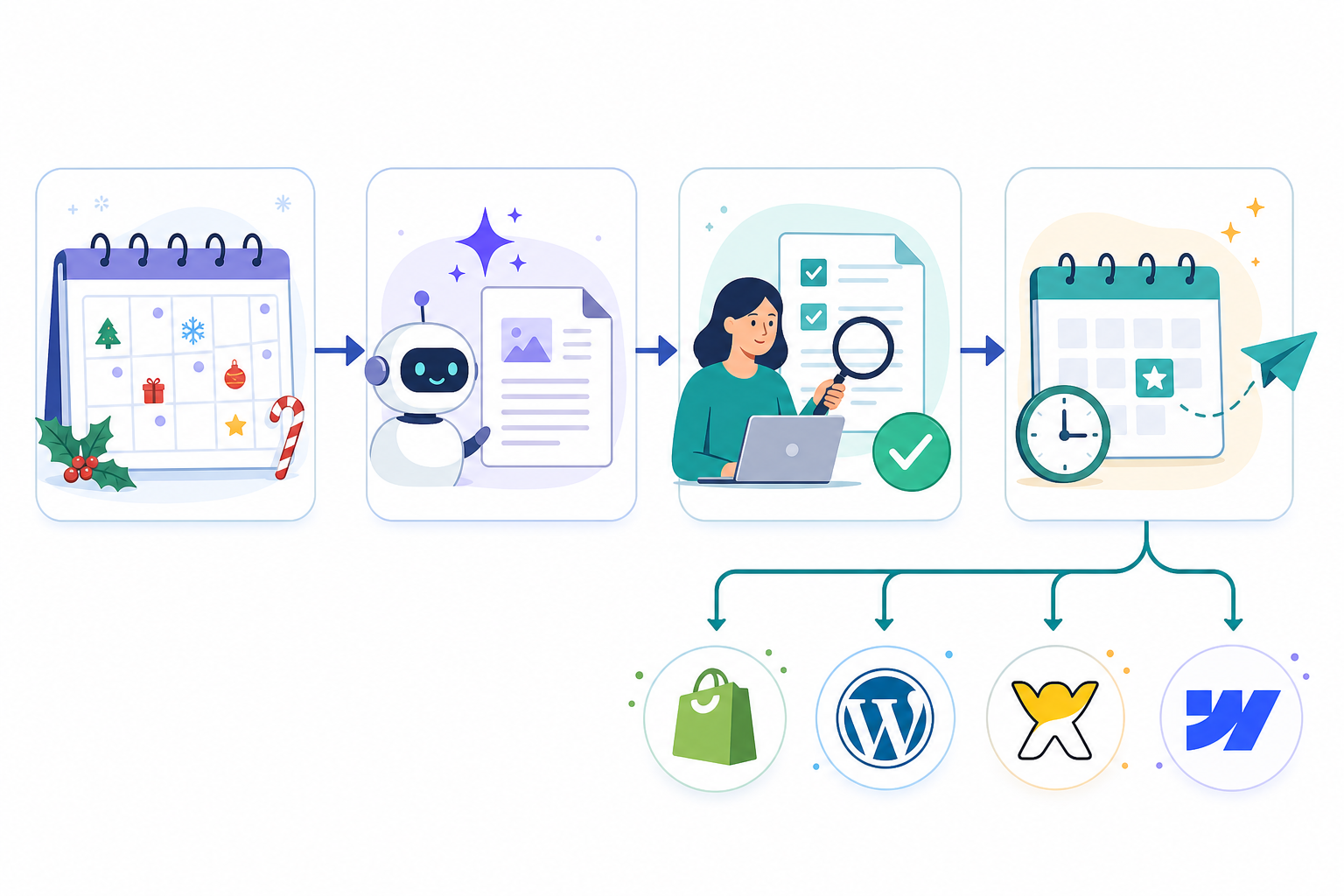
A sensible automated workflow looks like this: build the calendar first, including topic, target keywords, word count and publish date for every piece. Feed those briefs into an AI writing tool to produce full drafts, including images where the tool supports them. Route each draft through a defined review step before it's scheduled to go live. The automation handles volume and timing; the review step handles accuracy and trust. Splitting review by owner makes this manageable at volume rather than dumping everything on one editor:
- Product owner: checks prices, stock availability, sizing and specifications, since these can go stale between when a draft is generated and when it's published.
- Commercial or legal owner: checks discount percentages, "while stocks last" wording, and any comparison claims against your actual terms and current pricing rules.
- Operations owner: confirms delivery cutoffs and returns windows, which change year to year and sometimes week to week during peak season.
- Editor: checks brand voice, catches generic phrasing or repeated structure across posts, and confirms alt text and a text equivalent exist for anything conveyed only visually.
That split matters for capacity planning too. Say a reviewer can properly fact-check and approve four to six seasonal drafts a day, more time for a cornerstone gift guide, less for a short deals update. If you need 20 pieces published across a 10-week run-up, that's roughly two drafts a week per reviewer, comfortably manageable alongside their other work. Try to push all 20 through in the final two weeks of October instead, and you'd need ten approvals a week, which is exactly where teams start skipping the checks that matter. If review capacity is your bottleneck, the fix isn't fewer AI drafts, it's spreading the same drafts across a longer runway, or adding a second approver on the busiest days rather than doubling volume without adding any review time.
As one example of a tool that supports this kind of workflow, Scribe (which we build) lets you queue briefs, generate drafts with images, and schedule publishing to platforms like Shopify, WordPress, Wix and Webflow so content goes live without manual copy-pasting. Generation speed and specific features vary by tool and plan, so check current documentation for whatever platform you're evaluating rather than taking any single number as fixed. What matters more than any one tool's speed is whether it fits into a workflow that keeps human review before anything ships, regardless of which platform you choose.
SEO tips for seasonal keywords and holiday content
Getting the content produced is only half the job. Making sure it ranks during the weeks that matter takes a bit more thought, and a few decisions that are easy to overlook.
With limited time before peak season, prioritise using four factors rather than working through your list top to bottom: search demand (check Trends and Search Console rather than guessing), commercial value (average order value and margin on the products involved), existing authority (does a URL already rank for this or a similar term), and deadline risk (how much lead time you genuinely have left). Score each planned piece 1 to 3 on each factor and tackle the highest scorers first; a comparison post with real demand and an existing page beats a brand-new gift guide for a low-volume term every time.
- Target keywords with clear seasonal intent early, such as "best Christmas gifts for [audience] 2025" or "Black Friday deals on [product category]." Publishing early gives search engines time to understand and rank the page before demand peaks.
- Decide between refreshing an existing URL and publishing a new one. If a gift guide performed well last November, updating that same URL tends to preserve the ranking signals and backlinks it's already built up, rather than starting from zero with a new page each season. Reserve new URLs for genuinely new content angles, and watch for cannibalisation if two similar pages end up competing for the same query.
- Check Search Console before assuming what worked. Look at which seasonal pages actually earned impressions and clicks last year, and which queries they ranked for, rather than guessing.
- Update meta titles and descriptions with the current year only where it reflects genuine demand. UK shoppers do search for terms like "January sale 2026," but adding a year to every title regardless of search behaviour wastes a title tag's limited space. Check whether the year modifier actually appears in relevant queries first.
- Use internal linking between seasonal posts and core product or category pages. This helps both users and search engines navigate your site during high-traffic periods, and it spreads ranking authority across related content.
- Plan for what happens after the season ends. Decide in advance whether a page gets archived, redirected, or left live but deprioritised, to avoid a graveyard of outdated Black Friday pages still ranking for the wrong year come March.
- Use quality scoring to prioritise review time, not to skip it. With a tight schedule, tools that flag which drafts are strong versus which need another pass help you focus limited editing hours where they matter most.
How to stay consistent during the holiday season
Consistency is often what separates brands that build lasting organic traffic from those that spike for a few weeks and disappear. It's tempting to treat Q4 as a one-off sprint, but brands that keep publishing steadily through January and beyond tend to be the ones still ranking well the following autumn.
Scaling content output doesn't have to mean hiring seasonal writers or asking your team to work weekends they didn't sign up for. Think of it in tiers instead. In baseline months, February through August, your existing team might sustain two to four posts a week. In peak season, September through December, you might scale to six to ten posts a week using AI drafting, but only if review hours scale with it, for instance by adding a second approver two days a week rather than doubling draft volume with no extra checking capacity. If you can't add review hours, cap draft volume to match what one reviewer can genuinely check. A smaller number of well-checked posts beats a backlog of unapproved drafts every time.
Analytics close the loop. Seeing which posts drove traffic, which keywords converted, and which gift guides got the most engagement means next year's holiday content calendar starts smarter rather than from scratch.
Where to start your holiday content planning this week
If you take nothing else from this: pick your Black Friday date for the year you're planning, count back 8 to 10 weeks for your gift guides and 4 to 6 weeks for comparison content, and put those dates in a shared calendar with an owner against each one. Assign your four review roles, product, commercial, operations and editorial, before you generate a single draft. Then, and only then, bring in AI tools to execute against that plan at a pace no manual team could match alone. Do this in August or September, and November becomes a publishing month instead of a writing crisis.
Frequently asked questions about holiday content planning
When should I start planning holiday content?
Start in August for the following Q4. Evergreen gift guides do best published 8 to 10 weeks before peak search demand, which typically means early-to-mid September for a late-November Black Friday. Comparison and deals content needs 4 to 6 weeks, so mid-to-late October. Time-sensitive content like shipping cutoffs should only go live once terms are confirmed, but build the page structure well in advance so you're only adding final dates at the last minute. Check your own Search Console history for how quickly similar pages ranked in past seasons, since that's more reliable than any generic rule.
How do I automate seasonal blog posts?
Build your calendar first, with topic, keywords, word count and publish date for every piece, then feed those briefs into an AI writing tool to generate drafts, including images where supported. Route every draft through four review checks before it's scheduled: a product owner for prices, stock and specifications; a commercial or legal owner for discount claims and promotional terms; an operations owner for delivery and returns information; and an editor for brand voice, originality and accessibility. Match your draft volume to what your reviewers can actually check each week, roughly four to six drafts per reviewer per day, so automation adds output rather than creating a backlog of unapproved content.
What SEO strategies work best for holiday shopping content?
Publish early enough that search engines can index and rank the page before demand peaks, and update existing URLs that already rank rather than starting from zero each year, reserving new pages for genuinely new angles. Check Search Console to see what actually earned clicks last year rather than guessing, add year modifiers to titles only where search data supports it, and link seasonal posts to core product and category pages so authority spreads across related content. Decide in advance what happens to each page once the season ends, archived, redirected, or left live, so you're not carrying dead Black Friday pages into spring.
How far in advance should seasonal content be published?
Publish evergreen gift guides and cornerstone holiday content 8 to 10 weeks before peak search demand. Comparison and deals content should generally be live 4 to 6 weeks in advance. Pages covering shipping cutoffs, prices and promotional terms can be prepared earlier, but should only be published or updated once the relevant details are confirmed.
Should I update last year's seasonal page or create a new URL?
In most cases, update an existing seasonal URL if it already has relevant rankings, backlinks and engagement. Refresh the title, content, products, dates and internal links while preserving useful historical authority. Create a new URL only when the search intent or content angle is genuinely different, and check for keyword cannibalisation before publishing.
Create content like this automatically
Scribe uses AI to generate high-quality blog posts that engage your audience and drive traffic.