How Digital Agencies Can Manage Content at Scale (Without Losing Quality or Sanity)

How Digital Agencies Can Manage Content at Scale Without Losing Quality
If you're running a digital agency and watching your team scramble every time you land a new client, here's the good news: the agencies that manage content at scale without falling apart do three things well. They standardise their process before they automate it. They use AI content generation to handle the heavy lifting while humans focus on strategy and brand voice. And they build reporting systems that prove ROI to every client without anyone manually pulling numbers at midnight.
Get those three things right and you can grow from five clients to 50 without your team burning out or your quality slipping. This guide covers how digital agencies can manage content at scale through repeatable workflows, sensible automation, client-specific quality controls and transparent reporting.
I've watched agencies hit a wall around 10 to 15 clients. It's almost never a talent problem. It's a systems problem, and it's fixable. Let's break down exactly how.
How do agencies handle content for many clients?
The multi-client content challenge
Managing content for one brand is hard enough. Managing it for 15 brands, each with its own voice, SEO approach, approval chain and deadline, is a different beast entirely. What works for an in-house content team doesn't translate directly to agency life, because in-house teams only need to protect one brand's context. Agencies need to protect 15 contexts at once, often with the same headcount they had when they served five clients.
The cracks start showing in predictable places. Briefs get buried in Slack threads. A writer forgets that Client B doesn't allow the word "cheap" anywhere in copy. A deadline slips because nobody owned the review step. None of these are dramatic failures on their own, but they add up fast.
The Content Marketing Institute's 2023 B2B Content Marketing Benchmarks report found that 63% of the most successful B2B content marketers had a documented content strategy, compared with 41% of marketers overall. That was a self-reported survey of B2B marketing professionals, not agencies specifically, but the pattern still holds up: documented processes support more consistent content operations.
A documented strategy that defines goals, audiences, formats, approval owners and success metrics before a single word gets written is what keeps multi-client content operations from descending into chaos.
There's also a quieter cost that doesn't show up until you look at your margins. Every hour your team spends manually formatting briefs, chasing approvals or reformatting the same SEO checklist for a new client is an hour you're not billing for growth. As client count rises, the administrative overhead per client should shrink, not grow. When it grows instead, that's your signal you're relying on manual processes that were never built for this scale.
Plan agency content capacity by effort, not count
Capacity planning gets worse if you're counting deliverables instead of effort. A 500-word social caption and a 2,000-word technical guide with a compliance review (common for FCA-regulated finance clients or healthcare content needing clinical sign-off) both count as "one piece of content," but they demand wildly different amounts of coordination.
Agencies that plan capacity by counting pieces rather than estimating effort tend to overcommit, then scramble to catch up.
A simple capacity formula helps here:
Available production hours per person per week − admin and meeting time ÷ weighted effort per deliverable type = realistic production capacity
If a writer has 30 productive hours a week, a short caption takes roughly half an hour of weighted effort, and a compliance-reviewed guide takes six hours, that writer can handle a very different mix at five clients than at 15 or 30. The mix matters more than the headcount.
What is the best workflow for agency content teams?
Standardise your content process before automating
Before you touch any automation tool, get your process standardised. Automating a messy workflow just means you make mistakes faster. Here's the sequence I'd recommend, with an owner and a turnaround target attached to each stage so nothing sits in limbo:
Build one repeatable content brief template. Owner: account manager. SLA: brief finalised and approved at least five business days before the writing deadline. It should capture brand voice notes, target keywords, competitor examples, word count, internal linking requirements and the client's specific goals for that piece. Use the same template structure for every client, just with different inputs. This alone kills most of the "wait, what did the client actually want?" confusion.
Create a single content calendar system that spans every account. Owner: content operations lead. One spreadsheet per client might feel organised at first, but it becomes unmanageable past client number six. A centralised calendar, whether that's Airtable, Asana or a dedicated content operations tool, gives your whole team visibility into what's due, for whom and when, without switching between a dozen tabs.
Define quality benchmarks before anyone starts writing. Owner: senior editor. Whether the content comes from a freelancer, a staff writer or an AI writing assistant, it needs to hit the same quality bar. Vague standards like "make it good" don't scale. Specific ones do: readability scores, keyword placement rules, minimum source citation counts.
Document your SEO checklist once, then reuse it everywhere. Owner: SEO lead. Title tag length, header structure, internal linking rules, meta description formatting and image alt text should all live in one document that every writer and tool references. Write it once. Use it hundreds of times.
Build in an escalation rule too: if a client hasn't approved a brief within two business days of receiving it, the account director gets looped in automatically rather than letting the deadline quietly slide.
This matters because separating reusable systems from client-specific expression is what keeps quality consistent without flattening each client's individuality. The systems (briefs, calendars, checklists, review stages) stay the same. The client-specific elements (terminology, tone, claims, audience priorities) are what you plug into those systems.

Build flexible approval workflows
A single approval path rarely works for every client. A regulated industry client, say a finance business operating under FCA rules or a healthcare organisation whose content needs to satisfy advertising standards, needs a compliance reviewer in the loop. A straightforward ecommerce client might just need a quick brand check.
Build flexibility into your approval workflow rather than forcing every client through the exact same gate. The core process can stay consistent while you add specialist reviews where the subject matter or risk level calls for them.
How can automation help agencies scale content?
Use AI content generation for repetitive work
Once your process is standardised, automation actually helps instead of just papering over a broken system. This is where AI content tools can change the maths for agencies, though it's worth separating vendor marketing from realistic outcomes.
AI content generation can cut drafting time significantly. Scribe, for example, advertises the ability to generate a complete, SEO-structured blog post draft averaging over 2,000 words in around five minutes, including images and diagrams. That figure describes the drafting step specifically, not the full production cycle. Fact-checking, source verification, brand alignment, accessibility checks and human editorial review still take real time on top of that, and should. Treat vendor speed claims as a starting point for evaluation, not a guaranteed outcome for every client.
Tools that learn from published performance data can improve over time, in principle, by analysing which formats and structures perform well for a given audience. At agency scale this matters more, because the pattern data comes from dozens of accounts rather than one blog. Ask any vendor making this claim to show you evidence of measurable improvement, not just a feature description.
Automated publishing removes a category of manual work. Uploading formatted posts to WordPress, Shopify, Wix or Webflow one at a time for 15 different clients can eat a junior team member's entire week. Direct integrations cut that overhead considerably.
Scheduling tools let you queue content per client instead of managing daily check-ins on every account. You set the calendar and review against it, rather than manually executing each step.
Automation should stop where brand sensitivity starts. Sensitive announcements, crisis communications or campaigns tied to a client's reputation still need a human hand on the wheel. AI can draft, but a person should always have final say on anything that touches trust or brand risk, particularly for clients operating under ASA/CAP advertising rules or FCA financial promotion requirements.
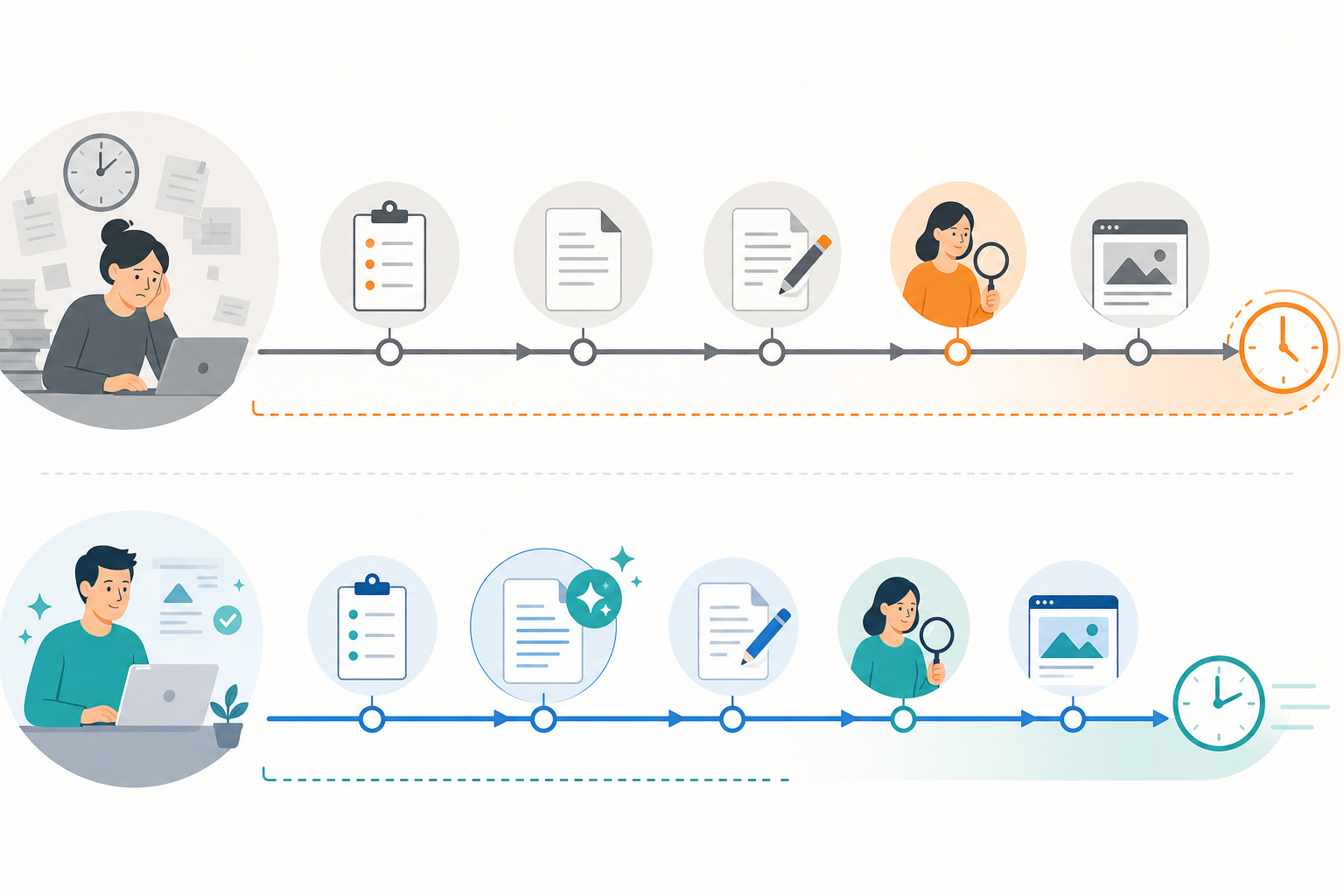
Google's own guidance on AI-generated content is worth keeping in mind here: AI can speed up research, drafting and repurposing, but human review still matters for accuracy, originality and brand alignment. Automation doesn't replace editorial judgement. It frees up your team's time so they can spend it on judgement instead of formatting.
How can agencies maintain quality across client content?
Create per-client brand and style guidelines
Generic AI output is the fastest way to lose a client who hired you specifically because you understood their voice. If every blog post you deliver reads the same regardless of which brand it's for, you're not scaling content, you're diluting it.
The fix is building per-client style guides that your tools and your team actually reference, not just a PDF sitting unread in a shared drive. A useful client playbook includes approved terminology, prohibited claims, examples of on-brand writing, audience segments and preferred sources. When your AI writing assistant has this context, output stops sounding interchangeable and starts sounding like the client actually wrote it.
Use a consistent content quality score
Quality scoring is the other half of this, and it's worth defining what "quality" actually means rather than treating it as a black box. A practical rubric scores each draft against:
- Factual accuracy against cited sources
- Alignment with search intent
- Adherence to brand voice
- Originality, meaning genuinely non-generic, not just plagiarism-free
- Internal linking
- Accessibility of language
- Relevance to conversion goals
Set a pass threshold, and anything below it goes back for revision before it reaches the client. This gives editors a consistent bar to review against rather than relying on gut feel. It's also worth checking for in any tool you evaluate, not just one vendor's platform.
Use performance data to personalise content
Historical performance data adds another layer of precision. If a client's audience consistently responds better to how-to formats over listicles, or to certain keyword clusters over others, a system that tracks this can lean into what's already working for that specific audience instead of applying a one-size-fits-all template.
That's the difference between AI content that feels generic and AI content that feels tailored.
How should agencies report content results to clients?
Clients don't care how many articles you published this month. They care whether those articles moved the needle. Traffic growth, keyword rankings and conversions are what justify the invoice, not word counts.
The challenge for agencies is building a reporting template that scales across accounts without turning into a manual data-pulling exercise every month, and one that's honest about what the numbers actually prove. Here's a structure that works well, built around Google Analytics 4 and Google Search Console data, which most UK agencies already have access to for client sites:
| Metric | What It Shows the Client | Data Source | Reporting Cadence | Attribution Note |
|---|---|---|---|---|
| Organic traffic growth (non-branded) | Whether content is attracting a new audience, separate from existing brand searches | GA4 + Search Console | Monthly | Exclude branded search terms to isolate content impact |
| Keyword ranking movement | Whether SEO work is improving visibility | Search Console / rank tracker | Monthly | Track ranking bands (1–3, 4–10, 11–20) rather than single positions, which fluctuate |
| Conversion rate on content pages | Whether traffic is turning into business results | GA4 goals/events | Monthly | Note assisted conversions separately from last-click, since content often supports rather than closes |
| Content published vs. planned | Whether the agency is delivering on schedule | Internal content calendar | Monthly | N/A |
| Quality score trends | Whether output is consistently strong | Internal QA tooling | Quarterly | Useful as a leading indicator, not a client-facing KPI on its own |
Be upfront with clients that rankings and traffic are leading indicators, while conversions and revenue are the commercial outcomes. A page can rank well and still underperform commercially if the offer, landing page or sales follow-up isn't working. That's worth flagging rather than glossing over.
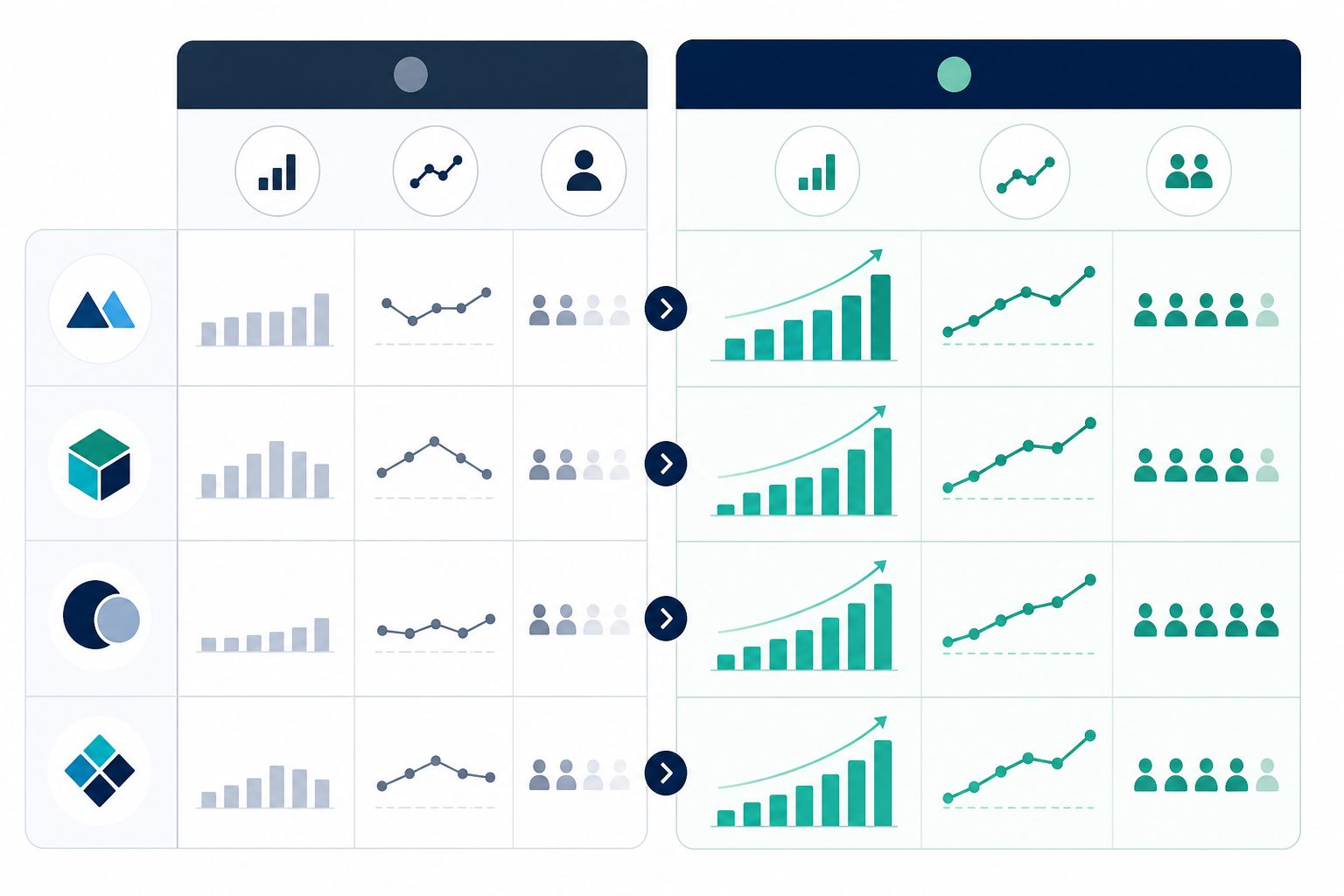
As one illustration of what's possible with a consistent approach, one Scribe customer reported a 340% increase in organic traffic over six months after moving to a documented, data-driven content strategy, according to the vendor's published case study. Treat this as a directional example, not a guaranteed benchmark. Every client's baseline traffic, industry and starting point differ, and you should validate results against your own client's historical data before setting expectations.
When a client can see a credible, well-sourced line from published content to traffic growth to conversions, renewing the contract becomes a far easier conversation.
This is also where reporting doubles as an upsell mechanism. If a client is on 10 articles a month and seeing genuine ranking movement, showing them the trajectory makes the case for 20 articles a month a lot more convincing than a pitch deck alone.
How should agencies choose content management and AI tools?
Not every AI writing assistant is built with agencies in mind. Rather than taking any single vendor's word for it, score tools against a neutral checklist covering the things that actually matter for multi-client content management:
Multi-client separation. Can you manage separate brand voices, keyword strategies and publishing destinations for each client from a single dashboard, with proper permissions so one client's data never leaks into another's account?
Drafting speed versus total production time. A tool might draft a 2,000-word post quickly, but ask what that figure includes and what still needs to happen afterwards: fact-checking, source verification, accessibility review and brand approval.
Subscription tiers that match your client volume. Look for plans structured around realistic ranges, such as 10 to 30 articles per month, so you're not paying for capacity you don't use or hitting limits mid-month.
Publishing integrations. Direct connections to WordPress, Shopify, Wix, Webflow and custom APIs save your team from manual uploads across every client site.
Data handling and audit trail. Can you export your content and data if you switch tools later? Is there an audit log of who approved what, which matters for regulated clients?
Questions worth asking before you commit agency-wide: Does the tool improve over time based on performance data, with evidence you can actually see, or does it produce static output regardless of results? Does it support per-client brand guidelines? Can you see quality scores before publishing, not just after? And does it integrate with the publishing platforms your specific client roster actually uses?
Getting these answers before rollout saves you from a painful mid-year tool switch once you've already onboarded 20 clients onto the wrong system.
Frequently asked questions about scaling agency content
How many clients can one content team realistically manage without automation?
There's no universal number since it depends on content complexity and team size, but many agencies report strain somewhere between eight and 15 clients when relying purely on manual writing and publishing. Beyond that range, quality control and deadlines tend to slip unless you introduce standardised templates and automation to handle repetitive tasks.
Use the capacity formula above with your own team's hours and deliverable mix rather than relying on a generic threshold.
Will AI content generation make our agency's output feel generic?
Not if you set it up properly. Tools that use performance data to adapt output, rather than producing static, one-size-fits-all content, may sound less generic over time. The bigger factor is feeding the tool clear, specific brand guidelines and reviewing output against per-client quality benchmarks before it goes anywhere near a client's site.
How do we prove content ROI to clients who are sceptical about automation?
Show them the data, not the process. Clients care about organic traffic growth, keyword rankings and conversions, reported honestly with attribution caveats included. Build a simple reporting dashboard using GA4 and Search Console that tracks these metrics monthly, so the results speak for themselves regardless of whether AI or a human wrote the draft.
What's the best way to transition an existing client roster onto a new content workflow?
Start with your newest or most flexible clients as a pilot group. Standardise the brief template and publishing process with them first, measure the time savings and quality scores over a few weeks, then roll it out to the rest of your accounts once you've worked out the kinks.
A simple rollout plan for scaling content operations
If you're starting from scratch, don't try to overhaul every account at once. In week one, document your brief template, calendar system, quality benchmarks and SEO checklist, and assign an owner to each. In week two, pilot the standardised process with one or two flexible clients, including a trial of whichever automation tool you're evaluating.
In week three, measure time saved per piece, quality scores and client feedback against your baseline. From week four onwards, expand to the rest of your roster in batches, adjusting the approval workflow for regulated or sensitivity-heavy clients as you go.
Managing content at scale across dozens of clients isn't about working harder or hiring endlessly. It's about building a system, standardised processes, sensibly scoped automation and reporting that's honest about what it proves, that lets your team focus on the parts of the job that actually need human judgement.
Get that system right, and growing your client roster stops feeling like a threat to your sanity and starts feeling like exactly what you built the agency to do.
Create content like this automatically
Scribe uses AI to generate high-quality blog posts that engage your audience and drive traffic.