How Digital Agencies Manage Content for Multiple Clients (Without Losing Their Minds)

How a Content Marketing Agency Keeps Multi-Client Chaos Under Control
It's 9am and you're deep in a technical B2B piece for a SaaS client. Twenty minutes later you're writing warm, chatty copy for a boutique skincare brand, then reformatting a listicle for a third client's Shopify blog while three Slack threads argue about approval timelines. Multiply that across ten, twenty, or fifty accounts, and you understand why so many agencies feel like they're drowning even when business is good.
Here's the short version of what separates the agencies who handle this well from the ones stuck in the weeds: a content marketing agency that scales smoothly standardises its production workflow so quality doesn't wobble from client to client, adapts tone and voice per account without reinventing the process each time, and builds reporting that's easy to explain without endless back-and-forth. The agencies still drowning are usually doing all three manually, one spreadsheet and one Google Doc at a time.
Let's look at why running content across a full client roster is so exhausting, where the time actually disappears, and what a better operating model looks like in practice.
The multi-client content juggling act for a content marketing agency
Running content for one brand is hard enough. Running it for fifteen is a different job entirely. When you manage a single brand, you build deep familiarity over time. You know the tone, the audience, the seasonal quirks that matter, and every piece gets a little faster to produce as the weeks go on.
A content marketing agency doesn't get that luxury. Every account resets the clock. You're switching entire mental models each time: industry jargon, audience sophistication, brand personality, even the CMS platform changes from one client to the next. One brand wants punchy and irreverent. Another wants formal and data-heavy. A third is somewhere in between but very particular about never using certain words or claims its legal team has flagged.
This constant context-switching has a real cost, even if it never shows up as its own line item on an invoice. Say an account manager spends twenty minutes re-reading brand guidelines before every piece just to get back into the right headspace. Across a roster of fifteen clients, each getting four pieces a week, that's roughly 258 pieces a month. At twenty minutes of reorientation per piece, that's about 86 hours a month, more than two full working weeks, spent purely on getting your head back into the right brand before any actual writing happens.
Some of that time is unavoidable; you can't skip understanding a brand before writing for it. But a meaningful chunk of it is pure waste caused by information being scattered across old emails, outdated docs, and someone's memory. That's the part worth fixing, because none of it is billable and all of it eats into margin.
The knock-on effects are just as painful. Deadlines slip because a writer got pulled onto an urgent client fire before finishing a scheduled draft. Quality dips on a Friday afternoon when everyone's mentally fried from switching brand voices six times since Monday. Approval cycles drag because nobody's quite sure which version of a style guide is current. None of this is anyone's fault individually. It's simply what happens when a business built on variety collides with a production process built for sameness.
Common bottlenecks every content marketing agency runs into
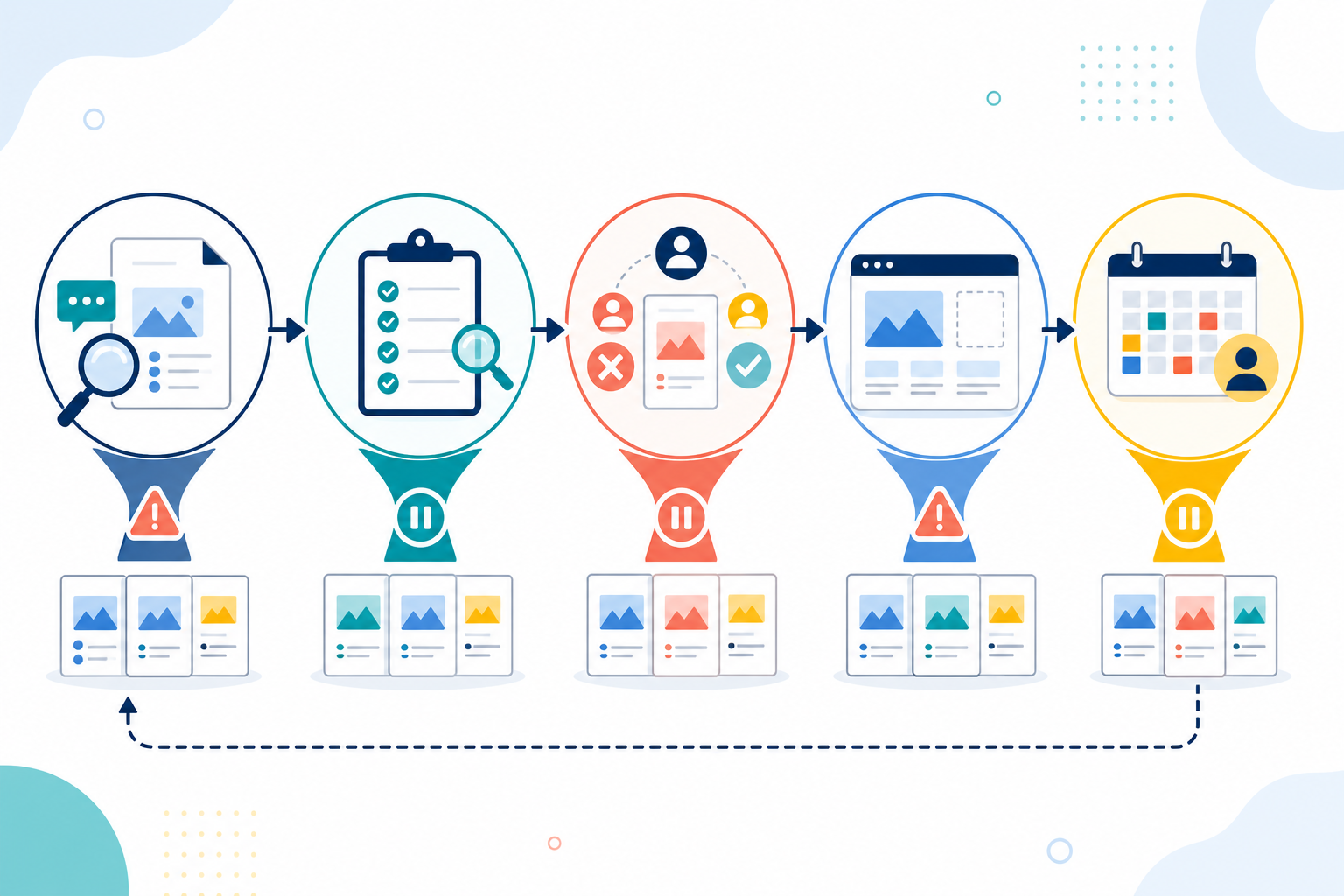
Most agencies I've spoken with hit the same handful of chokepoints, even though their client rosters look completely different. Here are the five that come up most often, along with who typically owns the problem, what it costs, and what tends to fix it.
Research and briefing. Owned by whoever's assigned the piece that day, which is exactly the problem. Every new draft starts with someone digging through old briefs, competitor content, and keyword data before a single word gets written, and research quality varies wildly depending on who's doing it. The fix is a consistent brief template per client, capturing audience, tone, keywords, and no-go language in one place, so research never starts from zero.
Quality assurance. Owned, informally, by one overworked editor. With multiple writers and multiple brand voices, QA either becomes a bottleneck (everything queues for one exhausted person) or gets skipped under deadline pressure. A lightweight, brand-specific checklist removes the reliance on any one person's memory or gut feel.
Client approvals. Often owned by nobody in particular, which is the issue. Vague or open-ended approval windows are one of the biggest silent killers of agency margin; a piece that should take two rounds of feedback can drag through five without a clear service-level agreement. Setting a defined approval SLA, for example 48 hours for first-round feedback, keeps projects moving and makes scope creep easier to spot.
CMS and formatting differences. Owned by whoever happens to be publishing that week. One client runs on WordPress, another on Shopify, a third on a bespoke CMS with unusual metadata fields, and reformatting the same piece for three platforms wastes time that should go towards strategy. Documenting each client's publishing quirks once, rather than relearning them every cycle, removes a surprising amount of friction.
Calendar ownership. Owned by everyone and therefore no one. When nobody clearly owns the content calendar across accounts, pieces get double-booked, deadlines get missed, and seasonal content goes out too late to matter. A single shared view of what's due, for which client, and by when, solves more scheduling chaos than any amount of extra headcount.
Standardising content workflows without losing personalisation
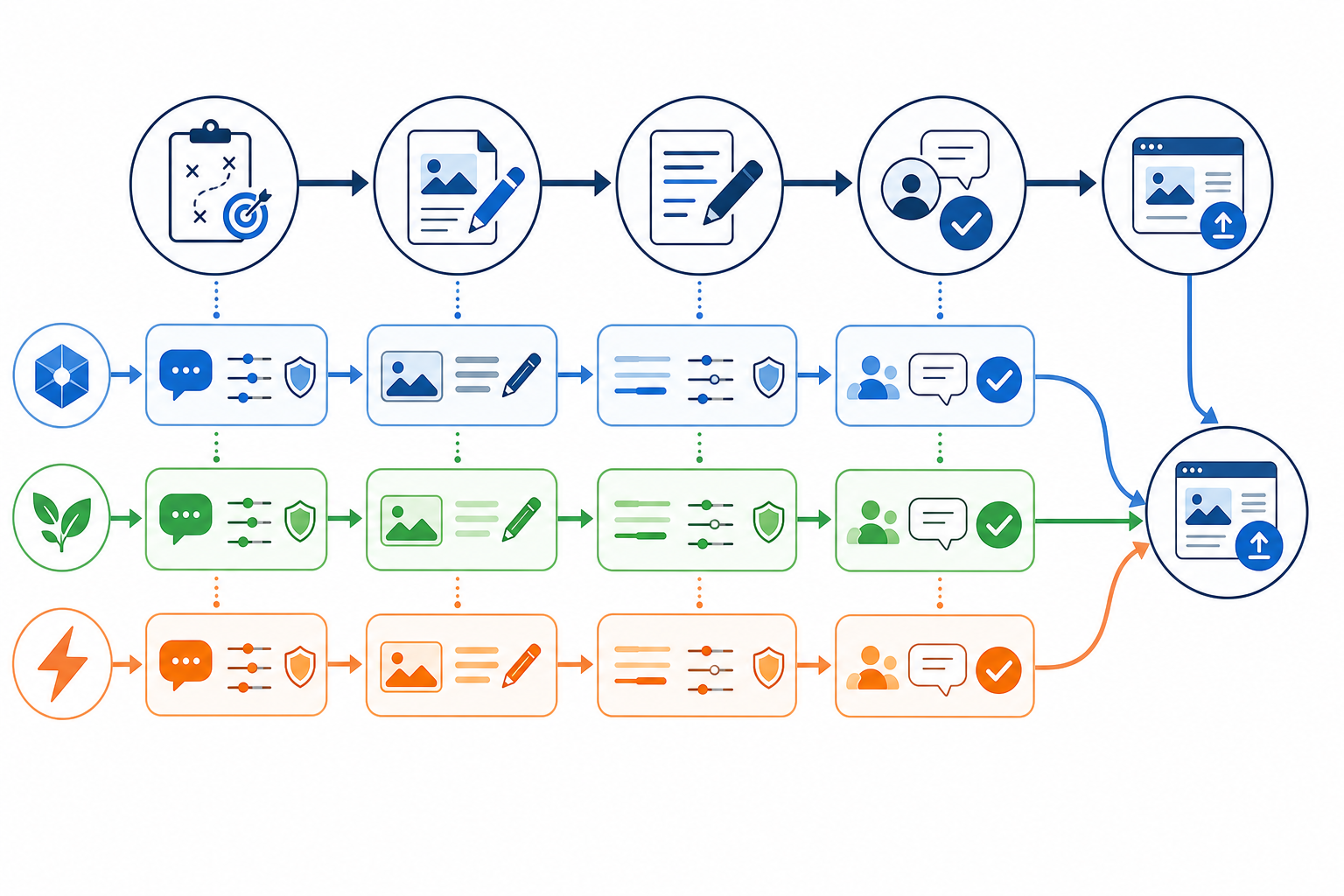
Here's the distinction that trips up a lot of agencies: standardising the process is not the same as standardising the output. You want every account moving through the same disciplined steps: intake, research, drafting, QA, approval, publishing, reporting, while the actual voice, tone, and content of each piece stays completely client-specific.
In practice, this starts with a brand voice brief for every client that goes beyond "friendly but professional." A useful one covers:
- Sentence length and rhythm preferences (short and punchy versus longer and explanatory)
- Whether contractions, humour, or first-person voice are allowed
- A list of banned words, phrases, or claims (competitor names, regulatory language, regional spellings)
- Two or three example paragraphs that capture the tone in action
- Who has final sign-off internally before anything reaches the client
This becomes the single source of truth any writer or editor can reference, rather than relying on institutional memory that walks out the door when someone leaves the team.
Approval rules deserve the same treatment. Decide upfront who signs off internally before anything goes to the client, how many revision rounds are included in scope, and what happens when a client asks for an extra round outside that agreement. A simple responsibility matrix, listing who drafts, who edits, who approves, and who publishes for each account, prevents the "I thought someone else was handling that" problem that causes most missed deadlines.
Finally, keep a human review checkpoint no matter how good your tools or briefs are. Even the best style guide can't catch every nuance, particularly around sensitive topics, regulatory language, or a recent product change a client hasn't documented yet. A quick human pass before publishing protects the relationship far more than it costs in time.
How a content marketing agency reports results client by client
Reporting is where a lot of agencies lose client trust, not because results are bad, but because the reporting itself is inconsistent or hard to interpret. A client shouldn't have to ask what a metric means or dig through three tabs to find the number that matters to them.
A solid monthly report, whatever tool produces it, should cover the same structure every time: an executive summary, what was published, keyword ranking movement, qualified organic traffic (not just raw sessions), on-site conversions or leads attributable to content, which pieces over- or under-performed and why, and clear next actions for the following month. Consistency matters more than sophistication here. A client who sees the same format every month can track progress at a glance instead of relearning your report each time.
Many of the more mature agency setups now also include a quality score for each piece before it publishes, a composite check of readability, keyword coverage, structural completeness, and adherence to the brand brief. This doesn't replace editorial judgement. It catches issues at scale, across dozens of accounts, before a client ever sees them, and it gives you something concrete to point to when a client asks why a piece underperformed.
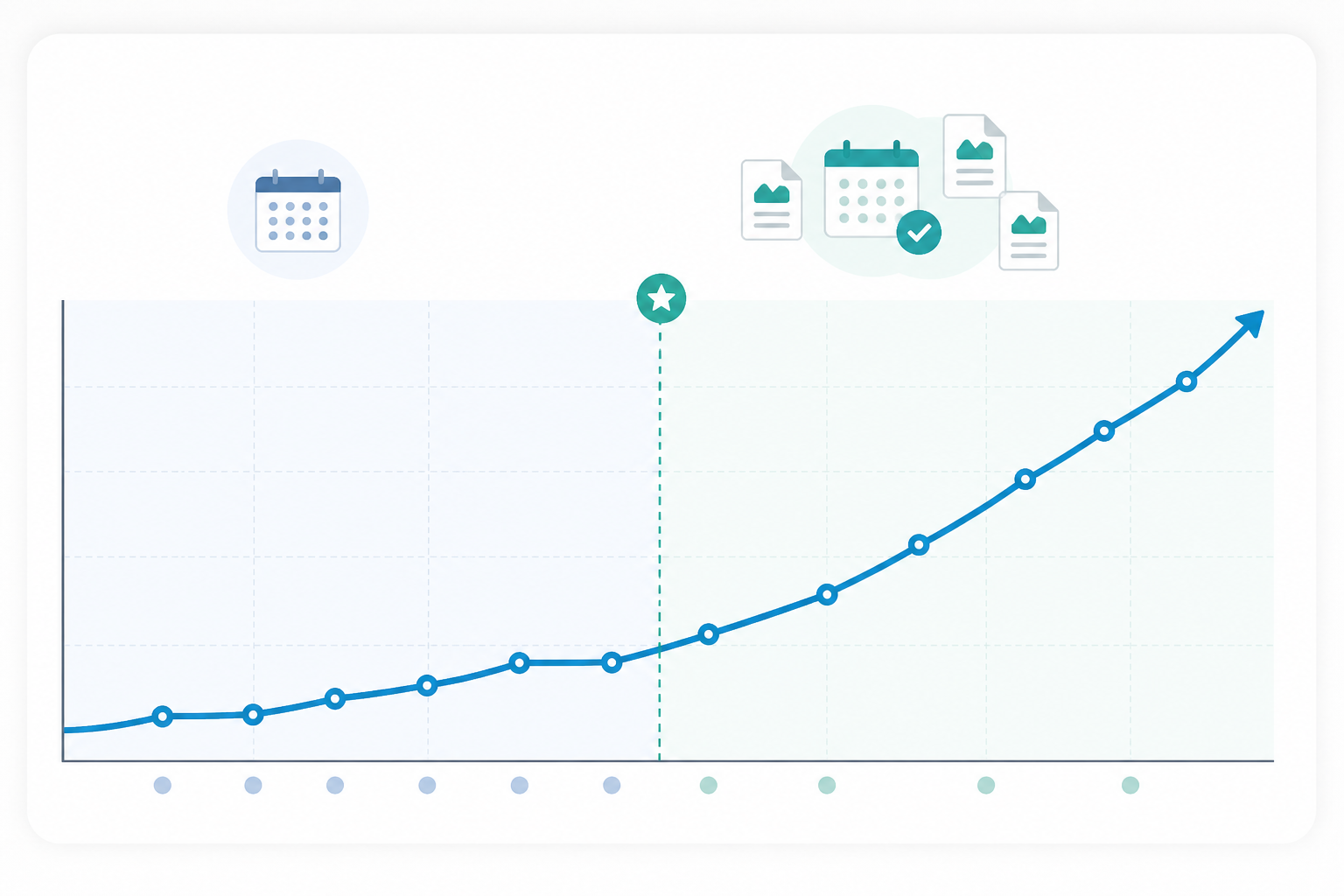
To make this concrete: one mid-sized UK agency I worked with tracked a 340% increase in qualified organic traffic to a single client's blog over eight months, from a baseline of roughly 1,200 monthly organic sessions to around 5,300. That figure came from Google Search Console data, filtered to organic sessions landing on blog URLs specifically, after the agency standardised its briefing process and moved to a consistent twice-weekly publishing cadence. It's a useful illustration of what standardisation can do, not a guaranteed outcome; the same agency's other clients saw far more modest gains over the same period, and the result assumed consistent publishing throughout.
That's the other half of good reporting: turning numbers into a decision. Instead of just listing that three comparison pages drove a chunk of leads, say it plainly: "Three comparison pages generated 42% of content-assisted leads this month, so next month we're expanding that content cluster." That's the sentence a client actually remembers.
It's also worth being honest about what content marketing can and can't do quickly. Organic growth compounds over months, not days, and setting that expectation early avoids awkward conversations later. Whenever you cite a specific improvement, attribute it: state the timeframe, the starting baseline, and how the metric was defined, so the client can judge the claim on its own merits rather than taking a headline number at face value.
Tools built for agency-scale content production
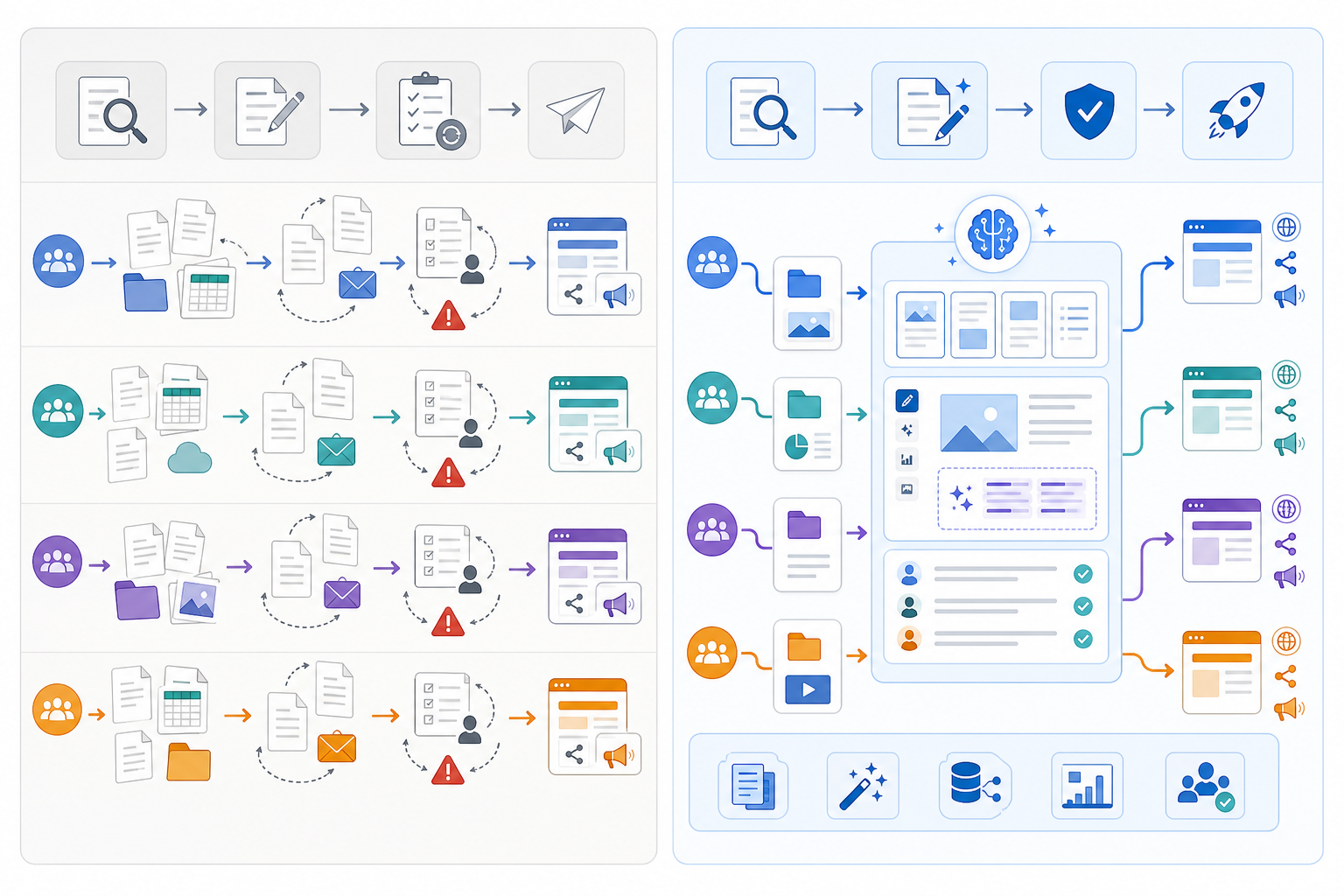
Manual workflows work fine at a small scale. The trouble starts when the number of accounts outpaces the number of hours in a week. This is where AI-assisted content platforms have started to change the maths for agencies, without replacing the judgement that makes an agency valuable in the first place.
Here's a general comparison of where manual and AI-assisted approaches tend to differ across a typical production cycle. These are platform-agnostic capabilities to look for, not a description of any single tool:
| Stage | Manual approach | AI-assisted approach |
|---|---|---|
| Research | Writer manually searches competitors and keyword tools per brief | Tool surfaces relevant keywords and competitor gaps automatically; writer still validates |
| Drafting | Writer starts from a blank page each time | Tool generates a first draft matched to a stored brand voice profile |
| Brand voice consistency | Relies on writer's memory of the style guide | Voice profile applied consistently across writers and accounts |
| QA | Manual proofreading against a checklist | Automated checks flag banned terms, tone drift, or missed keywords before human review |
| Scheduling | Manually tracked in spreadsheets or shared calendars | Centralised calendar across all client accounts, sometimes with autopilot scheduling for recurring content types |
| CMS publishing | Manual reformatting per platform | Direct publishing integrations reduce formatting rework |
| Reporting | Manually compiled per client, often inconsistent format | Standardised reporting templates pulled from live performance data |
| Volume scaling | Adding output usually means adding headcount | Some platforms support scaling from roughly 10 to 30 articles a month per client without a proportional headcount increase, though quality still depends on review capacity |
The important caveat: none of this removes the need for editorial judgement, and results depend heavily on how well the brand voice profile is built, how carefully drafts are reviewed, and the quality of the data feeding the tool. A platform can draft faster, flag inconsistencies, and keep a calendar organised, but it can't decide whether a piece actually serves a client's strategy or handles a sensitive topic with the right care. We build one such platform at Scribe, and features like stored voice profiles, direct CMS publishing, and tiered output plans are things we've built specifically because agencies asked for them, not a claim that AI output is inherently more reliable than a skilled freelancer's. It's a tool for reclaiming hours from repetitive work, not a replacement for editorial accountability. If you're evaluating any platform, including ours, ask for specifics: which CMS integrations are actually live, what the quality checks cover, and what a real client report looks like.
For UK-based agencies specifically, a few extra considerations are worth building into any tool evaluation. Check that the platform supports UK English spelling and conventions rather than defaulting to US English throughout. Confirm how client data is stored and processed, since GDPR obligations apply to any tool handling client or customer information, and ask directly about data residency and retention. And factor tool costs into client pricing transparently, including VAT, so margins hold up once software costs are added to the production budget.
Bringing it together: a scalable content marketing agency workflow
Managing content across a full client roster will always involve some juggling. Different voices, different platforms, and different expectations are simply the nature of the business. But the agencies that handle it smoothly aren't necessarily working harder than everyone else. They've standardised the parts of the process that don't need to vary, kept the parts that do genuinely client-specific, and built reporting clients can understand without a phone call.
If you're auditing your own operation, here's a rough sequence for the next 30 days: in week one, build or update a brand voice brief for your three most demanding accounts. In week two, set a defined approval SLA across every client and document each account's CMS quirks in one place. In week three, standardise your monthly report template and back-test it against last month's data to see if it actually answers the questions clients ask. In week four, decide honestly whether your current bottleneck is process or capacity, and only then evaluate whether a tool like an AI-assisted platform is worth adding to the mix.
Less time lost to context-switching, more time spent on the strategic work that actually grows client accounts. That's the whole goal.
Frequently asked questions about content marketing agencies
How do agencies keep client content organised across multiple accounts?
Most rely on a combination of standardised brief templates, a shared content calendar visible across the whole team, and a documented brand voice guide per client. The templates and calendar handle the logistics, while the brand guide keeps quality and tone from drifting between writers. None of this requires expensive software to start; a well-maintained shared document works fine until volume outpaces what a spreadsheet can track.
Can one tool handle multiple brand voices at once?
It depends on the tool. Look for one that lets you store separate voice profiles, style rules, and banned-language lists per client, applied at the account level rather than one generic setting across the whole workspace. Even with a good tool, someone still needs to review early outputs against each brief, because voice consistency degrades if the underlying profile was built carelessly or never updated.
What's the biggest time-waster in agency content production?
For most agencies, it's re-familiarisation: the time spent re-reading old briefs, style guides, and past content before starting something new. This rarely gets tracked as its own cost, but across a large roster it adds up to real hours every month, and it's one of the easier inefficiencies to fix with better documentation and templated briefs.
Do AI content tools replace the need for editors and account managers?
No. AI tools can speed up research, drafting, and formatting, but human editorial judgement is still essential for strategy, nuance, and quality control, particularly on sensitive or regulated topics. Treat these tools as a way to free up time for higher-value work, not as a substitute for a team's judgement, and expect to invest real time upfront setting up voice profiles and review checkpoints before they save you any.
Create content like this automatically
Scribe uses AI to generate high-quality blog posts that engage your audience and drive traffic.