How to Scale Content Marketing Without Losing Your Brand Voice

You can scale content marketing without sacrificing your brand voice, but it takes more than good intentions. It takes clear brand guidelines that AI tools can actually follow, a lightweight approval workflow that catches inconsistencies before publishing, and ongoing measurement of how content performs against your voice standards. The teams that pull this off treat brand voice as a system to maintain, not a personality trait only humans can preserve. That said, no system removes the need for subject-matter expertise, fact-checking, or legal review, especially if you work in a regulated sector or need to stay on the right side of ASA and CAP advertising rules here in the UK. AI can speed up drafting and help you spot patterns in what's worked before. It can't replace editorial judgement.
If you're a marketing manager staring down a content calendar that needs to triple in size, I understand the anxiety. We've spoken to enough UK marketing teams to know the fear isn't laziness or lack of ambition. It's that scaling content marketing usually feels like a trade-off: either you keep quality tight with a small trusted team, or you open the floodgates and watch your brand voice turn to mush. That trade-off is real for teams without a system. It's far less inevitable once you build one, and that's what this post walks through.
Why Teams Struggle to Scale Content Marketing
As a rough planning range, most in-house teams in the UK hit a ceiling somewhere between four and eight blog posts a month. That's not a fixed law, and it varies a lot depending on approval requirements, subject complexity, and how much research each piece needs. But it's a common enough pattern that it's worth naming. Research, drafting, editing, and publishing a single post can easily take ten or more hours when you include stakeholder sign-off, and a small team only has so many of those hours in a working week.
So teams face what feels like a false choice: stay slow and protect the brand, or go fast and accept generic output. Neither option is great. Slow and precious means you lose visibility in search results while competitors publish more frequently. Fast and generic means you're producing content that technically exists but doesn't sound like you, doesn't build trust, and often doesn't convert.
Outsourcing feels like the obvious fix, but it introduces its own problem: voice drift. Freelancers and agencies work across dozens of clients, and even the best ones can't fully internalise the subtle things that make your brand sound like your brand. A phrase here, a formatting choice there, and suddenly your blog reads like it was written by five different companies.
Here's the part that surprises a lot of teams: simply hiring more writers doesn't solve this either. Adding headcount without fixing the underlying process just means more people making inconsistent decisions faster. The real bottleneck isn't the number of hands on deck. It's the absence of a repeatable system that keeps voice consistent regardless of who, or what, produces the first draft.
Setting Brand Guidelines AI Tools Can Follow
This is where most attempts to scale content marketing quietly fail. Teams write brand guidelines full of adjectives like "friendly," "authoritative," and "approachable," hand them to a writer or an AI writing assistant, and wonder why the output still feels off. Vague adjectives don't give anyone, human or machine, anything concrete to act on. You need guidelines specific enough to test.
Here's what a testable guideline actually looks like in practice: instead of "we sound conversational," write something like, "use contractions in most explanatory copy, address the reader as 'you', avoid sentences longer than 30 words unless explaining a technical exception, and open most sections with a direct statement rather than a rhetorical question." That's specific enough that a human editor or an AI tool can check a draft against it and get a clear yes or no.
A practical sequence for building guidelines that actually work:
- Document tone, vocabulary, and sentence rhythm in testable terms. Specify average sentence length, contraction frequency, and point of view. Note the corporate jargon you avoid and the phrases you default to instead.
- Create a do-and-don't list using real examples. Pull three or four paragraphs from your best-performing content and annotate exactly what makes them work. Do the same with a piece that missed the mark, and explain why, specifically.
- Give AI writing tools real sample articles, not just a brief. Most AI content generation platforms improve noticeably when they're trained on examples of your best writing rather than a one-paragraph description of your tone. This applies broadly across tools, not just one platform, though the exact mechanism for feeding in examples varies by provider.
- Define your non-negotiables clearly. List banned phrases, required disclaimers, formatting rules, and anything else that's not up for interpretation, whether a person or an AI tool produces the draft. For UK teams, this is also where you'd flag things like required GDPR language for data collection claims, or ASA-relevant restrictions if you're writing anything that could be read as a promotional claim.
- Revisit the guidelines every quarter. Your brand evolves, audience expectations shift, and your best-performing content patterns change. Guidelines left untouched for two years are usually part of the problem, not the solution.
A simple voice scorecard helps make this testable rather than subjective. Something like this, scored 1 to 5 against a defined threshold (say, an average of 3.5 or higher to pass without extra review):
| Category | What it checks | Example threshold |
|---|---|---|
| Tone | Matches documented adjectives with concrete markers (contractions, directness) | 4+ |
| Vocabulary | Avoids banned jargon, uses preferred terminology | 5 (pass/fail) |
| Sentence rhythm | Mix of short and long sentences, average length within range | 3+ |
| Evidence | Claims are sourced or clearly labelled as illustrative | 4+ (mandatory for factual claims) |
| Prohibited language | No banned phrases, correct disclaimers present | 5 (pass/fail) |
The teams that get this right treat brand guidelines less like a style manual gathering dust and more like a living document that both people and AI tools are expected to actually use, and that gets updated when it stops matching reality.
Building an Approval Workflow to Scale Content Production
Once your guidelines exist, the next piece is making sure content actually gets checked against them without grinding your publishing schedule to a halt. This is where a lot of ambitious plans to scale content marketing stall, because teams either skip review entirely (risky) or route everything through the same three overworked people (slow).
Here's a workflow structure that tends to hold up as volume increases, with roles and turnaround times defined upfront:
| Stage | Owner | Input | Turnaround (SLA) | Escalation |
|---|---|---|---|---|
| Draft | Writer or AI tool + editor | Brief, guidelines | 1 day | N/A |
| Quality score | Automated tool | Draft against scorecard | Instant | Flag if below threshold |
| Human review | Voice guardian | Scored draft | 1 business day | Escalate factual disputes to subject expert |
| Legal/compliance check | Legal or compliance lead | Final draft (only for regulated claims) | 2 business days | Escalate to legal counsel |
| Publish | Ops/automation | Approved draft | Same day | N/A |
A few notes on how this holds together:
- Every review step needs a maximum turnaround time. Without a deadline, a review step expands to fill however much time people give it.
- Use quality scoring to triage, not to replace judgement. A quality score is a useful signal for whether a draft needs light-touch or thorough review, but it's not proof the content is accurate, original, or strategically sound. A draft can score well on tone and structure while still containing a factual error or a claim that needs legal sign-off. Treat scoring as an aid to prioritise attention, not a substitute for a human reading the piece.
- Assign a single voice guardian rather than spreading edits across a committee. One person who deeply understands your brand voice will catch more drift than five people each making small, uncoordinated tweaks.
- Build two lanes: fast-track and thorough. Time-sensitive content, like a reactive piece tied to news, needs a quicker path. Cornerstone content that will drive traffic for years deserves slower, more thorough review, including a compliance check if it makes any specific claims.
- Automate publishing once content clears approval. Tools that integrate with WordPress, Shopify, Wix, or Webflow let approved content go live without anyone manually touching the CMS.
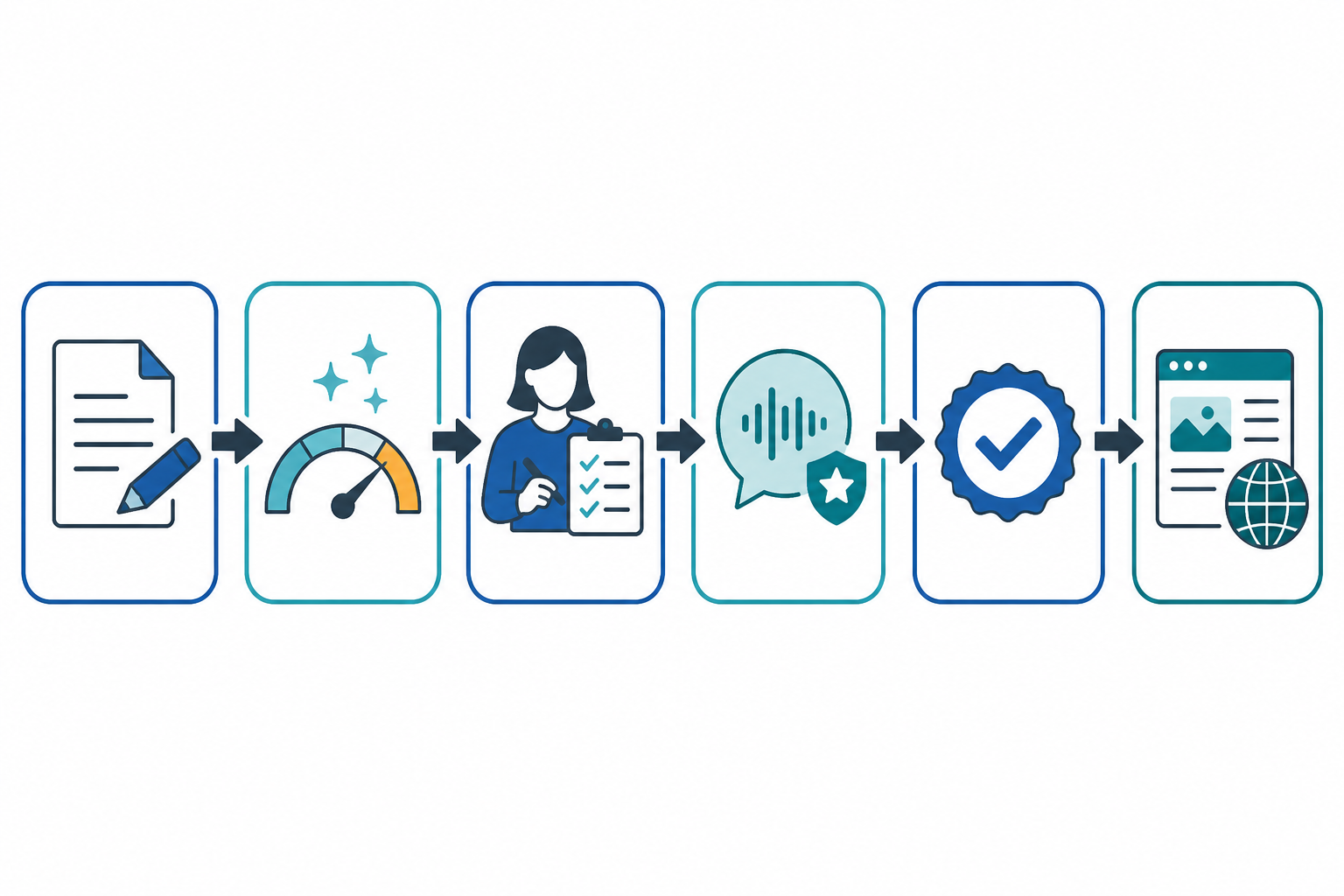
Alt text: Flowchart of a content approval workflow showing six stages from draft to publication. Caption: A quality score should speed up triage, not replace the human review and compliance check stages for regulated or high-risk claims.
The goal isn't to remove human judgement from the process. It's to make sure human judgement is spent on decisions that need it, rather than on repetitive checks a scoring system can handle just as reliably, while keeping a clear line for anything that touches legal or factual risk.
Measuring Brand Voice Consistency at Scale
Guidelines and workflows are only half the story. You also need a way to know, with some rigour, whether your voice is holding steady as output increases. This matters more once you're publishing 20 or 30 articles a month, because small inconsistencies that would be obvious at low volume can hide in the noise at scale.
It's worth separating voice consistency from business performance, because they're not the same thing and conflating them leads to bad conclusions:
Voice-specific measures:
- Track quality scores across articles over time. A gradual decline is an early signal of drift, worth investigating before it becomes visible to readers.
- Run periodic voice audits. Once a month, pull five random articles and read them side by side against your do-and-don't examples. This catches things metrics alone won't, like a shift in sentence rhythm or overuse of certain phrases.
- Measure edit distance between AI drafts and published versions. If human editors are rewriting large portions of every AI draft, that's a sign the tool isn't actually matching your voice yet, regardless of what its own quality score says.
Business performance measures (influenced by voice, but not proof of it):
- Compare engagement between AI-assisted and fully manual content, as one input among several, not a definitive verdict.
- Watch organic traffic trends, but with the caveat that traffic is shaped by rankings, backlinks, seasonality, and search demand as much as by voice. A decline could mean drift, or it could mean a competitor outranked you, or Google changed its algorithm. Don't treat traffic alone as a proxy for whether your voice is working.
- Pay attention to reader feedback and comments. Readers often notice off-brand content before internal teams do, but this is qualitative signal, not a metric to chart against quality scores.
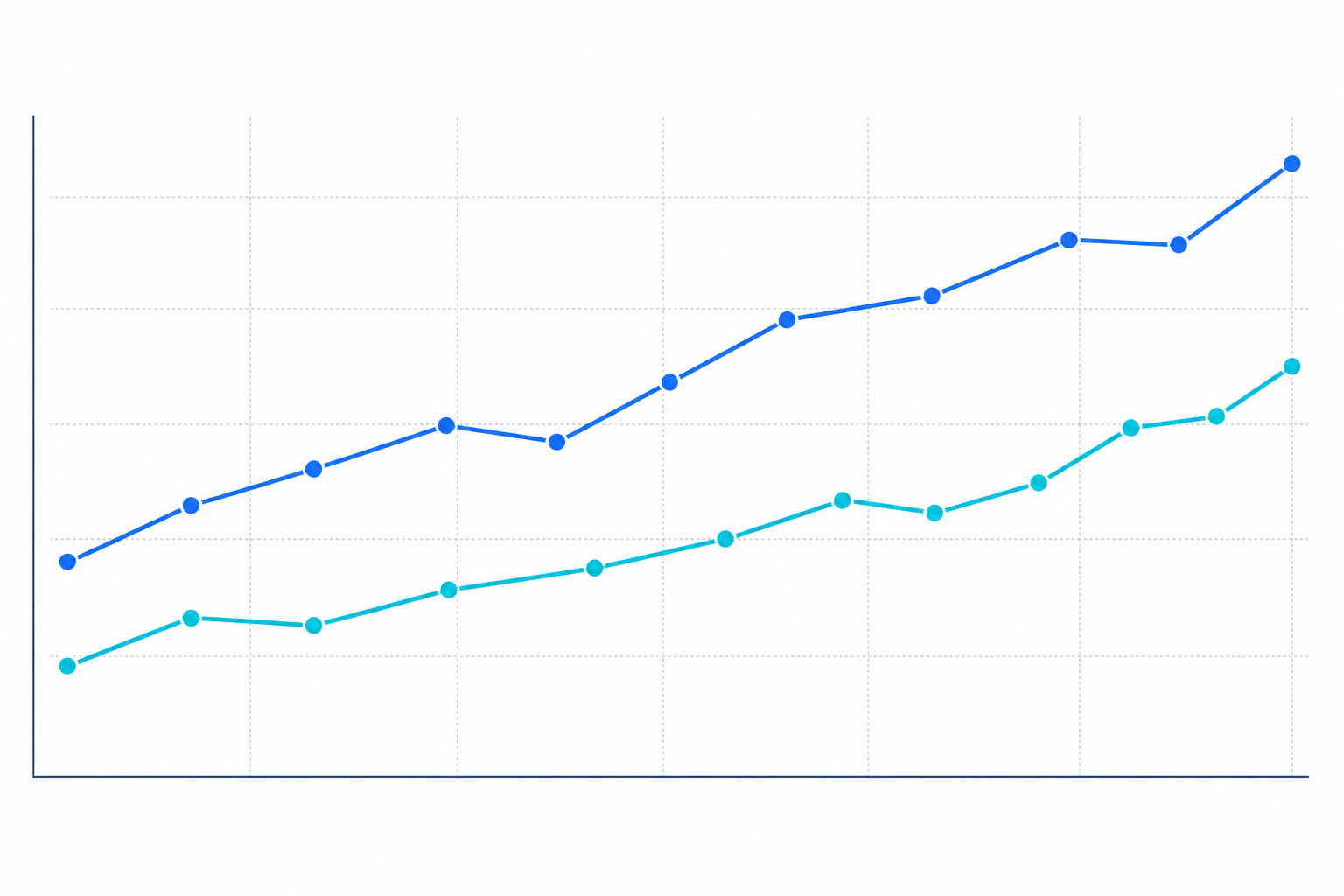
Alt text: Line chart showing quality scores and organic traffic both trending upward over a six-month period. Caption: These two metrics moved together in this example, but traffic is affected by many factors beyond voice consistency, including rankings, backlinks, and seasonality. Correlation here isn't proof that voice consistency alone drove the traffic increase.
The teams that scale content marketing successfully treat measurement as ongoing maintenance, not a one-time audit. Voice consistency isn't a box you tick once. It's something you check the way you'd check the oil in a car you rely on every day, using the right measure for the right question.
How AI Content Tools Support Content Marketing at Scale
This is the part that's genuinely shifted in the last couple of years, though it's worth being precise about what's actually changed. Early AI writing assistants were static: you gave them a prompt, they gave you generic output, and every article felt roughly the same regardless of how it performed. Some newer AI content generation platforms, including the one we use, Scribe, incorporate feedback signals, such as quality scores or engagement data, into how they generate future drafts. Not every AI tool does this, and it's worth checking what a specific platform actually does before assuming this capability.
In principle, a system like this looks at what's already published, considers which articles performed well against quality and engagement measures, and leans toward the structures and stylistic patterns associated with that performance. In practice, this needs a caveat: performance data is confounded by all sorts of things unrelated to writing quality, including topic demand, distribution, backlinks, and timing. A system that adapts too quickly to a small sample of "high-performing" articles risks reinforcing a fluke rather than a genuine pattern. The tools that do this well build in human review before a pattern gets treated as a rule, rather than adjusting fully automatically.
What this can reduce, when it works well, is some of the manual correction that used to eat up review time on structural issues the system has already learned to avoid. That's a meaningful shift from static content automation toward something closer to a learning collaborator, though "learning" here means pattern-matching against past performance data, not genuine understanding of why something worked.
There's also a practical visual side to scaling. Producing 20 to 30 articles a month means sourcing images and diagrams at the same pace, and manually designing visuals for every post is its own bottleneck. AI-generated images and diagrams built into the content workflow can keep visual output consistent without adding a separate design queue, though they still benefit from a quick human check for accuracy and brand fit, the same as written content does.
Real Team Scenarios: What Scaling Content Marketing Looks Like
The scenarios below are illustrative composites based on patterns we've seen across teams, rather than a single verified case study with published figures. We're describing them this way deliberately, because specific percentage claims without baseline data, methodology, or attribution aren't something you should take at face value from any vendor, including us.
Scenario one: a small in-house team increases output without new hires. A team publishing around 10 articles a month moved first-draft generation to an AI writing assistant trained on their documented brand guidelines, then reassigned their existing team's time from blank-page writing to review and strategic decisions. Over several months, they were able to sustain a higher publishing cadence without adding headcount, because the bottleneck shifted from writing time to review time, and review time scales differently than drafting time does.
Scenario two: a team standardises process before scaling volume. A team that had been publishing inconsistently, both in frequency and in tone, built brand guidelines, a quality scoring checkpoint, and a defined approval workflow before increasing output. Once the process was in place, they scaled volume on top of it rather than trying to fix voice and grow output at the same time.
Here's a simplified comparison of what changed operationally in scenarios like this:
| Metric | Before standardising | After standardising |
|---|---|---|
| Articles per month | 8-10 | 20-30 |
| Hours per article (team time) | 8-10 | 3-5 (review-focused) |
| Voice audit consistency (self-rated) | Inconsistent, varied by writer | Consistent against documented guidelines |
| Quality score trend | Not tracked | Tracked monthly, stable or improving |
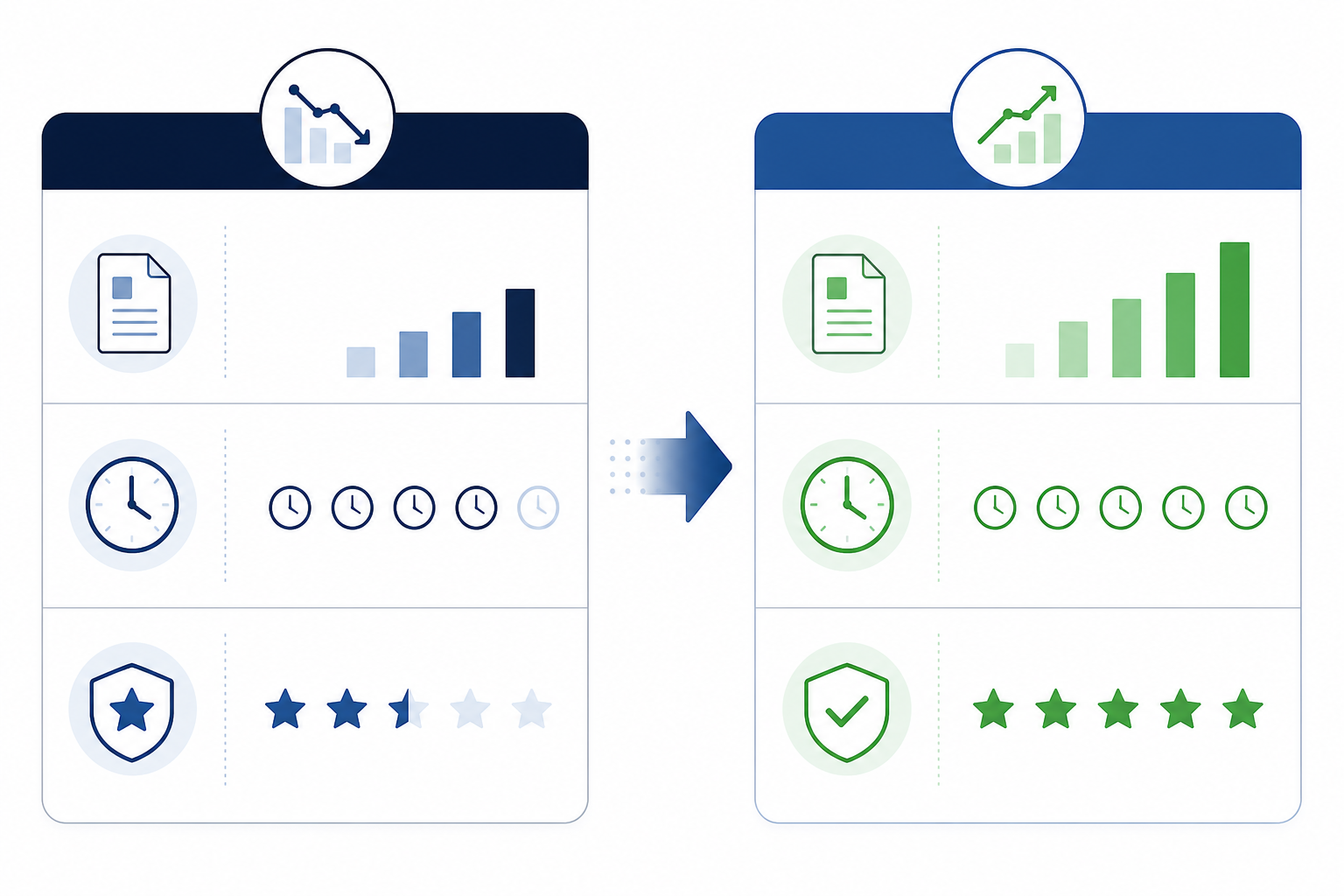
Alt text: Table comparing content output metrics before and after a team introduced brand guidelines and a quality scoring workflow. Caption: Illustrative comparison based on common patterns observed across teams that formalised their process before scaling volume; actual results vary by team, industry, and starting point.
Not every attempt to scale content marketing goes smoothly, and it's worth being honest about that. Teams that jumped straight to high volume without guidelines in place typically ended up with a content library that felt scattered, some posts sharp and on-brand, others clearly generic. The fix wasn't slowing back down. It was going back and building the guidelines and workflow they'd skipped the first time, then scaling again on that foundation.
The common thread across teams that succeed is that they don't treat AI content generation as a replacement for brand voice. They treat it as a way to encode that voice into something repeatable, then rely on a system, clear guidelines, sensible approval steps, and ongoing measurement, to keep it consistent as volume grows.
Frequently Asked Questions About Scaling Content Marketing
How Can Marketing Teams Produce More Content Without Losing Quality?
Separate the creative decisions from the repetitive ones. Lock down brand guidelines once, use AI tools trained on those guidelines to handle first drafts, and reserve human review for judgement calls, factual accuracy, and anything with legal or compliance implications, rather than proofreading every sentence from scratch. This lets a small team realistically manage 20 to 30 articles a month instead of 5 to 8, though the exact ceiling depends on how much regulatory or technical review your content needs.
What's the Best Way to Scale Content Production?
Start with documented, testable brand guidelines, then build a workflow with clear roles, turnaround times, and a quality scoring checkpoint before anything gets published. Layer in an AI writing assistant that can generate drafts quickly, but keep a defined escalation path for regulated claims, factual disputes, or anything that needs legal sign-off. Automate publishing to your CMS so the team's time goes toward strategy and review.
How Do Teams Keep Brand Voice Consistent at Scale?
Consistency comes from a written, testable reference for voice that both humans and AI tools can follow, plus regular spot checks comparing new content against your best past work. Some AI platforms incorporate performance feedback into how they generate future drafts, which can help, but this works best alongside human review, not instead of it, since performance data can be confounded by factors unrelated to voice or quality.
Will AI-Generated Content Sound Robotic or Generic?
It depends heavily on the inputs. Generic AI output usually comes from vague prompts and no brand context. Feeding an AI writing assistant specific examples, tone guidelines, and feedback on past drafts noticeably narrows the gap. It won't close it entirely without human review, and it won't catch factual errors or make legal judgement calls on its own.
Who's Responsible if AI-Generated Content Contains a Factual Error or an Inaccurate Claim?
Your team is, regardless of what tool produced the draft. This is why a human review step and, for regulated claims, a compliance check, shouldn't be skipped even when a quality score is high. A scoring system checks tone and structure; it doesn't verify facts or assess legal risk.
Does This Approach Work for Regulated Industries or Heavily Compliance-Driven Content?
It can, but the workflow needs an explicit compliance or legal review stage before publishing, not just a voice check. If you're in financial services, healthcare, or another regulated UK sector, build that review into your SLA table from the start rather than treating it as an afterthought.
What About Data Privacy When Using AI Writing Tools?
Check where your brand guidelines, draft content, and any customer data are stored and processed, and whether that's compliant with UK GDPR. Most reputable platforms will have clear documentation on this, but it's worth confirming before feeding sensitive information into any AI tool.
Getting Started: A Practical Plan to Scale Content Marketing
If you're ready to scale content marketing without the usual trade-offs, here's a realistic starting sequence rather than trying to do everything at once:
- Document testable brand guidelines this month, using real examples from your best and worst content.
- Build a simple approval workflow with defined owners and turnaround times, including a compliance step if you need one.
- Pick one AI writing tool, train it on your strongest sample articles, and run a small pilot before scaling volume.
- Set up monthly voice audits and quality score tracking from day one, so drift gets caught early.
- Scale volume gradually, watching quality scores and audit results, not just traffic, as your signal that the system is holding.
None of this removes the need for good editorial judgement. It just means that judgement gets spent where it actually matters.
Related Articles

Create content like this automatically
Scribe uses AI to generate high-quality blog posts that engage your audience and drive traffic.