How Small Businesses Can Compete With Big Content Budgets (Without a Big Budget)
14 min read
Loading...

If you've ever looked at a big competitor's blog and felt a bit deflated, you're not alone. They've got a content team, a budget that makes your eyes water, and what feels like an endless supply of polished articles hitting the internet every week. Meanwhile, you're squeezing in a blog post between customer calls, supplier issues, and everything else that comes with running a small business.
Here's the reassuring part: small business content marketing doesn't have to mean losing to bigger budgets. The gap isn't about talent or expertise, since you almost certainly know your customers better than any corporate marketing team ever will. The gap is about volume, consistency, and technical SEO groundwork, three things that AI-assisted content tools have genuinely made more affordable over the last couple of years.
A quick disclosure before we go further: I work with Scribe, an AI content platform, so I'm not a neutral reviewer here. I'll use it as a working example throughout this piece, but the strategy underneath it, consistent publishing, smart keyword choices, and honest editorial review, applies whether you use Scribe, a different AI tool, or a hybrid of AI and freelance writers. Let's look at why the gap exists, and how to close it without a bigger budget.
Big brands don't just have more money to throw at content. They typically have dedicated writers, editors, SEO specialists, and often an agency on retainer, all working in coordination. That infrastructure lets them publish frequently, distribute across multiple channels, and continuously test what performs. Several advantages, stacked on top of each other, not just one.
For small businesses, that stacking effect is the real problem. You're not missing one thing, you're missing all of it at once: the writer, the editor, the SEO specialist, the distribution strategy. According to the Content Marketing Institute's 2023 B2B research, 71% of marketers said content marketing had become more important to their organisation over the previous year. The pressure to compete is rising, even though most small business budgets haven't grown to match it.
Here's where the cost breakdown gets painful, so let's put real numbers on it. A single freelance blog post in the UK, assuming roughly 1,000 to 1,500 words with basic research and one round of edits, typically runs £150 to £400. That price climbs if you add in-depth research, images, or SEO optimisation as separate line items. Publish 10 posts a month at that rate and you're looking at £1,500 to £4,000 before editing or images are even factored in. Twenty or thirty posts a month, which is closer to what larger competitors manage, quickly becomes financially out of reach for most small teams.
It's worth being precise about what consistency actually buys you here, because this gets oversimplified a lot. Publishing frequency by itself is not a direct ranking factor. What matters to search engines is relevance, depth, originality, technical health, and whether real users find a page genuinely useful. What consistent publishing does give you is more surface area: more pages that can answer specific customer questions, more chances to build topical depth in your niche, and clearer signals to search engines that your site is active and maintained. A business posting sporadically, even with strong individual articles, has fewer opportunities to build that depth than one publishing every week. Consistency helps you compete; it doesn't guarantee it.
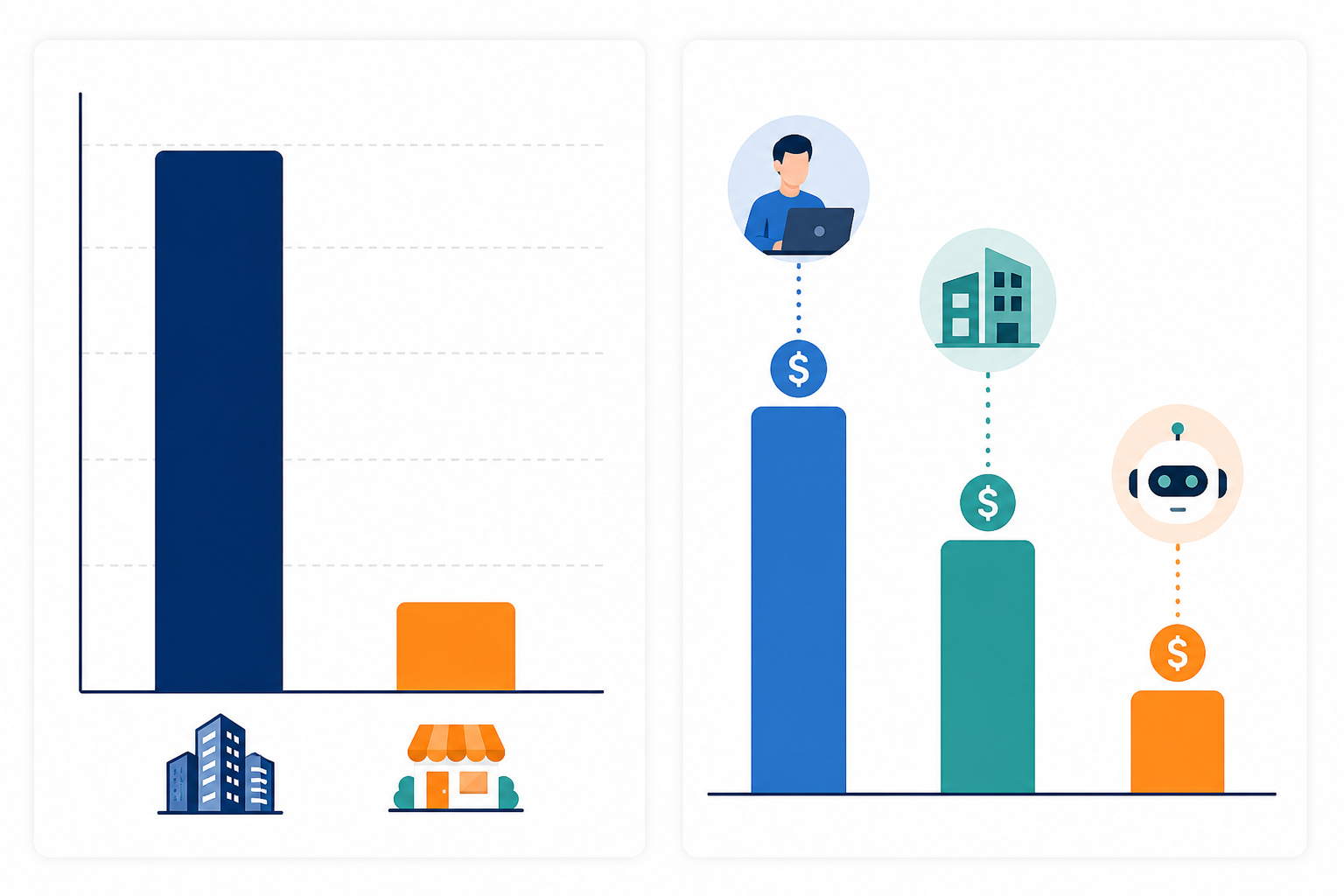
This is where AI content tools change the maths, though it's worth being honest about what they can and can't do. The old bottleneck, where one person can only research, draft, and edit so many articles a week, is far less binding than it used to be. But AI output still needs a human in the loop if you want it to be accurate, on-brand, and genuinely useful.
Here's what a realistic AI-assisted workflow looks like in practice, using Scribe as the example I know best:
A sensible five-minute review checklist before anything publishes: check facts and figures against your own records, cut anything generic that could apply to any business (swap in a real example or detail instead), confirm the tone matches how you actually talk to customers, check that links go to real, relevant pages, and confirm the piece actually answers the question a searcher typed in. Skipping this step is where AI-generated content tends to go wrong.
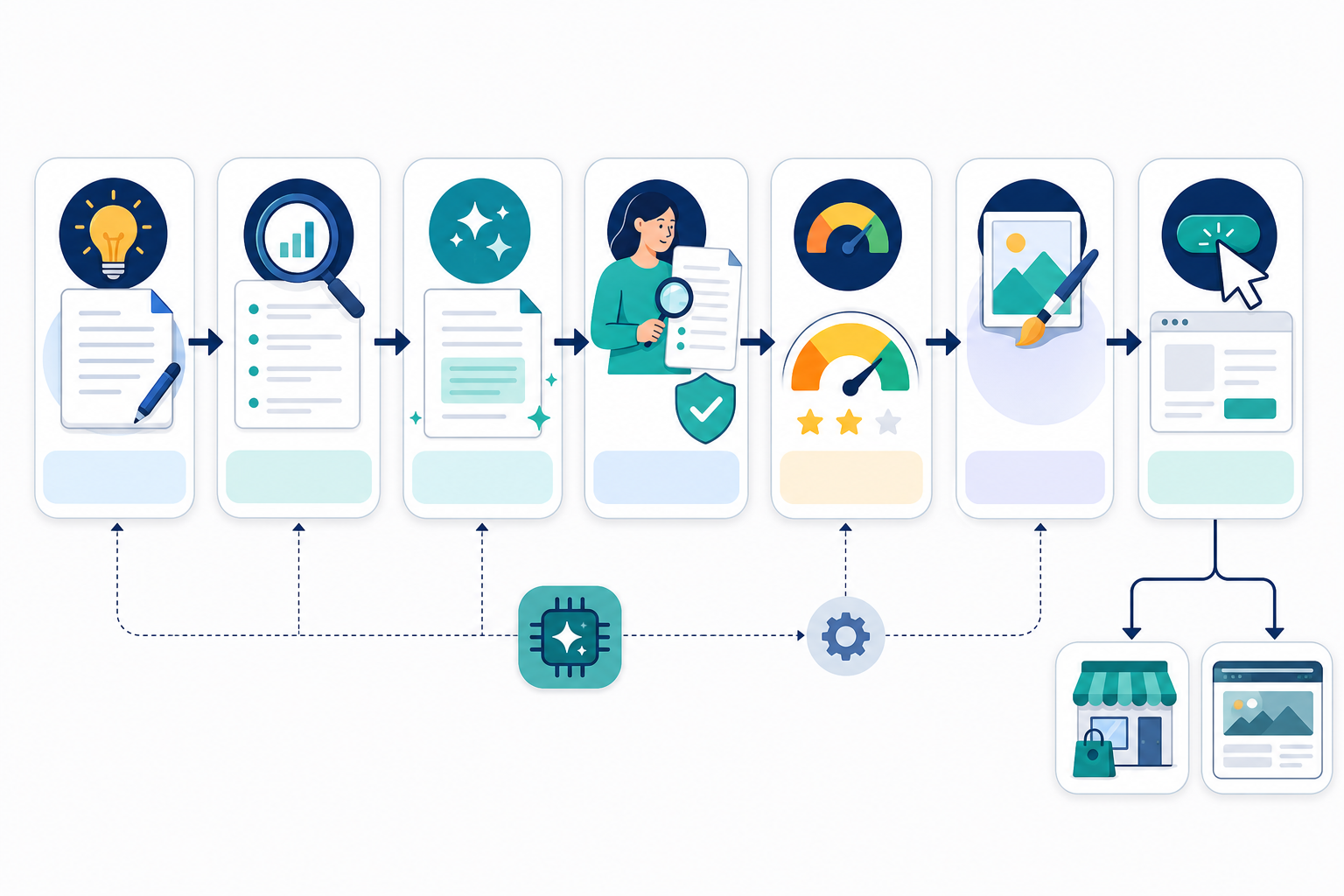
Having a tool that publishes quickly is one thing. Using it well is another. Affordable content marketing works best when it's targeted, not just frequent. Here's how I'd build a small-business content marketing strategy from scratch:
I want to be upfront: I don't have a single verified, named case study with full analytics access to share here, and I'd rather say that plainly than dress up an anonymous statistic as proof. What I can offer is a realistic, labelled example based on patterns we commonly see, plus the broader research on documented content strategies.
Imagine a small UK joinery business starting from roughly 150 organic visits a month, with an old blog that's been updated maybe once a quarter. They switch to publishing one well-researched, human-reviewed post a week, targeting specific questions like "how much does a fitted wardrobe cost in a 1930s semi" rather than broad terms like "bespoke joinery." Over six months, with 20+ new pages targeting real customer questions, it's reasonable to expect meaningful traffic growth, often somewhere in the range of two to four times the starting point, though the exact figure depends heavily on competition in their area, their site's technical health, and whether they earn any backlinks along the way. That range is illustrative, not a guarantee, and results in more competitive sectors will be slower.
What's notable in patterns like this isn't creative genius. It's consistency paired with specificity. A business that used to post "whenever there's time" moves to a fixed weekly rhythm targeting real questions, and over a few months, search visibility tends to climb because there's simply more relevant, well-matched content for search engines to surface. This lines up with what larger content marketing research has found for years: the Content Marketing Institute has repeatedly found that a documented content strategy correlates strongly with reported success, with 64% of the most successful B2B content marketers having one in place compared with roughly 19% of the least successful.
The takeaway for small businesses is reassuring, even without a dramatic single statistic. You don't need a bigger creative vision than your competitors. You need a repeatable system that keeps publishing, and keeps getting checked, even when you're busy running the actual business.

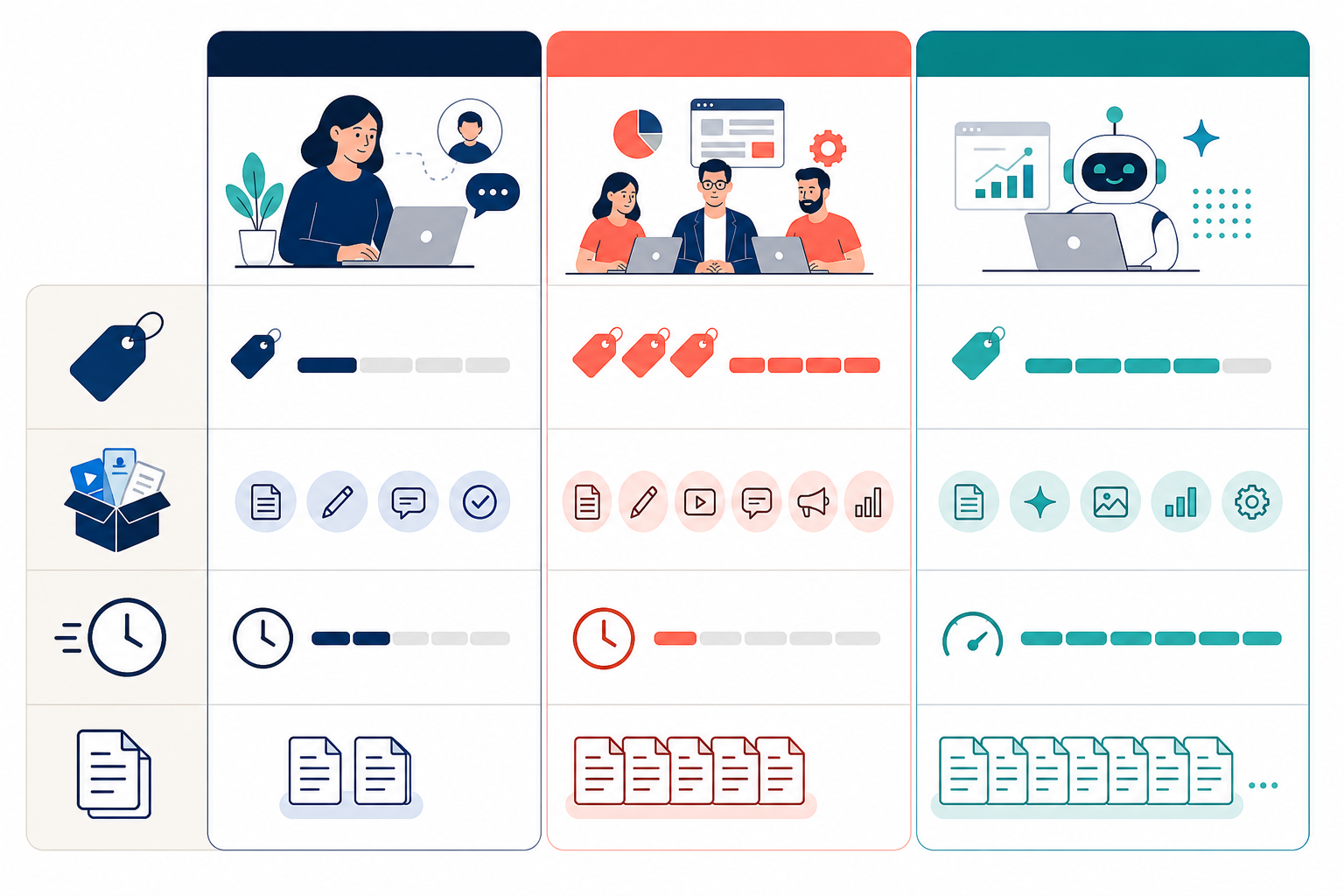
If you're weighing up your options, here's a more precise breakdown, with the assumptions spelled out so you can compare fairly. Freelance and agency figures reflect typical UK market rates as of this writing; always check current quotes, since pricing shifts.
| Option | Typical Cost | What's Usually Included | Turnaround | Realistic Monthly Volume |
|---|---|---|---|---|
| Freelance writer | £150–£400 per post | ~1,000–1,500 words, basic research, one edit round; images and SEO often extra | 3–5 days per post | 4–8 posts |
| Content agency | £1,000–£5,000+ per month | Strategy, writing, editing, some SEO and reporting; varies widely by agency | 1–2 weeks setup, then ongoing | 4–12 posts |
| AI content platform (e.g. Scribe) | Roughly £30–£150 per month depending on tier, check current pricing | Draft generation, suggested images, on-page SEO elements, quality scoring; human review time not included | Minutes per draft, plus your review time | 10–30 drafts, review time scales with volume |
To make the comparison concrete: publishing 10 articles a month with a freelancer at £250 average per post costs roughly £2,500 a month. The same volume through an AI platform might cost £50 to £100 in software fees, plus your own time (or a part-time editor's time) to review and refine each draft, say 20 to 30 minutes per piece. That's still a meaningful cost in your time, just a very different kind of cost than writing from scratch.
When you're choosing a plan, think about publishing frequency and your review capacity together, not just price. A tier offering 10 articles a month suits a business testing content marketing for the first time, since you can realistically review each draft properly. Twenty or thirty articles a month only makes sense once you or someone on your team has the time to review that volume, otherwise you risk publishing unchecked content, which can hurt trust more than sporadic publishing ever would.
Whatever tool you choose, look for these essentials:
A simple first-month plan: pick five to ten specific keywords based on real customer questions, connect your publishing platform, and set a fixed weekly slot to draft, review, and publish one piece. Track impressions and clicks in Search Console from week one, so you have a baseline before drawing conclusions about what's working.
Can small businesses really compete with big brands on content marketing?
Often, yes, particularly for specific, lower-competition questions where a big brand's content is generic and yours is genuinely informed by real customer experience. It's less true for broad, highly competitive terms where large sites have years of backlinks and authority behind them. The realistic path is competing on specificity and consistency for the questions your actual customers ask, rather than trying to outrank a national brand on its biggest keywords immediately.
How do I market content on a tight budget?
Start with specific customer questions, prioritise lower-competition keywords, publish consistently, and repurpose each article across email, social media, and relevant website pages. AI-assisted tools can reduce drafting costs, but you should still allow time for human review, editing, and fact-checking.
How much should a small business budget for content marketing?
Traditional routes like agencies or freelance writers typically run £1,000 to £5,000+ a month for a handful of posts, depending on scope. AI-assisted platforms can bring the software cost down to roughly £30–£150 a month, but you still need to budget time, either yours or a part-time editor's, for reviewing and refining drafts before they publish.
What tools help small businesses scale content without hiring a team?
AI writing assistants and blog generators are the main lever, but the useful ones combine drafting with keyword suggestions, quality scoring, and direct publishing integrations, so you're not stitching together five separate tools. Whichever you choose, build in a review step; the tool speeds up drafting, it doesn't replace checking the work.
Is AI-generated content actually good enough to rank in search results?
It can be, but "good enough" depends on what happens after the draft is generated. AI platforms that use performance data can improve their suggestions over time, and quality scoring helps catch structural or readability issues before publishing. Ranking still depends on genuine relevance, accuracy, and whether the piece answers the searcher's actual question better than what's already ranking, which is why a human review and fact-check step matters regardless of how the draft was produced.
The content budget gap is real, but it's not permanent. With a clear-eyed approach to content marketing for small business, a small business can match, and sometimes beat, the publishing consistency of much bigger competitors. You don't need their budget. You need a repeatable system, a bit of your own expertise added to every piece, and a habit of checking the numbers to see what's actually working.