How Solopreneurs Can Scale Content Without Growing Their Team


How Solopreneurs Can Scale Content Without Growing Their Team is a practical question with a surprisingly simple answer: pair automation with a clear editorial process. Here's a number worth sitting with: if you're publishing one blog post a week and doing everything yourself, from research through to checking analytics, you're likely spending a full working day on it, sometimes more. Add social captions, an email newsletter, and the lead magnet you keep meaning to finish, and content isn't a task anymore. It's a second job stacked on top of the one you're actually trying to run. Scaling content without growing your team is doable, but only if you pair automation with a clear editorial process. Tools alone won't save you if there's no quality bar behind them.
The mindset shift that makes this work is simple. Stop treating content production as something you either do entirely yourself or outsource to freelancers you can't yet afford. Instead, treat automation as your content team: not a replacement for your expertise or voice, but a system that handles the repetitive, time-consuming parts so you can focus on strategy, client work, and the judgment calls only you can make.
The solopreneur's content dilemma: why content takes so long
Content isn't just writing. It's research, drafting, editing, formatting, sourcing images, optimising for search, scheduling, publishing, and then checking whether any of it actually worked. Each step is its own mini-project. When you're already wearing every hat in your sole trader or one-person limited company, that's a lot to add to the list.
The numbers back this up. Orbit Media's long-running annual blogging survey has tracked writing time climbing for a decade: the average blog post took under two and a half hours to write in 2014, and recent editions put that figure at over four hours. Posts are taking longer to produce, not shorter, even as competition for attention has gotten fiercer. If you're publishing weekly, that's several hours a week on writing alone, before design or distribution enter the picture.
Most solopreneurs assume they have two options: grind through it all themselves, sacrificing evenings and weekends, or hire freelance writers, editors, and designers they genuinely can't afford yet. Neither holds up long-term. The first burns you out. The second eats margins you need for actually growing the business.
Content inconsistency has a real cost, though it's worth being precise about what that cost is. Google's Search Central guidance doesn't say that frequent publishing itself improves rankings. What it says is that helpful, relevant content backed by a well-organised, up-to-date site tends to perform better over time. Sporadic publishing doesn't directly damage your SEO, but it does interrupt three specific things that compound with steady output: internal links between related posts that help Google understand your site's structure, older posts getting refreshed with current information, and a growing library of pages that keep earning search traffic long after you published them. Stop-start publishing prevents all three from building.
For a UK-based consultant or agency owner, this shows up in a familiar way: you rank for a handful of terms, then disappear from search results for months at a time because the next post doesn't land until you have a quiet week. Steady output, even a modest one, tends to beat sporadic bursts.
What does scaling content really mean today?
For most of business history, scaling meant one thing: more people. Need more content? Hire more writers. Need better quality? Hire an editor. Need faster turnaround? Hire a project manager to keep everyone on schedule. That model made sense when every step required human hands.
That's no longer the only constraint. Scaling today is increasingly about systems rather than headcount, specifically the kind of automation-assisted workflow that lets one motivated person do far more than used to be possible alone. Bigger, better-resourced competitors haven't lost their advantages in expertise, distribution, or brand trust. But the production gap between a solo operator and a small team has narrowed.
There's a conditional advantage worth naming honestly. A one-person operation with a streamlined workflow can sometimes move from brief to published post faster than a five-person marketing department, simply because there's no approval chain to work through: no waiting for sign-off from a manager, then a client, then legal. But teams still tend to win on depth of expertise, quality control, and sheer capacity to cover more ground at once. Solo doesn't beat team. It just doesn't have to mean slow anymore.
The other useful shift: content marketing works best as a repeatable system rather than a creative burden you personally carry every week. Once you have a documented process, templates, and reliable tools handling the mechanical parts, publishing consistently stops feeling like an act of willpower.
How Solopreneurs Can Scale Content Without Growing Their Team: automation as your content team
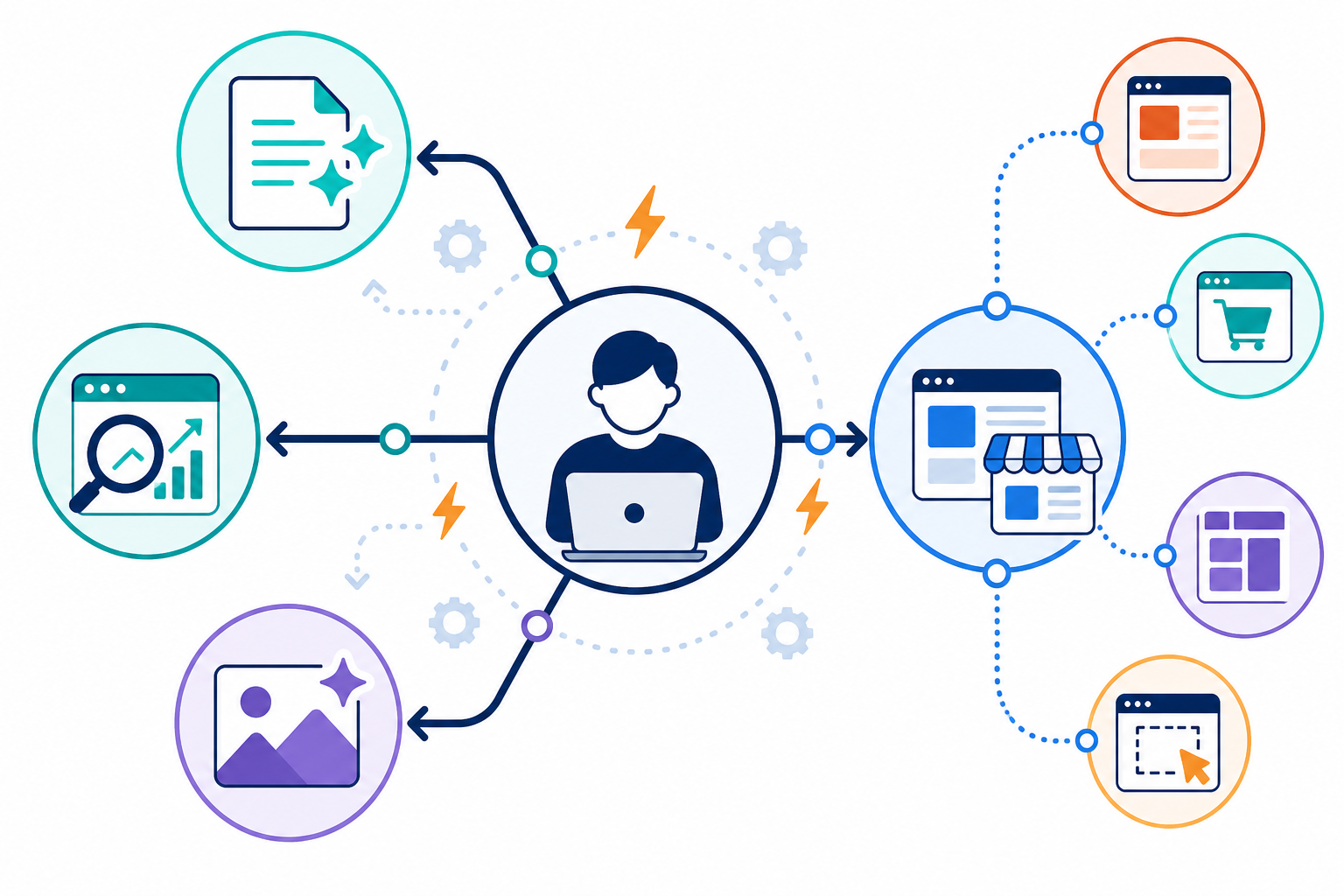
Think of a modern content workflow in six stages: plan, draft, review, publish, repurpose, and measure. Automation can genuinely take over most of the mechanical work in four of those stages. The other two, review and the strategic side of planning, still need you.
Plan. This is where your judgment matters most: what topics actually serve your clients, what makes your business different, what you're willing to put your name behind. Automation can suggest topics based on search data, but the strategic call is yours.
Draft. AI writing assistants that produce full first drafts, not just outlines, save the most time here. Plenty of tools give you a bullet-point structure and leave the actual writing to you; better tools generate complete drafts you can edit, rather than starting from a blank page. "Complete" should still mean "needs your review," not "ready to publish untouched."
Review. This is the stage where you check facts, add a real example or client anecdote, and make sure the piece sounds like you rather than like every other AI-generated post on the internet. No automation should skip this step, and no vendor claim should convince you otherwise.
Publish. Automated publishing integrations with platforms like WordPress, Shopify, Webflow, and Wix mean approved content goes live without a manual upload step, once you've signed off on it.
Repurpose. HubSpot's guidance on repurposing content points out that a scalable system usually starts with one core asset and adapts it across formats. If you're generating consistent blog content, you've already got source material to slice into social posts, email newsletters, or short video scripts, without starting from scratch each time.
Measure. Quality scoring tools can flag weak content before it goes live, catching structural or SEO issues. What they can't catch is a factual error about your own industry, so treat scoring as a useful signal, not a substitute for a human read-through.
A quick note on tool choice, since this is where a lot of solopreneurs get stuck comparing feature lists. Before picking a platform, check: how it handles factual accuracy and citations, whether you can export and edit content freely, how transparent it is about where information and images come from, what analytics it gives you, and how it handles data under UK GDPR if you're feeding it client or business information. AI writing tools broadly fall into three categories: outline generators that leave drafting to you, draft generators that produce full copy but no publishing workflow, and integrated platforms that combine drafting with SEO guidance and direct publishing. Scribe, which I've used as a working example throughout this piece because its feature set illustrates a full workflow, sits in that third category, alongside tools like Jasper and Copy.ai, which take different approaches to drafting and integration. I don't have a commercial relationship with Scribe; I'm naming it because it's a concrete, checkable example rather than a hypothetical one. Whichever platform you consider, verify vendor claims yourself rather than taking marketing copy at face value.
Real examples of lean content operations
To make this concrete, here's an illustrative example based on a common pattern I've seen among solo consultants, not a verified case study, but a realistic composite of how the shift typically plays out.
Before: a solo strategy consultant publishes roughly one blog post a month, usually late, often skipped entirely during busy client weeks. Each post takes around four hours of writing time, spread across several evenings, plus another hour hunting for a stock image and formatting it for WordPress.
After adopting an AI-assisted workflow, the same consultant's week might look like this:
- Monday (30 minutes): Brief two topics based on recent client questions and a quick look at search terms worth targeting.
- Tuesday (automated): Draft generation happens in the background while the consultant is on client calls.
- Wednesday (45 minutes per post): Review both drafts, fact-check anything industry-specific, swap generic examples for a real client story, adjust the opening to sound less like a template.
- Thursday (20 minutes): Approve and schedule, plus pull one paragraph from each post into a LinkedIn update and a newsletter blurb.
- Friday (15 minutes, once a month): Check Google Search Console for what's gaining traction.
Total hands-on time: roughly two hours a week for two published posts, down from four-plus hours a month for one. What changes isn't magic, it's time allocation. Research, drafting, and formatting get handled by a system rather than squeezed into calendar gaps. The consultant's job shifts from "write the post" to "review the draft, add something only I know, check the facts, then publish."
I'd treat any specific traffic-growth figures you see in vendor marketing, including from Scribe or similar tools, as illustrative rather than guaranteed. They typically come from a single account, a specific starting point, and a timeframe that isn't always disclosed in detail. The realistic takeaway isn't a percentage. It's that a consistent, reviewed publishing habit compounds over months, and every hour you're not manually drafting is an hour back in the part of your business that generates revenue.

What automation shouldn't replace
AI-generated content can produce factual errors, especially on niche or fast-moving topics, so anything technical, regulated, or industry-specific needs a human check before it goes live. It can also default to generic phrasing that doesn't sound like you, which matters more than it seems, since brand voice is often what actually converts a reader into a client.
Here's a simple way to decide what to hand off and what to keep:
| Task | Automate | Keep human |
|---|---|---|
| Topic research and keyword data | Yes | Final topic choice |
| First draft generation | Yes | Editing for voice and accuracy |
| Formatting and scheduling | Yes | Approving before it goes live |
| Image sourcing | Yes | Licensing check |
| Publishing to CMS | Yes | Sign-off |
| Client examples and opinions | No | Always |
| Regulated or technical claims | No | Always, fact-checked |
There are practical UK-specific considerations worth building into your process from day one: don't paste client names, case details, or confidential information into AI tools unless you've checked the vendor's data-processing terms; check copyright and licensing on AI-generated images before publishing; and remember Google's guidance focuses on whether content is genuinely helpful, not on publishing frequency or AI involvement itself. None of this means avoid automation. It means build the review step into your workflow rather than treating publish as the final stage.
A reasonable process looks like this: brief the topic and intent, generate an AI-assisted draft, have a subject-matter review, even if that's just you wearing your expert hat rather than your production hat, run an originality and fact check, then approve and publish. Skipping the review step is the single most common way automation goes wrong.
How to start scaling content without a team
If this all sounds appealing but slightly abstract, here's a minimum viable stack and a 30-day way to test it.
Minimum viable stack: one AI drafting tool with export capability, your existing CMS (WordPress, Shopify, Webflow, or Wix), Google Search Console for measurement, and a simple shared document for your publish-readiness checklist.
Publish-readiness checklist, worth adapting to your business: facts checked against a source you trust, at least one detail or example only you could have written, voice sounds like you rather than a template, sources credited where relevant, images licensed correctly, no client-confidential information included, and a clear call to action.
- Audit your current output and find the biggest time sink. Research, drafting, formatting, or publishing? Knowing where your hours go tells you what to automate first.
- Pilot with two posts before committing to a volume. Run one topic through the full workflow, from brief to published post, and time yourself honestly at each stage.
- Choose a volume that matches your review capacity, not a round number. There's nothing magic about 10, 20, or 30 articles a month. Start smaller than you think you need, and increase once your review process is solid.
- Build the quality gate before anything goes live. Decide, in advance, what "good enough to publish" means for your brand, then require every draft to clear that bar.
- Connect your publishing integration so approved content goes live without manual steps, once you've signed off.
- Review analytics monthly, not daily. A monthly check with Google Search Console gives you enough signal to spot real trends without becoming a new time sink.
The goal isn't to disappear from your own content strategy. It's to stop being the production line while staying the editor-in-chief.
Frequently asked questions about scaling content as a solopreneur
Can one person really run a full content strategy without help?
Yes, with caveats. AI-assisted drafting and automated publishing let a solopreneur maintain a schedule that used to need several people. The tools handle production, not judgment. You're still responsible for accuracy, brand voice, and strategic decisions, and skipping the review step is where quality problems creep in.
How can solopreneurs produce more content without hiring?
Start by documenting a repeatable process, then automate research support, first-draft creation, formatting, repurposing, and publishing. Keep topic selection, fact-checking, brand voice, and final approval human-led. Increasing output gradually is more sustainable than publishing a large volume of lightly reviewed content.
How much review time should I realistically budget per post?
For a typical 1,000 to 1,500 word draft, expect 30 to 60 minutes if you know the subject well: fact-checking, adding a genuine example, and adjusting tone. Technical or regulated topics will take longer. If review is taking as long as writing from scratch used to, your drafting tool or your brief isn't doing enough of the work yet.
Can I put client information into AI writing tools?
Only if you've checked the vendor's data-processing terms and you have a lawful basis to share it under UK GDPR. Safer practice for most solopreneurs: anonymise client details, use composite examples, or get explicit permission before referencing a real client in AI-assisted content.
What tools help scale content without a team?
Look for platforms combining AI-assisted drafting with SEO guidance, transparent sourcing, and publishing integrations, and check data handling policies if you're UK-based. Scribe is one example, generating draft blog posts with images that connect to WordPress, Shopify, Webflow, or Wix; Jasper and Copy.ai take different approaches worth comparing. Treat any specific speed or word-count claims from vendors as marketing figures to verify yourself, not guarantees.
Will AI-generated content actually rank well in search results?
It can, but only when it's genuinely helpful, accurate, and reviewed by someone who knows the subject. That's what Google's guidance rewards, not publishing frequency or AI involvement itself. Treating AI output as a first draft rather than a final product is what tends to separate content that performs from content that doesn't.
How much content should a solopreneur aim to publish each month?
There's no universal number. A better approach is to start with whatever amount you can properly research, review, and stand behind, then increase gradually as your process and bandwidth allow. For many solopreneurs, that means a handful of well-reviewed posts a month rather than a large batch of thinner ones.
What should I measure besides traffic?
Traffic is easy to track but doesn't tell you much about business impact. Also check which posts generate enquiries or bookings, how long readers stay on the page, and whether older posts still bring in traffic months later, a sign your content is compounding rather than just accumulating.
Create content like this automatically
Scribe uses AI to generate high-quality blog posts that engage your audience and drive traffic.