Loading...
Meta description: Learn how top UK performance marketers find winning ad angles through competitor research, pattern recognition and rapid testing—before everyone else does.
Here's something that might be uncomfortable to hear: the best performance marketers aren't creative geniuses dreaming up winning ad angles in the shower. Most of the time, they're doing something far less glamorous. They're systematically studying what's already working in the market, spotting patterns across competitor creative, and testing fast before anyone else catches on.
To be fair, that's not the whole story. Offer quality, audience fit, media buying skill and genuine creative execution all matter too. Angle isn't the only lever in performance marketing. But it's the lever most teams neglect, because it feels like it requires inspiration rather than process. That's where the opportunity sits.
The marketers who consistently win watch what competitors are running, figure out why it might be resonating, and adapt that insight into something that fits their own brand before the window closes.
If you're still waiting for the perfect angle to strike you during a brainstorm, I've got good and bad news. The bad news: that's not how the consistent winners operate. The good news: the actual process is learnable, repeatable, and a lot less stressful than staring at a blank doc hoping for inspiration.
Let's break down how this actually works, including where it goes wrong if you're not careful about evidence.
Before we go further, let's get clear on terminology. A lot of teams conflate angle, creative, and copy, and that confusion is often part of why ads underperform.
The ad angle is the core argument or emotional hook. It's the "why should I care" sitting underneath everything else. The creative is the visual execution: the video, the static image, the UGC clip. The copy is the specific words used to deliver that angle. The same angle, delivered through completely different creative and copy, can still convert because the hook underneath is doing the heavy lifting.
Here's a simple way to see it. Say you're selling the exact same pair of running shoes, priced at £89.99. You could run:
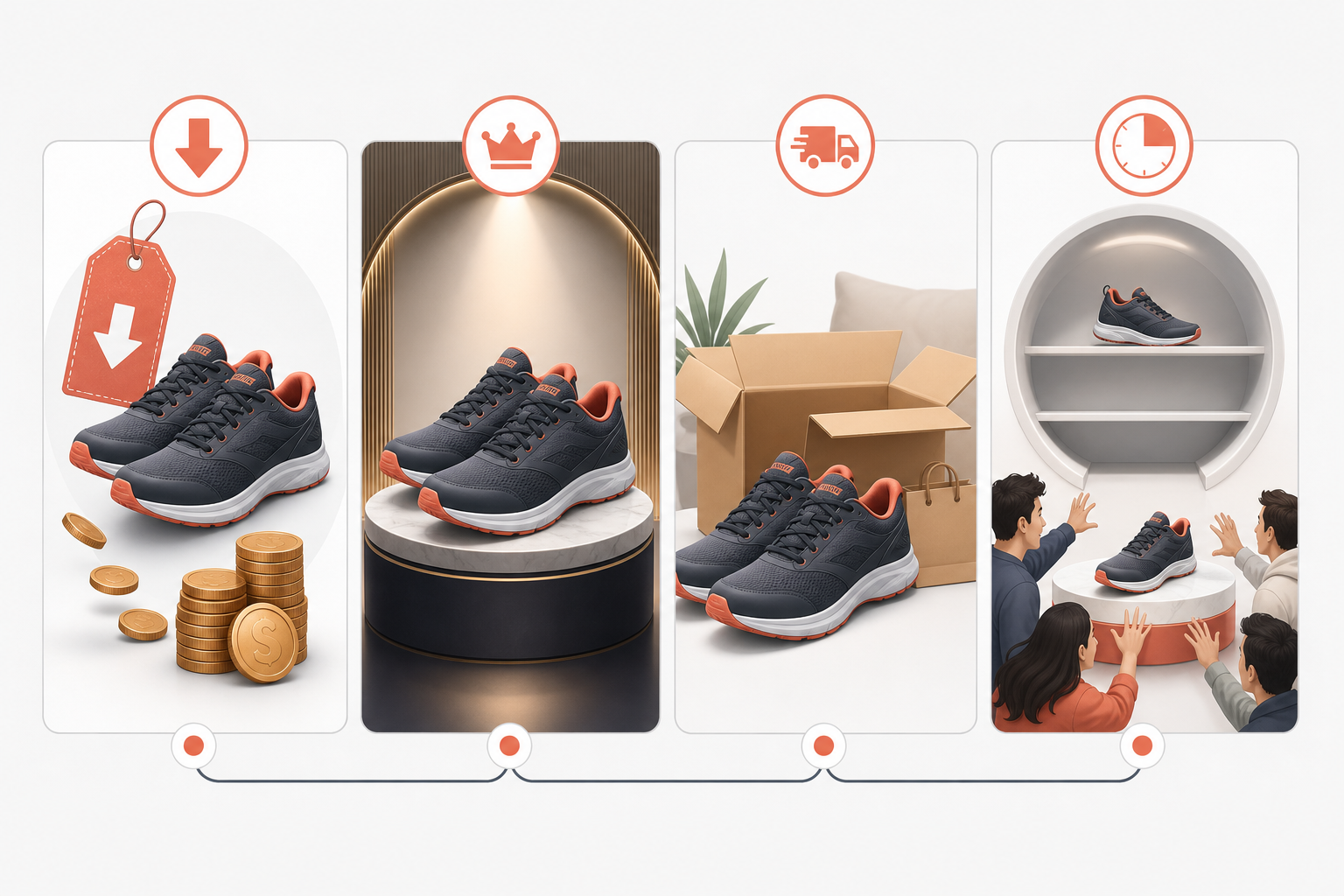
Same product. Same offer, even. Four completely different reasons to click.
When an ad underperforms, it's tempting to blame the creative first. But angle is only one link in a longer chain: offer, audience, message-market fit, angle, creative execution, landing page, and delivery (targeting and budget). If you're diagnosing a weak ad, work through that chain roughly in order. Check the offer is competitive, check you're reaching the right audience, then ask whether the angle actually taps into something that audience cares about, before you touch the creative at all. A lot of underperformance that gets blamed on "bad creative" is really an angle that never had anything to say.
Here's the uncomfortable reality check: very few angles are truly original. Most of what's performing well right now is a remix of something already proven elsewhere in the market. The marketers who look like they're constantly innovating are usually just faster at finding and adapting what's already working.
So where should you actually be looking, and how do you tell real signal from noise?
A quick note on evidence standards, because this is where a lot of angle research goes wrong: one competitor testing something once is barely worth noting. A competitor running the same angle for several weeks, or several unrelated competitors independently testing a similar hook within the same month, is a stronger (though still not definitive) signal that something in the market has shifted. Either way, you're building a shortlist of hypotheses to validate with your own audience, not a confirmed list of winners to copy.
So how do you turn "go look at competitors" into something systematic rather than an occasional scramble? Here's the process I'd build into a weekly workflow, with a concrete output at each stage.
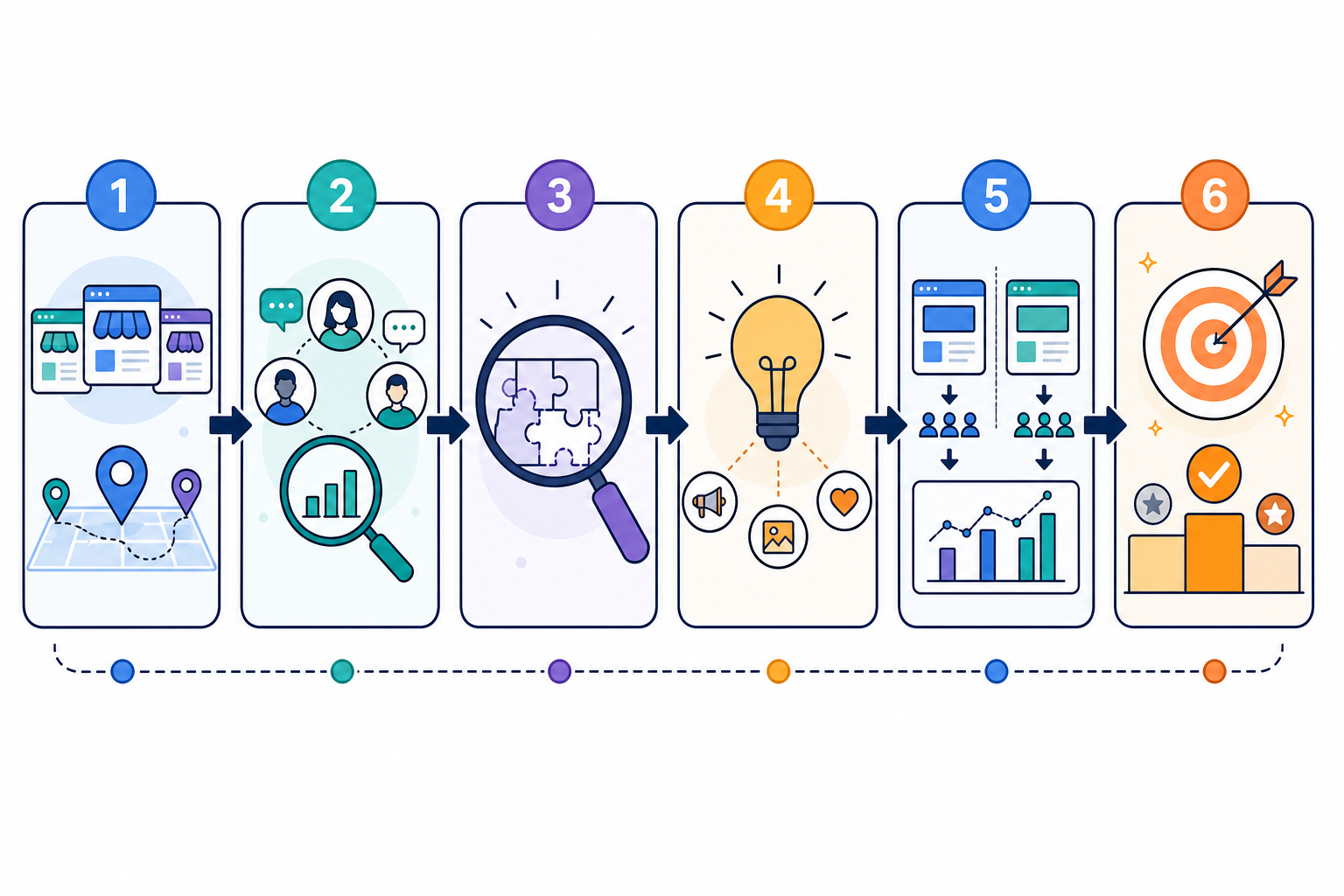
Map your real competitive set. Output: a competitor map. Don't just list your three obvious direct competitors; think about everyone solving the same customer problem. A UK meal kit service like Gousto or Mindful Chef competes with ready meals, meal-prep influencers, and even gym memberships for the same "I want to eat better without effort" customer.
Monitor their ads consistently, not just once. Output: a running monitoring log. A single snapshot tells you what's live today. It tells you very little about what's holding up over time. The angles worth studying are the ones still running or reappearing week after week, not the one-off test that got pulled after two days.
Look for patterns, not one-off ads. Output: a cluster of related angles with supporting examples. If one competitor tests a new hook, that's interesting but inconclusive. If three unrelated competitors test a similar hook within the same month, that's a stronger hypothesis. Markets often converge on what's working because they're reacting to the same underlying customer shift, without any coordination.
Reverse-engineer the "why." Output: a plain-English belief statement. Before touching a single word of copy, ask what customer pain, desire, or belief this angle is tapping into. Is it addressing a fear? A status aspiration? A convenience frustration? Naming the psychology is what separates lazy copying from genuine strategic adaptation.
Adapt, don't copy. Output: an adapted angle hypothesis, backed by your own proof. Take the underlying insight and translate it into your own brand voice, offer, and proof points. If a competitor is winning with "save 3 hours a week" and your product genuinely saves time too, don't lift their exact line. Find your own version backed by your own data or testimonials.
Prioritise by differentiation and provability. Output: a ranked test backlog. Not every angle you spot is worth pursuing. Score your shortlist on how differentiated it is for your specific product and how easily you can actually back it up with proof. An angle you can't substantiate, particularly for health, finance, or comparative pricing claims where the UK's CAP Code and ASA guidance apply, is a liability rather than an opportunity.
Here's what that looks like filled in for our running shoe example:
| Angle | Source | Evidence (duration/recurrence) | Underlying belief | Proof we have | Differentiation | Risk | Status |
|---|---|---|---|---|---|---|---|
| "Elite marathoners quietly switching" | 2 competitor ad libraries, 3 weeks live | Status/credibility | None yet—no athlete partnerships | Low—unsubstantiated | Medium | Need real testimonials before testing | |
| "Back in stock 48 hours, sold out in a day last time" | Internal sales data | Scarcity/FOMO | We genuinely sold out in 18 hours last drop | High | High | Ready to test | |
| "Order by 9pm, run in them tomorrow" | Customer reviews mentioning delivery speed | Convenience | Real UK next-day courier data | High | Medium | Ready to test |
A simple scoring formula, evidence strength plus provability plus differentiation, each scored 1-3, gives you a rough priority order without overthinking it. In this case, the FOMO and convenience angles move to testing; the status angle waits until there's real proof behind it.
This works whether you're doing it manually with a spreadsheet or with dedicated tooling. The structure is what matters. Ad angle discovery stops being guesswork once it becomes a repeatable research loop rather than a once-a-quarter scramble.
I'll be honest about the limitations of doing this by hand. Checking Meta Ad Library and Google Ads Transparency Center manually, even for just five competitors across two platforms, genuinely takes hours every week if you want to do it properly. Add TikTok and LinkedIn, and most teams simply don't have the bandwidth to keep this up consistently.
The bigger issue isn't even the time cost. Manual spot-checks only catch what's live today. They miss the trend: which angles keep reappearing week over week, and which were quietly killed after a few days because they flopped. Without that ongoing context, you're guessing at signal from noise, however carefully you check.
This is the gap we built Rival Ads to close. It runs automated ad monitoring across Meta, Google Ads, TikTok, and LinkedIn, and surfaces week-over-week changes: what's new, what's stopped, and what keeps showing up. Worth being upfront about what this can and can't tell you: it shows you ad presence and recurrence, not confirmed spend or profitability, and platform coverage can vary depending on how actively a brand advertises in a given region. Treat it as a faster way to spot patterns worth testing, not a guarantee of what will work for your audience.
Setup is quick, and there's no ad account connection required. You point it at a competitor's website, it detects their presence across the four platforms, and pulls their currently active ads on a rolling weekly basis, with creative, copy, and links included where the platform exposes them. If you'd rather build this manually in a spreadsheet to start, that's a completely reasonable way to test the process before investing in tooling.
Once you've identified a validated angle hypothesis, speed matters for getting a test live. But speed and statistically reliable results are two different things. Here's a realistic 48-hour sprint for turning research into a launched test, with a separate, later checkpoint for actually judging it.
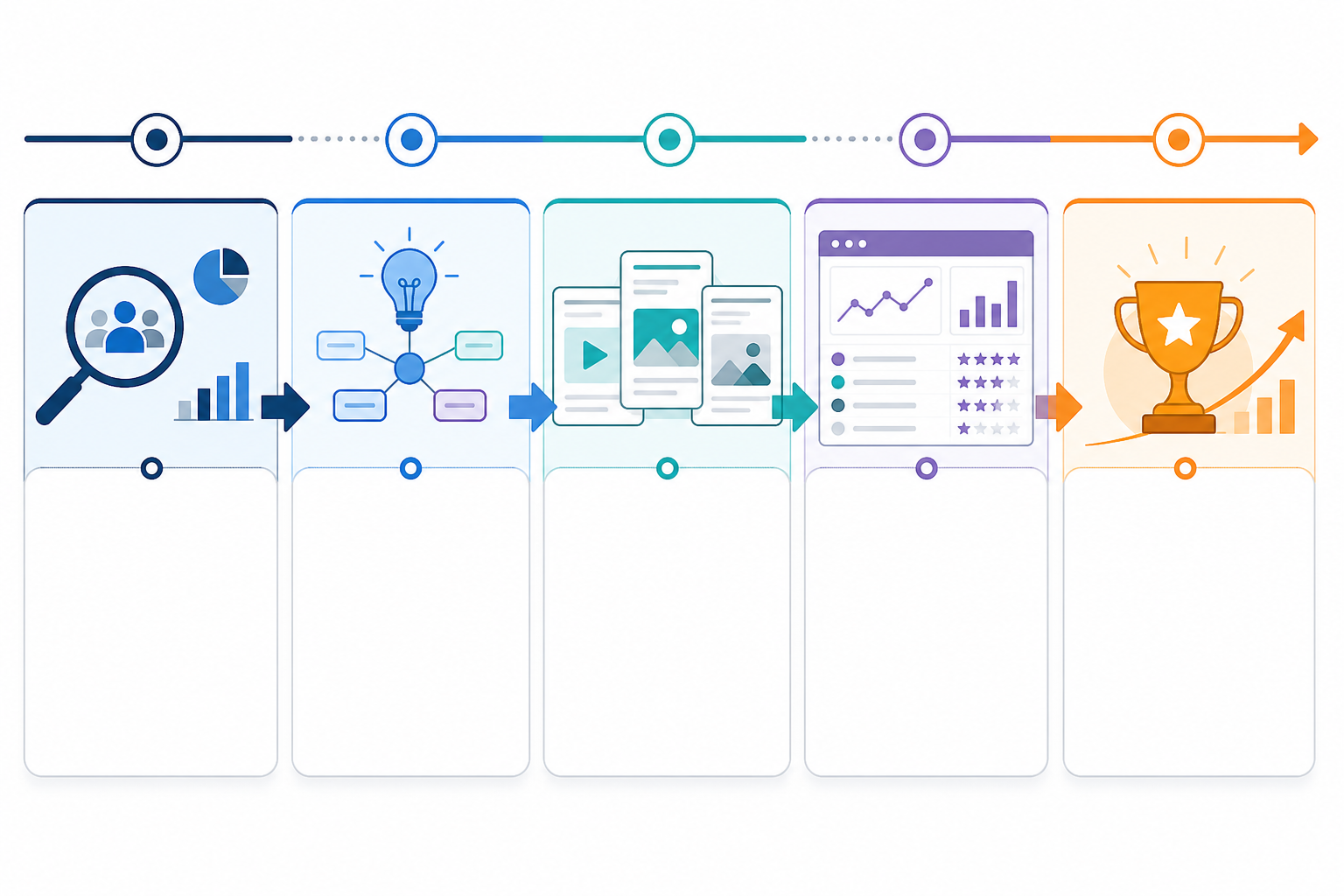
For the actual kill/iterate/scale decision on the angle itself, wait until you've hit a reasonable spend and conversion threshold for your typical CPA variance. That's often somewhere between 5-7 days, and enough conversions to trust the number, though it varies by account size and historical volatility. Use the 48-hour sprint to get something live fast; use a proper measurement window to decide if it's actually working.
One step a lot of teams skip is understanding why a competitor's angle might be working in the first place, which slows the whole sprint down when it's left until brief time. An AI-generated strategic read can help here. Rival Ads produces this using Claude, interpreting competitor creative changes the way a senior media buyer might, flagging what changed and a plausible reason it matters. It's a starting hypothesis to sense-check against your own customer data, not a verified fact.
The teams who consistently find winning ad angles aren't doing anything magical. They've made this a habit rather than a scramble. A few practical ways to build that habit:
Build these habits in, and angle discovery stops feeling like a creative crisis every time a campaign fatigues. It becomes a steady, ongoing input into your marketing strategy, closer to how the strongest performance marketers actually operate.
An ad angle is the core argument or emotional hook an ad uses to persuade someone to act: the "why should I care" behind the offer. The same product can be sold with entirely different angles. One ad might lean on saving money, another on status, another on solving a frustrating problem. Creative, copy, and format are just the execution of that underlying angle, which is why swapping the visual without changing the angle rarely fixes a genuinely underperforming ad.
Start by studying what's already circulating in your market rather than trying to invent something from nothing. Look at competitor ads that have stayed live or reappeared over several weeks, treating this as a hypothesis rather than proof of performance. Mine customer reviews and support conversations for authentic language, and check adjacent industries for angles that haven't crossed over to yours yet. Then adapt, don't copy, the underlying insight to fit your product, your proof points, and your audience.
They monitor competitor activity consistently rather than sporadically, which helps them catch early patterns, like several unrelated competitors independently testing a similar hook. That's a signal worth investigating, not a guarantee. Tools that automate ad monitoring across Meta, Google, TikTok, and LinkedIn can make it practical to review these shifts weekly instead of stumbling on them months later, though they show ad presence and recurrence rather than confirmed spend or profitability.
No. Platforms like Rival Ads don't require ad account access to monitor competitors. You provide a competitor's website, and the platform detects their presence across Meta, Google Ads, TikTok, and LinkedIn, then pulls their currently active ads, copy, and creative on a rolling weekly basis where the platform exposes that data. Coverage can vary by region and by how actively a brand advertises, so it's worth treating this as a strong starting point for research rather than a complete record of everything a competitor has ever run.