Measuring ROI From Baby Registry Partnerships: A Retailer Guide
20 min read
Loading...

If you want to know whether a baby registry partnership is paying off, track four things: referral traffic from the registry platform, conversion rate on those visits, average order value, and repeat purchases from the new customers you gain. Then set the contribution those sales generate against what the channel costs you (commission, discounts, fulfilment and your own time) and compare the result with your cost per acquisition (CPA) from paid ads.
Registry visitors are usually gift buyers working from a list the parents chose, so their intent can be high. Whether that means they convert better than cold ads for your shop is something you can only find out once you track properly. I'm Emma from bababloom, and by the end of this guide you'll have a basic tracking setup, a like-for-like CPA calculation, and a simple scorecard you can review each quarter without a data team. ☕
Picture a small baby shop owner in Bristol. She opens her dashboard on a Monday and sees a spike: eleven orders over the weekend, all gifts, a few with handwritten cards. She has no idea where they came from. Was it the Instagram post? The newsletter? Someone's sister sharing a link in a family WhatsApp group? She shrugs and moves on, and the channel that actually did the work stays invisible.
Registry sales behave differently from normal retail sales, and there are three reasons why.
The buyer isn't the parent. The person at your checkout is a guest: an aunt, a colleague, a friend from uni. They've been handed a list and told 'this is what we'd like'. Time on site will be short and browsing shallow, and that's often a good sign rather than a bad one.
Click metrics miss the point. Impressions and cost-per-click were built for channels where you're trying to create intent. With a registry, the parents have largely formed the intent before the guest reaches you.
Attribution can hide sales. A guest clicks through on Tuesday, gets distracted, and returns on Friday by typing your address directly. If the campaign tags aren't carried through, that second visit may be reported as 'direct'. How a purchase is credited in Google Analytics 4 (GA4) also varies by report, attribution model and lookback window, so the same order can look different depending on where you view it. Registry purchases stretch across months as due dates and baby showers approach, so short windows tend to undercount the channel.
I think of a registry as a referral and discovery channel as much as a sales channel. Guests may meet your shop for the first time through someone they trust, and that deserves its own scorecard.
Before you sign up with any registry platform, ask where the guest actually checks out. If they land on your own checkout, the order runs through your payment setup and customer data, which makes tracking simpler. If the sale happens elsewhere and you only get a summary report, you'll rely more on the platform's numbers and need to reconcile them carefully.
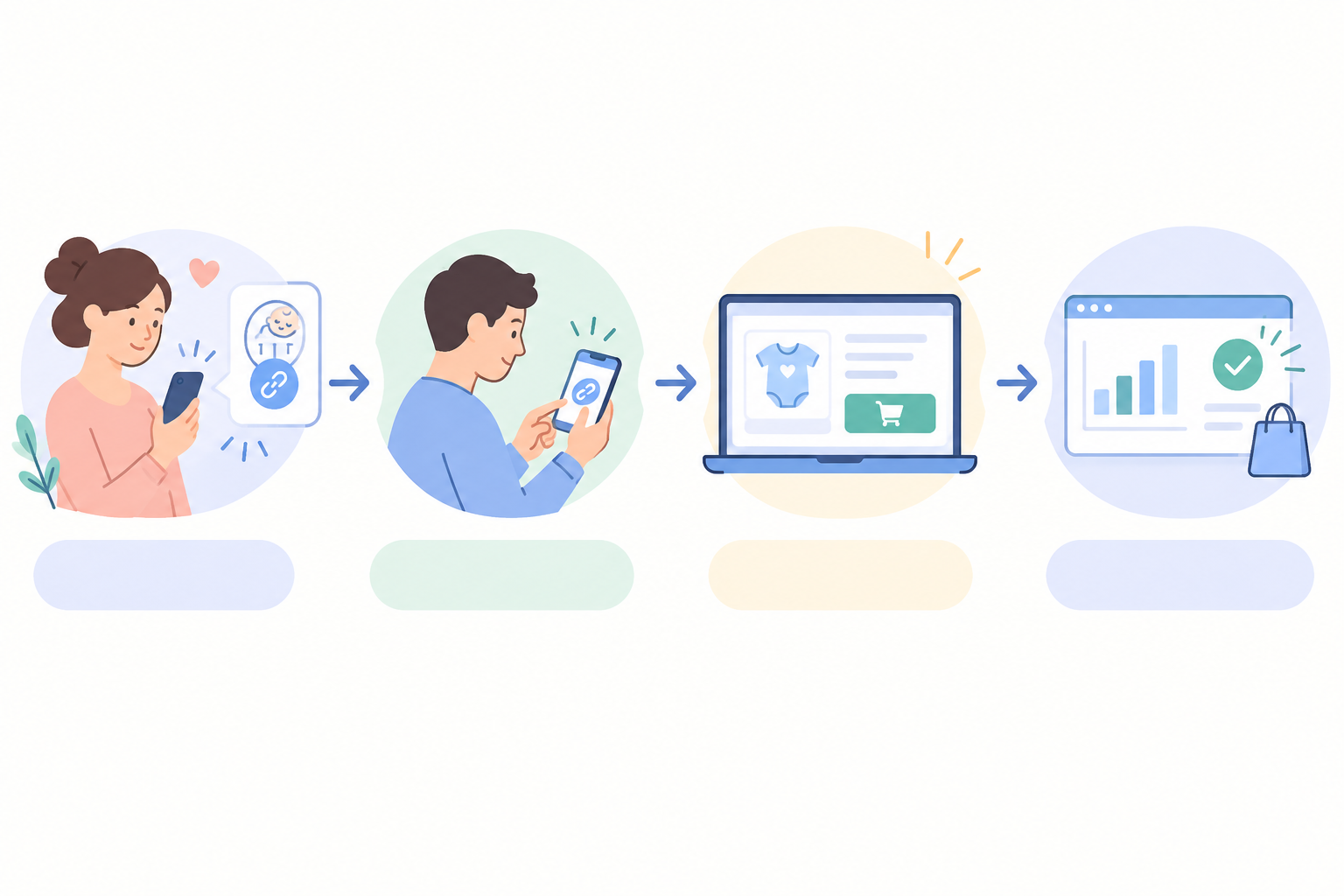
Good tracking is mostly about setting things up once, early, and checking in regularly. Here's the order I'd do it in.
?utm_source=bababloom&utm_medium=registry&utm_campaign=baby-registry. Consistency matters more than cleverness.One rule from analytics guidance: put campaign tags on links that bring people to your shop, never on links inside your own site. Internal tags can overwrite the original source.
A few definitions will save you arguments with your own spreadsheet later.
In the UK, analytics cookies generally need consent under PECR, so some registry visits will go unrecorded. That's another reason order tags and a registry code are worth having as a backstop.
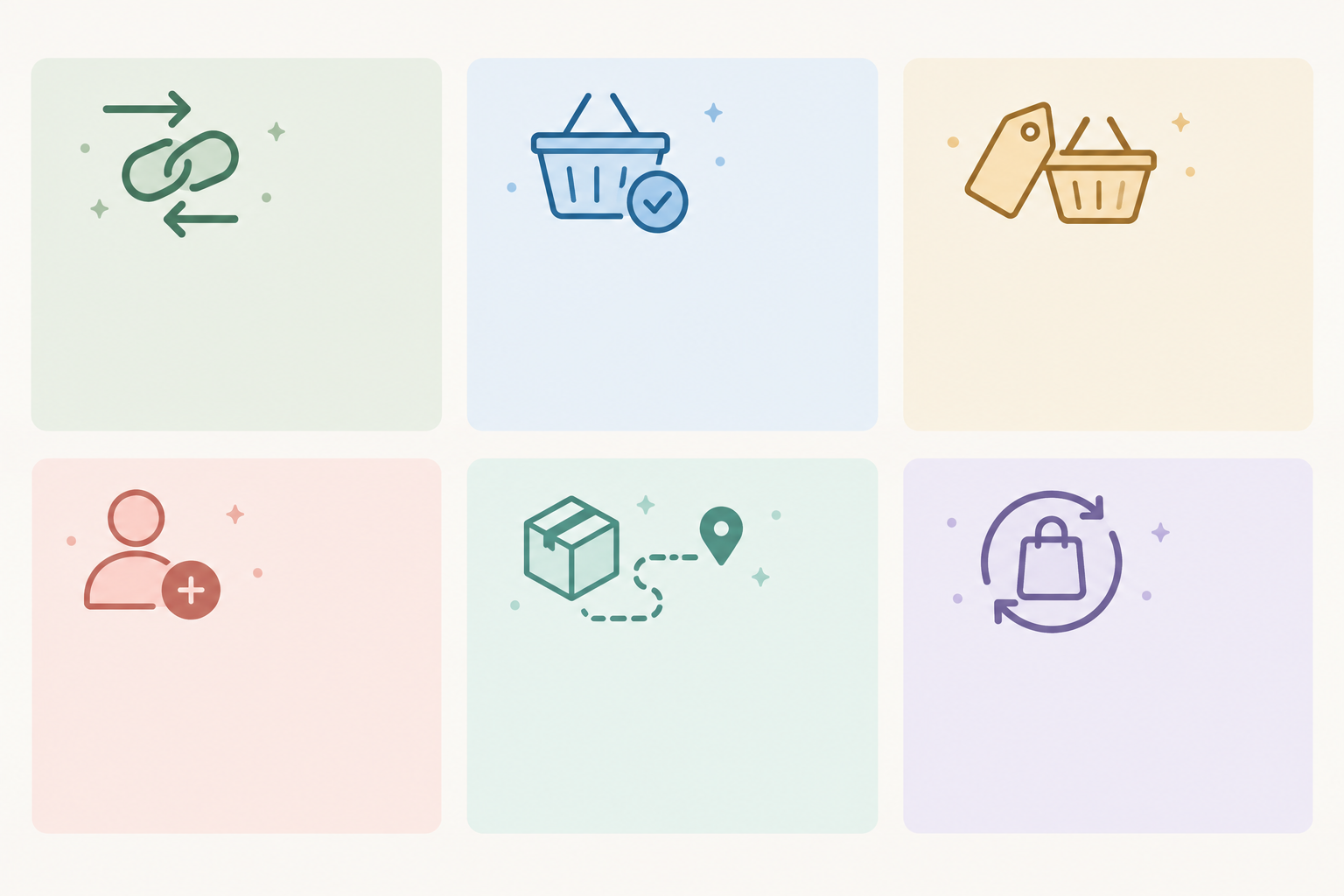
The core scorecard has six metrics:
Two more are diagnostic, so check them when something looks off: registry item share (listed products purchased versus just viewed) and return and exchange rate, since gifts often get swapped.
If you only have time for three, pick conversion rate, new customer rate and repeat purchase rate. Conversion tells you whether the traffic is good. New customer rate tells you whether the registry is widening your audience rather than re-selling to people who already know you. Repeat rate tells you whether those new customers stay.
You'll be tempted to Google 'average registry conversion rate'. I'd resist. Published figures come from different markets, categories and business sizes, and they won't tell you much about a handmade baby blanket business in Norfolk. Use your first 90 days to set your own baseline. That's a period in which registries build as parents share links closer to due dates. Group registry shoppers into cohorts by the month they first ordered so delayed and repeat purchases can be compared fairly.
Here's the formula everything else feeds into:
Registry ROI = (contribution from registry-attributed sales − total partnership costs) ÷ total partnership costs
Three related numbers get mixed up, so let's separate them:
One honest caveat: the formula uses attributed sales, and some would have happened anyway. For a more cautious figure, multiply contribution by your best estimate of the genuinely incremental share (say 70%) and compare both ROI figures. A wide gap is a signal to be careful before scaling.
The first gift is only the opening move. Parents go on to buy newborn essentials, clothing, toys and milestone gifts over the following years, and guests who liked what they received may shop with you again. If you judge the channel on the first order alone, you'll probably undersell it.
I'm deliberately using 12-month net contribution per acquired customer rather than a full 'lifetime value', because most small shops don't yet have enough history to estimate a lifespan honestly. Here's how to build it:
These figures are invented to show the maths, so please swap in your own. I'm assuming a 30% contribution margin, meaning what's left after cost of goods, payment fees and other per-sale variable costs. Acquisition costs are not included in that margin, so they're deducted separately, once.
Registry-acquired customer
| Step | Calculation | Result |
|---|---|---|
| First order contribution | £45 × 30% | £13.50 |
| Repeat contribution | 0.5 orders × £40 × 30% | £6.00 |
| 12-month contribution before channel costs | £13.50 + £6.00 | £19.50 |
| Channel costs | 10% commission (£4.50) + wrapping and handling (£4.00) | £8.50 |
| 12-month net contribution after partnership costs | £19.50 − £8.50 | £11.00 |
| 12-month ROI | £11.00 ÷ £8.50 | ≈ 129% |
Paid-ad customer, for comparison
| Step | Calculation | Result |
|---|---|---|
| 12-month contribution before channel costs | Same behaviour assumed: £13.50 + £6.00 | £19.50 |
| Channel costs | Ad spend per new customer | £18.00 |
| 12-month net contribution after partnership costs | £19.50 − £18.00 | £1.50 |
| 12-month ROI | £1.50 ÷ £18.00 | ≈ 8% |
On the first order alone, the registry customer nets £5.00 (£13.50 − £8.50), while the ad customer is £4.50 down (£13.50 − £18.00). Two notes on fairness. I've assumed both customers behave identically after the first order, which won't be exactly true, and I've assumed repeat orders carry no further partnership cost. This is a contribution comparison on tracked sales, not a full picture of your business's profit. Your numbers will differ, which is exactly why you measure.
You can only build repeat business if people can hear from you, and in the UK that means following UK GDPR and PECR. Broadly, you need a lawful basis for contacting people and, for marketing emails, either consent or a properly applied 'soft opt-in' for existing customers, with a clear opt-out every time. Whether the soft opt-in applies depends on how you collected the details and what you're promoting, so check the ICO's current guidance or take advice before building your process.
The friendliest approach I know is a thank-you card or packing insert with a clear opt-in and a small first-order incentive. No tricks, no pre-ticked boxes. And don't assume details you receive about a parent can be used for marketing without a proper basis.
One more thing that's hard to measure but real: handmade baby products often earn word-of-mouth. A guest gives a hand-stitched blanket, and three other parents ask where it came from. Jot those mentions down. They're part of the value, even if they never reach a spreadsheet.
Neither channel is 'better' in every situation, but they behave very differently. The table describes typical patterns, not guarantees. Always check the terms of the specific platform you're considering.
| Baby registry partnership | Paid ads | |
|---|---|---|
| Cost structure | Often commission or a listing fee; some costs arise only when a sale happens | Ad spend, paid whether or not anyone buys |
| Intent | Potentially high: the item was chosen by the parents | Varies, often lower for cold audiences |
| Conversion rate | Measure your own | Depends on targeting, creative and offer |
| Trust | Borrowed from the parents who shared the list | Built from scratch each time |
| Scalability | Limited by how many parents list your products | Scales quickly with budget |
| Measurement | Needs deliberate tagging and reconciliation | Built-in platform reporting (with its own biases) |
Both formulas count unique new customers, not orders, over the same period.
Paid ads: (ad spend + agency fees + creative costs + any introductory discount) ÷ new customers acquired through ads.
Registry: (commission or listing fees + discounts or codes + fulfilment extras + a rough value for your time) ÷ new customers acquired through the registry.
To keep the fight fair, net refunded orders out of both channels and treat standard fulfilment the same way in each. Any conversion-rate figure quoted for search ads is broad paid-search context, not a baby-retail benchmark, so use your own data.
If registry costs arise mainly when there's a sale, that can suit a small shop with a tight budget, though it depends entirely on your agreement. Ads scale faster and give you more control, while registry volume depends on how many parents add your products. You can't simply 'turn up' the registry.
The two can also feed each other. Ads may nudge parents to add your items to a list, and the list may bring gift buyers. Treat it as a loop to test rather than a contest. And while bidding against national retailers can get pricey for an independent shop, I'd check how visible your registry listings really are before assuming they level the field.
I'll be upfront: the three scenarios below are hypothetical composites with invented figures. They show how the scorecard leads to decisions. They are not real results from bababloom or any retail partner, and they're no evidence that a registry partnership will perform well for you. I don't have UK partner outcome data I can responsibly publish, so I'd rather label made-up numbers honestly than dress them up as case studies.
A shop selling organic cotton baby clothes lists twenty products. After 90 days, registry conversion looks healthy at 3.8%, but the return rate is 18% against 9% on her other orders. Guests are buying the wrong sizes.
A maker of wooden toys and knitted blankets finds that 82% of registry buyers are new to her. AOV is £38, but repeat rate at six months is 4% and she has no email opt-ins.
A furniture shop sees fewer registry orders but a much higher AOV (£210), with fulfilment eating 14% of order value.
Notice what they share: none 'grew' by magic. Each found one number that looked off, changed one thing, and checked again.
A spreadsheet is plenty. Here's how I'd set it up.
| Field | What to enter |
|---|---|
| Registry sessions | From your tagged source/medium |
| Link-attributed orders | Orders matched to tagged sessions |
| Separately identified orders | Code or order-note orders with no matching session, de-duplicated |
| Conversion rate | Link-attributed orders ÷ sessions |
| AOV (ex-VAT) | Revenue ÷ orders |
| Contribution | Revenue minus cost of goods and variable costs |
| Total partnership costs | Commission, discounts, fulfilment extras, time |
| New customer rate | New customers ÷ registry customers |
| Repeat rate (6 and 12 months) | Cohort by first-order month |
| Estimated incremental share | Your honest estimate, e.g. 70% |
| ROI | (Contribution − costs) ÷ costs |
A few habits to go with it:
Before you commit to any platform, check its current terms: what it costs parents, what it costs you, how guests reach your checkout and what reporting you get. Those details drive your cost lines more than anything else on this page.
You don't need a data team. A few consistent tags, a code or order note, and a monthly check-in will take you most of the way. 🌱
Keep three questions in front of you:
If you can answer those honestly, you'll know whether a registry partnership deserves more of your attention. If you're an independent UK baby store or baby artisan and want to explore it, get in touch with us at bababloom. Tell us a little about your products and how you currently fulfil orders, and we'll talk through what listing with us would involve, including the tracking and reporting you'd get.
Use UTM-tagged links for every registry product, build a registry-filtered view in GA4, and tag orders in your store platform. Report code- or note-identified orders separately from link-attributed ones, and compare both with the platform's monthly report.
Use (contribution − total partnership costs) ÷ total partnership costs over a fixed period. Deduct acquisition costs once, and consider an incremental-share estimate for a more cautious figure.
It can be, particularly if you pay mainly when a sale happens, but it depends on commission, discounts and fulfilment. Calculate CPA for both channels over the same period and compare them directly.
Start with conversion rate, new customer rate and repeat purchase rate, then add AOV and fulfilment cost as you get comfortable.
At least 90 days, then compare against the same period last year where you can.
Yes, within UK GDPR and PECR. The ICO's current guidance covers consent and the soft opt-in, and it's worth reading before you set up your opt-in card or insert.