Publishing Frequency vs. Quality: How Often Should You Actually Blog?
14 min read
Loading...

"How often should we actually be publishing?" is one of the questions I hear most often from content teams and solo creators. My honest answer: publishing frequency matters far less than most marketing advice suggests, at least once you've cleared a basic consistency threshold. After that point, quality becomes the bigger lever for organic growth, and pushing your blogging frequency beyond what your team can genuinely sustain tends to do more harm than good.
Publishing frequency means how often you release new content - weekly, twice a week or daily. There's no universal right answer, but there is a wrong direction: publishing more blog posts than you can properly research, write and edit.
In this guide, I'll unpack where the "publish more" advice came from, when a higher publishing frequency genuinely helps, and how to build a blogging schedule that fits your team's real capacity rather than a benchmark borrowed from a company with ten times your resources.
A lot of the "publish daily" advice traces back to a widely cited HubSpot study from around 2015, which found that companies publishing 16 or more blog posts a month saw roughly 3.5 times more traffic and 4.5 times more leads than companies publishing zero to four. That statistic has appeared in thousands of marketing decks since, and the correlation is real. But correlation is exactly what it is - the study didn't establish that publishing more caused the traffic growth.
In practice, the companies publishing 16 or more times a month were usually larger organisations with bigger teams, more backlinks, stronger domain authority and mature distribution channels, including email lists and social followings. High volume was a symptom of resourcing, not the reason for the traffic gains.
Google has been fairly direct about this too. Its Search Central guidance on helpful content states there's no preferred publishing frequency or word count, and that content should be created for people first rather than primarily to attract search traffic. In other words, Google isn't counting how often you hit publish - it's assessing whether each piece is genuinely useful to the person reading it.
The scale of the visibility problem is worth sitting with. Ahrefs' 2023 study of just over a billion pages found around 90% received no organic Google traffic at all, and only about 5.7% reached the top 10 results within a year of publishing. That research covers pages in general rather than high-frequency blogs specifically, but the point still holds: publishing more content doesn't fix a visibility problem if the content itself isn't earning its place in search results.
There's also a real production cost that gets lost in the "just publish more" advice. Orbit Media's long-running annual survey of over 1,000 bloggers found the average post now takes close to four hours to produce and runs around 1,376 words. That's a rough proxy for how much effort competitive content typically requires, not a target to hit for its own sake.
When teams try to out-publish that reality on a tight budget, quality tends to erode. Readers notice a thin post fairly quickly: pages that don't answer the question well often see shorter time on page and higher bounce rates. Google's helpful content systems are also designed to identify sites that produce large volumes of shallow, formulaic content, and can reduce that content's visibility in search results. How far this affects other pages on the same site is genuinely debated, so I'd avoid overstating it, but the risk is real enough that it's not worth testing on your own site.
So the myth isn't that publishing frequency never matters. It's that frequency without a quality floor is a losing trade.
There are specific situations where I'd tell you, without hesitation, to slow down and go deeper rather than speed up. Here's when quality should clearly outrank output.
For any search term where established, authoritative sites already occupy page one, a quick 600-word post is unlikely to move the needle. Backlinko's 2023 analysis of roughly 11.8 million Google search results found the average first-page result runs about 1,447 words, and long-form pieces earned roughly 77% more referring-domain backlinks than shorter ones.
Word count itself isn't the ranking factor. Length tends to reflect how thoroughly a topic has been covered. Google describes this in terms of E-E-A-T: experience, expertise, authoritativeness and trust. Comprehensive, well-researched content tends to signal more of all four, which is why it wins these fights more often than volume does.
YMYL stands for "Your Money or Your Life": Google's term for subjects where inaccurate information could cause real harm, including health, finance, legal advice and safety. Sites like NerdWallet and Mayo Clinic build entire editorial processes around expert review, sourcing and disclosure precisely because getting it wrong here damages trust and can actively harm readers.
Rushing YMYL content for the sake of a publishing schedule is one of the riskiest moves you can make. In these areas, accuracy, source quality and expert review should take priority over publishing frequency.
A topic cluster is simply a structure where one in-depth "pillar" page anchors a subject, supported by lighter posts that link back to it. HubSpot popularised this model because it separates two different goals: one deep, authoritative resource meant to rank for years, and quicker posts that capture timely searches, rather than a stream of disconnected articles competing with each other.
A strong pillar page can support your internal linking strategy, demonstrate topical expertise and give readers a more useful destination. That makes it worth investing more time in than a short, reactive post.
Watch your engagement metrics closely. Rising time on page, more shares, more comments and returning visitors on your longer, more thorough pieces suggest your readers want depth. If your quick posts get skimmed and bounced while your in-depth guides get bookmarked and shared, that's a useful signal, not proof on its own, but one worth acting on.
In B2B especially, this matters more than people assume. Edelman and LinkedIn's 2024 B2B Thought Leadership Impact Report found 73% of decision-makers see thought leadership as a more trustworthy signal of a company's capability than its marketing materials, and 86% said consistently strong thought leadership made them more likely to invite that company to bid on work. That's not a volume game. It's a credibility game.
Once you accept that quality is the bigger lever, the real question shifts from "how often should I publish?" to "what's the most I can publish without quality slipping?" Here's how I'd work that out.
Batching and topic clustering get noticeably easier once your drafting bottleneck disappears, which is where content automation can help. I'll come back to that below.
Here's a problem I see constantly: teams try to judge their own content quality by gut feel, and gut feel is a shaky instrument once you're moving fast. You're too close to your own drafts to notice when structure gets sloppy, when readability drifts or when SEO fundamentals quietly slip because you're rushing to hit a deadline.
Automated quality scoring is one way to close that gap. Rather than relying on a single tired editor late on a Thursday night, a scoring system can check structure, readability and basic SEO signals (heading hierarchy, keyword placement, sentence length and internal linking) against consistent criteria every time, before anything goes live. It's a useful early-warning system, not a replacement for editorial judgement. Fact-checking, originality, source quality and matching genuine search intent still need a human in the loop, particularly for anything approaching YMYL territory.

This is the principle behind how we built Scribe, our AI content generation platform, though I'd flag this as one example of the approach rather than the only way to do it. Scribe scores each draft against structure, readability and SEO criteria before publishing, and feeds performance data from published posts back into how it prioritises formats and structures for future drafts. That describes the mechanism, not a claim that it replaces editorial oversight. We still recommend a human review pass, especially for anything sensitive or highly technical.
One Scribe customer reported a 340% increase in organic traffic over six months after adopting this workflow. That's a single customer result, not a guaranteed outcome - it depended on their starting point, their niche and how consistently they published - but it shows the kind of gain that's possible when quality checks and higher publishing frequency work together instead of trading off against each other.
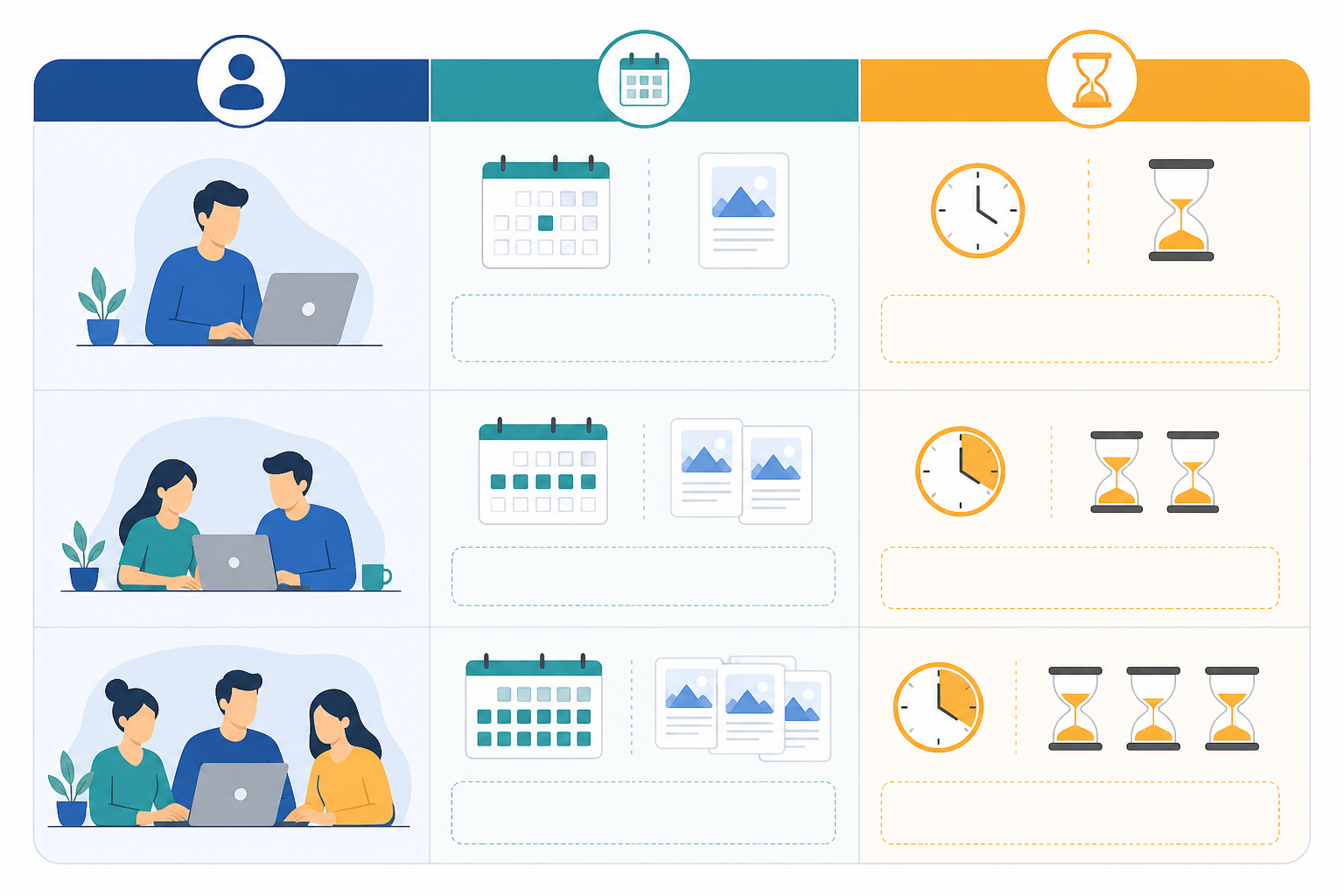
There's no single right cadence, but there are sensible starting points depending on your situation. Treat the estimates below as ranges to test against your own data, not fixed targets. The time figures cover the full production cycle - research, drafting, editing, fact-checking, images and publishing - not just the writing.
| Team type | Realistic weekly cadence | Full production time per post | Notes |
|---|---|---|---|
| Solo blogger / side project | 1-2 posts | 3-5 hours, largely manual | Focus on fewer, deeper posts; AI drafting tools can reclaim editing time but still need a human review pass |
| Small business, one content owner | 2-3 posts | 1.5-3 hours with automation support | Automation speeds up drafting; editing, fact-checking and images still take real time |
| Scaling content team or agency | 4-7 posts | 30-90 minutes of hands-on time per post, plus ongoing strategy work | Automation and quality scoring handle first drafts and initial checks; a human still reviews, fact-checks and adjusts before publishing |
Platforms like Scribe can produce a structured first draft, often 2,000-plus words with suggested images, in a matter of minutes rather than hours. That shifts where your time goes, from staring at a blank page to reviewing and refining a draft, but it doesn't remove editing and fact-checking from the process. Most of the time saving comes from the drafting stage, not from skipping quality control.
Scribe currently supports one-click publishing to platforms including Shopify, WordPress, Wix and Webflow, or via a custom API, which removes another manual step from the pipeline, though the review step before publishing still matters.
If there's one formula worth taking away, it's this: publish as often as you can while still meeting your own quality bar, and check that bar with real metrics rather than gut feel. Before you hit publish, ask whether the post covers its topic as thoroughly as the current page-one results, whether it's been reviewed by another person or a quality-scoring tool, and whether you'd be comfortable with it representing your brand in six months' time.
If the honest answer is no, that's a sign to slow down, not speed up. Most teams, whether that's a solo blogger in Manchester or a scaling content team with a distribution list and an editor, get further with a cadence they can sustain for a year than with a burst of daily posts that quietly tails off after six weeks.
It depends on whether you can sustain genuine quality at a daily pace, which is rare without a dedicated team or strong automation support. For most solo creators and small UK businesses, publishing two well-researched, well-structured posts a week tends to build organic traffic more reliably over six months than seven thin daily posts.
This depends heavily on your niche, competition and existing domain authority, so treat it as a starting assumption to test rather than a fixed rule. If you're already ranking well on a high-frequency schedule and your engagement metrics are healthy, there's no reason to slow down just because it feels counterintuitive.
Watch a small set of leading indicators: average time on page trending down, bounce rate trending up, and posts that stop ranking or drop out of the top 20 within a few weeks of publishing. None of these alone proves a quality problem, since traffic dips can have other causes, but a pattern across several posts is a reliable signal.
If you're writing manually, it also helps to have a second person, or a quality-scoring tool, review structure, readability and SEO fundamentals before you hit publish. It's genuinely hard to judge your own work objectively once you're moving fast.
Most solo creators I've spoken with can sustain one to two genuinely high-quality posts a week without burning out when they're writing and editing everything by hand. If you're using an AI writing assistant to handle first drafts, you can often push that to three or four posts a week while spending your own time on editing, fact-checking and distribution instead of writing from scratch.
The right number still depends on your topic, existing traffic and how much editing each draft realistically needs. Start with the highest publishing frequency you can maintain consistently, then increase it only when your content quality and performance remain stable.