Quality Scoring Systems Every Content Team Should Use (And How to Build One)
15 min read
Loading...

A content quality scoring system swaps subjective gut checks for a consistent framework that measures readability, SEO structure, brand voice alignment, and factual accuracy against a numeric threshold. Once you set that threshold, you can approve or reject content more objectively, and you can feed the scoring data back into your process to make future output better.
In this guide, I'll walk through a worked example of a scoring rubric with actual weights, show you how to set publishing thresholds without guessing, and give you a rollout checklist you can hand to your team this week.
If you're leading a content team trying to scale beyond a handful of posts a month, this matters more than it sounds. I've seen marketing teams hit a wall not because they lack writers or ideas, but because their quality control process was never built to handle volume. Let's look at why that happens and how a scoring system fixes it.
Here's a scenario that probably sounds familiar. Someone on your team writes a blog post, it lands in a shared doc, and a senior marketer reads through it and says, "Yeah, this feels right," or, "Something's off here, can we tighten it up?" That's gut-feel review, and it works fine at small scale. The trouble is, fine at small scale doesn't last.
The core problem is that "does this sound right to me" isn't really a check. It's a preference, and preferences shift depending on who's reading, what mood they're in, and how many other posts they've already reviewed that week. One editor flags a post for being too casual. Another waves the exact same tone through without a second thought. Neither is wrong exactly, but neither is consistent, and inconsistency is what breaks down as volume climbs.
Here's what that looks like in practice. At four posts a month, one editor can read every draft carefully, leave detailed comments, and still have time left over. At thirty posts a month with the same one-person process, that editor is skim-reading under deadline pressure, the queue backs up behind them, and standards drift depending on how tired they are on a given Friday. When quality control lives entirely in one or two people's heads, those people become the bottleneck for everything you publish, and a single week of annual leave can stall the whole content calendar.
There's a knock-on effect for writers too, whether they're in-house, freelance, or using an AI writing assistant to draft. If feedback is inconsistent, writers can't learn what "good" actually looks like. One week they're told to shorten sentences; the next week a different reviewer wants more detail. Without clear, repeatable criteria, everyone is guessing, and that guessing compounds as volume increases.
A content quality scoring system is a documented framework that checks an article against defined criteria, assigns points to each one, and combines those points into an overall score. The criteria might include search intent, factual accuracy, brand voice, SEO fundamentals, readability, and metadata quality.
The point isn't to reduce good content to a single number. It's to make editorial decisions more consistent, spot specific areas for improvement, and create a shared standard you can apply across writers, editors, freelancers, and AI-generated drafts alike.
A proper quality score isn't a single number pulled out of thin air. It's built from several measurable components, each targeting a different piece of what makes content work. Each component also needs its own scoring method, not just a label.
Here's a worked example based on a 100-point model, with the weighting I'd use as a sensible UK B2B starting point:

Here's how that plays out on an actual article. Say you're scoring a guide titled "Business Insurance for UK Startups." It covers the main policy types thoroughly and matches search intent well (22/25), but one statistic is uncited and another comes from an outdated report (18/25 on accuracy), the tone is a bit more formal than the brand guide calls for (16/20), the headers and keyword placement are solid (13/15), sentences run long in two paragraphs (8/10), and the metadata is clean (5/5). That totals 82, which lands the piece in a "light edit" band rather than "publish as-is."
Worth being honest about the limits here too. Weighted criteria like brand voice, search intent, and structural completeness still involve human judgement, whether that judgement comes from a person or a model trained to approximate one. A scoring system doesn't remove judgement from the process. It makes that judgement consistent, documented, and repeatable, which matters even if it isn't the same thing as pure objectivity.
A B2B SaaS company might weight factual accuracy and structural completeness more heavily than the model above, while an ecommerce brand might lean further into SEO fundamentals and readability, since conversion often depends on quick, scannable content. The weighting is where you encode your own priorities, not a fixed formula everyone should copy.
Factual accuracy deserves more than a single line item, because getting it wrong carries real consequences, particularly for UK-regulated sectors. A workable check has a few distinct parts: claim verification (can this statement be traced to a primary source?), source quality (is that source credible and current?), citation coverage (are all quantitative claims actually cited?), and a compliance layer for anything touching health, financial advice, or legal guidance.
For content that falls into YMYL territory, or anything that needs to satisfy the ASA's CAP Code, FCA financial promotion rules, or MHRA guidance on health claims, an automated score should never be the final word. Build in a mandatory human compliance sign-off regardless of the numeric score, and treat any article touching personal data handling with UK GDPR requirements in mind, particularly around consent language and data claims. The scoring system's job here is to flag risk early, not to approve regulated content on its own.
Once you've got a scoring model, you need to decide what to actually do with the number. Treat the bands below as a starting point rather than a fixed rule, since the right thresholds depend on your content type, risk tolerance, and how much you trust the model early on.
| Score range | Recommended action |
|---|---|
| 85–100 | Publish as-is |
| 70–84 | Light edit needed |
| Below 70 | Send back for substantial rework |
A few practical additions make this work better in the real world:
The goal here isn't rigid perfectionism. It's removing the ambiguity that used to require someone's personal judgement call every time, while keeping a clear escalation path for anything genuinely high-risk.
This is where quality scoring stops being a one-off filter and becomes something genuinely useful over time. When you track scores consistently across every article, patterns start to emerge. Maybe posts with shorter introductions consistently score higher on readability. Maybe certain header structures correlate with stronger SEO scores.
The real value shows up when you connect quality scores to performance data such as organic traffic, time on page, and conversion rate. Worth being precise about what that relationship actually is: a high quality score is diagnostic, not predictive. It tells you the piece met your internal standard. It doesn't guarantee it will rank or convert, because performance is also shaped by backlinks, distribution, competition, seasonality, and how long the piece has been live. Comparing scores to performance only tells you something useful once you control for those confounders. Otherwise, you risk crediting the scoring model for results that actually came from a good backlink or a lucky publish date.
With that caveat in mind, the feedback loop is still worth building. If a structure or tone scores well but consistently underperforms once live, across enough articles to rule out noise, that's a signal your scoring criteria need adjusting, not just a signal that one article missed the mark.
In the platform I work with, we use a version of this scoring model to flag articles before publishing and to review patterns across published content afterwards. I'd stop short of calling this "automatic" self-improvement. In practice, it's a structured feedback loop where the scoring data highlights what to test next, and a person still decides whether to change the underlying criteria. A static content tool generates output the same way regardless of what's landing with readers. A system with this kind of human-reviewed feedback loop gradually favours the patterns that score and perform well, and phases out the ones that don't.
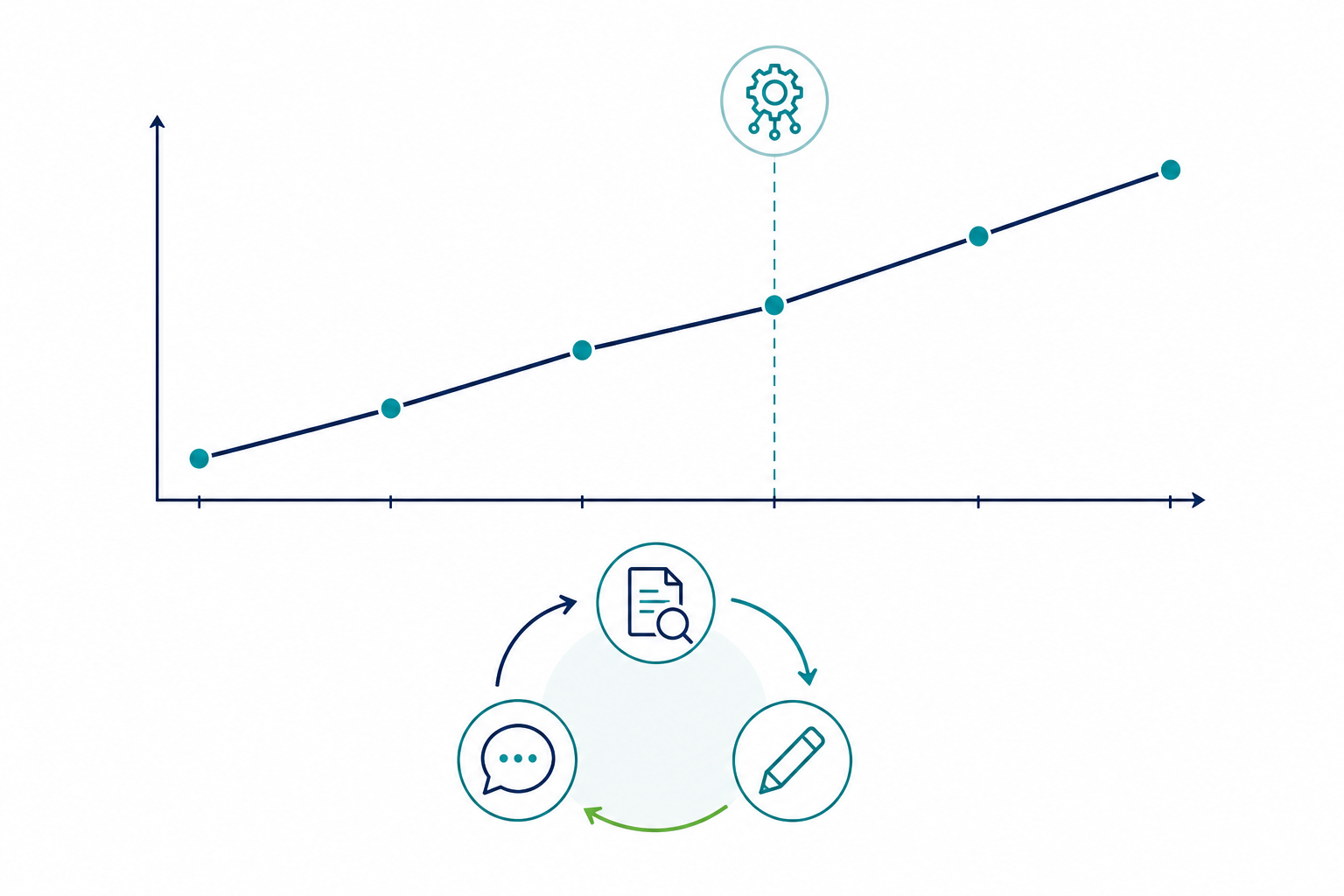
What matters here is that this compounds. It's not a one-time audit where you fix a few things and move on. Every article published adds another data point, and over months, the system, or your team if you're doing this manually, gets progressively better at knowing what works for your specific audience. That's a different proposition than reviewing content the same way you did a year ago.
Building the scoring model is only half the job. Getting your team to actually use it consistently is the other half.
Getting this right means your review process scales alongside your content output, rather than becoming the thing that caps how much you can publish.
You break quality down into measurable components rather than treating it as one vague judgement: SEO structure, readability, brand voice consistency, structural completeness, and factual accuracy, scored separately and combined into a weighted total. This gives you something consistent to compare across articles and writers, rather than relying on whoever happens to be reviewing that day. It doesn't remove judgement entirely, but it makes that judgement documented and repeatable.
At minimum, it should cover SEO fundamentals such as keyword usage and header structure, readability factors such as sentence variety and reading level, brand voice alignment, structural completeness against search intent, and factual accuracy with a defined citation standard. A 100-point model split roughly as 25 for search intent and completeness, 25 for factual accuracy, 20 for brand voice, 15 for SEO, 10 for readability, and 5 for metadata is a reasonable starting point. The exact weighting depends on your priorities and content type.
Once you're scoring consistently, you can spot patterns in what high-performing content has in common, whether that's header structures, keyword approaches, or tone choices, provided you control for other factors such as backlinks and seasonality when comparing performance. Feeding that data back into your editorial guidelines or content platform means each new piece has a better chance of hitting the mark, rather than repeating the same mistakes indefinitely.
No. They replace inconsistent, ad hoc judgement calls with a documented framework, but weighted criteria such as brand voice and search intent still need human calibration to set up and periodically review. Human spot-checks remain important even for content that clears the threshold, and anything regulated or YMYL should always get a human compliance sign-off regardless of score.
Watch for writers optimising for the score rather than the reader, such as stuffing keywords to boost the SEO component while readability quietly drops. Your quarterly model review should specifically check for this by comparing scored components against actual reader engagement, and by having a second reviewer occasionally re-score articles that scored unusually high on one component alone.
Apply a minimum gate on the factual accuracy and compliance components regardless of the overall score, and route anything touching health, financial, or legal claims through a mandatory human sign-off aligned with relevant UK rules, such as the ASA's CAP Code, FCA financial promotion requirements, or UK GDPR considerations around data and consent claims. An automated score can flag risk, but it shouldn't be the final approval for this category of content.
Yes, and arguably it matters more there, since AI writing tools can produce content at scale without any reliable way to know if that scale is coming at the cost of quality. Platforms with built-in quality scoring use this data not just to gate publishing but to refine how future articles get structured, provided there's still a human reviewing the criteria and the edge cases the model gets wrong.