Scaling Content Production Without Losing Brand Voice: A Framework for Marketing Teams

Scaling Content Production Without Losing Your Brand Voice
Yes, you can scale content production without sacrificing brand voice. But it requires setting clear guardrails before you scale, not after. The marketing teams that pull this off treat brand voice as a system with defined rules, not a feeling that lives only in one writer's head. They use automation for the repeatable parts of content creation while keeping humans focused on judgment calls and final review.
That's the short version. The longer version is more useful, because it's where most teams actually go wrong. I've watched growing UK businesses double or triple their blog output, only to find their content sounds like it was written by five different companies: a punchy, jokey post on Monday, then a stiff, jargon-heavy one on Wednesday. It's not a talent problem. It's a workflow problem, and a fixable one.
Picture a 12-person UK e-commerce brand that's just gone from one in-house writer to a mix of two freelancers and an AI writing assistant, trying to triple output for a Q4 push. Within a month, product pages read differently depending on who wrote them, and the founder starts rewriting drafts the night before publish. The freelancers aren't the problem, and neither is the AI. This is what happens when you scale content marketing before you've written down what "on brand" actually means.
The volume vs. voice tradeoff in content marketing scale
Here's the tension every marketing leader eventually hits: you need more content to compete, but every new writer, tool, or channel adds another decision point where tone, terminology, or claims can drift. Add a freelancer, and suddenly your "friendly but authoritative" voice sounds either too casual or too stiff. Add an AI writing assistant without guardrails, and you get technically correct content that could belong to any brand in your category.
This isn't just an aesthetic problem. Inconsistent brand voice erodes reader trust and creates internal rework when someone has to rewrite half of what gets published before it goes live. It can also blur topical clarity for readers and search engines alike. If your site's tone and terminology shift constantly, it's harder for both humans and crawlers to tell what your site is consistently an authority on. That's a trust and clarity issue, not evidence of a direct Google penalty; Google doesn't penalise brands for having a distinctive voice. According to CMI's B2B Content Marketing Benchmarks report, only 29% of B2B content marketers rate their content marketing as very or extremely successful, despite most organisations planning to increase investment. Producing more content isn't the same as producing more effective content.
AI adoption has made this more urgent, not less. The same CMI research found that 81% of B2B content marketers used generative AI tools for content work in 2024, up from 72% the year before. AI content generation is already mainstream. The question isn't whether your team will use it, but whether you'll set it up to protect your voice or accidentally dilute it.
Here's the reassuring part: this tradeoff is largely a process problem, not a law of physics. Teams that scale content marketing successfully separate two things that often get conflated: voice, which stays relatively stable, and tone, which flexes by channel, audience, and content type. Mailchimp's public style guide is a good example of this distinction in practice; it documents personality and values as fixed points while explicitly allowing tone to shift depending on context. That's the model. Volume goes up when structure goes up alongside it, not when structure gets skipped to save time.
Setting brand voice guardrails before you scale content
If your brand voice currently exists only as an unwritten sense of "what sounds like us," that's the first thing to fix. You can't scale a feeling. You can scale a documented system. Here's how to build one, with a few concrete examples so it's actually usable rather than aspirational.
Document your brand voice in specific, teachable terms. Don't settle for adjectives like "friendly" or "professional." Those mean something different to everyone on your team. Instead, write rules like: use contractions (we're, you'll) in blog content but drop them in compliance or legal copy; keep average sentence length under 25 words; explain any acronym or piece of jargon the first time it appears; address the reader as "you," never "users" or "clients." Specificity is what makes a voice guide usable by someone who didn't help write it.
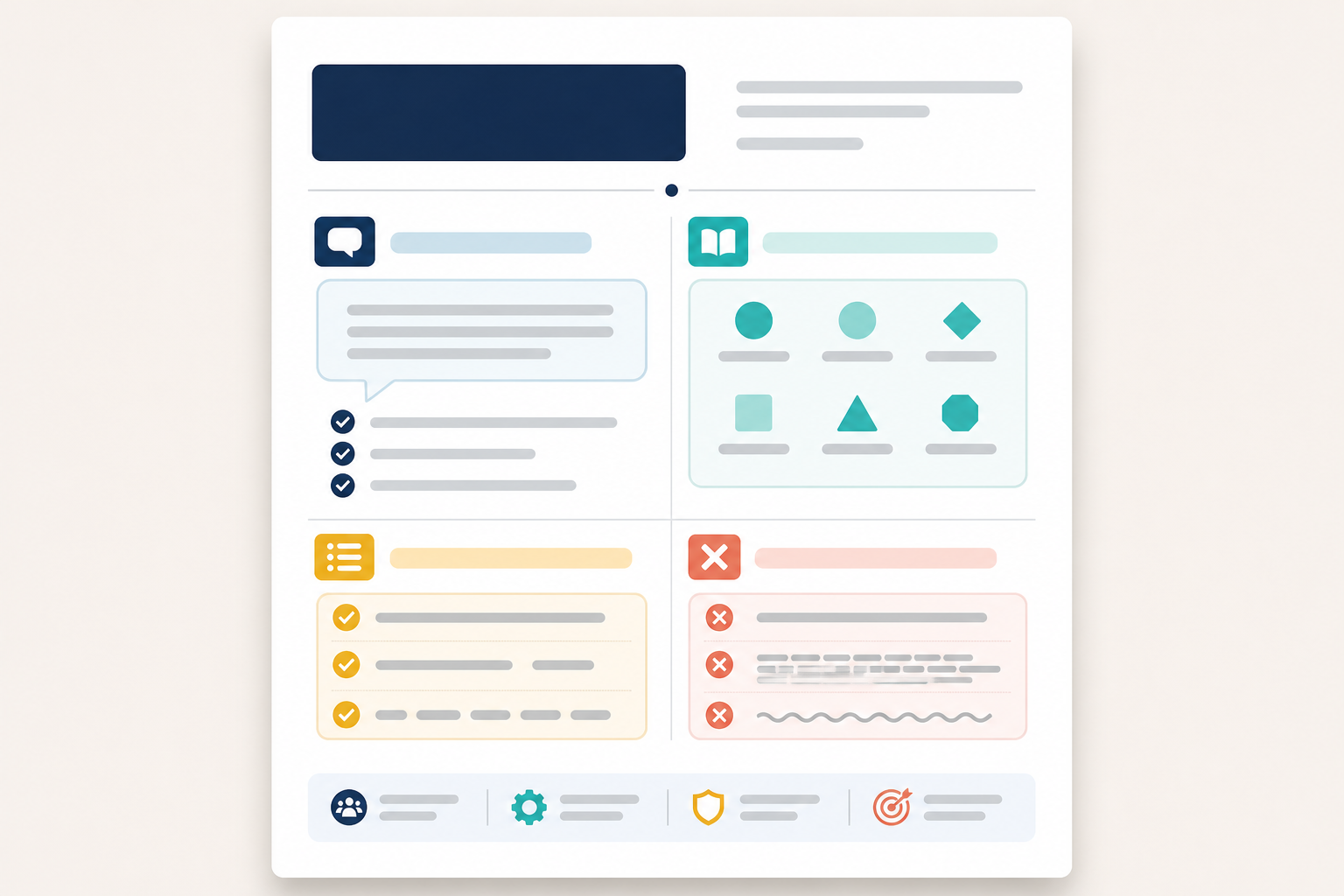
Create a short style reference sheet. This shouldn't be a 40-page brand bible nobody reads. Aim for one page covering tone, vocabulary, sentence rhythm, and a clear list of things to avoid. Any writer, freelancer, or AI writing assistant should be able to follow it without needing a briefing call.
Define non-negotiables versus flexible elements. Some rules apply everywhere, say, never use industry jargon without explanation, or always write in second person. Others can flex by content type: a product comparison post might read more direct and punchy, while a thought leadership piece might allow for longer, more reflective sentences. Naming which is which prevents both rigidity and drift.
Build example banks of on-brand and off-brand content. Show, don't just tell. Here's a quick example of what that looks like in practice:
Off-brand: "Our solution leverages best-in-class technology to deliver best-in-class results for enterprise clients."
On-brand: "Our tool does the heavy lifting so your team can focus on strategy — no jargon required."
Two or three paragraphs marked "this sounds like us" next to two or three marked "this doesn't" will teach your voice faster than any written description. This is also the kind of training data that helps any AI writing tool, self-improving or not, get closer to your voice with each piece it generates.
GOV.UK is a useful reference point here, even outside the commercial world. It runs one of the largest decentralised content operations in the UK, with hundreds of contributors across government departments, and it stays consistent through documented content design standards, reusable patterns, and clear publishing responsibilities, not through a single editor reviewing every sentence. For UK marketing teams juggling freelancers across time zones or in-house staff working from different offices, that same principle applies: centralise the standards, decentralise the execution.
Where automation helps and where human review still matters
Once your guardrails exist, the next question is what to automate and what to keep human. This is where a lot of teams either over-automate and lose voice, or under-automate and never actually scale. Both AI tools and human editors have clear strengths. The trick is matching each task to the right one, not picking a side.
| Task | Best handled by |
|---|---|
| Keyword research and SEO structure | Automation |
| First drafts and outlines | Automation |
| Formatting and publishing logistics | Automation |
| Repetitive content types (product updates, roundups) | Automation |
| Nuanced brand storytelling | Human |
| Sensitive or regulated topics | Human |
| Final voice and accuracy check | Human |
| Strategic judgment on claims | Human |

Automation genuinely excels at the parts of content production that are repeatable but time-consuming: keyword prioritisation, first drafts, and consistent formatting. As one example, AI-assisted publishing tools (Scribe is one; there are others like Jasper and Writesonic doing similar work) can generate full draft blog posts with SEO structure and images in minutes, then publish to platforms like Shopify or WordPress. Vendors report significant time savings from this kind of automated drafting and publishing, though the actual gain depends on your existing workflow and how much editing each draft still needs. The specific tool matters less than the category: this kind of automation removes a genuine bottleneck without removing human oversight, as long as review still happens before anything goes live.
Some of these tools also include a feedback layer that reviews performance data from published articles and adjusts future drafts based on what's worked before. It's worth asking vendors about this kind of adaptive learning if you're evaluating options, since it can reduce the gap between generic AI output and content that actually fits your audience over time. But treat vendor claims here as exactly that: claims to verify with your own published data, not settled fact.
What automation still can't replace is judgment on claims, tone in sensitive situations, or whether a piece genuinely captures your brand's point of view. The NIST AI Risk Management Framework makes a similar point: AI can accelerate drafting, but it can't independently determine whether a claim is strategically appropriate or factually defensible. That's a human call, every time. Google's own guidance on AI-generated content backs this up too. It doesn't penalise content because it was created with automation. It penalises content, automated or not, that's produced mainly to manipulate rankings rather than help readers. Quality and usefulness matter more than production method.
Reviewing content at scale without creating bottlenecks
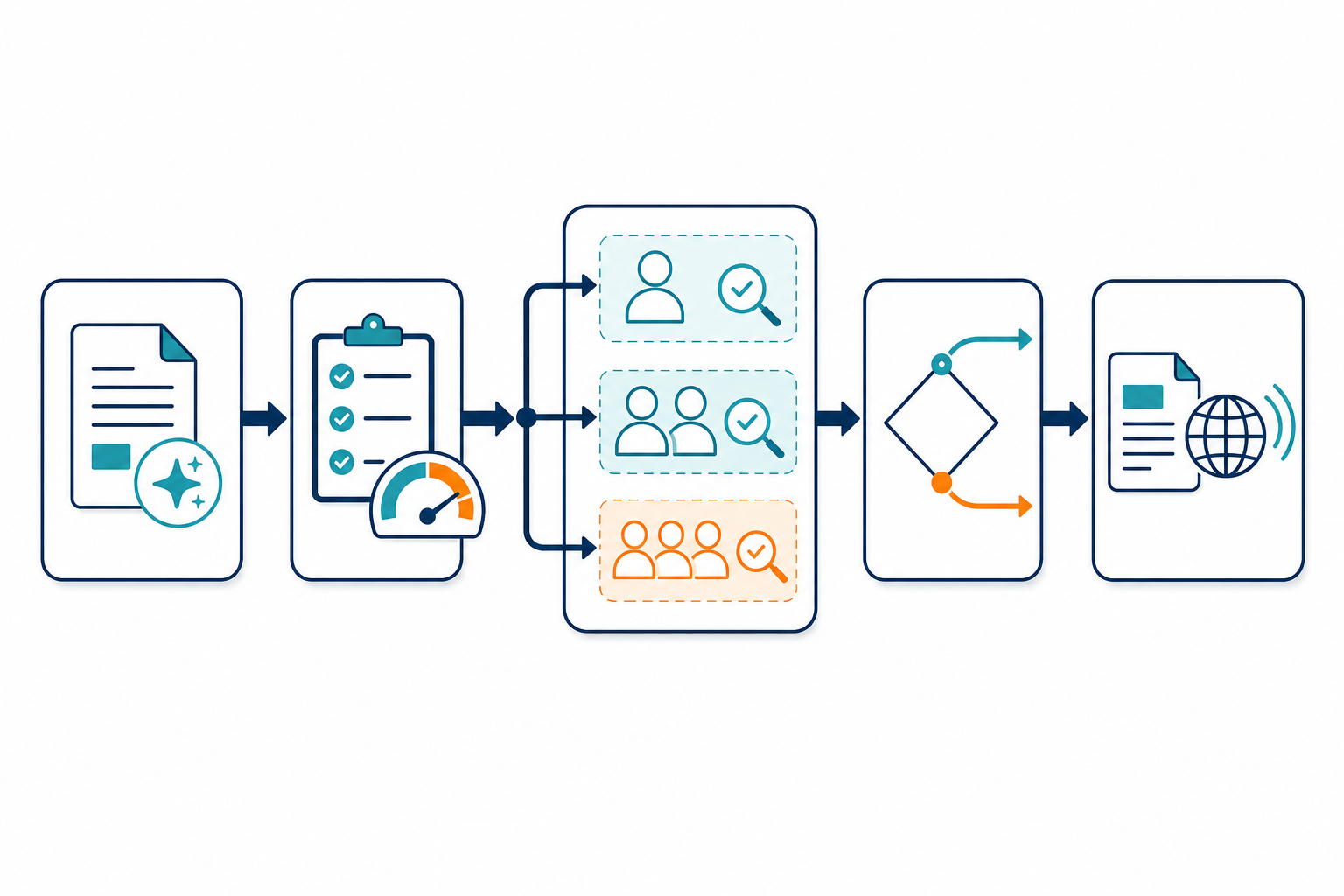
This is usually where scaling plans quietly fall apart. Teams build a documentation system, adopt an AI writing assistant, and then try to review every single article the same way they reviewed content when they were publishing four posts a month. That doesn't scale. Here's a workable alternative, built around three tiers rather than one flat process.
Tier 1: routine content (roundups, minor updates, evergreen how-tos): a light check by any trained team member against the style sheet, focused on tone and obvious errors. Same-day turnaround is realistic here.
Tier 2: strategic content (cornerstone guides, comparison pages, anything ranking for competitive terms): review by a senior marketer or content lead, checked against the style sheet and a basic quality scorecard covering brand fit, search intent match, and originality. Budget one to two days.
Tier 3: regulated or high-risk content (financial claims, health-adjacent topics, anything a UK regulator might care about, or content touching customer data in a way that raises GDPR considerations): sign-off from a subject matter expert or compliance lead, in addition to the standard editorial check. This tier should take longer, and that's fine. It's not where you're trying to save time.
A simple quality scorecard, whether generated automatically or filled in by a reviewer, might score each piece from 1–10 on: brand fit, factual accuracy, search intent match, originality, readability, and compliance with any claims policy. A sensible starting threshold is that anything scoring below 7 on brand fit or compliance gets escalated a tier, regardless of which tier it started in.
A few other habits that keep review from becoming the new bottleneck:
- Close the feedback loop. If a reviewer keeps flagging the same issue, that note needs to feed back into your style sheet or your AI tool's prompt and training inputs, not just fix the one article in front of you. Otherwise you're solving the same problem forever.
- Track review time per article, not just output volume. If review time is climbing even as your guardrails improve, something upstream isn't working, usually a gap in your style documentation or an undertrained automation setup.
- Use analytics to catch drift early. Patterns in underperforming content, declining time-on-page, high bounce rates, weak engagement, often show up before a full backlog does. Most analytics dashboards, whether built into your CMS or your writing tool, can be set up to flag these patterns automatically rather than waiting for a quarterly review.
Signs your content is drifting off-brand
Even with good systems, drift happens gradually enough that it's easy to miss. Here's how to tell the difference between voice drift and a broader content-performance problem, and what to do about each.
| Signal | Likely cause | Corrective action |
|---|---|---|
| Sentence structure or vocabulary no longer matches your style guide | Style sheet is outdated or wasn't shared with new contributors | Re-circulate the sheet; add the specific drift as a new example in your on-brand/off-brand bank |
| Repeated phrases or generic filler that could sit on a competitor's site | Over-reliance on unedited AI drafts | Add a "generic phrase" checklist to Tier 1 review; tighten AI prompts with brand-specific examples |
| Inconsistent tone across posts published the same week | Multiple contributors working without a shared reference | Assign one person to own final tone consistency across that week's batch |
| Declining engagement or time-on-page despite steady publishing volume | Could be voice drift, but could also be topic fatigue or SEO issues, check both | Compare against older top-performing posts for tone AND check search intent match before concluding it's a voice problem |
| Reviewers saying a piece "doesn't sound like us" without being able to say why | A real but undocumented voice rule | Ask the reviewer to try to articulate the specific issue and add it to the style sheet as a named rule |
If you're seeing two or more of these regularly, it's worth pausing to revisit your style documentation and quality scoring thresholds before pushing more volume through the pipeline.
Frequently asked questions about scaling content production
Can content volume increase without sacrificing brand quality?
Yes, but only if you build the guardrails first. Teams that scale successfully document their brand voice in specific terms, use tools that learn from performance data, and keep a human checkpoint before publishing. Skipping any of these steps is usually where quality starts to slip.
How do marketing teams keep dozens of posts on-brand?
Most rely on a written style reference, a tiered review process, and quality scoring to flag content that needs a closer look. Rather than reviewing every article the same way, they focus deeper attention on cornerstone and regulated content and use lighter checks for routine posts.
What's the right balance between automation and human review?
Automation works best for research-heavy tasks, first drafts, SEO structure, and publishing logistics. Humans are still essential for nuanced judgment calls, brand storytelling, and the final read-through that confirms a piece genuinely sounds like your company. The balance shifts as your tools and processes mature, but full removal of human review is rarely a good idea.
Who should own the brand voice guide as a team grows?
One person, usually a content lead or senior marketer, should own updates to the style sheet even if multiple people contribute to it. Without a single owner, the guide tends to drift out of date the moment two people disagree about a rule and nobody has authority to settle it.
How often should the style guide and example bank be updated?
Review it at least quarterly, and update it immediately any time a reviewer flags a recurring issue that isn't already covered. A style guide that hasn't changed in a year is either perfect or, more likely, being ignored.
The bottom line: a practical content production scaling plan
Scaling content production and protecting brand voice aren't opposing goals. They just require different tools for different jobs. If you're starting from scratch, here's a realistic first-month sequence rather than a vague principle to keep in mind:
Week 1: Document your voice in specific terms (sentence length, contractions, jargon policy) and build a one-page style sheet.
Week 2: Create your on-brand/off-brand example bank and define your non-negotiables versus flexible elements.
Week 3: Set up your three-tier review process and assign an owner to each tier, including who signs off on regulated content.
Week 4: Introduce automation for drafting and publishing on Tier 1 content only, track review time as a baseline, and set your quality score escalation threshold.
Document your voice as a system rather than a feeling. Let automation handle the repeatable work of drafting, optimising, and publishing. Keep your team's judgment focused on the calls that actually need a human. Do that, and scaling content marketing stops being a threat to your brand and starts being the thing that grows it.
Create content like this automatically
Scribe uses AI to generate high-quality blog posts that engage your audience and drive traffic.