The Hidden Cost of Inconsistent Content Marketing (And What It's Really Doing to Your SEO)
14 min read
Loading...

By the Scribe Editorial Team — Updated November 2025
Inconsistent content marketing costs businesses far more than a few missed blog posts. It quietly erodes search visibility, wastes previous SEO investment, burns out marketing teams during catch-up sprints, and creates gaps competitors happily fill. Google isn't penalising you for going quiet - it doesn't work that way. The real problem is the compounding opportunities you lose every time you stop and restart.
If you're a marketing manager juggling content alongside a dozen other priorities, this probably sounds familiar. You publish three great posts, life gets busy, six weeks go by, and suddenly you're staring at a content calendar full of gaps and a traffic graph that's flatlined. I've watched this pattern play out across UK marketing teams more times than I can count. The frustrating part is that the damage stays invisible until you compare yourself to a competitor who never stopped.
Let's work through what inconsistent content marketing actually costs, with a real worked example rather than vague warnings, and how to fix it without working your team into the ground.
First, let's define the problem properly, because "inconsistency" actually covers three separate issues that create different costs:
Any one of these on its own is manageable. Together, they compound into something much more damaging.
Here's a nuance worth clearing up: Google has never stated there's a required publishing frequency or minimum word count for ranking well. Its Search Essentials guidance says content needs to be helpful, reliable, and created for people, not search engines. So inconsistency isn't a direct ranking penalty. That's exactly why the real cost is so easy to miss - there's no single algorithmic slap you can point to, just a slow accumulation of missed chances.
The actual damage is indirect, and it shows up in a few predictable ways:
Here's the part that really stings for UK marketing teams competing in crowded sectors like SaaS, finance, and professional services: the cost stays invisible until you measure yourself against a competitor who's been quietly consistent the whole time. They're not doing anything flashy. They're just showing up every week while you're catching your breath.
Let's move past the qualitative version and actually model this, because vague warnings about "lost momentum" aren't much use to anyone building a budget case.
Say you're a UK B2B SaaS company targeting a commercial keyword cluster with roughly 2,000 monthly searches across your target terms. If you publish consistently and eventually rank in the top 5 for your core terms, a realistic blended click-through rate might land around 15%, giving you roughly 300 monthly organic visits from that cluster. At a modest 2% visitor-to-lead conversion rate and an average deal value of £3,000, that's 6 leads a month and potentially one closed deal, worth £3,000 monthly, or £36,000 annually, from a single well-built content cluster.
Now model the stop-start version. If a six-week publishing gap delays you reaching page-one rankings by three to four months (a reasonable estimate given how long new pages typically take to mature, more on that below), you're not just losing three months of traffic. You're delaying the point at which the whole cluster starts compounding, which can push your break-even point back by six months or more once you factor in the time needed to catch up on internal linking and topical depth.
Add the production cost of catch-up sprints: if a rushed two-week sprint to publish six articles takes a content manager 15 extra hours of coordination and editing compared to steady-paced production, and your team's fully loaded cost is £40/hour, that's £600 in pure inefficiency, before you even count the quality dip that often comes with rushed work.
These numbers are illustrative, not universal. Your actual search volume, conversion rates, and deal values will differ. But the formula is one you can adapt with your own data: monthly search volume × expected CTR × conversion rate × deal value gives you the monthly value of a ranking position. Delaying that ranking by even a few months has a real, calculable cost.
Even though publishing frequency isn't a direct Google ranking factor, irregular content still affects your search performance through a few real mechanisms. It's just less direct than "Google punishes gaps."
When you publish sporadically, you generate fewer signals over time that help search engines understand your site as a comprehensive resource on a topic. You also get fewer chances to earn backlinks, build internal linking pathways, and learn from performance data what's actually working. None of this happens quickly. Research from Ahrefs found that only 5.7% of newly published pages reach Google's top 10 within a year. That's a finding about how long ranking generally takes, not a direct measure of publishing consistency, but it tells you something important: content marketing is a long game, and stopping halfway through often means you never see the return on what you already invested.
Picture two businesses side by side, as an illustrative model rather than a guaranteed outcome. One publishes weekly, builds interconnected topic clusters, and steadily earns more impressions and clicks each month. The other publishes in bursts, disappears for six weeks, then scrambles to catch up. All else being equal - same content quality, same technical SEO, same promotion effort - the consistent publisher's traffic curve tends to look like a gentle, upward staircase, while the sporadic publisher's curve spikes after each burst and flattens in between. Worth noting: cadence is only one variable here. Content quality, search intent match, technical health, and link building often matter more than frequency alone, so consistency is a necessary foundation, not a silver bullet.
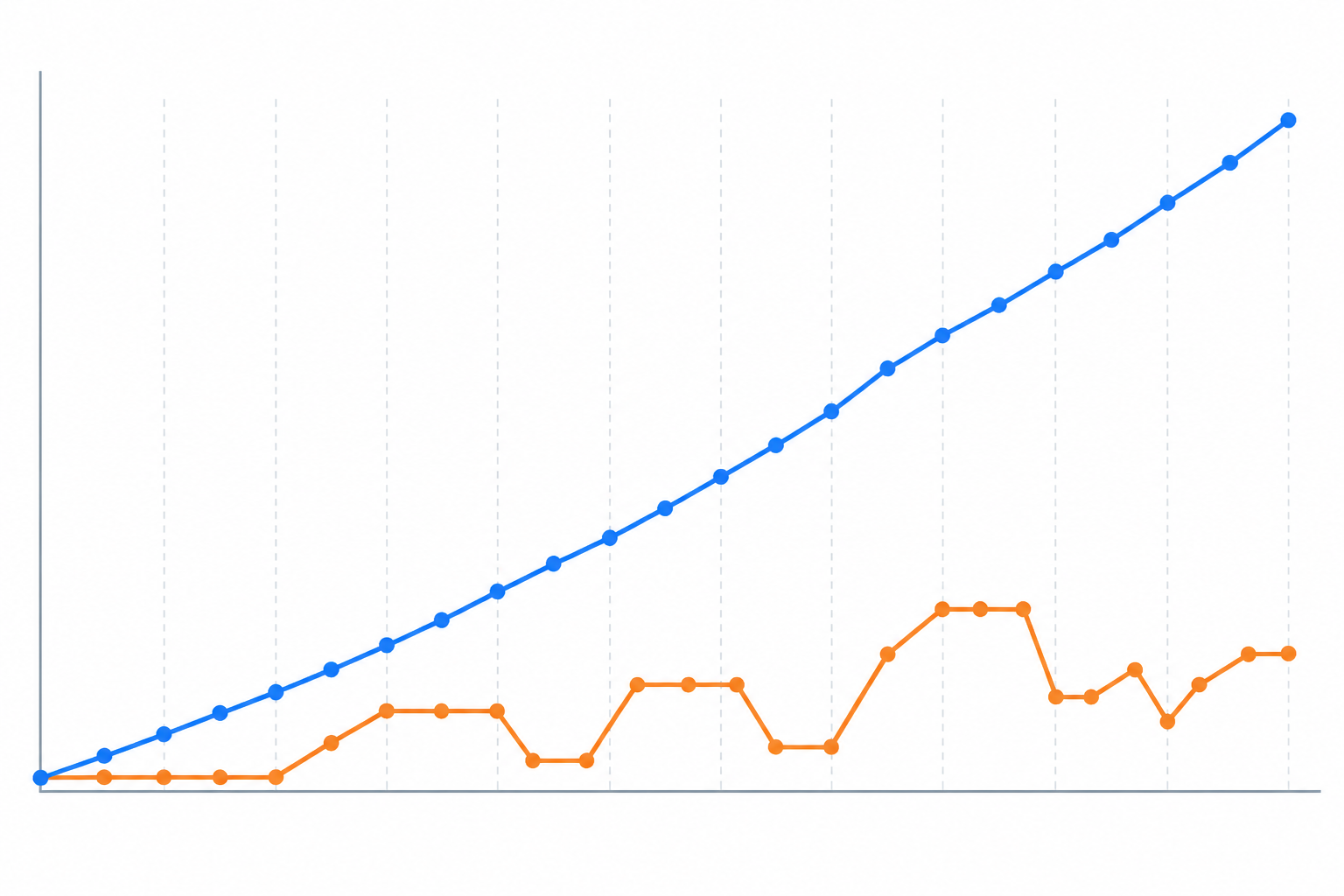
There's also a more permanent risk here. When you go quiet, competitors don't wait politely for you to come back. They publish the guide you were planning, answer the question your customers were searching for, and earn the backlinks that would have pointed to your site. Once a competitor's page ranks and starts accumulating authority, it can be genuinely difficult to displace, even after you resume publishing. Your gap becomes their gain, and sometimes a lasting one.
The SEO cost is only half the story. The human cost of inconsistent content marketing is just as real, and it's often what causes the inconsistency in the first place.
Here's the cycle I see constantly with marketing teams, along with what actually breaks it at each stage:
The cruel irony is that the harder teams work during these sprints, the more burnt out they get, and the more likely they are to fall behind again soon after. This isn't a willpower problem you solve with more hustle. It's a systems problem, and it needs a systems-level fix.
There are a few established ways teams try to fix this: hiring additional in-house writers, building a bench of freelancers, adopting stricter content operations workflows, or using AI-assisted drafting tools. Each has trade-offs. More headcount is expensive and slow to scale up or down. Freelancer pools require management overhead and can vary in quality. Process improvements help but don't solve a raw capacity problem. AI-assisted tools have become the fastest-growing option because they attack the actual bottleneck: the time and effort required to research, draft, edit, and format a genuinely useful blog post week after week, without needing to hire your way out of the problem.
This is the category Scribe operates in, and I want to be upfront that what follows describes our own product, not an independent benchmark. Scribe generates SEO-optimised blog posts averaging over 2,000 words, complete with AI-generated images and diagrams, in about five minutes. It's built to produce a strong first draft grounded in keyword and structural data, not a finished piece that skips human review. We'd recommend editorial oversight for accuracy, compliance, and brand fit before anything goes live, particularly in regulated sectors like finance or professional services where factual precision carries real risk.
What's different from a basic AI writing assistant is the self-improving system underneath it. Scribe analyses quality scores and performance metrics from every published article, learning which topics, structures, and formats tend to drive traffic and engagement for that specific site, then leans into the patterns that work. One customer using this system reported a 340% increase in organic traffic over six months. That figure comes from a single case study rather than an average outcome, and results will vary based on starting traffic, industry competitiveness, and how consistently the output is reviewed and published.

A few things this kind of system unlocks for teams trying to scale without burning out:
The goal isn't to remove humans from content production. It's to stop the whole operation depending on any one person's availability, which is precisely the fragility that causes most inconsistency in the first place.
Fixing inconsistent content marketing isn't about heroic effort. It's about building a system that keeps running whether or not any individual person has a good week. Here's how to approach it, with a measurable target for each step:
Content marketing rewards patience and punishes inconsistency, quietly but persistently. The good news: with the right systems and review processes in place, sustainable consistency stops being a willpower problem and becomes something closer to a repeatable operating rhythm.
Inconsistent content marketing typically leads to slower organic growth, weaker topical authority, and a fractured brand voice, rather than a direct search penalty. Because ranking well takes sustained effort over months, gaps in publishing delay the point at which your content starts compounding, and competitors who keep publishing steadily can capture the queries, backlinks, and rankings you were building toward, sometimes permanently.
Publishing frequency itself isn't a confirmed Google ranking factor, and there's no evidence that occasional gaps trigger algorithmic penalties. What irregular posting does is reduce your opportunities: fewer chances to target relevant queries, build internal links, earn backlinks, and learn from performance data about what resonates with your audience. Over time, competitors with steadier output simply accumulate more of these opportunities than you do, which shows up as a widening gap in rankings and traffic even without any direct penalty.
The most sustainable approach combines realistic planning with automation and clear review processes. Set an achievable publishing cadence based on your team's actual capacity, maintain a four-week buffer of ready content, and use AI writing tools like Scribe to handle first-draft production at scale. This can remove the manual bottleneck that causes most consistency breakdowns, provided human editorial review stays part of the workflow to catch errors and protect brand voice.