The ROI of AI Content Marketing for Small Businesses: A Real Cost Breakdown

ROI of AI Content Marketing for UK Small Businesses: Real Costs, Savings and a Break-Even Formula
If you're a small business owner in the UK trying to work out whether AI content marketing is worth the money, here's the honest short version: freelance writers in the UK typically charge £150-£400 for a 1,500-2,000-word blog post, and you'll usually spend another few hours briefing, reviewing, and publishing each piece. AI content platforms can cut the per-article cost significantly and produce a full draft in minutes rather than days. But the real picture is more nuanced than a single headline number. Results vary depending on your starting point, your sector, your search competition, and how much human review you build into the process.
So let's do this properly. Below, I'll walk through a like-for-like cost comparison with real assumptions stated upfront, a worked AI content marketing ROI example with figures you can adapt, a realistic and appropriately hedged timeline, and the risks nobody selling you a platform wants to dwell on.
A quick note on sourcing: The freelance and agency figures below reflect typical rates advertised on UK freelance marketplaces and small agency websites as of 2024. Your local market may differ, so treat these figures as a starting point to sense-check against quotes you actually receive, not gospel.
The Real Cost of Traditional Content Creation for UK Businesses
Most small business owners underestimate what a blog post actually costs them, because the invoice from your freelancer is only part of the picture. Strategy, editing, design, SEO optimisation, formatting, and publishing all take time or money, even when nobody sends you a separate bill for them.
To make this comparable, let's fix a single scenario: four 1,800-word blog posts per month, published consistently. Here's what that typically costs across three routes, with the assumptions stated so you can adjust them for your own numbers.
| Cost Component | Freelance Writer Route | Agency Route | AI Content Platform |
|---|---|---|---|
| Writing (4 x 1,800 words) | £600-£1,600 (£150-£400/post) | Included in retainer | Included in subscription |
| Your review/editing time | 4 x 1-2 hrs = 4-8 hrs | 4 x 30-45 mins = 2-3 hrs | 4 x 45-60 mins = 3-4 hrs |
| Value of your time (@£30/hr) | £120-£240 | £60-£90 | £90-£120 |
| SEO optimisation | Often a separate cost or DIY | Usually included, at a premium | Typically built into generation, varies by plan |
| Images/graphics (4 posts) | £80-£300 (stock or freelance) | Often included | Often included, check your plan's limits |
| Publishing/formatting time | 2-4 hrs total | Sometimes included | Near-instant, one-click on supported CMSs |
| Illustrative monthly platform/writer cost | £600-£1,600 | £1,500-£4,000+ | £69-£249 (varies by provider and tier) |
| Total monthly cost, including your time | £720-£1,840 | £1,560-£4,090 | £160-£370 |
| Time from brief to published, per post | 3-7 days | 5-10 days | Minutes for the first draft, plus your review time |

A few things are worth flagging honestly. First, AI platform pricing varies significantly by provider and tier, so check current published pricing before you budget against it. Second, the AI column still includes real human review time, because skipping that step is where quality and brand-safety problems creep in. Third, agencies often bundle in strategy and distribution that a raw cost comparison doesn't fully capture, so the value isn't purely about the per-post price.
The part that trips up most owners isn't the invoice, though. It's the hidden time cost and the opportunity cost that comes with it. Every hour spent briefing a writer or proofreading a draft is an hour not spent with customers or on the parts of the business that generate revenue. For a lot of small business owners, that's the actual reason content marketing stalls: not a lack of belief in it, but an inability to sustain the time drain month after month.
Where Content Marketing Automation Saves Time and Money
This is where content marketing automation can genuinely change the equation—not by removing quality control, but by collapsing steps that used to take days into minutes. It's worth being specific about what's typically automated and what still needs a human, because platforms vary and marketing pages tend to overstate the “fully automatic” element.
- Generation speed: Platforms such as Scribe can produce a full first draft of a 1,500-2,000-word post in a matter of minutes, compared with the 3-7 days a freelance writer typically needs to research, draft, and revise the same piece. That first draft still benefits from a human read-through before it goes live.
- Subscription pricing versus per-piece fees: Rather than paying £150-£400 per article, AI platforms generally offer tiered plans covering a set number of articles per month. Divide the subscription cost by your monthly volume and the effective cost per article is usually well below freelance or agency rates, although the exact saving depends on which tier you're on and how much of it you actually use.
- SEO groundwork: Many platforms build basic keyword targeting, heading structure, and meta descriptions into the generation process. This reduces—but doesn't eliminate—the need for a separate SEO consultant. You'll still want to sense-check keyword choices against your actual customer language and search intent.
- AI-generated images: Some plans include auto-generated visuals, which can reduce or remove stock photo and design costs. Check what's included at your tier, since not every plan bundles unlimited images.
- Publishing integrations: Direct integrations with platforms such as Shopify, WordPress, Wix, and Webflow can remove the manual upload-and-format step. Confirm which integrations are live for your specific CMS before assuming this is fully hands-off.

Added together, this isn't one saving; it's several stacked on top of each other: less spent on writing, less spent on separate design and SEO help, and considerably less of your own calendar consumed by the process. But it's worth being upfront about the trade-off: automation doesn't remove the need for human oversight.
You still want someone checking brand voice, verifying factual claims, and reviewing anything sensitive or regulated before it publishes. The realistic comparison isn't “humans versus a zero-cost machine”; it's human-led production versus AI-assisted production with a lighter, faster human review layer.
What AI Content Marketing Can't Do Yet
Before the maths gets exciting, a fair evaluation needs to sit with the risks too, because they affect the real cost of doing this properly.
- Hallucinations and factual errors: AI-generated content can state things confidently that aren't true, especially around statistics, regulations, or niche technical detail. This is the single biggest reason human fact-checking isn't optional.
- Generic or repetitive content: Left unchecked, high-volume AI publishing can produce content that reads similarly across many sites, which can hurt reader trust and search performance. Search engines have publicly stated they aim to reward helpful, original content regardless of how it's produced, and to demote content made primarily to manipulate rankings.
- Publishing more doesn't guarantee ranking better: Increasing volume without a corresponding increase in quality or relevance can waste budget and, in some cases, dilute your site's overall quality signals.
- Brand and legal liability: You're responsible for what goes out under your business name, including accuracy, disclosure, and any regulated claims in sectors such as finance, health, or legal services.
- Data privacy: If you're feeding customer data or proprietary business information into a prompt to personalise content, check the platform's data-handling policy first.
None of this means automation isn't worth it. It means the realistic cost model has to include a genuine review step, not an assumption that content is ready to publish the moment it's generated.
How Self-Improving AI Systems Can Change the ROI Over Time
Some AI content platforms, including Scribe, use adaptive or self-improving systems that analyse quality scores and performance metrics from published articles, then lean into patterns associated with better engagement. In principle, this is different from a flat-rate freelancer, where cost per article stays the same in month one and month twelve regardless of how earlier content performed.
In practice, how much this moves the needle depends on your starting traffic, your niche's competitiveness, and how much content you're publishing for the system to learn from. A small monthly volume gives any learning system less data to work with, so the effect compounds more slowly than it would at higher volume.
One customer reported a 340% increase in organic traffic over six months using this approach. I want to be transparent about the limits of that figure: it's a single, self-reported example, we don't have independent verification of the baseline traffic, sector, or attribution method, and results like this are not typical. Treat it as an illustration of what's possible under favourable conditions, not an average outcome you should bake into your own forecast.
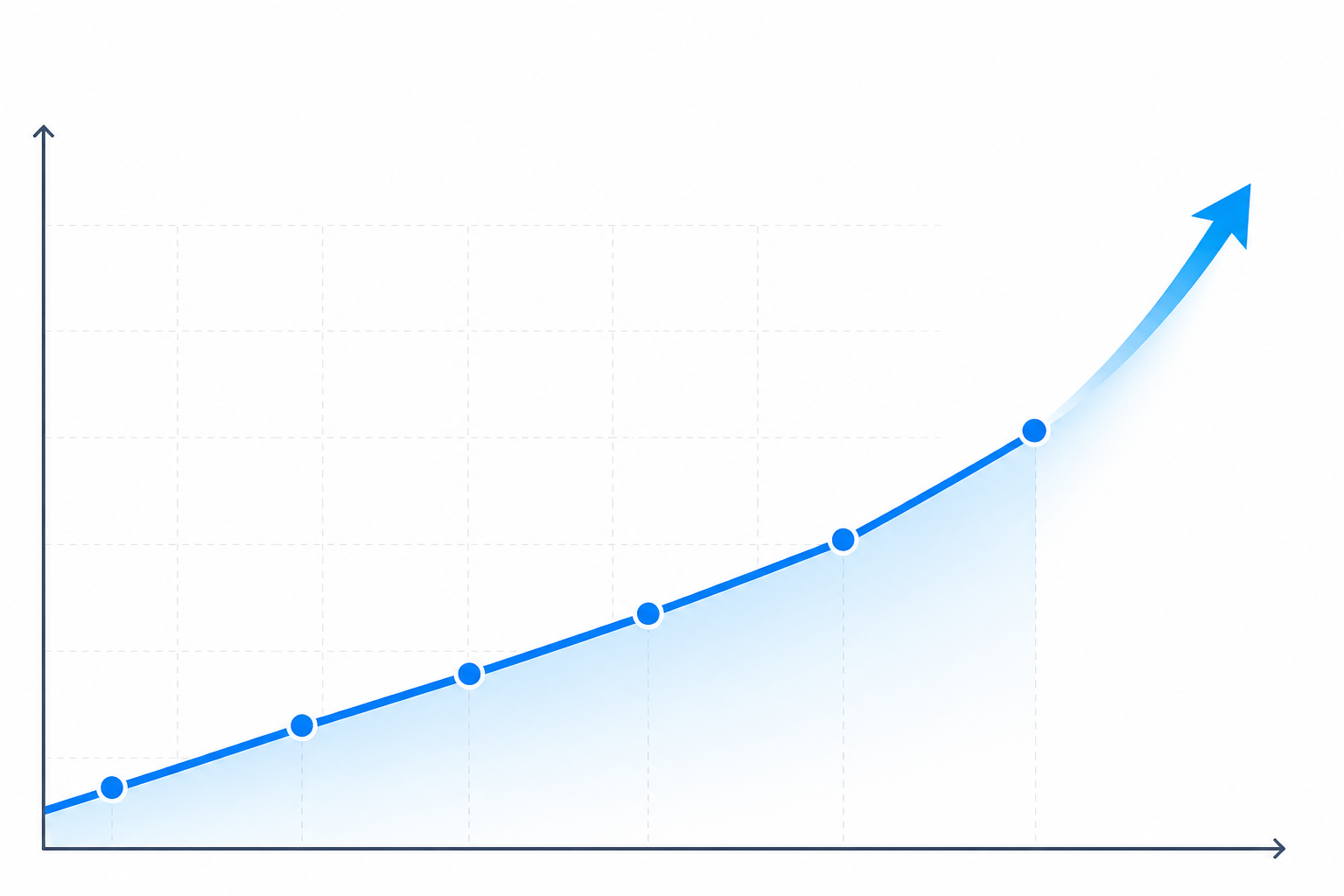
How to Calculate Your Own AI Content Marketing ROI
Case study numbers are useful for context, but the number that matters is yours. Here's a five-step process, followed by a worked example with real figures so you can see how it fits together.
Step 1: Add up your current monthly content spend, including writer fees, your editing time valued at your hourly rate, design costs, and publishing time. Be honest about hidden time costs, not just invoices.
Step 2: Estimate your current traffic and lead numbers. Look at your blog's performance over the last three to six months. How much organic traffic is it generating, and how many leads or enquiries can you reasonably attribute to it?
Step 3: Compare that to an AI content plan producing the same volume. Find the actual published price for a tier that matches your monthly output, not an average across the market.
Step 4: Factor in your own review time, not zero time. Multiply the hours you'd realistically spend on brand and fact-checking review by your hourly rate.
Step 5: Apply a two-part ROI formula that separates cost savings from incremental revenue, since conflating the two overstates your return:
Cost savings = (Previous monthly cost) - (AI subscription + your review time cost)

ROI = (Incremental gross profit + Verified cost savings - Total AI-assisted cost) / Total AI-assisted cost x 100
Worked AI Content ROI Example for a Small Business
Say you currently pay a freelancer £275 per post for four posts a month (£1,100), spend 6 hours reviewing and publishing at £30/hour (£180), and pay £190 a month for images. That's £1,470 a month, all in.
Switching to an AI platform at an illustrative £129/month subscription, plus 4 hours of your own review time at £30/hour (£120), brings your total AI-assisted cost to £249/month.
That's a verified cost saving of £1,221 per month before you even count new leads. If the extra consistency in publishing also generates, say, one additional qualified enquiry a month that converts at 25% with an average gross profit of £150 per sale, that's £37.50 in incremental gross profit.
ROI = (£37.50 + £1,221 - £249) / £249 x 100 ≈ 405%
That figure looks striking, and most of it comes from labour and vendor cost savings rather than new revenue, which is worth being clear-eyed about. Recovered time only becomes real value if you redeploy it into something that earns money or reduces stress. Run your own numbers over a three-month period rather than a single month, since content takes time to compound and a single month can be noisy.
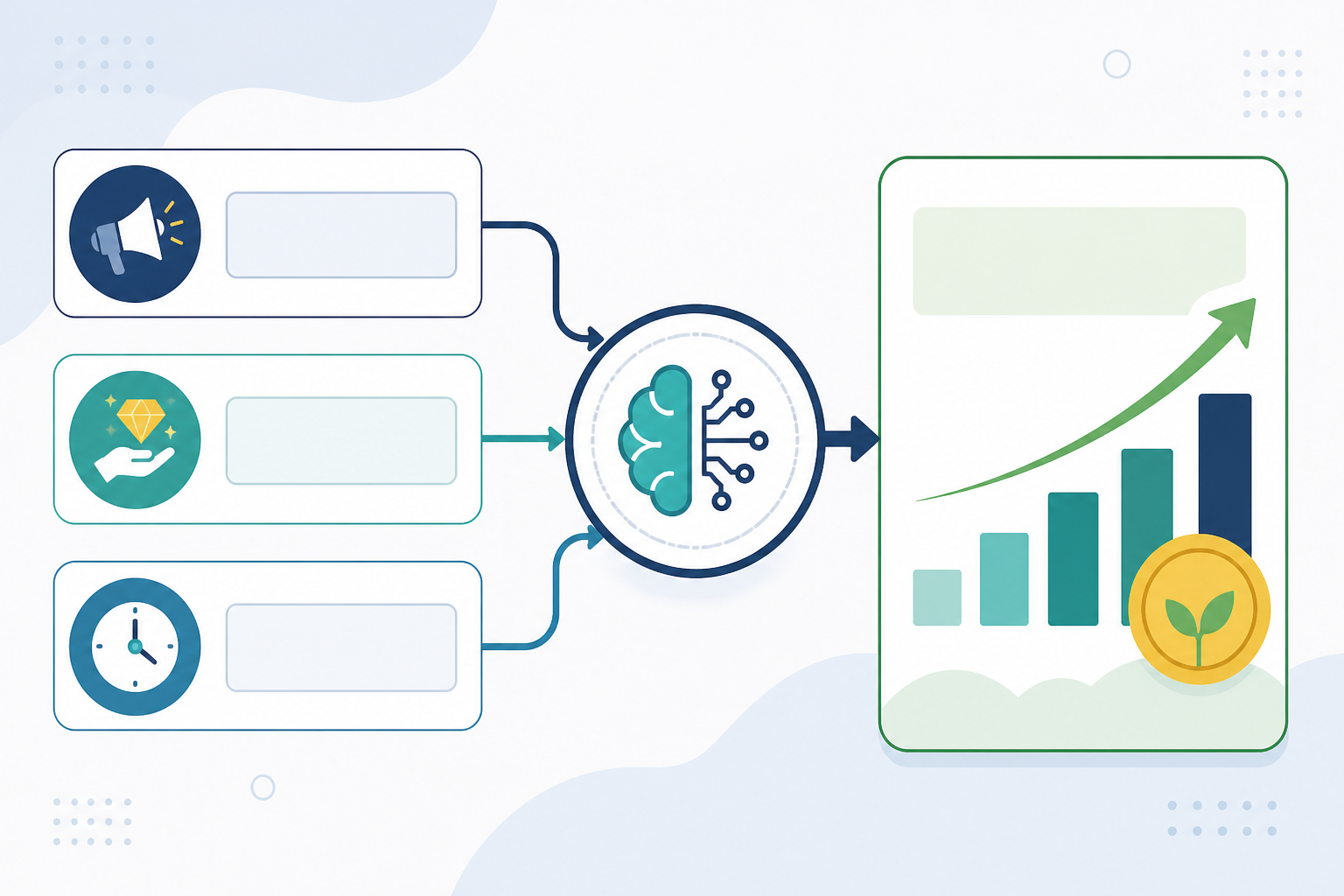
What to Expect from AI Content Marketing in the First 90 Days
It's worth being realistic: switching to an AI writing assistant doesn't produce overnight results, and nobody should promise you that it does. SEO content takes time to work regardless of who or what produces it, because search engines need time to find, crawl, and rank new pages. Outcomes vary substantially by domain authority, competition, technical SEO health, and sector.
Weeks 1-2: Foundation building. Keyword targeting gets established and your publishing cadence begins. You're laying groundwork, not chasing results yet. Track pages indexed and publishing consistency.
Weeks 3-6: Early signals. Search engines begin indexing new content. Some businesses see early upticks in impressions; others, especially in competitive niches or on newer domains, see very little movement yet. Track impressions and average position in Search Console, not just traffic.
Weeks 7-12: Possible acceleration. If quality and relevance are strong, traffic and engagement may start picking up pace here, particularly for lower-competition keywords. This is a plausible window, not a guarantee. Track organic clicks, ranking keyword count, and enquiry volume.
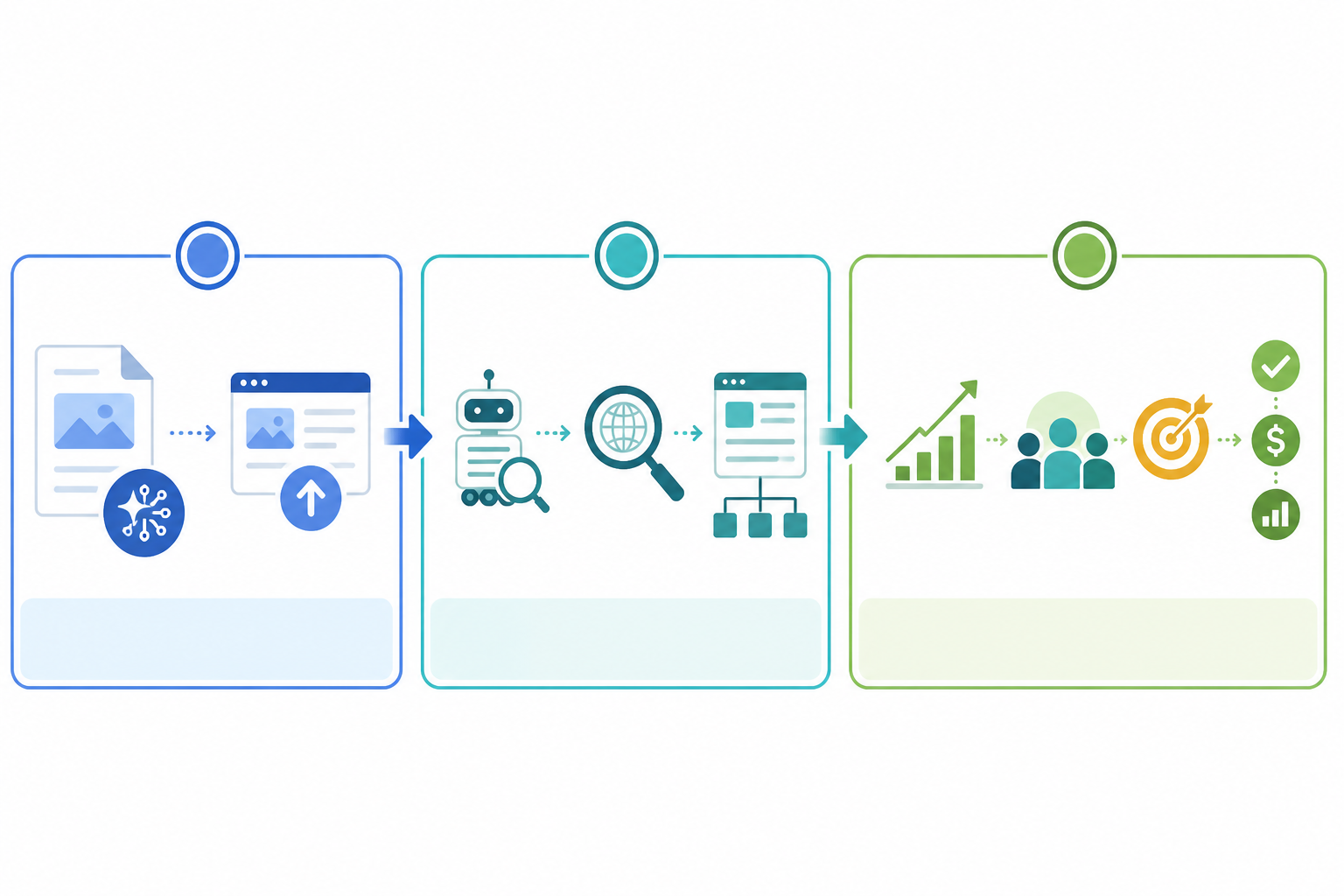
If someone promises page-one rankings in week two, be sceptical of that specific claim. Consistent publishing over a 60-90 day window is a reasonable timeframe to start evaluating trends, whether the content is written by a human or generated by an AI writing assistant. It is a checkpoint for assessment, not a guaranteed outcome date.
Does AI-Generated Content Actually Convert Customers?
This is the question I hear most often, and it's a fair one. Traffic is nice, but traffic doesn't pay your bills. Customers do.
The honest answer is that AI-generated content converts when it's built around genuine buyer search intent, not simply produced for volume. There's a real difference between vanity traffic—visitors who were never going to buy—and content targeting commercial, buyer-intent keywords, where people are actively searching for a solution you sell.
Some platforms use quality scoring to prioritise topics and structures associated with historical engagement. This can help weight commercial intent over purely informational curiosity, but it depends on the platform and how it's configured.
To measure this rather than assume it, track conversions by landing page and query type: form submissions, phone calls, and qualified leads attributable to specific articles. Ideally, use UTM tracking or your CRM's source field rather than aggregate traffic alone. The right question isn't “does AI content get traffic?” It's “does this specific content target the searches that lead to a sale, and can I trace that path?”
Is Automated Content Marketing Worth It for Your Business?
Content marketing automation isn't a universal fit, and I'd rather say that plainly than oversell it.
It's probably a good fit if:
- You need consistent publishing volume, weekly or more, but don't have in-house writing resources to sustain it
- You've tried content marketing before but couldn't keep up with the time or cost commitment long term
- You're currently paying £150-£400+ per article and want to redirect that budget toward greater volume
- You want SEO, images, and publishing folded into one workflow instead of managing several vendors, and you're comfortable doing a review pass on each piece
It's less ideal if:
- Your content depends on highly technical or niche expert commentary that needs substantial rewriting regardless of who drafts it
- You're not willing to do any review or brand-voice checking before publishing
- You publish so infrequently that the time savings wouldn't meaningfully change your workload
- Your sector has strict regulatory content requirements that need specialist legal review regardless of the drafting method
AI Content Automation Screening Checklist
- Do you currently spend more than 5 hours a month managing content production?
- Is your current cost per article above £150?
- Have you gone more than a month without publishing due to time or budget constraints?
- Do you need to scale to 10+ articles a month without hiring another person?
If you answered yes to two or more, it's worth running the ROI worked example above with your own numbers, including realistic review time and a conservative estimate of incremental leads, before you commit to a plan.
Frequently Asked Questions About AI Content Marketing ROI
How much does it cost to hire a content writer versus using AI?
In the UK, a freelance SEO writer typically charges £150-£400 per 1,500-2,000-word blog post, and agencies often charge more once strategy and management fees are included. AI content platforms typically work on subscription tiers covering a set number of articles per month; check current published pricing, since it varies by provider. Once you divide the subscription cost by volume and add your own review time, the effective cost per article is usually lower than freelance or agency rates for comparable output, although “comparable” depends on how much editing each route needs.
How long until I see results from automated content marketing?
Many businesses see early indexing and impression signals within 4-6 weeks, with more meaningful traffic and ranking changes building over 60-90 days if content quality and relevance are strong. This timeline applies to SEO content generally, not just AI-generated content, and actual results vary by domain authority, competition, and technical SEO health.
Does AI content actually convert customers?
It can, provided the content targets genuine buyer search intent rather than simply chasing traffic volume, and provided you're tracking conversions by page and query rather than assuming traffic equals sales. Some platforms use quality scoring to prioritise topics and structures linked to historical engagement, which may help, but it isn't a substitute for reviewing whether your content actually answers a buying question.
Do I still need to review AI-generated content before publishing?
Yes. AI-generated drafts can contain factual errors, outdated statistics, or claims that don't match your brand's actual policies or positioning. A human review pass for accuracy, tone, and regulated claims is a necessary step, not an optional extra, regardless of how polished the draft looks.
Can AI content hurt my SEO if I publish too much of it?
It can if volume increases without a corresponding focus on quality and relevance. Search engines have said they aim to reward genuinely helpful content and demote content produced primarily to manipulate rankings, regardless of whether a human or an AI wrote it. Consistent quality review matters more than raw output volume.
Are images generated by AI platforms free to use commercially?
This varies by provider and plan tier, so check the specific terms before assuming unlimited or fully licensed image generation is included at your subscription level.
Is AI content suitable for highly technical or expert-led topics?
It can work as a starting draft, but heavily technical or niche expert content usually needs more substantial human input and fact-checking than general commercial content. That affects how much time you'll actually save on those specific pieces.
Create content like this automatically
Scribe uses AI to generate high-quality blog posts that engage your audience and drive traffic.