The Science Behind Self-Learning Content Systems: How AI Actually Gets Better at Writing

Self-Learning Content Systems: How Adaptive AI Gets Better at Writing
Here's the distinction that actually matters: an AI writer generates output. A self-learning content system changes what it generates next based on validated evidence about what worked. That difference is the whole story. Done well, it means content quality can compound with volume instead of flatlining. Done badly, it means a vendor dashboard dressed up as intelligence, with nobody checking whether the "learning" is real or just noise that happens to look good this month.
Quick disclosure before we go further: I'm part of the team at Scribe, which builds a content platform that includes this kind of feedback loop. I've tried to write this as a genuine explainer of how self-learning content systems work and where their limits are, rather than a pitch. Where I describe our own product specifically, I'll say so clearly, and I'll separate that from general research and industry practice.
A self-learning content system uses machine learning to analyse the performance of published articles, then adjusts how future content gets generated based on what actually correlates with stronger results. The distinguishing feature is a validated feedback loop: measured outcomes change future generation or selection behaviour, rather than sitting in a dashboard nobody acts on. Most AI content tools don't do this. They run on largely static prompts and templates until a human manually updates them, with no built-in mechanism checking whether last month's output actually beat the month before.
What Are Self-Learning Content Systems and How Do They Work?
"Self-learning" gets used loosely in marketing copy, so it's worth being precise about what's actually happening under the hood. It's not one technique. It's an umbrella term covering several distinct mechanisms, each with different data requirements, speed, and risk:
| Mechanism | What changes | Data required | Speed | Principal risk |
|---|---|---|---|---|
| Prompt/template updates | Instructions given to the model | Moderate volume of labelled outcomes | Fast | Overfitting to recent patterns |
| Retrieval improvements | Which source material gets pulled in | Curated reference content | Fast | Stale or biased sources |
| Rules-based automation | Hard-coded editorial routing | Minimal | Fast | Rules become outdated silently |
| Ranking/recommendation models | Which draft among several gets selected | Historical performance data | Medium | Model favours proxy metrics over real quality |
| Fine-tuning | The underlying model's weights | Large, carefully filtered dataset | Slow, deliberate | Bakes in errors alongside improvements |
| Human-in-the-loop review | Whether a change is trusted at all | Editorial time | Ongoing | Bottleneck if skipped under pressure |
Most commercially available systems, including ours, rely mainly on the first four, with human review as a safeguard, rather than continuous fine-tuning. It's also worth distinguishing this from adjacent machine learning concepts that get conflated with it: reinforcement learning (where a model is rewarded or penalised for actions and adjusts its own policy), online learning (where a model updates continuously as new data streams in, without a separate validation step), and supervised learning (training on labelled examples of "good" and "bad" output). Most content platforms, including Scribe's, are closer to structured retrieval and prompt optimisation than to any of these — the model itself isn't being retrained in real time.
Think of the difference between a junior writer who never receives feedback and one who reviews analytics weekly, notices what resonates, and adjusts accordingly. Most AI writing assistants behave like the first: competent, but with a quality ceiling that never moves. A self-learning content system behaves more like the second, except it's reviewing dozens or hundreds of articles at once, continuously.
The feedback loop typically looks like this:
- Publish – the system generates and publishes an article based on current best practices.
- Measure – it tracks performance signals: organic traffic, click-through rates, time on page, and quality scores.
- Learn – patterns that correlate with stronger and weaker results are identified, then reviewed before being trusted.
- Improve – future generation is weighted towards what's working and away from what isn't.
This matters most when teams scale volume. If you're moving from a handful of posts a month to 10, 20, or 30, you want a system that gets sharper with more data, not one that multiplies the same static quality across more pages.
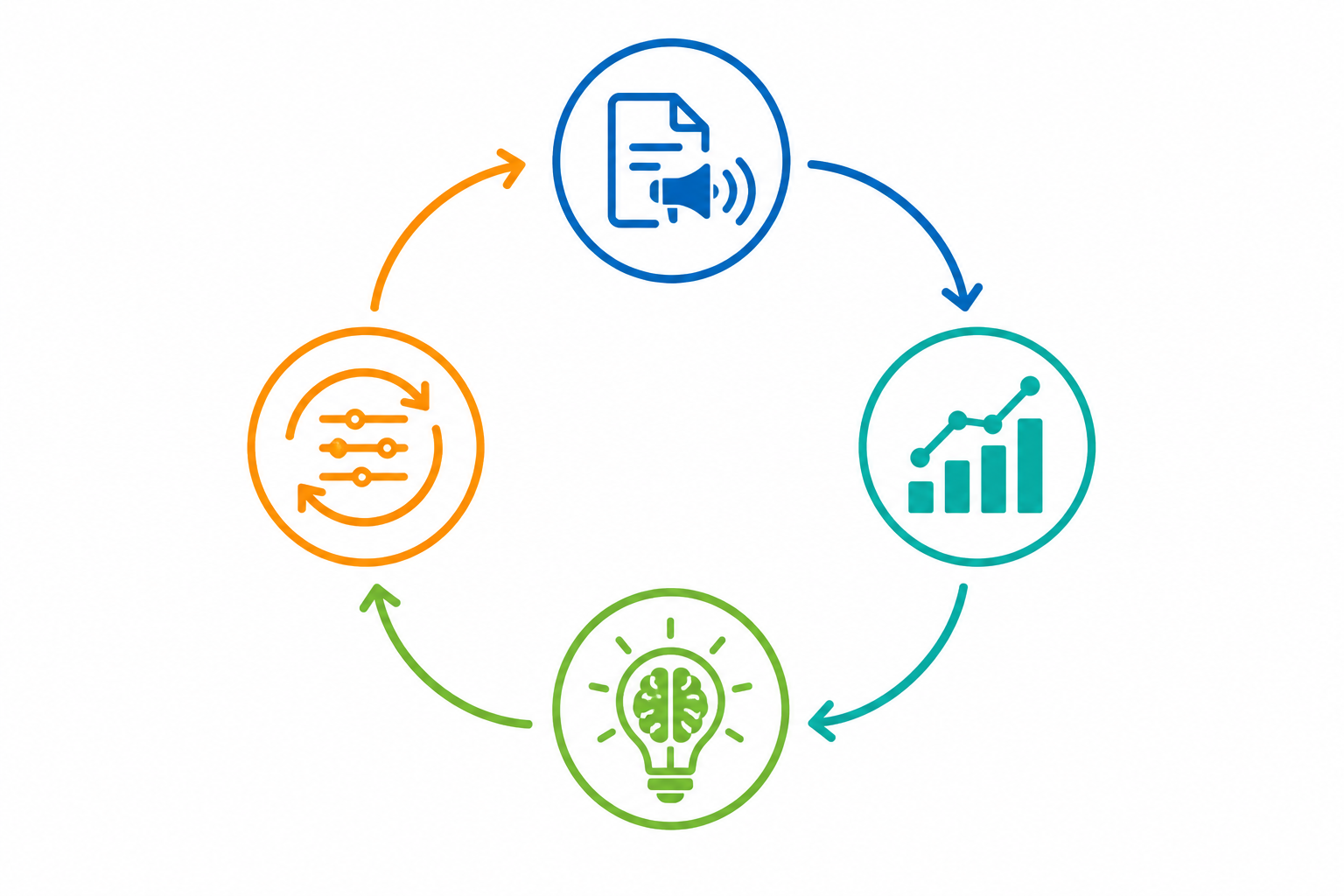
Caption: The four-stage feedback loop that separates self-learning content systems from static AI content generation.
How Machine Learning Improves Content Quality
What happens during an adaptive AI feedback cycle?
Rather than describe this abstractly, here's what one cycle actually involves in a system like ours. First, every published article is tagged with structural metadata — heading count, keyword position, paragraph length, use of lists — alongside performance signals collected over a fixed window (say, 30 days post-publish, adjusted for normal SEO ramp-up). Second, the system extracts which structural features correlate with stronger quality scores across that batch. Third, those correlations become candidate changes: a prompt adjustment, a retrieval tweak, or a rule change. Fourth — and this is the step that's easy to skip — the candidate change is tested against a held-out set of articles that weren't used to generate the pattern in the first place, to check whether the improvement generalises rather than just fitting noise in one batch. Fifth, the change only ships if it beats the baseline on that held-out set by a defined margin. Sixth, after rollout, new articles are monitored against the same benchmark, and a human editor reviews a sample before wider rollout. If performance regresses, the change is rolled back.
To be specific about what this means at Scribe: we use prompt and template adjustment, retrieval ranking, rules-based routing, and a ranking model for candidate drafts, with human review as a checkpoint before and after rollout. We do not continuously fine-tune the underlying language model on production data. That's a deliberate choice, not a limitation we're glossing over — unfiltered fine-tuning can reinforce mistakes as easily as improvements, and the held-out testing step is what keeps that risk in check.
What does the evaluation research support?
Stanford's Center for Research on Foundation Models publishes HELM, a framework for testing language models against fixed benchmarks rather than ad hoc impressions. HELM doesn't study content-marketing feedback loops specifically, but the methodology is exactly the discipline described above: collect examples, evaluate against defined criteria, update the system, then re-test against a held-out set. Without that last step, it's genuinely hard to know whether a system is improving or just drifting in a direction that happens to look good on the metric you're watching.
There's also evidence that how a system learns matters more than raw scale. In the InstructGPT paper, human evaluators preferred outputs from a 1.3-billion-parameter instruction-tuned model over the much larger 175-billion-parameter base GPT-3. That's a study about instruction-tuning generally, not content marketing, but it supports the same principle: the quality of the feedback loop matters as much as the size of the model behind it.
What can a self-learning content system not infer?
This is where I'd ask you to be genuinely sceptical of any vendor, including us. Search performance is not a safe stand-in for quality — Google's guidance on scaled content abuse explicitly warns against content whose primary goal is manipulating rankings. A well-designed system weighs multiple signals rather than optimising purely for clicks, partly because of Goodhart's law: once you optimise hard for a proxy metric, that metric stops reliably measuring the thing you actually care about. Optimise purely for click-through and you'll eventually get better headlines and worse articles.
There's a second problem: confounding variables. Backlinks, topic difficulty, search intent shifts, author expertise signals, SERP layout changes, and brand recognition can all move traffic independently of content quality. If quality scores rise at the same time traffic rises, that doesn't prove the scoring system caused the gain. A rigorous system treats this as a monitoring problem, not a solved one — it flags when outcome signals move without a corresponding change in content, rather than assuming every traffic increase validates the model.

Caption: A simplified view of how published-article data feeds back into future content generation, with held-out testing and human review as checkpoints.
Quality Scoring Explained: What Is a Content Quality Score?
Quality scores make the feedback loop measurable, but they combine genuinely different kinds of signal, and it's worth keeping two categories separate rather than blending everything into one number.
Content health score – measurable before anything goes live, and reasonable to use as a direct optimisation target:
- Readability (sentence structure, clarity, scannability)
- SEO structure (header hierarchy, meta descriptions, internal linking)
- Keyword relevance (matching search intent, not just density)
- Brand and style adherence
An illustrative weighting might split these roughly evenly — say 25% each — though the exact weights should reflect what your editorial team actually values, not a fixed formula.
Business outcome signals – measurable only after readers interact with the content, and better treated as outcomes to monitor than as optimisation targets:
- Engagement (time on page, scroll depth, bounce rate)
- Search performance (click-through rate, ranking movement)
Keeping these separate matters because outcome signals are noisy and affected by factors that have nothing to do with the article: search position, device mix, brand strength, and seasonality all shift the numbers independently. If you fold engagement straight into the same score you're optimising generation against, you risk training the system to chase whatever drives short-term clicks rather than genuine quality — the Goodhart's law problem again. A more defensible design treats the content health score as the thing you actively steer generation towards, and watches outcome signals as diagnostic evidence, reviewed by a human, before feeding anything back into the loop.
When the two disagree — high readability but poor engagement, for instance — that's useful diagnostic information about audience fit, not a sign the formula is broken. The fix is investigation, not automatically averaging the numbers together.
What matters most is the trend across a reasonable sample, not any single article. Comparing this quarter's batch against last quarter's, after waiting long enough for SEO ramp-up to settle, is a more honest test than judging one post in isolation. A steady upward trend in content health scores across several months of consistent publishing is reasonable evidence the loop is functioning — not proof, and worth pairing with periodic human review rather than treating it as the final word.

Caption: Example breakdown of a content health score, kept separate from post-publication business outcome signals.
Real-World Performance Data in Action
I want to be upfront here: I'm not going to hand you an unverified customer statistic dressed up as proof. Instead, here's an honest illustrative walkthrough of the mechanism, clearly labelled as hypothetical, plus the research context for how much weight this kind of claim should carry.
| Baseline | Intervention | Cohort | Illustrative outcome | |
|---|---|---|---|---|
| Hypothetical scenario | 8 articles/month, modest existing traffic | Self-learning system applied from article one | ~40 articles over 5 months | Content health score trending upward; traffic trending upward, direction only |
The mechanism works like this, in principle: early articles feed quality and engagement data into the loop; by article ten or so, there's enough data to start favouring structures that correlated with stronger results for that specific audience; by month four or five, assuming consistent volume, you'd expect content health scores for new articles to average higher than month one. Whether it plays out that cleanly depends on niche competitiveness, existing domain authority, and how much genuine signal exists in the traffic data versus noise. Treat any specific percentage a vendor quotes, including from us, with scepticism unless it comes with baseline traffic, article volume, timeframe, and an account of what else changed on the site.
Broader research offers a directional signal, not direct proof. A National Bureau of Economic Research study on generative AI in customer support found productivity gains were uneven — largest for less experienced workers, smaller for those already performing well. That's about customer service agents, not content writing, but it supports a reasonable hypothesis: a feedback loop likely helps more from a lower baseline, and less when a team already has strong, well-tested content practices.
When evaluating any vendor's claims, including ours, ask:
- Is the result from a single article, or sustained performance across many published pieces?
- Does the platform show quality score trends over time, or just a final traffic number?
- What timeframe does the result cover, and does it account for SEO ramp-up?
- What else changed on the site during that period — backlinks, design, other marketing activity?
A platform that answers these clearly is one worth taking seriously.
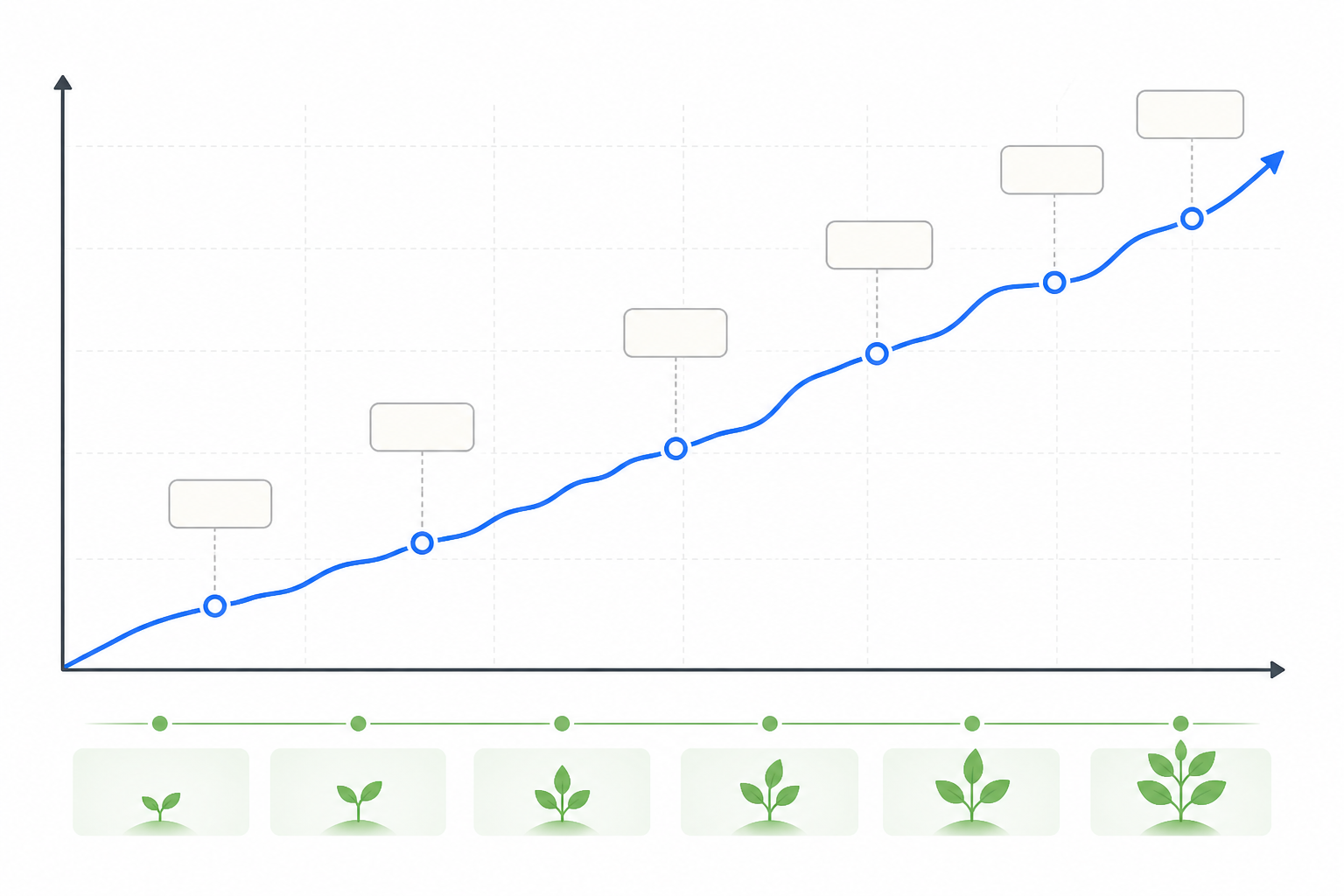
Caption: Illustrative traffic trend over a six-month publishing period. Correlation with content volume does not by itself establish causation.
Why Self-Learning Content Systems Matter for Your Content Strategy
For most marketing teams I talk to, the appeal isn't the technology itself — it's what it makes possible: scaling from a handful of posts a month to 10, 20, or 30-plus, without quality dropping off a cliff.
To make that concrete, here's how a static AI assistant, an adaptive workflow, and a fine-tuned model actually compare:
| Static AI assistant | Adaptive workflow (most platforms) | Fine-tuned model | |
|---|---|---|---|
| How it improves | Only when a human edits prompts | Prompts, retrieval, rules, ranking adjust from validated feedback | Model weights retrained on new examples |
| Data needed | None | Moderate, reviewed continuously | Large, carefully filtered |
| Typical risk | Quality ceiling never moves | Overfitting to recent noise if unvalidated | Reinforces errors at scale |
| Update speed | Manual only | Fast, incremental | Slow, deliberate |
A practical pilot design, rather than a generic checklist: start with a defined cohort — 15 to 20 articles minimum, since anything smaller makes trend detection unreliable. Set success criteria before you start (for example, content health score improving across the second half of the cohort compared with the first, with no drop in outcome signals). Review as a batch at the midpoint and end, not article by article. Keep a human editor as a mandatory checkpoint for anything touching pricing, regulated claims, or factual accuracy, regardless of what the automated score says.
For UK teams specifically, a few things need building into that pilot from the start rather than retrofitted later. Most AI content tools are benchmarked primarily on US search behaviour, so UK spelling and phrasing need explicit rules, not an assumption the model gets it right. If you're in financial services, content sits under FCA guidance on fair, clear, and not misleading communication; health-adjacent content needs a similarly high accuracy bar — either way, automated publishing at volume needs stronger human review, not less. If your analytics stack uses user-level tracking, GDPR and UK cookie consent rules affect what engagement data you can legally feed back into a learning loop, so confirm your setup is compliant before treating that data as a training signal. Accessibility under WCAG is worth building into formatting rules from day one.
A UK ecommerce team, for instance, might reasonably automate structure, SEO formatting, and internal linking through a self-learning content system, while keeping human review mandatory for anything touching pricing, stock claims, or regulated product categories. That's a sensible split of labour, not an all-or-nothing decision.
Before adopting any platform, get straight answers to: Does it show quality scores per article, trending over time? How does it handle factual accuracy for regulated or expertise-sensitive topics? Does it integrate with your publishing stack? How does it handle UK spelling, compliance, and consent requirements? What role does human review play as the system learns, and how is brand voice preserved? A vendor who can't answer these clearly isn't ready for your budget.
Frequently Asked Questions About Self-Learning Content Systems
How does AI learn from content performance?
The system tracks metrics like organic traffic, click-through rates, time on page, and content health scores, then looks for patterns in what performed well against a held-out set of articles not used to generate the pattern. Future generation is weighted towards validated patterns. This only works reliably with enough published volume and a review step to filter out noise.
What is a content quality score?
It's best understood as two things, not one: a content health score (readability, SEO structure, keyword relevance, brand adherence, measurable before publishing) and separate business outcome signals (engagement, rankings, measurable after publishing). Blending them into a single optimisation target risks training the system to chase clicks rather than quality.
Can AI actually improve its own writing over time?
Within defined parameters, yes. Most systems don't rewrite their underlying model; they adjust prompts, retrieval, and rules based on measured performance, validated against held-out articles before rollout. Over months of consistent publishing, this can show up as steadier quality scores, though it depends heavily on data quality and volume.
How do you know the system is actually improving, rather than just changing?
Compare cohorts, not single articles — for example, this quarter's batch against last quarter's, with a minimum sample of 15–20 articles per cohort. Use a held-out test set that wasn't used to generate the pattern change, and wait long enough for SEO ramp-up noise to settle, typically three to six months. Pair the trend with periodic human review rather than trusting the score alone, since outcome signals can be moved by backlinks, seasonality, or SERP changes unrelated to content quality.
Is a self-learning system the same as retraining an AI model?
Usually not. Most systems improve at the level of prompts, retrieval, rules, and ranking rather than continuously fine-tuning the underlying model, because unfiltered fine-tuning risks reinforcing mistakes. Full retraining, when it happens, tends to be a deliberate, periodic step with human-reviewed data.
Will a self-learning system still match our brand voice?
Usually, if it's set up properly. Brand voice typically comes from initial templates and style rules, with the learning layer focused on structure and SEO rather than overriding tone. It's still worth spot-checking output periodically, since drift can happen gradually enough to miss without review.
Create content like this automatically
Scribe uses AI to generate high-quality blog posts that engage your audience and drive traffic.