How to Turn Your Freelance Services Into a Subscription Clients Actually Want (South Africa Guide)

How South African Freelancers Can Use a Booking System to Sell Monthly Service Packages
The simplest way to escape hourly billing is to package the work you already do into a fixed monthly offer, like R2,500 a month for four social posts and a monthly report, and let clients book, pay and renew through a simple booking system. In this guide I'll show you which services suit this model, how to price a package so it actually pays, how to set boundaries, and how to run monthly plans and one-off appointments from a single booking page. The aim is an income that stops swinging so wildly.
No jargon, no developer needed. Just a practical plan you can start on this week. 🙂
Why Hourly Billing Can Keep Your Income Capped and Your Month Unpredictable
Picture a Joburg graphic designer. March is brilliant: three brand projects land at once and she invoices R30,000. April is quiet, and she bills R9,000. In between, she spends her Fridays chasing EFTs, answering 'any update on my quote?' messages and wondering whether the rent will clear.
That is the hourly trap, and it causes three problems.
- There's a ceiling. You only have so many billable hours in a week, and quoting, invoicing, emails and admin eat into them.
- It can punish efficiency. The faster and better you get, the less you earn for the same result.
- It makes planning hard. Rent, your load-shedding backup costs (inverter batteries, data, a power bank for the laptop) and provisional tax payments don't shrink just because you had a R9,000 month.
In fairness, hourly billing isn't always wrong. It still makes sense when the scope is genuinely unknown, when a client's needs change week to week, or when you're doing a tightly bounded fix like a few hours of troubleshooting. Many freelancers end up with a mix: monthly packages for repeatable work, project quotes for big once-offs and an hourly rate for the odd extra.
A quick honest note from me: subscriptions are not magic, and they are not passive income. You still do the work every month. What changes is that your income becomes more predictable, and you stop re-selling yourself to the same people over and over.

Illustrative example only: a freelancer's income swings between about R9,000 and R30,000 a month on hourly billing, while a recurring plan keeps it closer to a steady line.
Which Freelance Services Can Be Sold as Subscriptions?
Here's the test I'd use: does the client have an ongoing need, rather than a one-time project? If yes, a monthly package is probably a natural fit.
Freelance services that work well as monthly subscriptions
- Social media management
- Bookkeeping and admin support
- Monthly content or blog writing
- SEO upkeep and website maintenance
- Virtual assistance
- Tutoring
- Personal training and coaching check-ins
Creative work can fit too. A Cape Town photographer could offer a monthly product-photo slot for small online stores that constantly need fresh images. A Durban copywriter could write a set number of email newsletters each month for a handful of local businesses. Same skills, different packaging.
Services that are harder to sell as subscriptions, and how to repackage them
A one-off logo, a single wedding shoot or a once-off tax return is project work by nature, and forcing it into a subscription will feel awkward to your client. You can still build recurring income around it. For example, sell the brand refresh as a project, then offer a monthly design support plan afterwards for new social graphics, menus or flyers.
A subscription is also the wrong move if a client's needs are very unpredictable, if you can't realistically cap the workload, or if the client only needs you once or twice a year. In those cases, stick with project or hourly pricing.
A quick checklist: Is your service subscription-ready?
Run each of your services through these four questions:
- Recurring need: does the client need this every month?
- Predictable scope: can you describe the work in one or two sentences?
- Repeatable process: do you do it roughly the same way each time?
- Measurable monthly outcome: can the client see what they got?
Three or four yeses means it's probably subscription-ready.
You can also go membership-style: a client resource library, a monthly group coaching session or a members-only set of templates. Digital downloads can sit alongside your services on the same page, so the whole offer lives in one place.
Your first step: audit your last 10 clients and note who came back more than twice. Those are your best candidates for a first monthly package.

Four-question checklist: recurring need, predictable scope, repeatable process and a measurable monthly outcome. Three or more yeses suggest a service can be packaged.
How to Structure and Price a Monthly Freelance Package
This is where most freelancers either underprice or overpromise. Let's follow one example all the way through. Meet Naledi, a Pretoria social media freelancer who currently charges R350 an hour and wants to move her regular clients onto a monthly plan.
Step 1: Define a clear monthly deliverable
Sell an outcome, not vague availability. 'I'm on call for your marketing' invites trouble. '4 posts, 2 stories and 1 report a month' doesn't. Spell out the quantity, turnaround time, revision limits and communication channel, and say what happens to unused work.
Step 2: Work out your price from time, capacity and costs
Don't guess, and don't just divide your income goal by a price. Work through these pieces:
- Delivery time: Naledi reckons 4 posts and 2 stories take about 5 hours.
- Admin and communication: briefing, feedback and WhatsApp replies add about 1.5 hours.
- Reporting: the monthly report takes about 1 hour.
- Total: that's roughly 7.5 hours per client per month.
- Capacity: she can realistically give 80 hours a month to client work after her own admin and marketing. That's a ceiling of around 10 clients on this plan.
- Price check: at R3,200 a month, her fees on a 6% per-sale plan are R192, leaving R3,008. Divided by 7.5 hours, that's about R401 an hour, which beats her R350 hourly rate and comes with more predictability.
Now the income goal. Naledi wants about R28,000 a month in gross revenue (before fees, tax and business costs). Nine clients at R3,200 gives R28,800 gross, or roughly R27,072 after the R192 per-sale fees. Nine clients need about 67.5 hours, which fits inside her 80-hour capacity.
Two cautions. First, R28,000 is not take-home pay, because income tax and your own business costs still come out. Second, clients leave, so aim for a small buffer (say a tenth client) rather than assuming everyone stays forever. If the numbers only work when you're at 100% capacity, the price is too low.
Step 3: Build two or three package tiers
Tiers let clients choose for themselves and give you an easy upgrade path. For instance:
- R1,800: the essentials, such as 2 posts and a short monthly report
- R3,200: the core plan, such as 4 posts, 2 stories and a report
- R5,500: the full service, with faster response times and a strategy call
Make the differences obvious (deliverables, response time or strategy access) and make sure even the entry tier is sustainable for you to deliver. Run the same time-and-fee check on every tier, not just the middle one.
Step 4: Set limits on your monthly service package
Decide on the number of revisions, your response times, whether unused work rolls over and what counts as extra. Cap the monthly workload and price anything beyond it separately.
Step 5: Check South African VAT requirements
VAT in South Africa is 15 percent, but it only applies if you're registered. Registration is compulsory once your taxable turnover passes R1 million in a 12-month period, and voluntary from R50,000. On a R3,200 plan, a VAT-registered freelancer would charge R480 VAT on top, so R3,680 in total. If you're registered, decide whether your displayed prices include VAT and say so clearly. Thresholds can change, so confirm the current rules on the SARS website (sars.gov.za) or with an accountant.
A note on income tax
Monthly package income is still taxable income, so declare it to SARS like everything else. The upside is that steadier cash flow makes provisional tax easier to plan for, because you can set aside a fixed percentage of each payment instead of guessing. How much to set aside depends on your personal circumstances, so ask an accountant for a percentage that suits you.
Discounts and onboarding fees
A small discount for paying annually, or a modest onboarding fee, can work well if you have a lot of setup work. But you can also skip discounting entirely. If your price is already fair, there's no rule that says you must discount it.

Example plans at R1,800, R3,200 and R5,500 a month, with the deliverables listed under each tier. Prices are illustrative.
What a Booking System Needs to Do for Monthly Clients
If you're juggling invoices, a spreadsheet, a calendar app and a separate payment tool, every extra tool is another place for something to slip. A single link is easier for you and much easier for clients, which matters if you're not technical.
Whichever tool you choose, check that it can do these things:
- Take bookings for onboarding calls, strategy sessions and recurring appointments, so you can stop the 'does Thursday at 3 work?' back-and-forth.
- Take payment in rand and pay out into your South African bank account.
- Handle monthly payments. This is where tools differ most, and some only collect payment for a single appointment without managing a monthly charge.
- Show your terms before the client pays.
- Handle failed payments and cancellations in a way you can explain to clients.
How to bill clients automatically each month
Before you build anything, be clear on which of these you're using, because the answer shapes your whole workflow:
- A recurring or subscription charge, if your platform and payment setup support it. This is the most hands-off option, but confirm exactly how it works before you promise clients it's automatic.
- A monthly payment link or booking, sent or opened on the same date each month. It's slightly more manual, but it works with almost any setup and clients still pay by card in a few taps.
- A bank EFT or debit order arrangement, managed outside your page. It suits clients who prefer paying their bank directly, but it means more reconciling on your side.
Many freelancers start with option 2 and move to option 1 once they've confirmed it works for them. There's no shame in a slightly manual start. Your clients care about a smooth experience, not the plumbing.
How to Set Up a Booking Page on Shopstar
Shopstar is the platform we build, so I'll be upfront that this section is specific to it. I'll also say what I'm confident of and what you should check yourself.
What Shopstar offers for this setup: a simple page with your own shopstar.page link (or your own domain), a booking system, the ability to list services, memberships and digital downloads, and payment processing through Shopstar Go, which supports card, Apple Pay and Scan to Pay. Payouts go to your South African bank account.
What to confirm before you promise clients anything: whether fully automatic monthly charges are available on your plan, how billing dates work and your exact payout timing. Shopstar's features and fees can change, so check the current details on the Shopstar pricing page or ask our support team before you publish your plans. If automatic renewal isn't available for your setup, use the monthly payment link approach above and tell clients plainly how it works.
Step 1: Create your page and claim your link
Set up your Shopstar page and claim a shopstar.page URL, or connect your own domain. Then use it as your link in bio on Instagram, LinkedIn and your WhatsApp Business profile. No full website required.
Step 2: Add each plan as an offer
Add each tier as a membership or service offer with a clear name, a price in rand and a plain list of what's included. Put the billing date, your included limits and how clients pay each month right there, so nobody is surprised.
Step 3: Turn on your booking system
Use the booking system for onboarding calls, strategy sessions or recurring appointments. Clients pick a time that suits them, and you can stop the diary ping-pong.
Step 4: Check how payments will work
Payments run through Shopstar Go. Look at your dashboard to see which payment methods and billing options are available on your plan, and match your terms to what's actually switched on.
Step 5: Test it as a client
Go through the whole journey yourself, from the link to the confirmation. Check what the client sees, what the emails say and how the booking appears for you. Then think through what happens if a payment fails or someone cancels, and how you pause or restore their access.
What it costs
Shopstar has two plans:
- Start Free: no monthly fee, and 6% all-in per sale (a 2.9% payment gateway fee plus a 3.1% Shopstar fee). On a R2,500 plan, that's R150, leaving you R2,350.
- Lower Fees: a monthly fee plus 2.9% per sale. On the same R2,500, the per-sale cost is R72.50, before the monthly fee.
To choose, take your expected monthly sales and compare the totals, including the monthly fee on the second plan. With only a few clients, Start Free usually keeps things simple. As your volume grows, the lower per-sale rate can outweigh the monthly fee. These figures reflect Shopstar's published plans at the time of writing, so check the pricing page for current terms and any other costs that may apply.
Other booking and payment tools exist, and some are built specifically for recurring billing. If fully automated renewals matter most to you, compare a few options on features, fees and local payout speed before you commit. And if you'd like a hand with Shopstar, we offer hands-on onboarding support and we're happy to walk you through it.
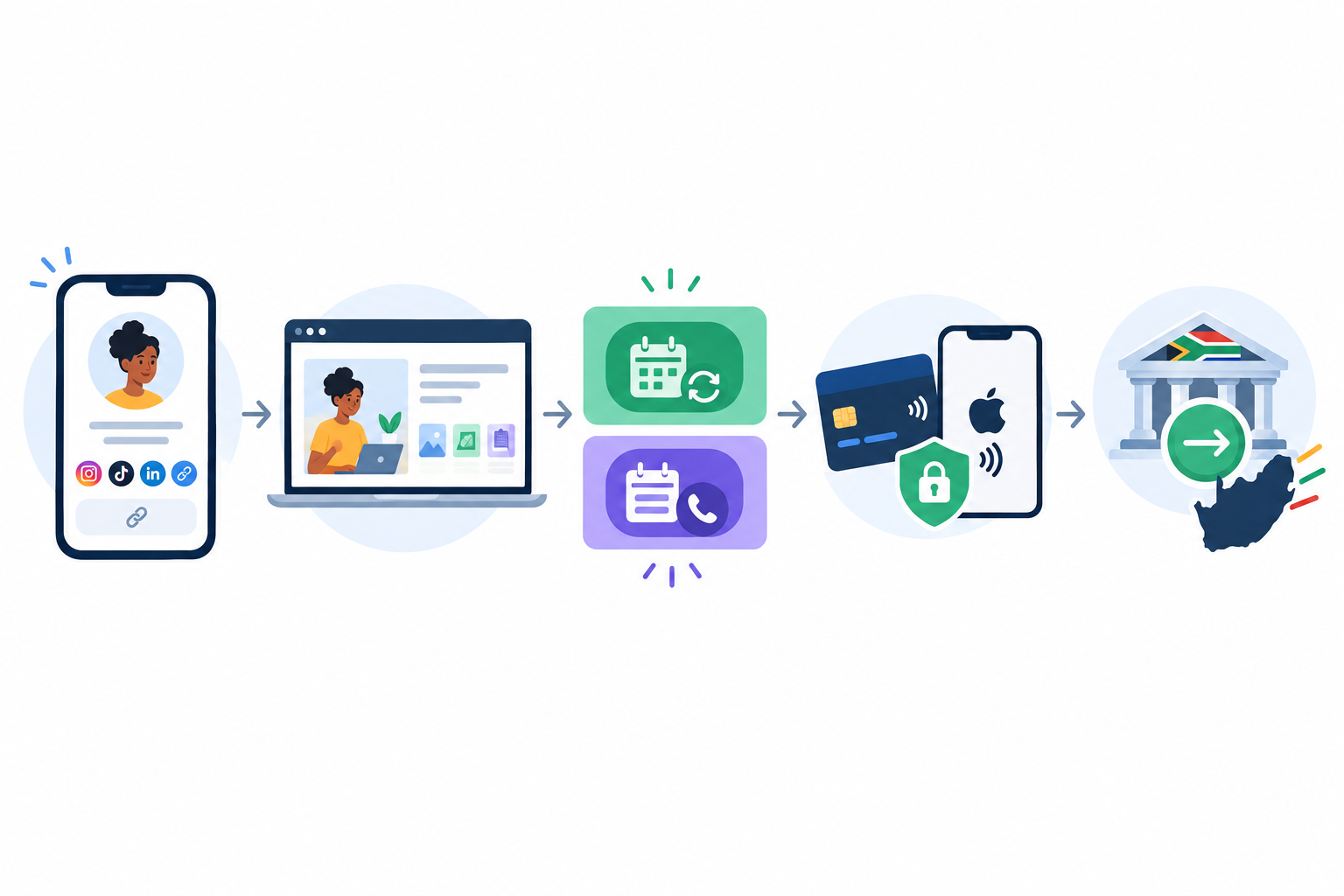
Client journey: link in bio, then your Shopstar page, then choosing a plan or booking a call, then paying by card or Apple Pay. Confirm current payout timing on Shopstar's pricing page.
Legal housekeeping, briefly
This is a short summary, not legal advice, and the rules can change.
- ECTA (the Electronic Communications and Transactions Act) expects you to give clear information about your business, the price and your terms when selling online.
- The CPA (Consumer Protection Act) may apply when your clients are individuals, and it can also cover smaller businesses below its turnover or asset threshold. It has rules on fixed-term agreements and cancellation. Where it applies, consumers can generally cancel a fixed-term agreement with 20 business days' notice, and you may charge a reasonable cancellation penalty.
- POPIA (the Protection of Personal Information Act) applies to the client details you collect. More on that below.
Whether any of these applies depends on your client and your agreement, so spell out your terms plainly. For current wording, check the National Consumer Commission and SARS websites, and get professional advice if you're unsure.
Managing Client Expectations With a Monthly Subscription Package
Let's tackle the big question honestly: will clients actually want a monthly package over one-off work? Many do, especially when it saves them the hassle of rebriefing, re-quoting and chasing you for availability. Others will prefer to pay per job, and that's fine too. You have to show the value clearly, because nobody signs up just because it's convenient for your invoicing.
How to pitch it: lead with outcomes and convenience, not billing mechanics. 'You'll have a full month of content planned, written and scheduled, without lifting a finger' lands better than 'I'd like to move you to recurring billing.' For hesitant clients, offer a trial month or a short first term.
Write a one-page scope and terms document. Keep it plain and cover:
- What's included and what isn't
- Turnaround times
- Communication channels
- Billing date and payment method
- Cancellation notice and pause rules
- How upgrades work
Prevent scope creep with a friendly script. Something like: 'That's a great idea, but it falls outside this month's plan. I can book it in as a one-off for R[price], or we can add it to next month's scope. Which would you prefer?' It stays polite and clear, and it turns a freebie request into paid work.
Keep exits easy. Use reasonable, consistent notice periods, in line with the CPA where it applies, and never make it hard to leave. Easy exits build trust, and trust is what makes people stay.
Protect client data under POPIA. Only collect what you need, store it safely and be clear about how you'll use it. A booking form usually captures names, contact details and preferences, so treat that information carefully.
Show your rhythm. A monthly report or short check-in call lets clients see what they're paying for. In my experience it's one of the best retention habits you can build.
When something goes quiet: if a client goes silent or a payment fails, send a polite reminder, allow a short grace period and then follow your stated pause or end rule. Having the rule written down means you never have to make it awkward.
Can You Combine Monthly Packages With One-Off Bookings?
Yes, you can offer both from one page, and it's often a sensible setup. One-off offers are an easy way in, and monthly packages are where your steadier income comes from.
Here's how the offers compare. All prices are illustrative, so set yours using the time-and-cost method above.
| Offer | Illustrative price | Commitment | Best use |
|---|---|---|---|
| Monthly package | R1,800 – R5,500 a month | Ongoing | Your core, repeatable work |
| One-off project | From R6,000 | Single deliverable | Rebrands, launch shoots, training days |
| Discovery call | Free | A single chat | Fit check before a bigger offer |
| Paid consultation | R650 | A single session | Strategy session that converts to a plan |
| Workshop or event ticket | R350 per seat | A single event | Reaching your wider audience |
A few ways to make this work:
- Use one-offs as the entry point. A R650 strategy session or R1,200 audit can lead naturally into a monthly plan.
- Keep monthly packages for core work and one-offs for extras like a rebrand or a launch shoot.
- Add event ticketing. A paid workshop for your wider audience raises your profile and can feed your package clients.
- Consider pricing one-offs higher per hour. Clients are committing less and you're getting less certainty, so the rate can reflect that.
- Add digital downloads. Templates, checklists and guides make low-priced extras that also build your credibility.
And keep the page simple: three to five offers at most, clearly labelled so visitors know exactly where to click.
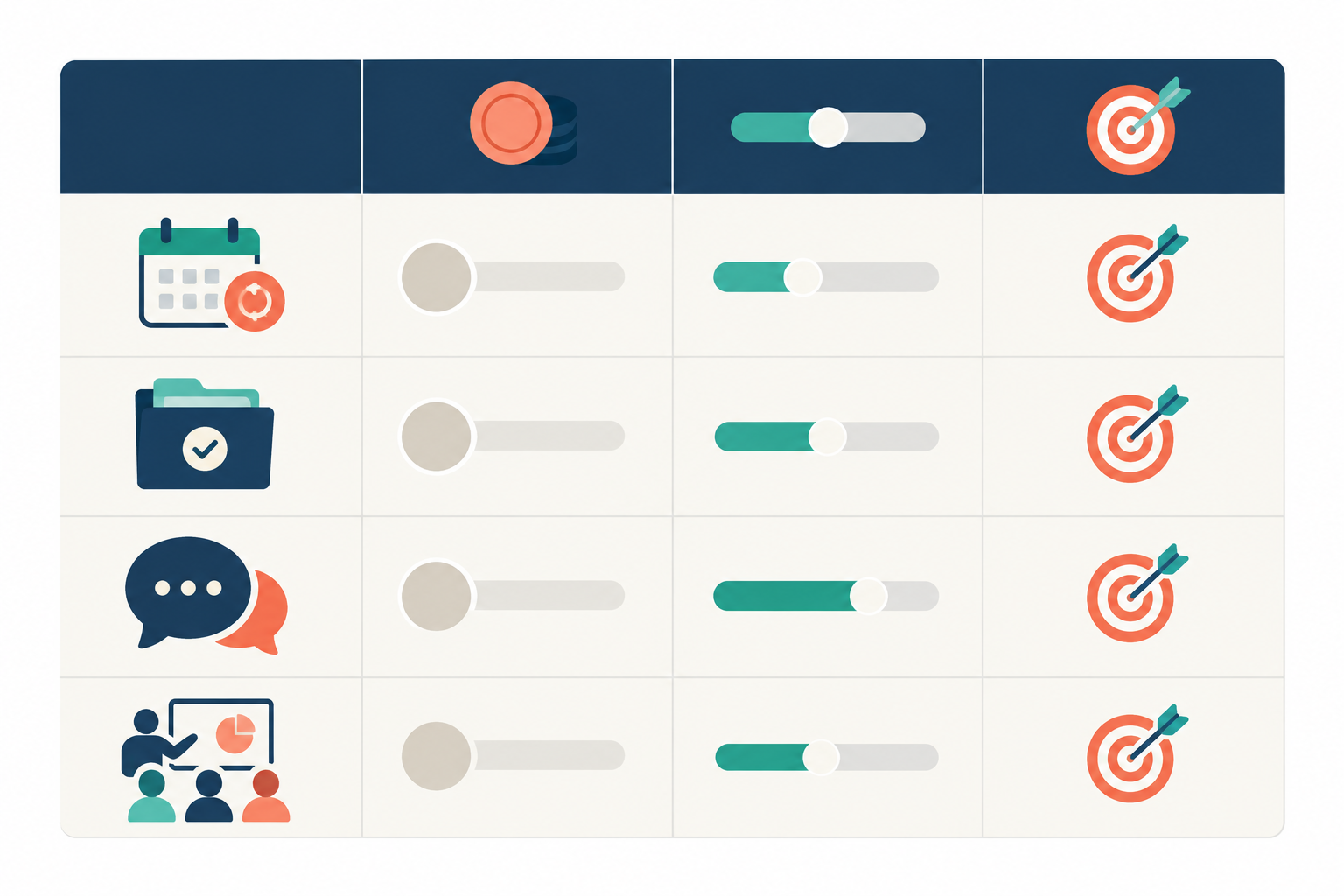
Comparison of a monthly package, one-off project, discovery call and paid workshop by illustrative price in rand, commitment level and best use.
Your First 30 Days: A Realistic Plan to Launch
You don't need to overhaul your business overnight. Here's a month-long plan.
- Week 1: audit your current clients and pick one service to package. Work out your time, capacity and price, and write the scope.
- Week 2: build your page and booking flow, add your terms, confirm how monthly payment will work and run a test purchase.
- Week 3: pitch your two or three best existing clients personally. A short, warm message beats a general announcement.
- Week 4: review what happened, tweak the wording and the tiers, and then share your link in bio more widely.
Set a realistic goal, like moving three clients onto monthly plans before you expand. For many freelancers, that alone changes how the month feels.
You don't need a full website or a technical background to do this, and we're here if you want help getting set up. When you're ready, you can start with Shopstar's free plan and see how it feels with your first client.
Prices, fees and legal thresholds in this guide reflect what we could confirm at the time of writing. Please check the current details with Shopstar, SARS and the National Consumer Commission before you act on them.
Frequently Asked Questions About Booking Systems and Monthly Freelance Packages
What kind of freelance services can be sold as subscriptions?
Anything with an ongoing, repeatable need: social media management, bookkeeping support, content writing, website maintenance, virtual assistance, tutoring, coaching and fitness training. One-off projects like a logo can be paired with a monthly support plan. Work with unpredictable scope is usually better priced per project or per hour.
How do I bill clients automatically each month?
It depends on your payment setup. If your platform supports recurring charges, set up each plan as a subscription or membership and confirm exactly how billing dates, failed payments and cancellations work before you promise clients automatic renewal. If it doesn't, you can send a monthly payment link or booking on the same date each month, or arrange a bank EFT or debit order. With Shopstar, check your dashboard or ask our support team which billing options are available on your plan.
Will clients actually want a subscription over one-off work?
Many will if the plan saves them time, gives them priority access or lowers their cost per deliverable. Others won't, and that's okay. Start by offering it to existing clients who already come back regularly, and consider a short trial period for people who are hesitant.
Can I offer both subscriptions and single bookings?
Yes. You can list a monthly plan alongside one-off appointments, workshops or digital downloads on the same page, so clients can start small and upgrade when they are ready.
Do I need to charge VAT on my subscriptions?
Only if you are registered for VAT with SARS. Registration is compulsory once your taxable turnover exceeds R1 million in any 12-month period and voluntary from R50,000. VAT is 15 percent, so confirm with SARS or an accountant whether your prices should be quoted inclusive or exclusive.
Does the Consumer Protection Act apply to my client agreements?
It can, particularly when your clients are individuals, and sometimes smaller businesses below its threshold. The CPA has rules on fixed-term agreements and cancellation, so keep your terms fair and plain, and get professional advice if you are unsure how it applies to your services.
Related Articles

5 Tips to Get Paid Faster as a Freelancer or Service Pro
Tired of chasing invoices and proof of payment? Here are 5 practical tips for South African freelancers and service pros to get paid faster, from upfront payments to a booking system that collects money for you.
How to Set Up a Booking System That Gets You Paid Instantly
Set up a booking system that takes payment upfront in rand, sends reminders and cuts late payments and no-shows, without needing a separate website.
Create content like this automatically
Scribe uses AI to generate high-quality blog posts that engage your audience and drive traffic.