How to Use Competitor Ad Data to Build a Creative Testing Roadmap

The best way to build a creative testing roadmap from competitor ads is to watch what your rivals keep running. Longevity is a useful (if imperfect) clue about what they're investing in. Turn those patterns into testable hypotheses about your own audience, then rank them by potential impact and effort. Put the strongest into a test calendar that suits your budget, and feed every result back into the next cycle. Done right, you borrow the signal, not the creative.
That's the short version. The rest of this post is the practical one: how we'd actually do it, step by step, with a scoring model, a calendar and a checklist you can steal. It works the same whether you're a UK in-house marketer or an agency juggling ten clients.
Why competitor ads make great raw material for a creative testing roadmap 🎯
Most testing backlogs stall for a boring reason: the ideas are guesses from a brainstorm. Someone says 'what if we tried a founder video?', everyone nods, and three weeks later nobody can remember why it seemed like a good idea. Ad creative testing only works when you have a steady stream of ideas worth testing, and a reason behind each one.
Competitor ads are a handy source of that stream. Your rivals run experiments every week, and the ones they keep running are visible if you know where to look. Someone has already paid to put those angles in front of your market, so they make a far better starting point than a blank whiteboard.
Let's be honest about the limits, though. You can't see their spend, conversion rate or ROAS. Public ad libraries show what's running and what it looks like, not whether it's profitable. So competitor data informs hypotheses and never proves them. Your own results are always the judge. (I'll keep that in mind throughout, but I won't nag you about it.)
The framework we use fits in one line: observe, hypothesise, prioritise, schedule, learn, then loop back to observe.
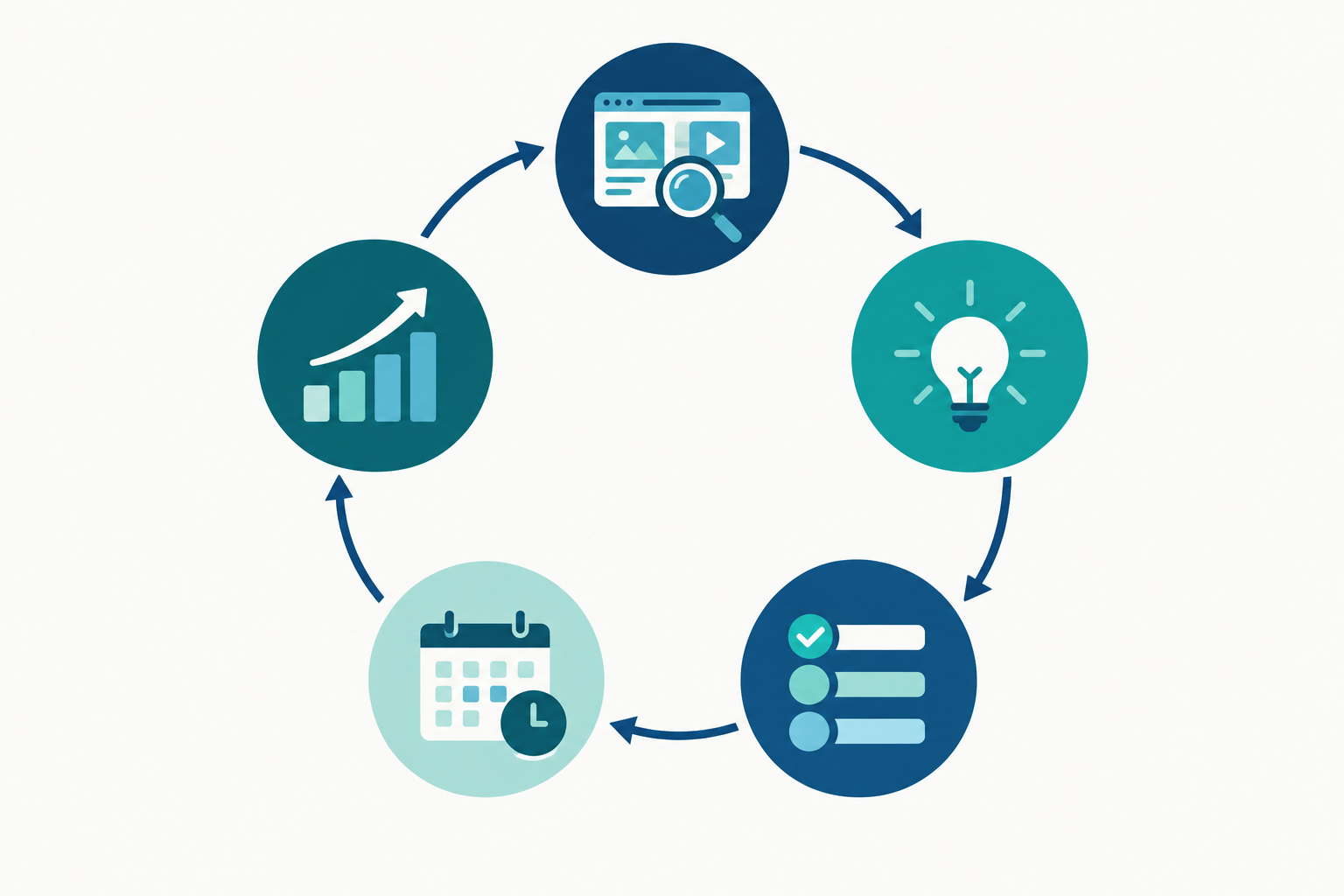
Why give this process proper time? Because creative is one of the few levers you fully control once targeting and bidding are largely automated. A deliberate roadmap means creative decisions get made on evidence, not in the gaps between reporting tasks.
Start with what competitors keep running
The first job is to find the ads that stick around. Advertisers generally have an incentive to switch off ads that clearly aren't working, so when a creative has been live for six weeks or more while its siblings have quietly disappeared, it may be worth a closer look.
'May' is the operative word. An ad can persist because it's evergreen, cheap to maintain, aimed at a tiny audience, or simply forgotten. Run time and variant counts don't reveal profitability or budget. So we log longevity as a hypothesis to investigate, not a performance result.
Start free, then notice where it breaks
The Meta Ad Library is the obvious free baseline. You can see a competitor's active ads, creative variations and, in many cases, start dates. For a first pass, it's brilliant. Two others are worth pairing with it:
- TikTok Creative Center (Top Ads) lets you browse by market and category and inspect openings, formats and calls to action. It surfaces selected high-performing ads, so it's great for ideas but gives you an incomplete picture of any one brand.
- Google Ads Transparency Center shows ads from verified advertisers across Google surfaces and regions.
Where manual checking falls over is history. The libraries show you today. They don't tell you what was live last Tuesday, there are no diffs, and ads that were quietly stopped simply vanish. If you check once a month, you'll miss the interesting bit, which is the movement.
Track weekly competitor ad changes, not just snapshots
Whatever tool you use (even a spreadsheet and a calendar reminder), a week-over-week comparison separates three things that matter for a roadmap:
- New: what they've just started testing
- Stopped: what they've apparently moved on from
- Continuing: what's still live, including new variants of the same idea, which may point to continued testing or investment
None of these tells you what's profitable. Together, they tell you where a competitor's attention is going, and that's exactly what you want when generating hypotheses.
Disclosure: we make Rival Ads, a tool that automates this weekly comparison. There's a short note on it at the end of the post, but the process works without it.
Look across platforms for creative testing ideas
The same brand often tells different stories on different channels. Their TikTok ads might be scrappy, creator-led and problem-first, while their LinkedIn ads lean on ROI proof and case studies, and the Google Ads Transparency Center might show a price-led search message. To be clear, you're observing the messages they choose to show, not accessing any tracking or conversion data. Each one is a different angle on the same audience, and you want all of them in your log.
What competitor ad data should you log?
Keep observation and inference separate. For every ad, record:
- Advertiser, platform, market and first-seen date
- Format (static, UGC video, carousel, founder-led and so on)
- Hook (the first line or first three seconds)
- Offer
- Angle (the audience problem or desire it speaks to)
- CTA and landing page
- Run time
- How many variants of the same idea exist
- Your confidence in the pattern
One thing I pay attention to: when a competitor launches several variants of a single concept in one week, I treat it as a flag. Maybe they're testing hooks around an idea they like. Maybe it's just a short promotion. I can't tell which from the outside, so those clusters go to the top of my watch list, and not my copy list.
Re-check periodically, too. A single snapshot can mistake a short test or a seasonal promotion for a durable strategy.
Turn competitor ad observations into testable hypotheses
A folder of screenshots isn't a roadmap. Here's how we turn raw observations into something a media buyer can launch.
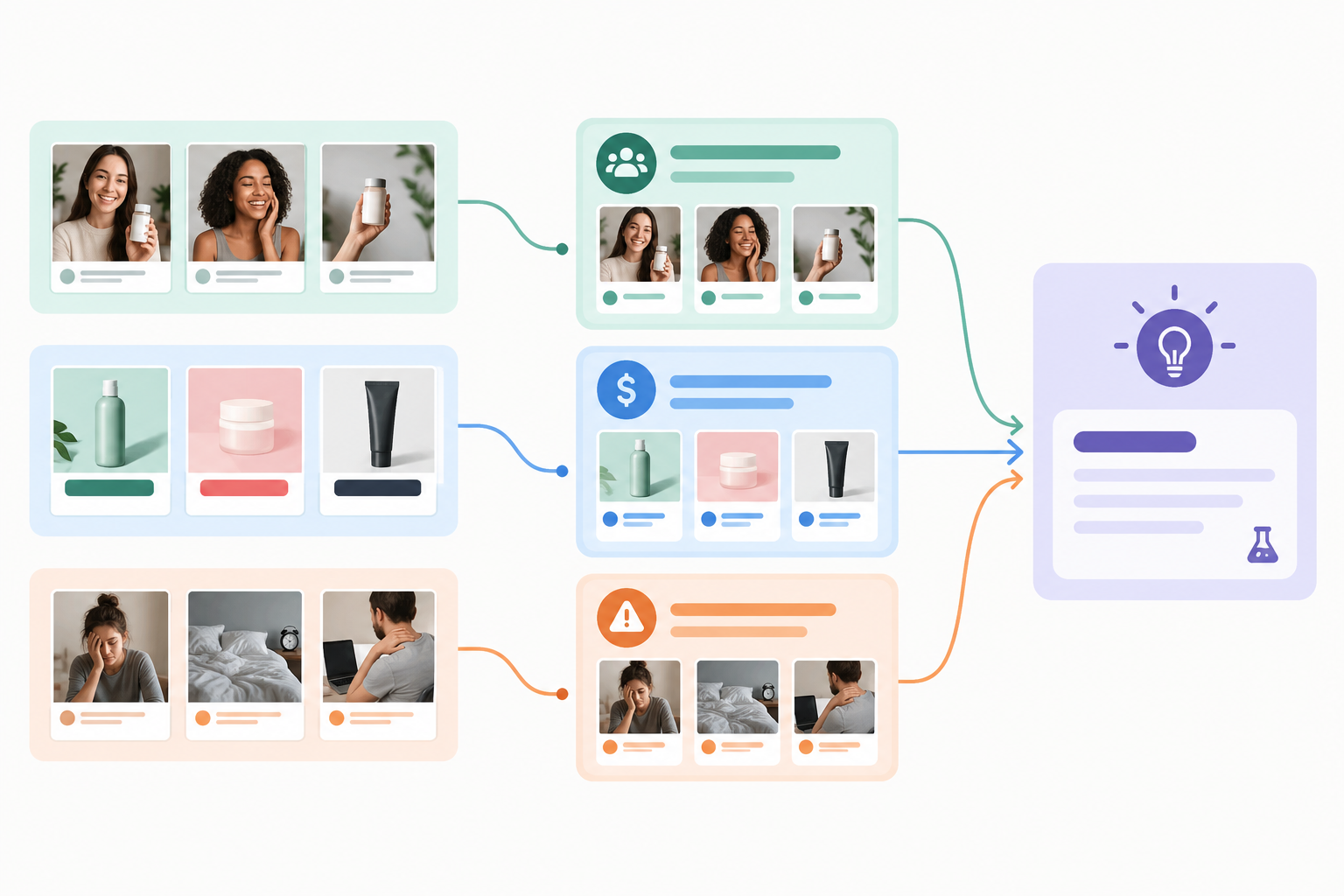
- Cluster ads into patterns. Don't look at single creatives. Group them into founder-led video, UGC testimonials, price-led static, comparison ads and so on. A pattern that appears across several ads, or several advertisers, tells you far more than one standout.
- Ask why it might work for them, then whether the same logic applies to you. Perhaps a rival's testimonial ads work because their product is a high-trust purchase. Is yours? If you sell a low-cost impulse buy, the logic may not transfer.
- Write each idea as a hypothesis. Use a simple template: If we [change], then [metric] will [improve] because [reason]. The 'because' is the important bit. It forces you to say what you'll learn even if the test loses.
- Isolate one variable per test: hook, format, offer or proof. Change all four at once and you'll have a result you can't read. If several rival ads use a testimonial-led opening but vary the offer, test the opening and the offer as separate hypotheses.
![Infographic: Infographic showing how competitor ad observations are clustered into patterns (UGC testimonials, price-led static, problem-first hooks) and converted into a hypothesis card using the template 'If we change for Use Competitor Ad Data to Build Your Creative Testing Roadmap, then [metric] will [improve] because [reason]']
A worked example: turning a competitor ad pattern into a test
Say your weekly comparison shows a rival has stopped their product-demo videos and started launching ads that open with a customer complaint ('I was sick of paying for X that never worked'). Several variants appear in the same week, and they're still live the week after.
That's a pattern, not a verdict. Your hypothesis might read:
If we open our existing video ads with a customer-frustration line instead of a product shot, then click-through rate (CTR) will improve, because problem-first openers speak to the pain our audience recognises before asking them to care about features.
Notice what's borrowed (the idea of problem-first openers) and what isn't (their footage, their words, their offer). You'd write the complaint from your own customer research.
How to prioritise ad creative tests
After a few review cycles you'll have more ideas than budget. Good. That's when a scoring model earns its place.
We like ICE (impact, confidence, effort), scored 1 to 5 and adapted for creative work:
- Impact: how big could the lift be on a metric that matters, such as CTR, conversion rate (CVR) or cost per acquisition (CPA)? To keep scores consistent, agree a rubric up front. For example, 5 = could plausibly move your primary KPI, 3 = likely to move a secondary metric, 1 = cosmetic change.
- Confidence: how much evidence supports the idea? Several independent advertisers on the same angle for a good stretch of time, plus support from your own customer research or past results, means higher confidence. Competitor evidence alone should never earn a 5.
- Effort: production time, budget, approvals, and whether you need new footage or just a new headline. Score it so that 5 means easy and 1 means painful, which keeps a higher total always better.
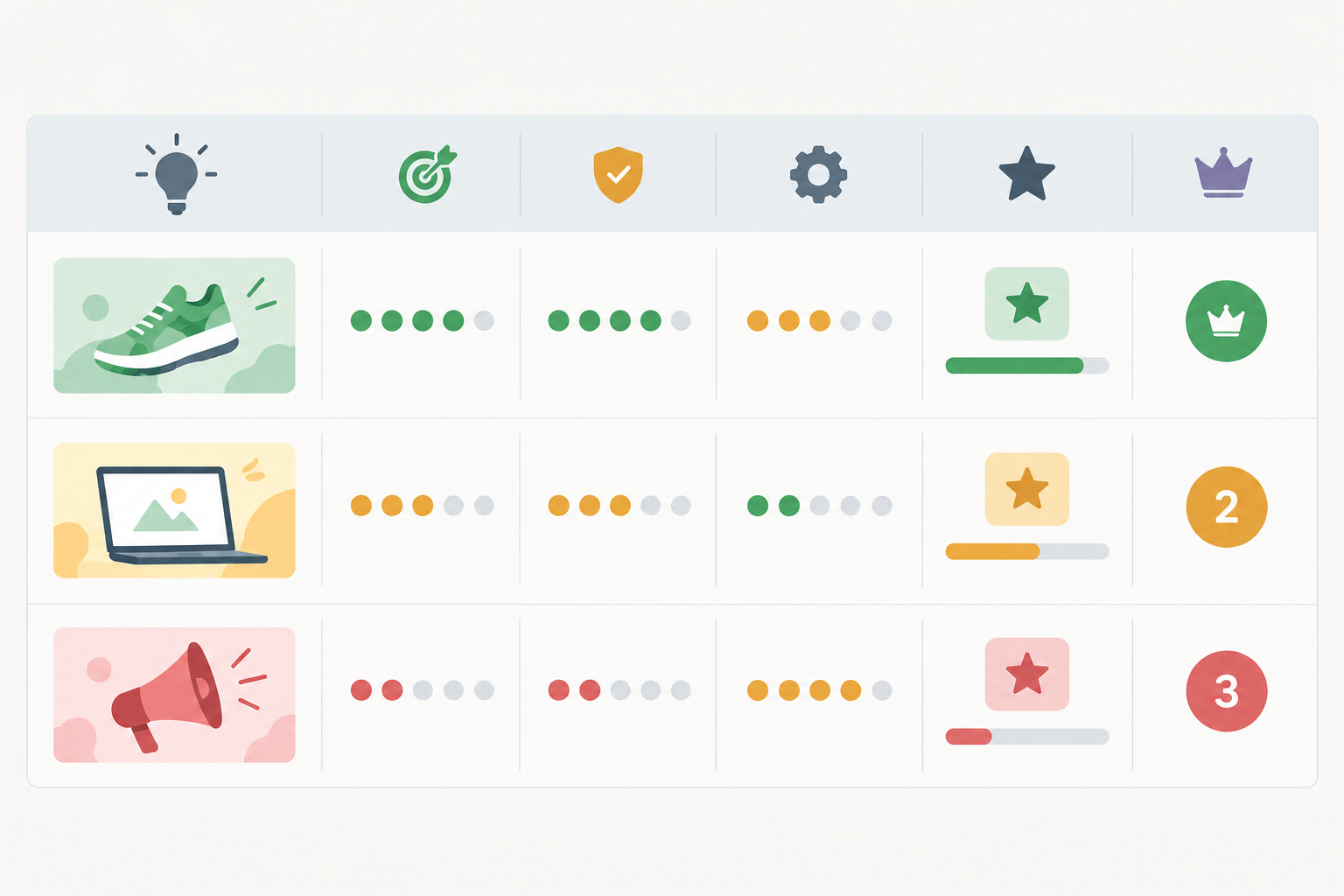
Here's an illustrative example with three hypotheses scored side by side:
| Hypothesis | Impact | Confidence | Effort (5 = easy) | Total | Order |
|---|---|---|---|---|---|
| Problem-first hook on existing UGC videos | 4 | 4 | 4 | 12 | 1st |
| Price-led static versus benefit-led static | 3 | 4 | 5 | 12 | 2nd (tie-break: lower impact) |
| Founder-led video explaining the 'why' | 4 | 3 | 2 | 9 | 3rd |
A quick word on the maths. These are subjective scores, so a total of 12 versus 11 isn't a meaningful gap. Use ICE to start a sensible conversation and break ties, not to pretend you've measured anything precisely. Here the first two tie, so we'd launch the problem-first test first because its upside is bigger. The founder video isn't a bad idea. It's just expensive for the confidence we have right now, so it waits.
One tip: reserve a slice for wildcards. Keep roughly one test in four for an idea no competitor is running. Gaps in the market can be as valuable as trends. If everyone in your category is price-led and nobody is leading with proof, that silence is a hypothesis too.
Avoiding competitor ad copycat traps
This is where competitor-led testing goes wrong, so it deserves a proper look.
- Copy the insight, not the execution. Borrow the angle, the structure or the proof type, then rebuild it in your own voice and visuals. A useful way to think about it: test the underlying concept first (say, benefit-led versus demonstration), then test hooks and visuals within the stronger concept.
- Know why direct copying is risky. You get brand confusion, potential IP issues, and zero differentiation in the feed. If a customer could mistake your ad for theirs, you've paid to advertise your competitor.
- Check your own data first. A rival's approach might rely on a brand awareness or pricing advantage you don't have. Their 'we're the cheapest' message works if they actually are.
- Watch for the herd effect. If everyone runs the same angle, it might be saturated rather than proven. Ten brands shouting about 'convenience' doesn't mean convenience still cuts through.
- Ask 'what would make this ours?' before anything goes into production. Translate the observed message into your own customer insight, product proof, tone or point of view.
- Remember the archive limits. Ad libraries differ by platform, country and category. What you see is evidence of what a brand chooses to say, not proof that it pays off.
Burger King's 2019 Whopper Detour is a good picture of the right spirit. It responded to a competitor's presence (McDonald's locations) with a completely distinct mechanic and brand voice, rather than lifting anyone's creative. It isn't evidence that watching rivals improves performance, but it shows what 'competitor-aware, not competitor-copying' looks like.
UK advertising compliance: check before you adapt
If you advertise in the UK, your ads need to follow the CAP Code, which the Advertising Standards Authority (ASA) enforces. Three areas matter most when you're inspired by a rival:
- Claims: you need evidence to back up any objective claim before the ad runs, whatever a competitor is saying.
- Comparisons: comparative ads must be fair, verifiable and not misleading, and shouldn't denigrate a competitor unfairly.
- Testimonials: they should be genuine, and endorsements or influencer content must be clearly identifiable as advertising where relevant.
The ASA and CAP publish detailed guidance on all of these on asa.org.uk. This is general editorial guidance, not legal advice. If a rival's ad is bold on claims, that doesn't mean yours can be, so run anything borderline past your compliance lead or legal adviser before launch.
Build a monthly creative testing calendar
A roadmap only works if it turns into a rhythm. There are two cadences here, and it helps to keep them apart. Competitor monitoring runs weekly (what changed?), while testing runs on a monthly planning cycle (what are we launching and learning?). Here's the month we'd run as a starting point. Treat it as a planning template, not a platform-mandated schedule.
How many creative tests should you run at once?
As a rough guide, two to four concurrent tests per channel suits accounts with decent budget and conversion volume. If your account is smaller, run one or two. Each variant needs enough spend and enough conversions to show a readable difference, so don't split a small budget across too many ideas. Fewer, cleaner tests beat lots of underfunded ones. Where you can, use the platform's own A/B testing tools and keep audience, offer and delivery conditions as consistent as practical.
A four-week creative testing cycle
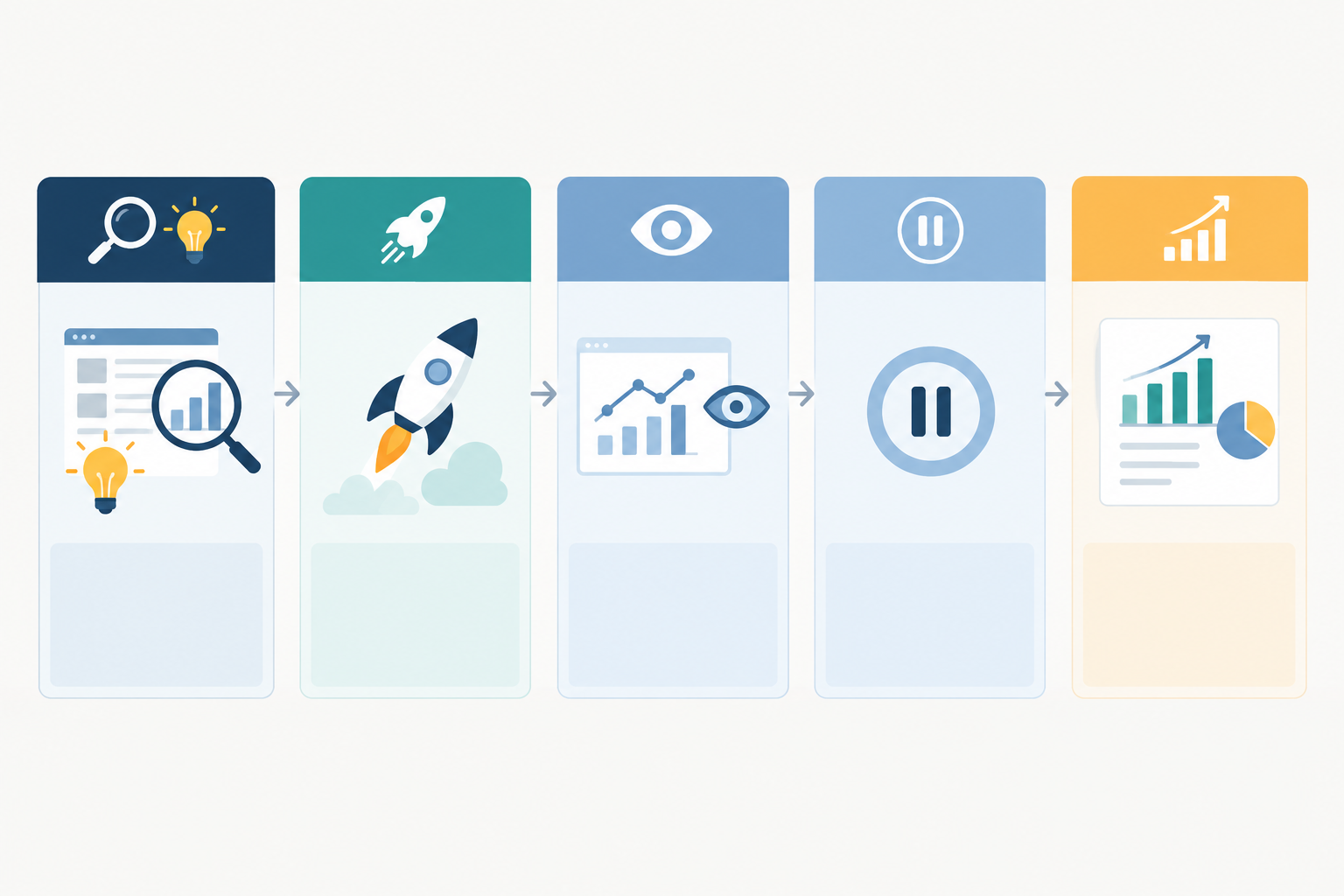
- Week 1: review and refresh. Go through the competitor changes from the past few weeks (new, stopped, continuing), update the hypothesis backlog and re-score anything that's shifted.
- Week 2: launch. Put the top-ranked tests live. Briefs and creative should be ready before the week starts, otherwise launch slips into week 3 and the whole month goes sideways.
- Weeks 3 to 4: hold your nerve. Let tests run and resist early calls. A strong first-day result often fades. Meanwhile, keep noting competitor shifts, because a rival stopping a similar angle mid-test is worth recording.
- End of month: read, document, re-rank. Close out tests, log the learnings and re-rank the backlog for next month.
One honest caveat: four weeks is a planning unit, not a guarantee. If your account gets low conversion volume, or your sales cycle is long, a test may need six to eight weeks (or a bigger, bolder change) before you can trust the result. Let the data volume set the end date, not the calendar.
A creative testing roadmap template you can copy
In Notion, Google Sheets or Asana, create one row per test with these columns: hypothesis, creative variable, format, audience, competitor evidence, launch date, end date, primary metric, decision, next step. Add a status column (backlog, in brief, live, read-out, done) and you've got a lightweight testing programme.
Here's an illustrative entry. Several meal-kit brands emphasise convenience in their ads. Your test is a convenience-led opening versus a taste-led opening, using your own product footage and brand voice. That's an original test sparked by a market pattern, not a claim about anyone's results.
Close the loop with ad creative testing results
The testing calendar gets the glory, but the learning log is where the compounding happens. After every test, record the hypothesis and the variants, the spend and primary metric result, the decision (scale, iterate, stop), and what you'll do next.
Then do something most teams skip: compare your result to what competitors did next. Did they keep, tweak or drop a similar angle? If your problem-first test won and a rival has just added more variants in the same style, that's reassuring. If your test won but they've dropped it, ask what they might know that you don't (or whether your audiences simply differ). It's a sense-check, not a verdict.
Turn winners into iterations with new hooks, new formats and new audiences. Treat losers and inconclusive tests as learnings, not failures, because a clean 'no' saves you from spending next quarter's budget on the same idea. Share a one-page summary with the wider team and stakeholders each month covering what we tested, what we learned and what's next. It builds trust in the programme faster than any dashboard.
For agencies
If you run this for clients, the roadmap and competitor reporting make a very sellable deliverable: here's what rivals are doing, here's what we're testing because of it, here's what happened. Keep each client's competitor set, backlog and learning log separate, and make sure account managers only see their own clients. That structure is what lets the process scale beyond a handful of retainers.
And if you're just starting out? Keep it small: one competitor, one month, three tests.
A quick-start checklist for your first creative testing roadmap ✅
- Pick 3 to 5 direct competitors and note which platforms they use
- Set up a weekly routine (manual or automated) so you see changes without ad hoc checking
- Log the long-running ads and cluster them by angle
- Write 8 to 10 hypotheses and score them with ICE
- Schedule the top 2 to 3 tests into the next four to six weeks, depending on your budget
- Book a monthly review in the diary
- Check claims, comparisons and testimonials against the CAP Code before launch
The creative testing roadmap in a nutshell
The loop is simple. Watch what competitors keep running, turn the patterns into hypotheses with a clear 'because', score them, schedule a manageable number of tests, and write down what you learn. Competitor ads give you a better supply of ideas, but they can't tell you what works for your audience. Your own test results do that, and every cycle makes the next backlog sharper. Borrow the signal, build your own creative, and let your data have the final say.
Optional tool note: if you'd rather not do the weekly monitoring by hand, we built Rival Ads for exactly that. It tracks competitor ads across Meta, Google, TikTok and LinkedIn, flags what's new, stopped and continuing each week, adds an AI-generated summary of the changes, and offers whitelabel reporting for agencies. Plans start at $29/month. The framework above works just as well with a spreadsheet.
FAQ
How do I come up with test ideas from competitor ads?
Look for patterns rather than individual ads. Note which angles, formats and offers appear repeatedly or stay live for a long time, then turn each pattern into a hypothesis about why it might work and whether it would work for your audience.
How many creative tests should I run at once?
If you have a healthy budget and conversion volume, two to four tests per channel is a sensible range. With smaller budgets, one or two is plenty. Each variant needs enough spend to produce a readable result, so fewer, cleaner tests beat lots of underfunded ones.
How do I avoid copying my competitors?
Borrow the underlying insight, such as the hook type, the proof style or the offer structure, and rebuild it with your own brand voice, visuals and product truth. If someone could mistake your ad for theirs, go back to the drawing board.
How do I prioritise which creative tests to run first?
Score each hypothesis on impact, confidence and effort, then use the totals as a guide rather than a precise ranking. Competitor evidence, such as several rivals running the same angle for weeks, can raise your confidence score, while production complexity lowers your effort score.
Does a long-running competitor ad mean it is performing well?
Not necessarily. A long run time may indicate continued investment, but it can also reflect an evergreen ad, a small budget or a forgotten campaign. Ad libraries don't show spend or conversions, so treat longevity as a prompt for a hypothesis, then test it with your own audience.
Related Articles

Create content like this automatically
Scribe uses AI to generate high-quality blog posts that engage your audience and drive traffic.