
Loading...
Competitor ad messaging is one of the best positioning signals you can get, because brands put real money behind the claims they hope will win customers. If you track what they say, who the copy seems to speak to, and how it changes week to week, you can often spot a strategic shift well before it reaches a press release or the homepage.
The catch is that ads are clues, not confessions. This guide covers how to read those clues without over-reading them, how to weigh your confidence, and how to turn what you find into sharper decisions for your own brand. I'll share the framework we use, the traps to avoid, and a lightweight routine that won't eat your week.
Ad messaging shows you four things: the promise a rival leads with, the proof it uses to back that promise up, the audience the copy appears to address, and the offer it wants people to take up. When those four change over time, that's the best early hint that a competitor's positioning is moving.
What ad copy can't show you is why the change happened, how well it performed, or what the company plans next. Hold that thought, because it shapes everything below.
Ads are paid bets. Every headline is something a competitor is willing to test in a specific market, for a specific audience. Advertisers run ads to test hypotheses, build awareness, hit campaign plans and sometimes just to keep a channel warm. But they rarely pay to say things that contradict how they want to be seen.
Compare that with a homepage or a brand guidelines deck. Those change slowly and are written to please everyone: investors, recruits, partners, customers. Ads get tested, rotated and retired much faster, so they give you a quicker read on what a company is trying to say right now.
How you read them matters. Treat these as weak-to-moderate clues, not proof:
Public ad libraries generally don't show results, spend, delivery or the reason an ad was stopped. So treat duration and duplication as signals to corroborate, not conclusions. Ad copy is evidence of expressed positioning, not proof of a company's full strategy. Check any hypothesis against their product pages, pricing and other public messaging.
The best-known campaigns show how explicit positioning can get. Avis's 'We Try Harder' made its number-two status part of the message and turned it into a promise of greater effort. Dollar Shave Club's launch video used irreverent humour and a direct-to-consumer offer to put convenience and value front and centre. In both cases, the ad was the positioning.
Each platform shows a different slice of the story. Availability and features change, so check what each library currently shows before you build a process around it.
Checking four platforms by hand is patchy. Ads disappear before you can screenshot them, copy gets edited, and nobody remembers what a competitor's campaign looked like six weeks ago. Without a dated record you can't see change, and change is where the insight lives.
A quick personal note: the most interesting moments I see in competitor sets are rarely a single dramatic ad. They're quiet patterns, like a core message getting paused while a new angle shows up in three formats. You only catch those if you're looking week over week, and even then they're a prompt for a hypothesis rather than a verdict.
When I open a competitor's ads, I run each one through the same six lenses. It keeps me honest and stops me getting seduced by a clever headline.

One tip: read ads in a batch, not one at a time. Patterns matter far more than any single creative. One ad is an experiment. Eight ads making the same claim in different ways starts to look like a strategy.
This is where tracking over time pays off. A value proposition shift is when the lead benefit a competitor sells changes, say from 'cheaper' to 'smarter', or from product features to customer outcomes. Apple's 'Shot on iPhone' is a neat example of the latter: camera specs gave way to what customers could create.
Here's the process I'd follow.
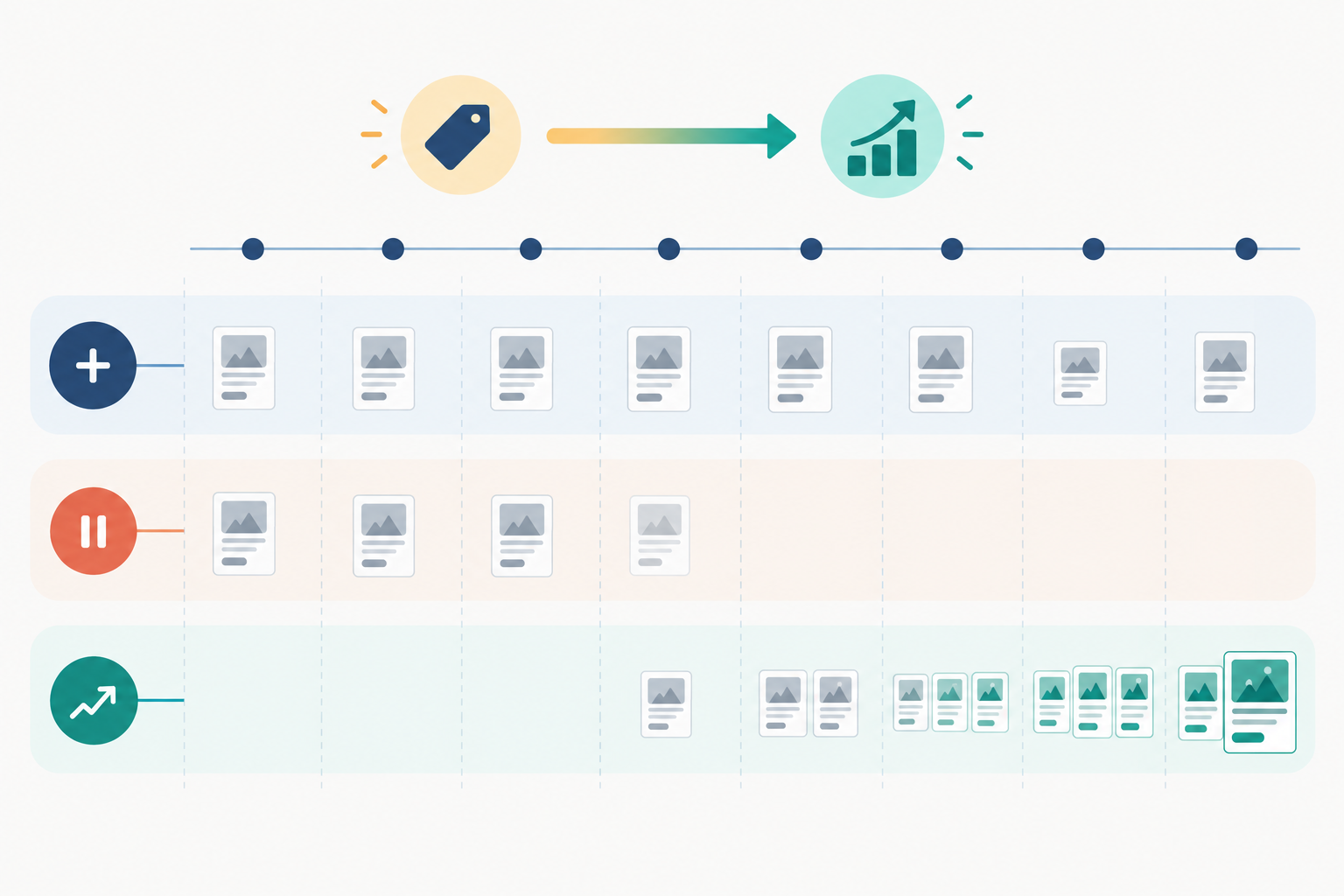
The most common mistake I see is treating every change as equally meaningful. Try this instead:
Only act strategically at medium-to-high confidence, and only when independent signals agree. Even then, you're working from a hypothesis.
Imagine a SaaS competitor that's spent a year running ads like 'Project management that won't break the bank' aimed at small teams. This is a hypothetical scenario, but here's how the signals might stack up over eight weeks:
No single signal proves anything. Together, though, they make a credible case that this competitor is moving away from the budget end of the market. That's also a possible opening for you, which we'll come back to.
Not every change is a pivot. Before you rewrite your strategy, rule out these:
A good habit is to test at least one alternative explanation for every apparent shift. If a new audience, a launch or a market event explains it just as well, hold your conclusion lightly.
Words matter, but so does how they're said, and where. Tone and platform mix can be early hints that a competitor is courting a different customer. They're hints, though, not guarantees.
For tone, watch formal versus casual language, jargon versus plain English, urgency versus reassurance, and humour versus authority. Say a brand with a long-established playful voice suddenly drops the jokes and starts sounding polished and authoritative. It may be eyeing larger or more risk-averse buyers. Or it may just have a new agency.
Platform behaviour adds another layer. Treat the right-hand column below as hypotheses to test:
| Platform | Typical audience | Typical tone | What a change might suggest |
|---|---|---|---|
| LinkedIn ads | Professional and B2B audiences | Professional, proof-led | New job titles or industries named in the copy may point to a new target segment |
| TikTok ads | Younger, awareness-stage audiences | Casual, creator-style, playful | A first appearance may point to a push into consumer or SMB, or a budget reallocation |
| Meta ads | Broad audiences and retargeting | Offer-driven, mixed | More discounts and urgency may suggest a conversion push; more story-led content may suggest brand building |
| Google ads | Searchers with a specific need | Direct, problem-led | New headlines show which problems and categories the brand is choosing to talk about (not which keywords it bids on) |

If you're operating in the UK, a few things deserve extra attention. Treat these as questions to test in your own category rather than fixed rules.
Also track audience cues over time: job titles, industry call-outs and regional language ('Manchester businesses', 'UK-based teams'). Where an ad library lets you filter by date and location, as Google's does, you can check whether a message is persistent and specific to the UK market.
The trick is telling signal from noise as early as you can, without crying wolf. Here's what I'd look for:
The more of these you see at once, and the longer they last, the higher your confidence should be. If you only see one, log it and wait.
Don't try to analyse everything constantly. Review the weekly diffs (new, stopped, continuing) to catch movement, then do a monthly synthesis to name the trend. Weekly is for noticing. Monthly is for deciding.
Interpreting a pile of diffs takes time, and AI summaries can speed up a first pass by grouping changes and flagging patterns worth a closer look. Treat the output as a draft hypothesis. It can't know your market history, your customers or your strategic context, so a human should always make the final call.
Competitive insight only matters if it changes something. Here's how I'd put it to work.
First, find whitespace. Map the claims in your category and see which ones nobody seems to own. Then ask yourself honestly whether you can credibly own one.
Second, avoid sameness. If every competitor leads with 'save time', that's a crowded lane. Differentiate on a different benefit or a stronger proof point.
Third, stress-test your own messaging. Compare what you say with what competitors keep repeating. This isn't about copying. It's about knowing whether your claim is distinctive or just familiar.
Share the positioning map with sales and product too, so objections and battlecards reflect what prospects are likely hearing in the market. And plan your responses deliberately: when to counter-position, when to ignore a move, and when to double down on your own story. Not every competitor move deserves a reaction.
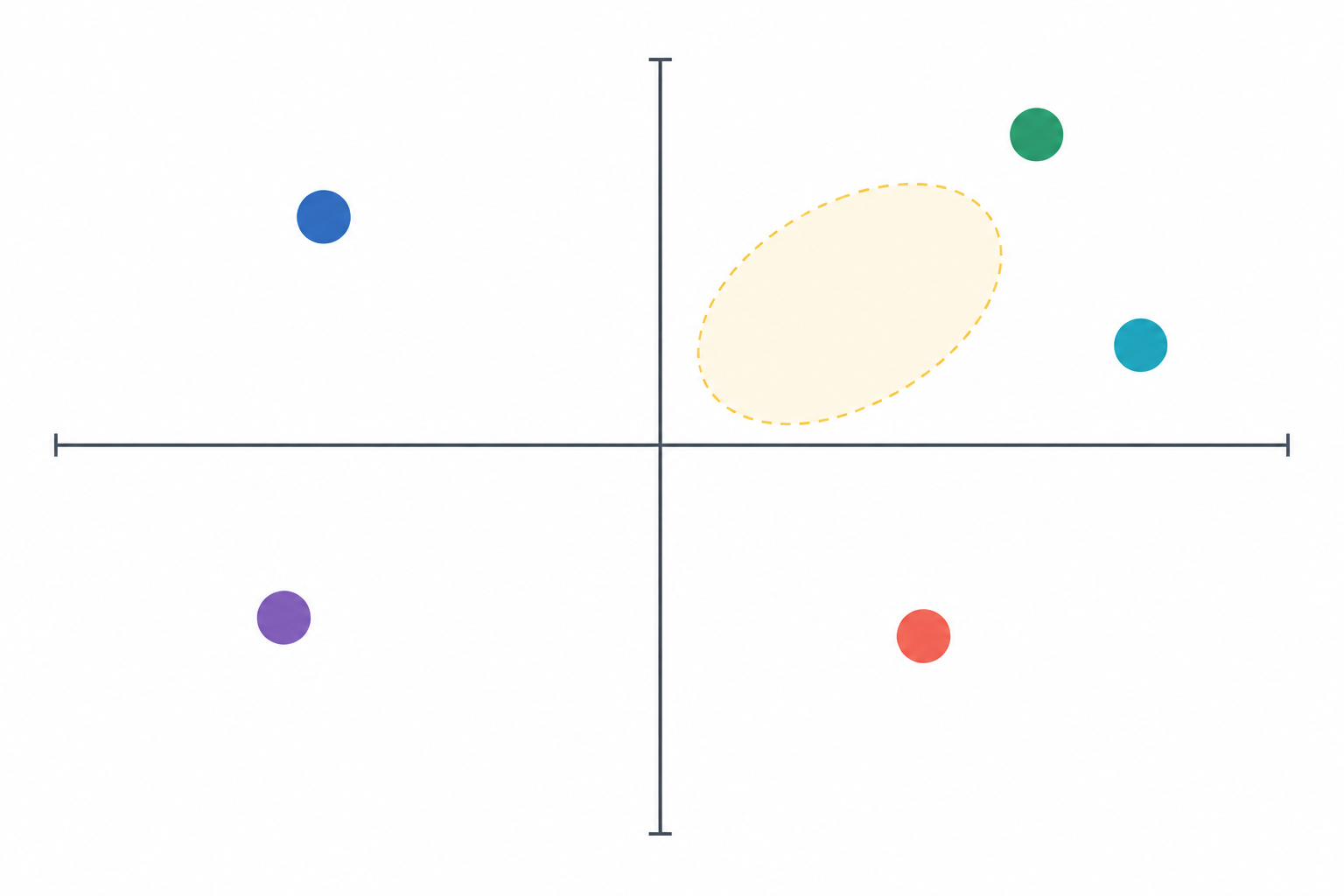
Picture a founder of a mid-market project tool who notices, over six weeks, that her biggest rival has stopped running its 'affordable for small teams' ads and is pushing enterprise logos with 'Talk to sales' CTAs. Its pricing page and landing pages have shifted the same way, so her confidence is medium to high. Rather than chase enterprise too, she leans in. Her ads now speak directly to the 20 to 200 person teams the rival appears to be leaving behind, with transparent pricing and a quick start. She still checks the move against what her customers tell her. The competitor's apparent pivot became her opening.
Share the weekly digest with the wider team so competitive awareness becomes routine rather than a quarterly panic. If you have a larger team, give each person a rival or two.
One caution: use ad intelligence to inform strategy, not to replace customer research. Ads tell you what competitors are saying. Only your customers can tell you what actually lands.
You don't need a research department. You need a routine you'll actually keep.
Here's what a log entry might look like:
| Date | Competitor | Channel | Observation | Hypothesis | Alternative explanation | Confidence |
|---|---|---|---|---|---|---|
| 12 May | Competitor A | Two new ads: 'Built for scaling teams' | Moving upmarket | A/B test of a new headline | Low | |
| 9 Jun | Competitor A | LinkedIn, Meta | 'Affordable' ads gone; enterprise logos; 'Talk to sales' CTA | Retiring budget positioning | Seasonal campaign swap | Medium to high |
Full disclosure: I work on Rival Ads, so take this as a product example rather than a neutral recommendation. Rival Ads is built to do the archiving and diffing described above. You give it a competitor's website, and it aims to detect their presence across Meta, Google, TikTok and LinkedIn, archive active ads and send weekly diffs and AI analysis through a dashboard and email digest. It doesn't need access to any ad account. At the time of writing, plans are listed from $29 a month in US dollars. Check the current pricing page for up-to-date plans, and confirm whether GBP pricing or VAT applies to you. Whatever tool you pick, judge it on whether it keeps dated records and makes the weekly review quicker.
Analysing publicly available ads is generally a normal part of competitive research, and platforms publish many ads in transparency libraries precisely so people can see them. That said, the details matter. Platform terms, how data is collected (manual review versus scraping), copyright in creative, and data protection can all be relevant. Ethically, the line is reusing a competitor's creative or copying their claims. Separately, any claims you make must be accurate and substantiated under UK advertising rules. If you have a specific concern or dispute, take legal advice.
Aim for at least four to six weeks, which helps separate short-term tests from real shifts, and look for corroboration in landing pages, pricing and CTAs. Longer campaigns and repeated formats strengthen the signal, but they never prove intent.
Not reliably. Ad libraries rarely show exact budgets, so the number of active ads, how long they've run and how many variations exist give you only rough, directional clues about priorities. Treat them as hints.
It depends on your market. LinkedIn ads can be especially useful for B2B because audience cues often appear in the copy, while Meta and TikTok show how a brand speaks to broader audiences. Google's transparency tools show the ads an advertiser has run, though not its keywords or results. Looking across several platforms gives you a fuller picture than any one alone.
It may be validation, or it may be coincidence, so check for sustained, consistent changes before deciding. Either way, strengthen the parts that are hard to copy, such as proof, specific customer stories and product depth, and keep monitoring.
Competitor ad messaging won't hand you a rival's strategy on a plate. But read in batches, over time, checked against landing pages and pricing, and weighed with honest confidence levels, it's one of the earliest signals you'll find of where a competitor may be heading.
Your next step is simple. This week, pick three rivals, save their current ads, and add the first rows to a messaging log with a hypothesis and an alternative explanation for each. Then look again in seven days. 🎯