What Is LLM Monitoring? A Plain-English Guide for Marketers

LLM monitoring is the practice of asking AI assistants such as ChatGPT, Claude, Gemini, Copilot and Perplexity the questions your customers ask, then recording whether and how your brand is mentioned, cited and recommended against competitors. Social listening tracks what people say. LLM monitoring tracks what machines say, and it produces the share-of-voice and visibility figures that leadership increasingly expects. You do not need technical skills to begin. You need a list of customer questions, a defined competitor set and a consistent way of measuring over time.
I am a data analyst, so I will separate what the evidence supports from what is merely plausible. There is no standardised LLM visibility metric and no industry-wide benchmark yet, so the teams that get value from this are the ones that are strict about method. Below I cover what LLM monitoring is, how it differs from the social listening you already run, which AI visibility metrics belong in a leadership report, and how to start without writing code. Where I am giving a recommendation rather than a sourced fact, I say so.
What Is LLM Monitoring? Definition and Why Marketers Are Hearing About It
In plain English, LLM monitoring means repeatedly putting realistic buyer questions to large language models and logging the answers, the sources cited, the sentiment of the framing and the competitors named alongside you. For a marketer, that boils down to a few practical questions. Does the brand appear? How is it characterised? Are the claims accurate? Which sources does the model rely on?
One note on method. Most teams start by querying the consumer-facing assistants, because that is what customers use. Some programmes query models through their APIs instead. That is easier to automate, but the answers can differ from the consumer products, which may add web search, personalisation or other layers. Whichever route you take, record it, because it limits how far you can generalise from the results.
Why LLM monitoring has become a reporting issue
Interest has jumped because of how many AI-generated answers people now see and what those answers do to click behaviour. The figures below come from US or global sources, and I have linked each so you can check the original wording.
- Reach of AI answers in search: Google said at I/O in May 2025 that AI Overviews had more than 1.5 billion monthly users across more than 200 countries and territories. This is a company-reported figure, not an independent audit.
- Consumer adoption: the Pew Research Center found in a February 2025 survey that 34% of US adults had ever used ChatGPT, up from 23% in 2023.
- Business adoption: McKinsey's State of AI survey reported in early 2024 that 65% of respondent organisations were regularly using generative AI in at least one business function. That explains why executives are asking about it, though it says nothing directly about your customers.
- Click behaviour: in a Pew analysis of browsing data from 900 US adults in March 2025, users clicked a traditional search result on 8% of visits when an AI summary appeared, compared with 15% when none did. Only about 1% of visits with a summary included a click on a link inside it.
- A forecast, not an outcome: Gartner predicted in February 2024 that traditional search engine volume would fall 25% by 2026. Present it as a prediction.
What should a marketing manager conclude? The data does not show that your customers have abandoned search, and it certainly does not show that for any particular UK sector. It does suggest that when an AI answer appears, fewer people click through, so being named inside the answer may matter even when no visit follows. That is a hypothesis worth testing with your own monitoring. It is not a proven law.
A caveat for UK teams
The usage figures above are US or global, so treat them as directional rather than as a measure of UK adoption. I have deliberately not quoted a UK usage number I cannot source with confidence. Ofcom's Online Nation research is where to check current UK online behaviour before you put a figure in front of your board. Better still, test demand in your own category by asking customers, in surveys, sales calls and support tickets, whether they use AI assistants when researching purchases.
LLM monitoring, AI visibility monitoring and GEO: terminology explained
The vocabulary is still settling, and vendors and practitioners use these terms differently. This is how I use them in this article:
- LLM monitoring (also called AI visibility monitoring) is the measurement side: what the models say about you.
- Generative engine optimisation (GEO), sometimes grouped under AI SEO, is the improvement side: the content and technical work that aims to change what the models say. Google's guidance on AI features is a useful reference on what it does and does not recommend.
- LLM brand monitoring is LLM monitoring applied to your brand and its competitors, as opposed to monitoring for safety or model quality.
Monitoring is the measurement half, and it is hard to run the improvement half sensibly without it.
Why a screenshot is not evidence
Answers can vary by prompt wording, by model, by day and sometimes by user, so a single response is a weak measure of visibility. A screenshot of ChatGPT recommending you is an anecdote. So is one of it ignoring you. Evidence comes from many questions, run repeatedly, across several platforms.
One more distinction will matter later. A mention is not the same as a citation, and neither is the same as a recommendation. A model may name your brand without linking anywhere, cite your page without endorsing you, or recommend a competitor while citing your research. Each is a separate signal.
What does a tracked LLM monitoring question look like?
An example makes this less abstract. Suppose you sell project management software to UK agencies:
- Tracked question: 'What is the best project management tool for a 20-person creative agency in the UK?'
- Raw result (illustrative): the assistant lists four tools, with your brand third and a competitor first, and cites two review sites and one competitor blog.
- Insight and action: you are mentioned but not recommended first, and neither cited review site features you prominently. That points PR and content teams at those two publications rather than at a generic content push.
Is LLM Monitoring the Same as Brand Monitoring? How It Differs from Social Listening
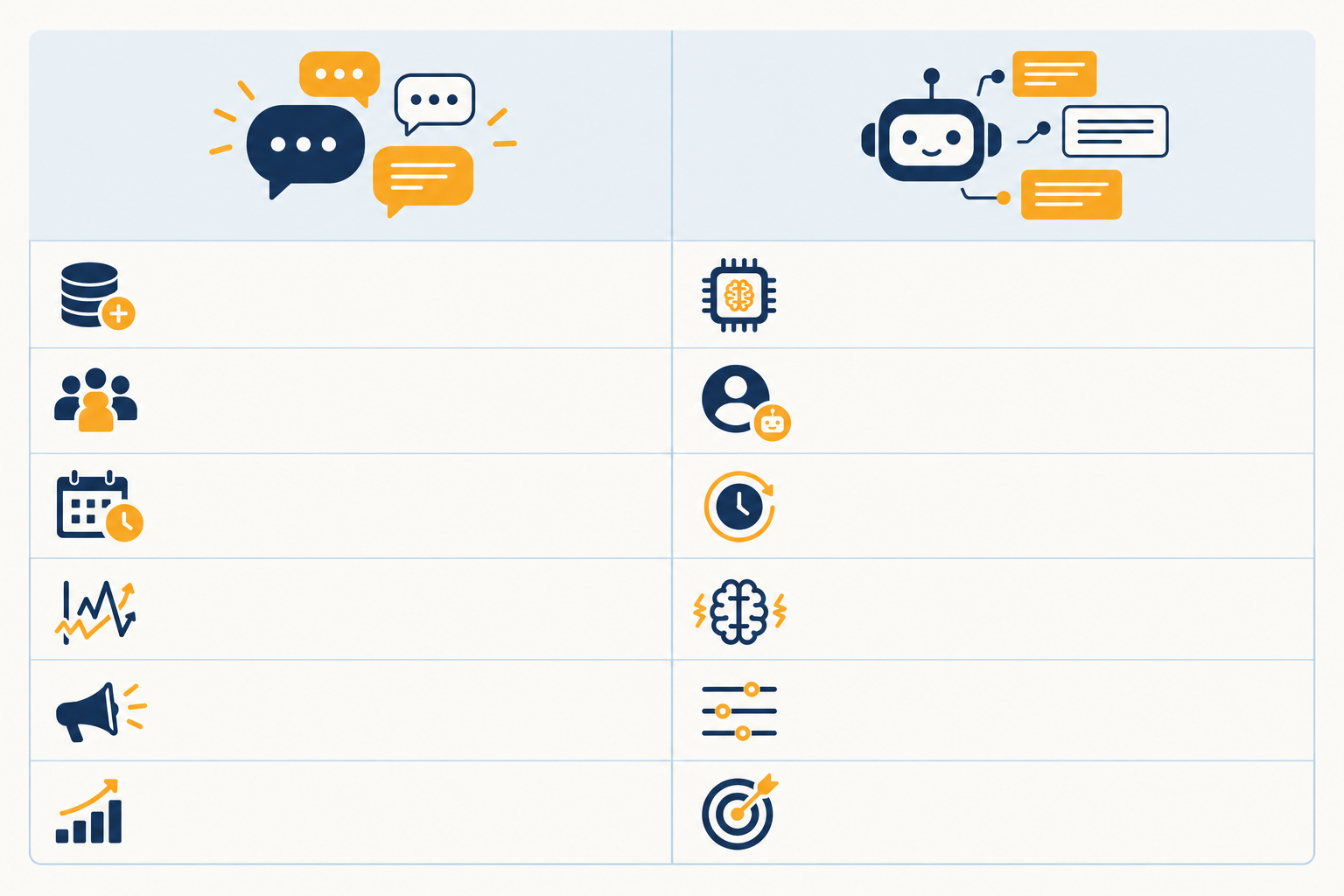
LLM brand monitoring is a new branch of brand monitoring, but its data source, volatility and action levers are quite different. The core gap is this: social listening captures things that were said, whereas LLM monitoring samples answers that could be generated. The first is a record. The second is closer to a probability distribution, which is why it needs repeated runs.
| Dimension | Social listening | LLM monitoring |
|---|---|---|
| Data source | Public posts, news, reviews, forums | Generated answers and their cited sources |
| Who is speaking | People | Models, synthesising many sources |
| Volume and cadence | Continuous, driven by real events | Sampled on a schedule you choose |
| Nature of sentiment | Expressed opinion of individuals | Framing assembled by the model, sometimes outdated |
| Volatility | Fixed once published | Varies by run, model and wording |
| What you can influence | Engagement, response, PR, advocacy | Content, citations, third-party coverage, AI legibility |
| Typical KPI | Mentions, reach, sentiment score | Query coverage, share of voice, citations, visibility score |
Where social listening and LLM monitoring overlap
The two datasets complement each other. Reviews, forum threads and press coverage often feed the third-party sources that AI engines cite, so what social listening surfaces can help explain what LLM monitoring finds. If a model repeats an out-of-date complaint, your social data may show where it came from.
Why rank tracking falls short for AI visibility
Traditional rank tracking assumes a fixed list with a position one. Generated answers have no such list, only answer composition and citation order, and both can shift between runs. So the question changes. It is no longer where your page ranks, but whether an answer mentions your brand and attributes information to your site.
What Data Should an LLM Monitoring Programme Collect?
Not every tool or spreadsheet captures what leadership will eventually ask for. Based on the measurement practice I trust, a useful programme should collect the following.
- A query set. Customer-style questions covering category, comparison and purchase-decision intent. Ideally these draw on your own website and customer language, and you refresh them periodically so they reflect how buyers actually phrase things.
- Platform coverage. ChatGPT, Claude, Gemini, Copilot and Perplexity are a reasonable starting set. They can give different answers because of differences in training data, whether and how they retrieve live web content, which sources they favour and how they present citations. Tracking a single platform can mislead, because strength in one can hide absence in another. Prioritise the platforms your own customers say they use.
- Raw answers and citations. The full response text and the URLs cited, so you can see which of your pages and which third-party sources shape the answer.
- Mention types. Explicit recommendations, ranked-list placements, and soft mentions, where the brand is named without endorsement or link.
- Sentiment and accuracy. How the brand is characterised, and whether that framing is accurate or outdated. Automated labels can miss context, so a human should review high-impact claims.
- Competitor mentions. Who appears alongside or instead of you. This is the raw material for competitor tracking and share of voice.
- Technical readiness data. AI legibility checks, meaning whether AI crawlers can access and interpret your pages, for example through crawlability and structured data. These can explain why good content never gets surfaced.
- Referral data. AI-driven traffic to your site, ideally measured in a cookieless way, meaning without placing tracking cookies on visitors' browsers, and in line with UK GDPR and PECR expectations.
That last item needs a closer look. Google confirms that AI Overviews and AI Mode traffic is included in the overall Web search data in Search Console, with no separate filter. Standard analytics will not isolate AI visibility for you, and referral attribution should be labelled incomplete where the originating AI product cannot be identified. A controlled prompt-monitoring dataset fills that gap.
Also record the model, version, location, language and date of every run. Without those, a change in your numbers cannot be interpreted.
How often should you collect LLM monitoring data?
There is no evidence-based universal answer, so treat this as a recommendation that depends on your circumstances. I would start by collecting data at least weekly during your baseline period, then compare run-to-run variance. If the same question produces very different results from one run to the next, sample more often or repeat each question several times per run. If results are stable, less frequent collection may be enough. Budget and query volume matter too. Collection cadence (how often you query) is also distinct from reporting cadence (how often you tell leadership), and the latter can be monthly even when the former is daily.
Which AI Visibility Metrics Matter for Leadership Reporting?
Leadership does not want forty charts. It wants a few figures that are defensible, comparable over time and tied to competitors. These are the AI visibility metrics I would put in a scorecard, along with how each is calculated.
| Metric | How it is calculated | Watch out for |
|---|---|---|
| Query coverage | Questions where your brand appears at all, divided by questions tracked | Meaningless if the query set is only branded |
| Position-weighted citations | Citations of your content, with more weight for prominent placement (for example first source cited versus fifth). The weighting scheme is a choice you must document | A citation is not an endorsement, and weights are not standardised |
| Share of voice | Your brand mentions divided by all brand mentions (yours plus named competitors) across the query set | Depends on a fair competitor set |
| Soft mentions | Unlinked or unendorsed references that still shape perception | Easy to overlook in link-based tracking |
| Sentiment distribution | Share of mentions framed as positive, neutral or negative over time | Automated labels miss context and accuracy errors |
A worked example of AI visibility share of voice
Here is an illustrative calculation with invented numbers. You track 50 questions. Your brand appears in 18 of them, so query coverage is 36%. Across all 50 answers, named brands are mentioned 82 times in total, 18 of them yours and 34 of them your leading competitor's. Your share of voice is 18 / 82, about 22%, against 34 / 82, about 41%, for the rival. The 22% alone tells leadership very little. The comparison shows them where the gap is.
How to use a composite LLM visibility score
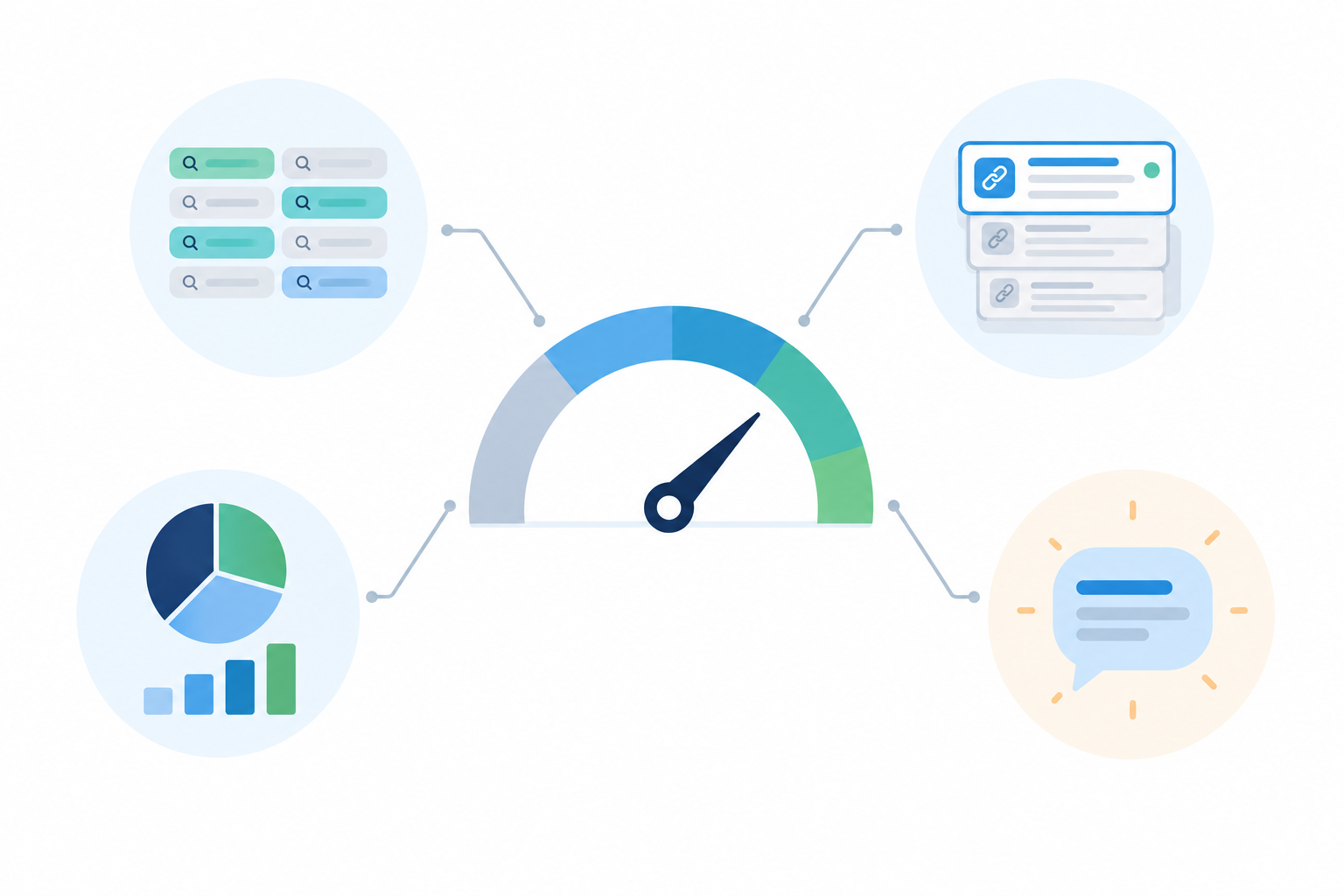
A single trendable number helps executives, but no standard formula exists, and you should be sceptical of any score whose method is not disclosed. Most composites combine coverage, citation prominence, share of voice and soft mentions into a 0-100 scale, with weightings chosen by whoever builds them. A score of 46 from one tool therefore cannot be compared with a 46 from another.
Disclosure: MentionOwl is our product. Its visibility score is built on a 0-100 scale from four components: query coverage, position-weighted citations, share of voice and soft mentions. Sentiment is tracked separately as a diagnostic rather than folded into that score, which is one reason I recommend reporting it alongside any composite. Treat this as one vendor's method, not an industry standard, and ask any provider, us included, to document its weightings.
A composite is only as useful as it is consistent. As long as the method stays fixed, a move from 38 to 46 over a quarter means something for your brand, even though the absolute number is not portable. Always keep the components available to explain movement.
Separate AI visibility from business impact
I recommend splitting the report into two layers. Leading indicators are prompt coverage, mention rate, share of voice, citations and answer accuracy. Downstream outcomes are referral sessions, conversions and revenue. Visibility is influence you can measure directly. Revenue attribution from AI answers is currently partial, and honest reporting says so. Track factual accuracy and correction priority alongside sentiment, because a positive mention can still carry the wrong pricing or availability.
How to present AI visibility metrics
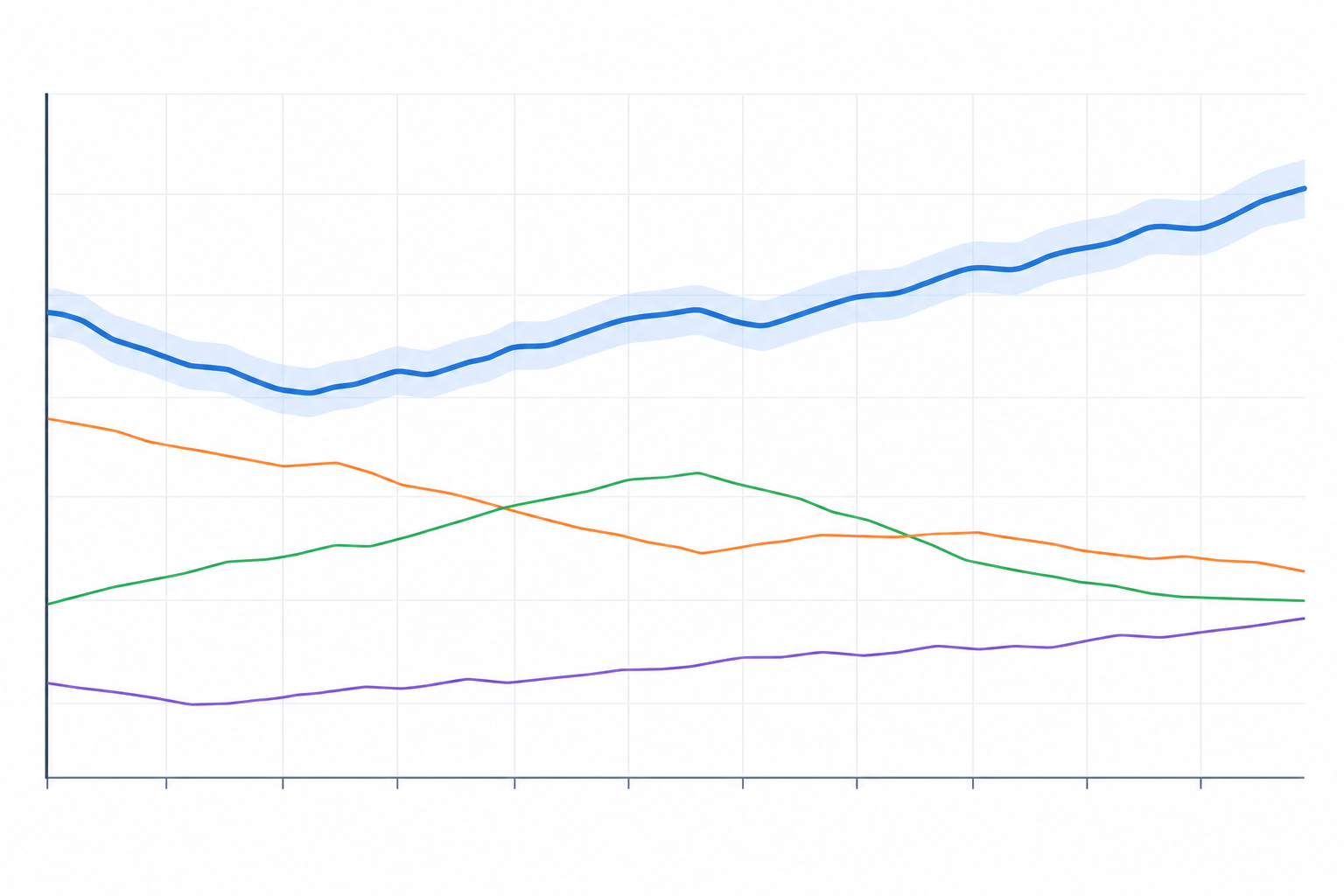
- Show trends over 8-12 weeks rather than single snapshots.
- Report ranges for volatile metrics, since run-to-run variation is a feature of the data.
- Pair every number with a competitor benchmark.
- State your sample size, the models tested and the dates covered.
Avoid raw mention counts without query context, which flatter the result. A sceptical finance director will not accept them.
Who Should Use LLM Monitoring (and Who Can Wait)?
The case is strongest wherever your own research shows that buyers ask AI assistants for recommendations. I would not assume that holds for every category or audience, so validate demand first, through customer surveys, sales conversations or a short baseline run, before investing in a full programme.
- In-house marketing teams that must report share of voice and brand health to leadership and need a defensible AI search number.
- Agencies and consultants who need client-ready benchmarks, where API access and weekly digests make recurring reporting practical.
- Brands in considered-purchase categories such as software, financial services, travel and professional services, where an assistant's shortlist may shape the decision.
- Solo founders and small businesses that suspect competitors are being named in AI answers while they are absent.
Who can wait: businesses with almost no online footprint, or purely local, offline word-of-mouth demand. If buyers are not asking assistants about your category, and the models have little material to draw on, monitoring will mostly record an absence you already know about. Build a basic web presence first.
Inside larger organisations, PR, SEO and content teams are the ones who will act on the findings, so involve them early. Citation data tells PR which publications to pursue, SEO which pages are failing, and content which questions remain unanswered.
Do You Need Technical Skills for LLM Monitoring? How to Get Started
Monitoring itself needs no coding. Technical knowledge only helps if you want API or MCP-based integrations into dashboards or AI agents. Any marketing manager can follow the process below.
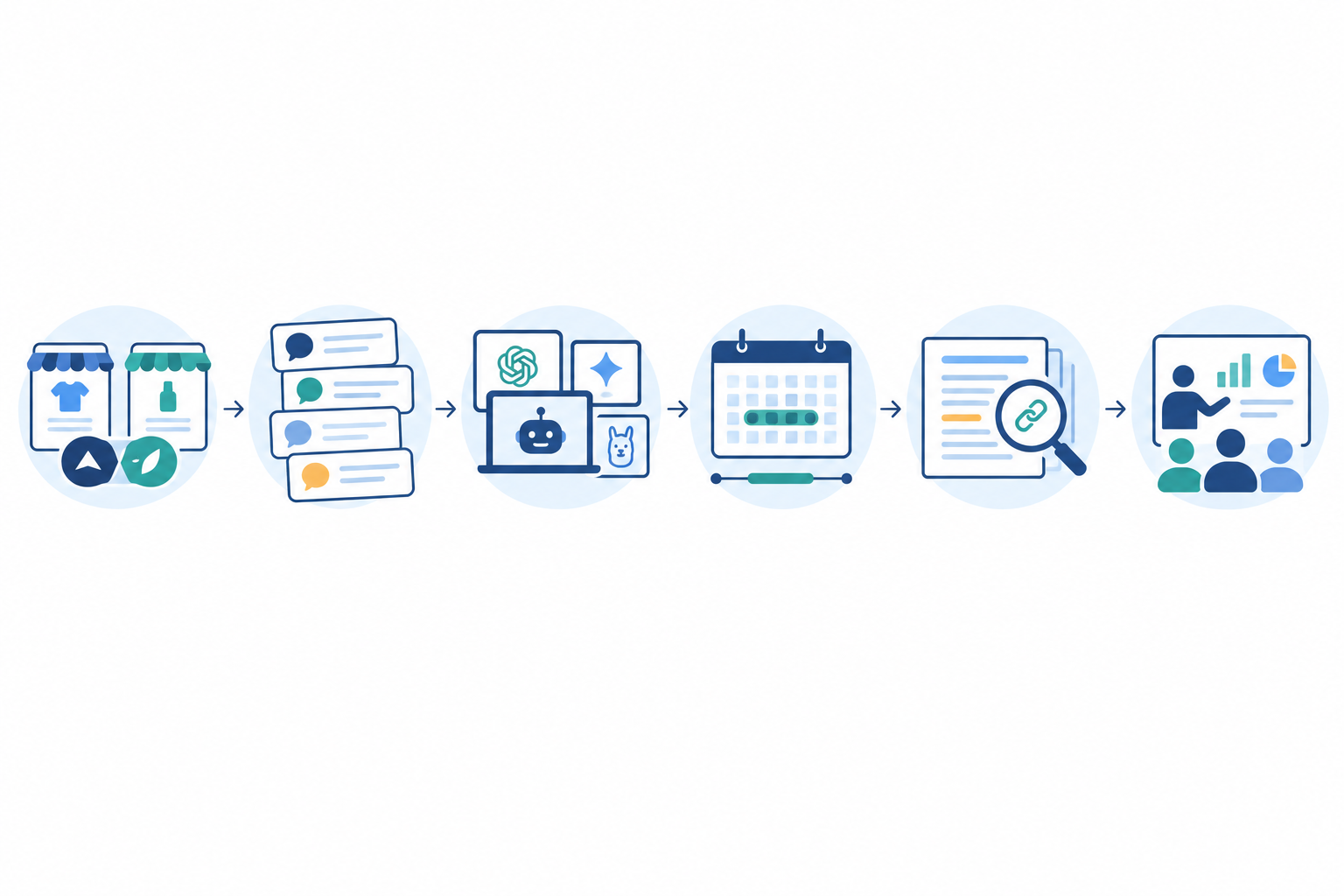
- Define your competitor set and categories. Choose the named competitors you want to be measured against, and the three to five product or service categories you want to be recommended for.
- Build a realistic question set. Draw on your website and on customer language from sales calls, support tickets and search queries. Cover category, comparison and purchase-decision intent, not just branded questions. Some platforms, ours included, can generate a starting set by crawling your site, but review it by hand.
- Choose platforms and a schedule. Start with the assistants your customers use, and run the same questions on a consistent cadence.
- Record a baseline. Collect two to four weeks of data before drawing conclusions. Early readings are noisy, and the baseline also tells you how volatile your answers are, which should set your sampling frequency.
- Review citations and AI legibility findings. Look for content gaps, weak third-party sources and technical blockers such as crawl or structured-data problems.
- Set a reporting rhythm. Weekly digests for the working team and a monthly visibility summary for leadership are a reasonable default, adjusted to your needs.
DIY spreadsheet or dedicated LLM monitoring platform?
Manual tracking is a legitimate place to start, and I would not discourage it. If you have a handful of questions and one or two platforms, a spreadsheet with the date, model, prompt, answer and cited URLs will teach you a great deal. The limits show up quickly, though. Five platforms across fifty questions run daily is 250 answers a day, and consistent sampling, citation extraction and competitor tallying turn into a job in themselves.
Four questions can help you decide:
- How many questions and platforms do you need to cover?
- How often must you sample, given how volatile your answers prove to be?
- Who will maintain the process, and how many hours a week can they spare?
- Do you need trend lines and competitor benchmarks that you can defend to leadership?
If the answers are small, occasional and informal, a spreadsheet is enough. If they are large, frequent and board-facing, a dedicated platform earns its cost. Whichever you evaluate, check that it documents its method, shows raw answers and lets you export your data.
Promotional note: MentionOwl is our product. If you would like a low-cost way to see a baseline, we offer a $1 seven-day trial. This is separate from the guidance above, which applies whichever tool you choose.
Common LLM Monitoring Pitfalls and How to Avoid Them
- Treating one prompt result as truth. Sample many questions, repeatedly, and report ranges.
- Tracking only branded queries. Branded questions flatter the results and hide category-level invisibility, which is where new customers are won.
- Ignoring competitor benchmarks. Without them, leadership gets numbers with no context.
- Confusing monitoring with optimisation. The data shows where you stand. Generative engine optimisation is the follow-up work.
- Expecting rapid change. In my experience, shifts can take weeks as content is crawled and models refresh, but I have no controlled data to put a timescale on it, and it will vary by platform. Google also states in its AI features guidance that no special optimisation is required beyond its existing Search guidance, so be wary of quick-fix promises.
Frequently Asked Questions About LLM Monitoring
Is LLM monitoring the same as brand monitoring?
Not quite. Traditional brand monitoring tracks what people publish about you on social media, news and review sites. LLM monitoring tracks what AI assistants say about you when customers ask questions. I think of LLM brand monitoring as an extension of brand monitoring that uses different data and needs repeated sampling.
What AI visibility metrics matter most?
Start with query coverage, share of voice against competitors, position-weighted citations, sentiment and soft mentions. A composite visibility score can summarise these for leadership, provided its method is documented and the components stay visible.
Do I need technical skills to use LLM monitoring?
No. You can start with a spreadsheet, and modern platforms handle question generation, querying and reporting. Technical skills only become useful if you want to pipe data into your own dashboards through an API, or act on AI legibility findings with a developer.
How do I calculate share of voice in LLM monitoring?
Count every brand mention, yours and your named competitors', across your full query set, then divide your mentions by the total. If you are mentioned 18 times out of 82 total brand mentions, your share of voice is about 22%. Keep the competitor set and query set fixed so the trend is comparable.
How do I choose questions to track?
Begin with the questions customers actually ask, taken from sales calls, support tickets and search queries. Include category, comparison and purchase-decision questions as well as branded ones, and refresh the set periodically.
Can LLM monitoring tell me how to improve my visibility?
It shows where and why you are missing: which competitors are cited, which sources the models rely on and which technical issues limit AI legibility. The improvement itself is generative engine optimisation, which uses those findings to guide content and technical changes.
Related Articles

How to Monitor Claude, Gemini, and Copilot Brand Mentions: A Guide for Agencies
Track Claude, Gemini and Copilot brand mentions with AI brand monitoring. Unify daily LLM monitoring, citations and sentiment to save agency hours.

How to Track ChatGPT Brand Mentions Without Manual Prompting: A Founder's Guide
Learn how to track ChatGPT brand mentions with daily LLM monitoring, automate customer-style questions, and measure answers, citations, sentiment and competitors.
Create content like this automatically
Scribe uses AI to generate high-quality blog posts that engage your audience and drive traffic.