White-Label Content: How UK Agencies Are Scaling Client Output With AI (Instead of Hiring)

White-label content automation vs. hiring: how UK agencies can scale content
White-label content automation lets agencies produce SEO-optimised blog posts for multiple clients under their own brand, without the overhead of hiring additional writers. Tools like Scribe generate complete, publish-ready articles in minutes rather than days. That means agencies can take on more client accounts or increase posting frequency while keeping delivery costs flat.
For most agencies weighing a new hire against automation, the maths increasingly favours automation, especially once you factor in training time, sick days, recruitment costs and the inconsistent output quality that can come with junior freelance writers.
If you're running content operations for a UK agency, you've probably had this conversation with yourself more than once: another client wants weekly blog posts, your current writers are already stretched, and the obvious answer seems to be hiring someone new. But is it actually the right answer? Let's look at why that instinct can lead agencies into a growth trap, and what white-label content automation looks like in practice.
The hiring trap agencies fall into
Here's the pattern I see again and again. A client asks for more content, or a new client signs on with an ambitious content calendar. The agency's instinct is to solve a capacity problem with a people problem: post a job ad, interview a handful of candidates, hire a junior writer or bring on another freelancer.
On paper, this looks straightforward. In reality, it's slow and expensive in ways that don't always show up on the initial budget line.
Think about what hiring actually involves. There's the recruitment process itself, which in the UK typically takes several weeks between advertising, screening and interviewing. Then there's onboarding: teaching a new writer your agency's tone guidelines, then teaching them each client's brand voice on top of that. That's not a one-off cost either, because client voice guidelines shift, new products launch and messaging evolves.
Freelancers bring their own version of this problem. Agencies often rotate through freelance writers as workloads fluctuate, which means constantly re-briefing new people on the same client accounts. Every time a freelancer churns, someone on your team has to re-explain the brand, the audience, the do's and don'ts. Quality can dip while the new writer finds their footing.
The deeper issue is structural: output scales linearly with headcount. Want to double content volume? You need roughly double the writing capacity, which means double the management overhead, double the onboarding time and double the exposure to inconsistent quality. That caps how quickly an agency can grow, because every new client account adds not just revenue but a proportional amount of hiring and management work.
What is white-label content automation?
White-label content, in the context of AI tools, means content generated on a platform but published under your agency's brand or your client's brand, with no visible trace of the tool behind it. The client sees a well-written, on-brief blog post. They don't need to know it was drafted by an AI writing assistant rather than typed by a human over several hours.
This is where platforms like Scribe change the economics of content production. Instead of briefing a writer and waiting two or three days for a draft, you can generate a complete, SEO-optimised blog post of 2,000+ words, including images and diagrams, in around five minutes. That's not a rough outline or a bullet-point draft. It's a structured, publish-ready article with headings, formatting and visuals already in place.
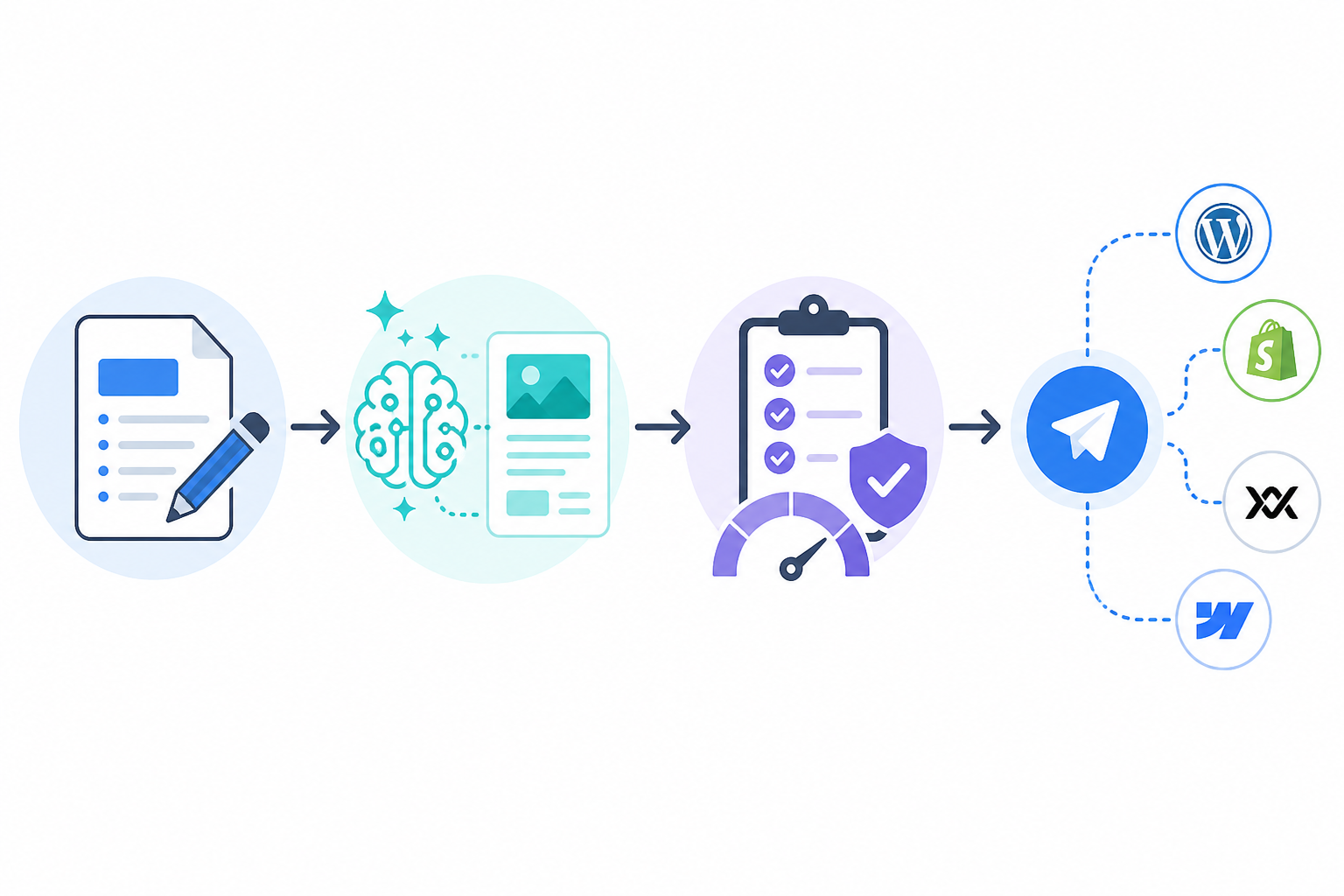
For agencies focused on content scaling, the workflow typically looks like this:
- Input the brief – add the topic, target keywords, client voice notes and the specific angle you want covered.
- AI generation – the platform produces a full draft, with SEO optimisation built in from the start rather than added afterwards.
- Quality scoring check – the content is scored against quality and performance benchmarks before it goes anywhere near a client site.
- One-click publishing – the finished post goes straight to WordPress, Shopify, Wix, Webflow or a custom API, depending on where the client's site lives.
Auto-pilot scheduling can also publish content on a consistent cadence without someone manually checking a calendar and pressing publish every week. For agencies managing content calendars across a dozen or more client accounts, that kind of automated publishing removes a genuinely tedious part of the job.
How to manage brand voice across multiple client accounts
The number one concern I hear from agency owners considering AI content tools is brand consistency. It's a fair worry: nobody wants a client's blog to read like a generic template, and nobody wants two clients in the same industry ending up with near-identical content.
Here's how this can be managed in practice:
- AI that learns per client. A good platform doesn't just generate text and forget it. Scribe's system tracks quality scores and performance metrics from every published article, then leans into what's working and drops what isn't. Over time, content for a specific client starts reflecting what actually performs for them, rather than just generic best practice.
- Quality scoring catches problems early. Before anything reaches a client's site, quality scoring flags content that's off-brand, thin or unlikely to perform, so someone can review it first.
- Editing beats writing from scratch. The workflow shifts from writing an article to reviewing one, which takes a fraction of the time. Keep a human in the loop here. The point is removing the slowest, most repetitive part of the job, not removing oversight.
- Separate content profiles per client. Distinct briefs, tone guidelines and keyword priorities stop the AI from trying to serve ten brand voices out of one generic setting. It's the same discipline you'd apply with human writers, just faster to set up and easier to keep consistent.
The honest takeaway is that AI content automation works best as a production accelerator paired with human editorial judgement rather than a substitute for review. Google's guidance on AI-generated content makes a similar point: the tools matter less than the quality control around them. Agencies that treat automation this way can protect their reputation while still gaining the speed benefit.
White-label content pricing and agency margin considerations
This is where the hiring-versus-automation decision becomes concrete. Let's put some rough numbers next to each other.
A junior content writer in the UK typically costs an agency more than just their salary. Once you factor in employer National Insurance contributions, pension contributions, recruitment costs, training time, equipment and the non-billable hours spent managing them, the fully loaded cost is significantly higher than the headline salary figure suggests.
Compare that with a tiered AI content subscription covering somewhere between 10 and 30 articles per month at a flat monthly cost, regardless of how many hours it takes to produce them.
| Junior Writer (Hire) | AI Subscription (Tiered) | |
|---|---|---|
| Monthly cost | Salary + NI + pension + overheads | Fixed subscription fee |
| Articles per month | Variable, capped by hours worked | 10–30, predictable |
| Onboarding time | Weeks | Minutes to hours |
| Consistency | Improves slowly with experience | Improves via performance data |
| Sick days / turnover risk | Yes | None |
| Scalability | Requires additional hires | Upgrade subscription tier |
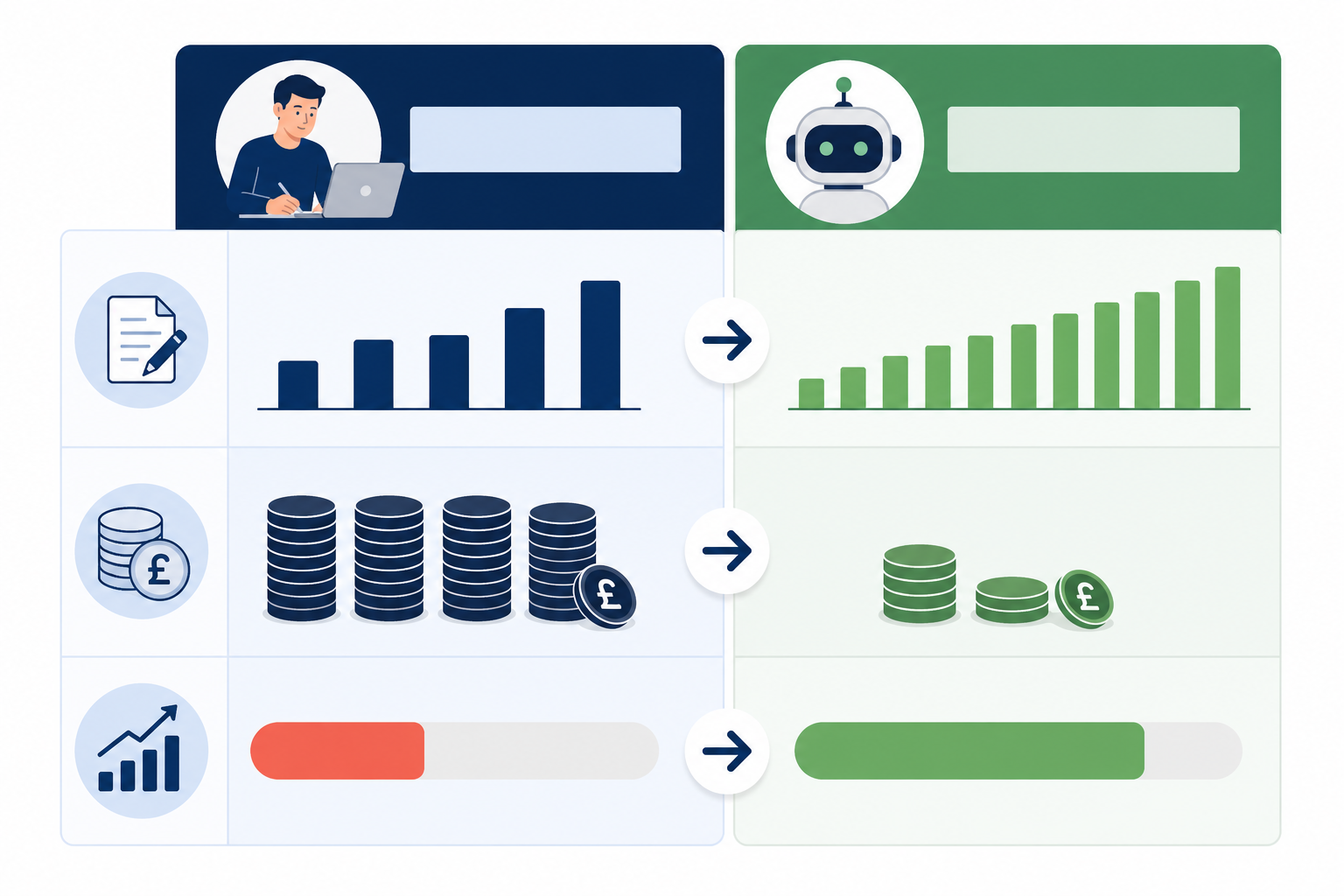
The margin shift is real, but it's worth being precise about where it comes from. AI reduces production time, not the need for review. The safest approach, and the one that protects your agency's reputation, is to keep a human editor checking brand voice, factual accuracy and compliance before anything publishes under a client's name. Selling entirely unedited AI output as finished work is where agencies can run into trouble, both reputationally and through rework further down the line.
What this does allow is repricing. Once your delivery cost per article drops, you have room to either lower client-facing prices to win more accounts or hold pricing steady and let the wider gap become margin. Many agencies use this as an upsell opportunity too, offering higher posting frequency as a premium tier because the marginal cost of an extra article is now much smaller than it used to be.
A useful discipline borrowed from agency remuneration guidance is to price the client outcome and service level, not the number of words generated. Structuring packages around a lower-cost AI-assisted tier, a standard human-edited tier and a premium expert-led tier makes the difference in review depth and turnaround explicit, rather than quietly absorbing extra editorial work into a single flat price.
The case for content automation over additional headcount
Let's do the capacity maths directly. One new hire, once fully onboarded, might realistically produce four to eight solid blog posts a month, depending on length and research depth. A single AI content subscription, by contrast, can support 10 to 30 articles a month depending on the tier, enough to cover several client accounts rather than stretching to cover one person's output.
Speed to market is the other underrated benefit. Launching a new client's content programme with a freshly hired writer means weeks of onboarding before the first article even goes out. With automation, you can have a client's content profile set up and their first batch of articles published within days.
There's also a quality trajectory difference worth noting. A junior writer's skill improves gradually and inconsistently. Some weeks are stronger than others, and quality depends heavily on workload and experience. A self-improving AI system, by contrast, gets better at a specific account over time because it tracks quality scores and performance data with every article published, then adjusts future output based on what resonates with real readers.
The results agencies report back this up. One Scribe user cited a 340% increase in organic traffic over six months after shifting to AI-generated content for their blog programme, the kind of outcome that's hard to reach on a linear, headcount-limited production model.
None of this means hiring becomes pointless. Strategy, client relationships and editorial oversight still need experienced people behind them. Hiring makes strong sense for roles focused on account strategy, senior editorial review and client-facing relationship management, areas AI can't replace. The most effective agencies often use a hybrid model: automation handles volume production, while a smaller, more senior in-house team focuses on the judgement calls that need a human.
FAQ: white-label content and content scaling
Can AI content tools support a white-label agency model?
Yes. Platforms like Scribe are built for this purpose. Agencies can generate SEO-optimised, publish-ready blog posts for multiple client sites and push them live through integrations with WordPress, Shopify, Wix, Webflow and custom APIs, without the client needing to know which AI tool was used. The key is maintaining a review step to check brand voice, accuracy and compliance before publishing.
How do agencies keep margins healthy while scaling content?
Margins improve because the marginal cost of producing each additional article drops sharply with automation. Instead of paying a writer per article or per hour, agencies pay a flat subscription covering a set volume of articles, then apply their own markup when pricing client retainers. The gap between the tool cost and the client fee becomes part of the agency's margin, and it can widen as the agency scales.
Is it better to hire more writers or adopt content automation?
For most agencies, automation wins on pure capacity and cost grounds, especially for standard SEO blog content. Hiring still makes sense for strategic work, client communication and specialised or highly technical content that needs deep subject-matter expertise. Many agencies settle on a hybrid model: automation handles volume production, while a smaller in-house team focuses on strategy, quality control and accounts that need a more bespoke approach.
Create content like this automatically
Scribe uses AI to generate high-quality blog posts that engage your audience and drive traffic.