Why Consistent Blogging SEO Is the Compounding Asset Small Businesses Keep Underestimating
12 min read
Loading...

Meta description: Does consistent blogging improve SEO? Learn how regular, high-quality content supports organic growth, internal linking and topical authority for UK small businesses.
If you've ever wondered whether it's worth publishing another blog post this week, here's my honest answer: probably yes, but not for the reason most people think. Google doesn't hand out ranking points simply because you post on schedule. What consistent blogging actually does is give you more chances to create genuinely useful content, more internal links connecting your site together, and more coverage of the questions your customers are typing into Google UK every day. Over time, that adds up. But it only adds up if the content itself is worth ranking.
I work on content strategy at Scribe, an AI writing platform for small businesses, so I'll say upfront that I have a stake in this conversation. I've also spent a lot of time talking to UK small business owners who've tried blogging, got quiet results in month one, and stopped. Then six months later they notice a competitor who kept going is now outranking them for terms they used to own. That pattern is real, even if what's driving it is a bit more nuanced than "Google rewards consistency." Let's dig into what's actually happening.
Here's a more accurate way to think about it: every genuinely useful blog post is a small, permanent entry point into search results. Not because Google likes frequency, but because each post is a fresh chance to answer a real question well. A single post might target a handful of keywords. A library of fifty posts, built around real customer questions, can realistically cover hundreds of variations and long-tail phrases. Each one keeps attracting impressions, and occasionally links, long after you've moved on to the next piece.
Google's SEO Starter Guide is fairly explicit about this: it favours sites that consistently produce helpful, people-first content, not sites that publish on a rigid schedule for its own sake. That distinction matters. Posting five thin articles a week won't outrank one well-researched article that actually answers a searcher's question. Consistency is valuable because it's a repeatable habit for producing useful content and reinforcing your site's structure, not because Google is tracking your calendar.
The part most business owners underestimate is the internal linking effect. An article you wrote in January might pick up modest traffic by March. By June, if you've published related posts since, you can link back to that January piece and reinforce its relevance. That's exactly the internal-linking signal Google talks about when it describes understanding the relationships between pages on a site. That January post, meanwhile, has quietly been feeding traffic and context into everything you've published since.
To illustrate the difference, picture two hypothetical businesses over a year. One publishes weekly around a consistent topic cluster. The other publishes in bursts: ten posts in an enthusiastic January, then nothing until a rushed batch in September. In this illustrative model, the weekly publisher tends to build a steadier organic traffic curve, because each new post reinforces earlier ones. The burst publisher's traffic tends to be jagged, because each burst has to rebuild relevance somewhat from scratch. This is a simplified pattern, not a guaranteed outcome; actual results depend heavily on competition, search demand, and content quality.
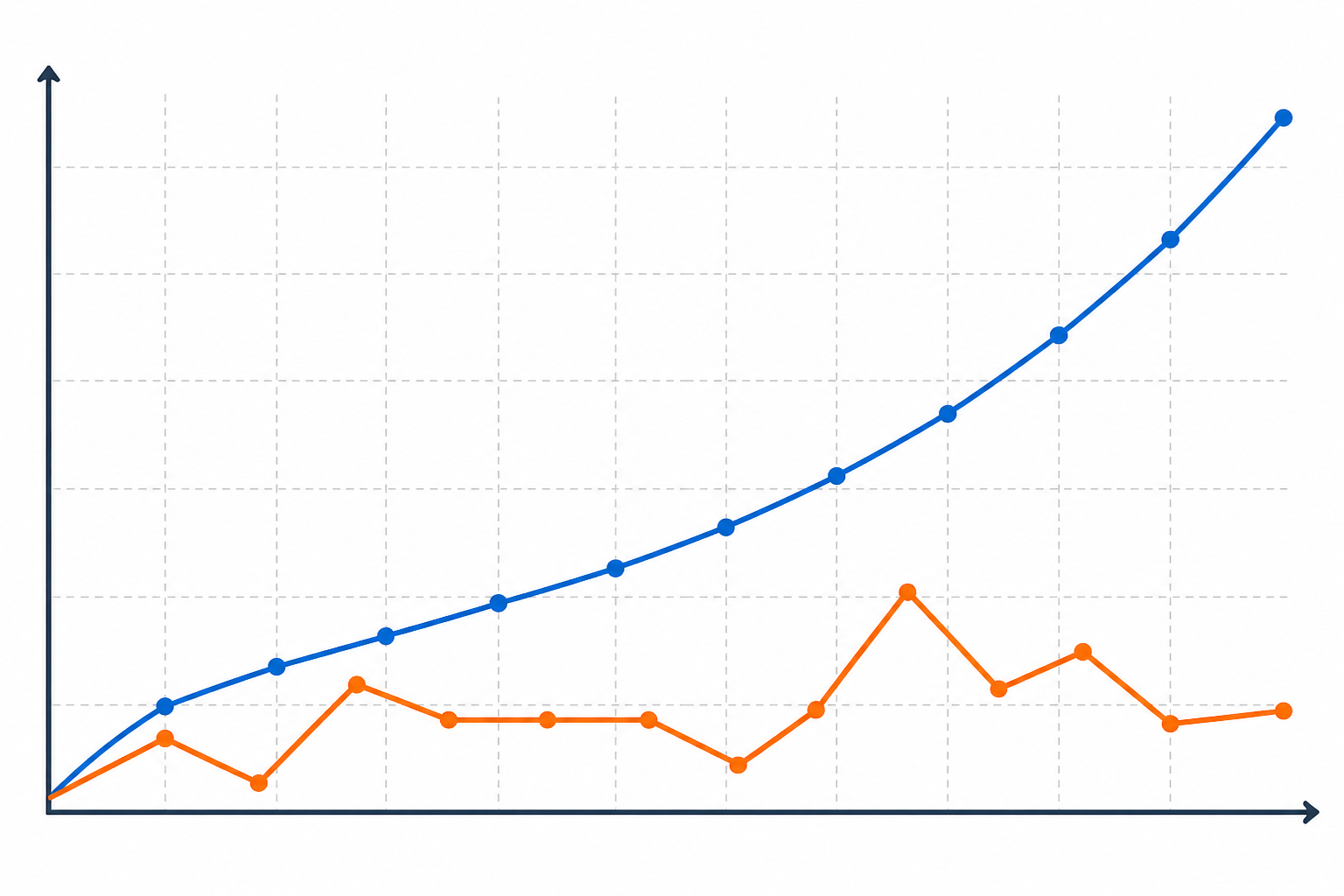
Illustrative model only, not measured data from a specific site.
It's worth being honest about the odds here too. Ahrefs' study of roughly a billion pages found that over 90% get no organic traffic from Google at all, and only around 5.7% of pages reached the top 10 within their first year. That's not meant to discourage you. It's meant to set realistic expectations. Consistent blogging isn't a guarantee every post performs. It's closer to a numbers game, where volume, quality, and time combine to produce a portfolio of pages, some of which do genuinely well.
Here's what tends to catch small businesses off guard: stopping doesn't just pause growth, it can work against you, though how much depends on your topic. Google has said freshness matters most for time-sensitive queries, like news, pricing, or product reviews, rather than being a universal ranking factor. The bigger issue with stopping is usually opportunity cost. Every month you're not publishing is a month a competitor might be publishing instead, picking up new queries and links you're no longer contesting.
Content decay is typically gradual rather than a sudden cliff, though the pace varies a lot by industry and competition. Animalz's research into content decay describes it as more of a slow leak than a dramatic collapse. That's almost more dangerous, because it's easy to miss until you look back and notice traffic has dropped over the past year. Some pages barely decay at all; others lose ground quickly if competitors update their content and yours doesn't.
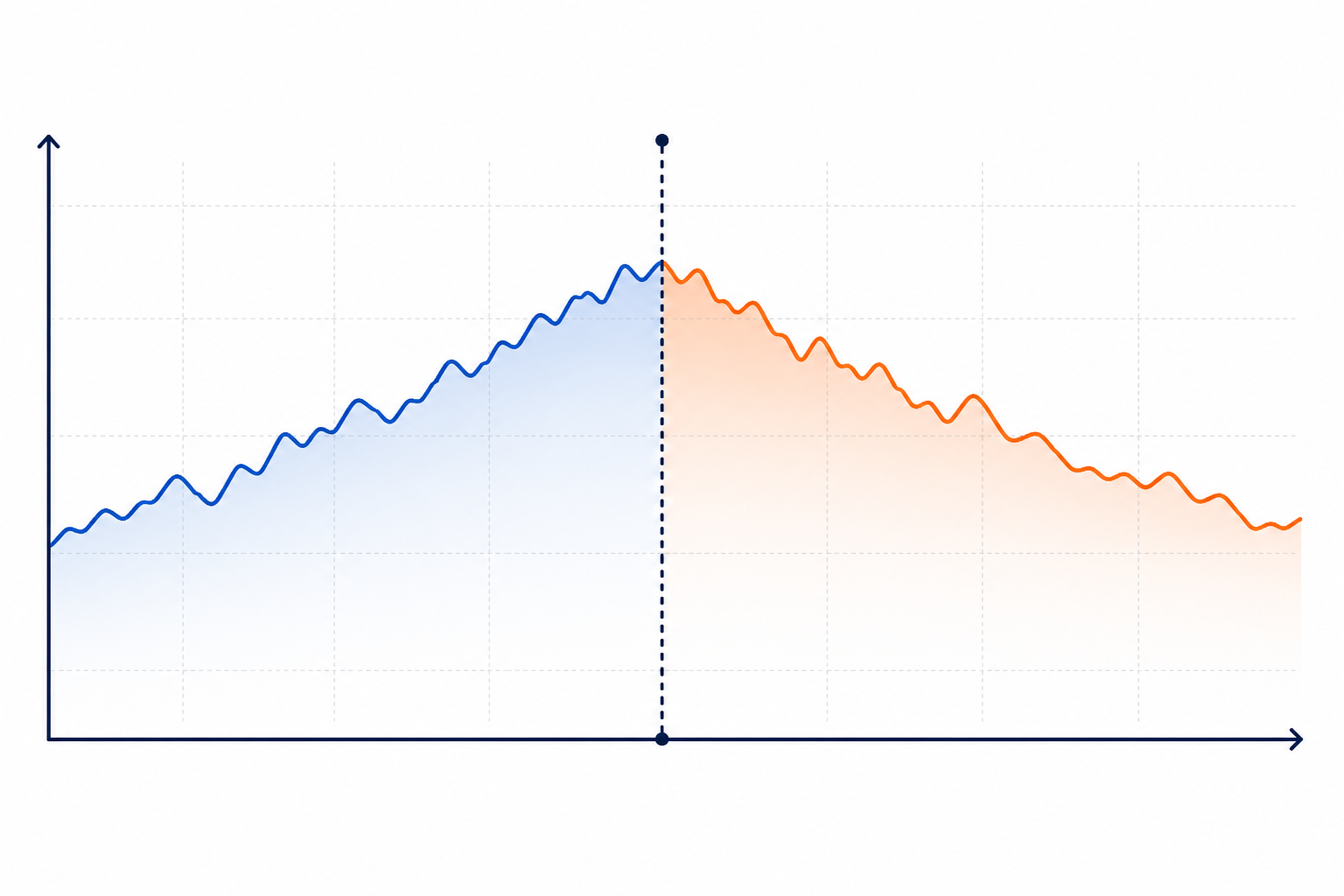
Illustrative pattern based on general content-decay research, not a specific measured case.
Here's a hypothetical example that mirrors what I've seen described in industry case studies. Imagine a local healthcare practice that published useful pages on treatments, insurance queries, and aftercare, then went quiet for the better part of a year while the team focused elsewhere. Their older pages likely wouldn't vanish from search overnight. But new competitor content covering updated insurance rules could gradually pull ahead, particularly for the fresh, time-sensitive questions patients search for. If the practice resumed publishing, they'd likely need to rebuild some momentum rather than simply pick up where they left off.
There's also a psychological trap worth naming. Many businesses lose momentum somewhere around the three to four month mark, which is often frustratingly close to when initial results start to show, since pages need time to be crawled, indexed, and gradually climb the rankings. This timeline isn't fixed for every site or industry, but giving up right before things start moving is a mistake I see fairly often.
"Topical authority" sounds abstract until you see it in practice. What it really means is that Google's systems, and your readers, start treating your site as a genuine, reliable source on a subject because you've covered it from multiple angles over time, not because you wrote one long article and called it done. It's not a fixed score Google assigns; it's closer to an outcome that emerges from genuinely useful, well-linked content.
Here's what that looks like in practice:

Illustrative diagram of a topic cluster structure, not a specific measured example.
I want to be clear about this: the pattern I've seen, both in published research and in individual results people share, is that meaningful SEO gains from blogging rarely show up in week one. They tend to show up somewhere between month three and month six, sometimes later, and sometimes not at all if the content or the market doesn't support it.
One Scribe customer reported a 340% increase in organic traffic over six months of consistent publishing. I want to be transparent about the limits of that figure: it's a single self-reported case, not an independently verified study, and I don't have the baseline traffic, exact publishing volume, or competitive context to know how typical that result is. I'm including it as an example of what's possible under good conditions, not a promise of what you should expect.

Self-reported customer result. Individual results vary based on competition, content quality and starting traffic.
I've also heard from businesses that paused publishing for months, then restarted with a steadier process, and saw growth pick back up faster than they expected. The dry spell cost them time, but existing content generally retained some residual value, and resuming consistent output gave search engines a reason to crawl their site more actively again. That said, "faster than expected" is relative. Recovery speed depends on how much authority the site had built before the pause and how competitive the space is.
On publishing volume: there's no single right number. Some UK small businesses do well with one strong, well-researched article a week. Others get better results from one solid article a fortnight combined with regularly updating older pages. A small handful of businesses with more resources publish 10 to 30 articles a month, but that's a high-volume model suited to larger content operations, not a baseline every small business needs to hit. The honest answer is: pick a cadence that matches your capacity and stick with it longer than feels comfortable.
Knowing consistency matters is one thing. Actually sustaining it is where most businesses struggle. Here's a practical approach, including a lighter version for very small teams.
A note on tools: this is where AI writing tools, including Scribe, which I work on, can genuinely help by handling research and drafting so the habit is easier to sustain. I'd rather you judge that on your own terms than take my word for it, so I've kept product specifics out of the main advice above. If you want to see what an AI-assisted workflow looks like, it's worth trying a few tools and comparing the output quality yourself rather than relying on any single claim, including ours.
The honest truth is that content marketing rewards patience and quality more than sheer intensity. A steady rhythm of genuinely useful posts, reinforced by internal linking and refined by what's actually working in Search Console, is what turns a blog from a nice-to-have into an asset that compounds.
Not directly, no. Google doesn't reward publishing frequency as a ranking factor on its own. What consistent publishing does is give you more opportunities to create genuinely useful, relevant content, build internal links between related pages, and cover more of the questions your customers search for. The effect is cumulative, but only if the content itself is good. Publishing often with weak content won't outperform publishing less often with strong, well-targeted content.
Most businesses start noticing meaningful traffic movement somewhere between three and six months of consistent, quality publishing, though this varies significantly by competition, niche, and site authority. Some posts pick up impressions sooner; others take longer or never gain much traction, which is normal. Treat any specific timeline as a general pattern rather than a guarantee for your site.
Traffic doesn't usually crash overnight. Growth tends to plateau, and rankings can gradually erode as competitors who keep publishing and updating their content pull ahead, particularly for time-sensitive queries. The speed of decline varies a lot by topic and competitiveness. Restarting is entirely possible and can reignite growth, sometimes fairly quickly if your site already has some authority, but the months of inactivity generally represent lost ground that takes some time to fully recover.