Why Content Velocity Matters for E-Commerce SEO Growth

Content Velocity for E-Commerce: Why a Steady Publishing Cadence Supports SEO
If you're a UK e-commerce brand owner wondering why your blog traffic has stalled despite the occasional "great" post, here's the short version: content velocity, the rate and consistency at which you publish, doesn't directly force search engines to rank you higher. Google has said this plainly. But a sustainable publishing cadence does something more useful. It expands the number of relevant topics you cover, keeps time-sensitive pages current, and gives you more chances to earn the internal and external links that support rankings over time.
For online stores, that can mean the difference between showing up for a seasonal collection or product launch when shoppers are searching, and watching a competitor capture that traffic instead.
I want to be careful with the causal story here, because it's easy to overstate. Publishing weekly doesn't cause Google to rank you higher, and it doesn't guarantee a competitor with a steadier cadence will outrank you. What it does is increase the number of legitimate opportunities you have: more pages that can be found for genuine queries, more internal links pointing at your category pages, and more chances to catch a seasonal trend while it's still rising.
Whether that translates into visibility depends on the quality of what you publish, your existing domain strength, your technical setup, and what your competitors are doing at the same time. This article explains how content velocity can support e-commerce SEO, not promise a specific ranking outcome.
What Does Content Velocity Really Mean?
Content velocity isn't just a fancy way of saying "publish more." It combines:
- Frequency: how often you publish
- Consistency: whether you maintain that frequency over time
- Quality threshold: whether each piece is genuinely useful enough to be worth publishing
A brand that publishes one thoughtful post every week for a year has built more durable coverage than one that publishes twenty posts in a single month and then disappears, even though the raw output might look similar on paper.
A practical way to measure your own content velocity is to count useful publications or meaningful content updates per month. Then adjust that figure based on whether the content serves a real search intent and whether your team has the capacity to sustain it.
If you can only genuinely sustain two well-researched posts a month, that's your content velocity, not the five-a-week plan you abandoned in March. Sporadic bursts of high-effort content can create a short-term spike around a launch, but they don't build the same ongoing library of indexed, relevant pages. Consistency builds that library.
Content Velocity Example for a UK E-Commerce Brand
Imagine a fashion retailer preparing for an autumn/winter collection launch ahead of the Christmas trading period. If the retailer publishes a single large blog post the week before launch, that piece is doing all the heavy lifting while competing against retailers that have already published style guides, trend round-ups, and gifting advice for weeks.
If the same retailer had published weekly throughout September and October, it could cover:
- Layering tips
- Fabric guides
- Colour trend predictions
- Gift guides for different budgets in GBP
- Advice on choosing seasonal clothing
Those pages would have time to be indexed and potentially gather traction by the time the collection launches. The launch content would then fit into an existing content ecosystem rather than starting from zero. That's not a guaranteed ranking boost, but it is a better starting position.
For UK e-commerce specifically, this matters because much of what you sell is tied to timing: the January sales, Black Friday and Cyber Monday, half-term and summer holiday shopping windows, and weather-driven demand for things like garden furniture or winter coats. A steady content velocity gives you the runway to build relevance before the moment matters, not after it has already passed.
Why Search Engines Reward Useful, Consistent Content
I want to be upfront about something Google has been consistent about: publishing more content doesn't, by itself, improve rankings. Google's guidance on creating helpful, reliable, people-first content is explicit that its systems reward genuine usefulness, not a specific publishing frequency.
It's worth separating a few concepts that often get blurred together: crawling, indexing, freshness, and ranking are not the same thing. A steady publishing cadence can affect them in different, mostly indirect, ways.
Here's how content velocity can plausibly support an e-commerce SEO strategy, and what it does not prove on its own:
| Mechanism | What a steady cadence enables | What to measure | What it does not prove |
|---|---|---|---|
| Freshness | New or updated pages for queries where recency genuinely matters, such as seasonal trends, availability, and pricing | Indexed date and impressions on time-sensitive queries in Search Console | That fresher content outranks better content on non-time-sensitive queries |
| Crawl activity | More pages worth revisiting if they are genuinely updated and useful, not just newly published | Crawl Stats report and indexation coverage over time | That publishing volume alone increases crawl priority |
| Topical coverage | A body of buying guides, comparisons, and use-case content around your category | Rankings for target topic clusters and non-brand impressions by page | That coverage guarantees a top ranking for competitive terms |
| Internal linking | More relevant pages to link to and from your product and category pages | Internal links per product page and assisted conversions from blog to product | That linking alone overcomes weak product page content |
| Competitive position | More opportunities to be the page that is already available when demand rises | Share of voice for seasonal queries versus named competitors | That a competitor's higher ranking is caused by your publishing gap without checking links, domain strength, and technical SEO |
Freshness and Time-Sensitive E-Commerce Searches
Google's documentation on how search ranking works notes that its systems are designed to surface newer results for queries where recency is genuinely expected. Examples include product availability, seasonal trends, or information that changes often.
If you sell products where recommendations, pricing, or trends shift over time, keeping relevant content current can give you an advantage for those specific queries. This isn't about publishing frequency in general. It's about matching update timing to genuine user need. You can validate this in Google Search Console by checking impressions on seasonal queries before and after refreshing a page.
Crawl Activity Is Not the Same as Higher Rankings
Crawl demand is a separate mechanism. Google's Search Central documentation notes that crawl demand is influenced by the perceived quality and popularity of pages, along with how stale they have become, among other factors.
That does not mean a steady publishing habit earns you more frequent crawling by default. It means that pages Google's systems judge as genuinely valuable, whether new or updated, are more likely to be revisited than pages that remain stale and low quality. The publishing pattern itself isn't the lever. The judged value of each page is.
Building Topical Coverage and Internal Links
Consistent publishing can help you build topical coverage within your product category, provided the content is genuinely useful. Rather than asking one product page to rank for everything, you can build a body of content covering buying guides, comparisons, use cases, and supporting questions. These pages can link back to relevant category and product pages with useful context.
Google's SEO starter guide recommends a clear internal linking structure. Building that structure steadily is usually more practical than trying to create it in a single sprint. However, topical coverage alone does not override weak product pages, poor technical SEO, or a highly competitive niche where established competitors already dominate.
The risk at the other end is worth naming clearly. A high-volume content programme that produces thin, repetitive, or barely differentiated pages can work against you. Google's quality rater guidelines are explicit that pages without a genuine, beneficial purpose are rated poorly, and enough of them can affect how the rest of your site is perceived.
The goal isn't to publish often for its own sake. It's to publish useful content that a shopper would actually want to read.
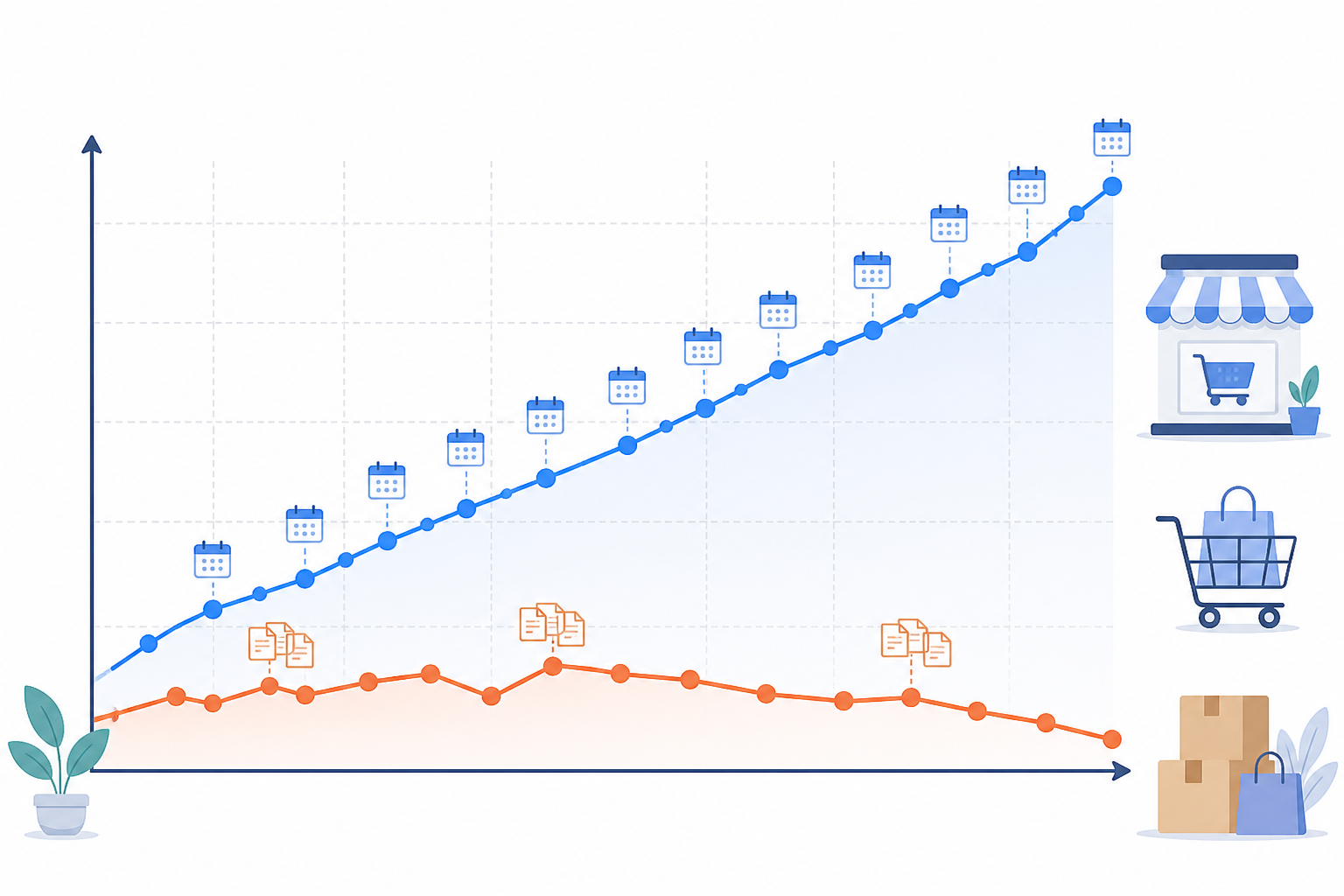
A quick caveat on that chart: it illustrates a plausible pattern, not a guaranteed outcome. Two sites publishing at different cadences will also differ in domain age, backlink profile, technical health, and competitive pressure, all of which affect the shape of that traffic line. Treat it as an illustration of what steady coverage can look like over time, not proof that content velocity alone drives the gap.
For UK e-commerce brands, this plays out clearly around new product drops and seasonal trends. If you're consistently publishing genuinely useful content around your category, whether that's skincare routines, outdoor gear maintenance, or homeware trends for the run-up to Christmas, you are building a reservoir of indexed, relevant pages that may already be positioned to gain traction when search interest spikes. Whether that traction turns into a top ranking still depends on everything else about your site and your competition.
How E-Commerce Brands Fall Behind on Blogging
I understand why blogging often slips down the priority list for online stores. It's rarely a lack of ambition. It's usually a resourcing problem. There are also some reliable warning signs that a brand has fallen into a burst-and-drought publishing pattern:
- Product teams prioritise listings over blog content. Updating catalogue entries, pricing, and inventory always feels more urgent than writing a blog post, even when the long-term SEO value of useful content is significant.
- Marketing bandwidth gets eaten up elsewhere. Paid ads, email campaigns, and social content tend to have more immediate, visible results, so blogging gets pushed to "whenever we have time," which often means never.
- Seasonal rushes create content droughts. Teams pour everything into the run-up to Black Friday or Christmas, then need weeks to recover, leaving a gap when they should be building on that momentum into the January sales.
- Quality content takes real time to produce. Research, writing, editing, and formatting a genuinely useful post isn't a quick task, especially without a dedicated content person or team.
- Gaps give competitors an opportunity. Every month you're not publishing is a month a competitor's content has a chance to gain ground for topics you'd normally want to cover.
Here's what this can look like in practice. A homeware retailer plans a January launch for a new range, but the team spends November and December entirely on Black Friday and Christmas fulfilment. No blog content goes out during that window. Come January, Search Console shows non-brand impressions for the new range's core terms flat or declining, while a competitor that kept publishing through December already has three ranking guide pages for the same category.
The revenue signal may appear a few weeks later: assisted conversions from organic blog traffic to that category's product pages are near zero because there is no content to assist from.
If you want to check whether this applies to your store, look for three diagnostic signs:
- An editorial calendar where nearly all activity clusters around launch weeks
- Non-brand organic impressions in Search Console that dip for months at a time
- A growing pile of published pages with no internal links pointing to them and no measurable contribution to traffic or conversions in your analytics
None of this is a criticism of e-commerce teams. It's the reality of limited hours and competing priorities. Recognising the pattern is the first step to fixing it.
How to Build a Sustainable Content Publishing Cadence
Fixing content velocity doesn't require a massive overhaul. It requires a realistic plan you can actually maintain, tied to a genuine review of quality rather than an arbitrary publishing number.
- Audit your current publishing frequency. Look back over the past six to twelve months and map out exactly when you published and when you didn't. Pull non-brand impressions from Search Console for the same period as your baseline. This usually reveals the burst-and-drought pattern quickly, along with which gaps coincided with your busiest trading periods.
- Set the highest cadence you can sustain without dropping quality. There's no universally correct frequency. Choose a pace, weekly, fortnightly, or otherwise, that you can maintain during Black Friday week and the Christmas rush. Stick to it rather than chasing an ambitious number you'll abandon after six weeks.
- Prioritise topics by demand, margin, and inventory. Before committing a slot in the calendar, check search demand for the topic, whether the product it supports has healthy margin and enough stock to sustain the traffic, and how competitive the existing search results are. A beautifully written guide for a product you're discontinuing next month isn't a good use of a limited content slot.
- Map content to your product calendar with real lead time. For a launch, work backwards eight weeks using a structure like this:
| Week before launch | Content type | Purpose |
|---|---|---|
| Week 8 | Early trend piece or buyer's guide | Start building topical relevance and capture early research-stage searches |
| Week 6 | Comparison or "how to choose" article | Support consideration-stage searches and link to the category page |
| Week 4 | Use-case or styling piece | Show the product in context and support internal linking |
| Week 3 | Care or maintenance guide | Add depth and target long-tail post-purchase queries |
| Week 2 | FAQ addressing pre-purchase questions | Reduce friction and target question-based searches |
| Week 1 | Launch announcement | Convert existing interest at the moment of release |
| Week +2 to +3 | Post-launch update or customer round-up | Refresh the page, add social proof, and sustain relevance |
Assign an owner and deadline to each piece so it doesn't slip when things get busy. Not every launch needs all seven pieces; scale the plan to the size and margin of the launch.
5. Batch your topic ideas each quarter. Set aside time to brainstorm and prioritise topics based on genuine search demand and commercial relevance to what you're actually selling that season. This helps prevent the team from starting each month with a blank page.
6. Review performance against meaningful metrics, not publishing volume. Track indexed pages, non-brand impressions, rankings for target topic clusters, organic sessions, and, where possible, assisted conversions or revenue. A proper quality review should also check search intent match, first-hand product expertise, accuracy, originality, and whether each piece links naturally to relevant product or category pages.
The thread running through all six steps is realism. A content publishing cadence you can maintain for a year, even a modest one, beats an ambitious plan that collapses after six weeks.
Tools and Workflows That Help Maintain Content Velocity
Here's where many e-commerce teams get stuck: they know consistency matters, but writing consistently is genuinely hard without dedicated resources. A workable process, regardless of the tools you use, usually includes:
- A content brief that ties the topic to a real product, margin, and search demand
- A first draft, whether written from scratch or generated as a starting point
- A review by someone with genuine product knowledge who checks accuracy and adds first-hand detail
- An originality check against your existing content to avoid internal cannibalisation
- A final approval step before publication
- A scheduled review weeks later to see whether the page is earning impressions, links, or assisted conversions
The hardest part of that process for many teams is the first draft. This is the gap that AI-assisted content tools, including one we build called Scribe, are designed to help close. I'll flag clearly that this is our own product, so weigh it as one option among several rather than a neutral recommendation.
Scribe generates long-form blog post drafts with suggested images, which your team then fact-checks, edits for accuracy and first-hand detail, and approves before publishing. It also integrates with Shopify, WordPress, Wix, and Webflow to reduce the manual publishing steps.
It doesn't replace the review, product knowledge, or originality-checking steps above. It's intended to shorten the time spent on the blank page so those steps receive more attention, not less.
Outcomes vary significantly by starting traffic, competitive category, and how rigorously the editorial process is followed. I won't quote a headline growth percentage without the context needed to judge it. If you're evaluating any content tool, including ours, ask the same questions you'd ask about a content velocity and rankings claim: What was the baseline? Over what timeframe? How much content was published? What else changed at the same time, such as technical fixes or new backlinks?

Frequently Asked Questions About Content Velocity
How often should an online store publish blog content?
There's no fixed number that works for every store, and I'd treat any specific figure you read elsewhere with caution. What matters more is choosing the highest frequency your team can sustain without sacrificing quality, then holding that pace through your busiest trading periods rather than just the quiet months.
A store publishing one genuinely useful post a fortnight, every fortnight, will typically build more lasting topical coverage than one that publishes five posts in a single month and nothing during the next three. Check your Search Console impressions after three months at your chosen cadence before deciding whether to change it.
Does posting more often actually improve rankings?
Not directly, and Google has said as much. Volume alone won't rescue weak content, and publishing frequency isn't a ranking signal in itself.
What consistent, high-quality publishing can do is give you more indexed pages covering relevant topics, more opportunities for natural internal linking, and better coverage of time-sensitive queries where freshness genuinely matters, such as seasonal trends or changing product availability. These are indirect contributors that still depend on domain strength, technical SEO, content quality, and competition. They are not substitutes for those things.
What happens if I go months without publishing?
Your existing pages don't automatically disappear from the index, but a long gap means you're not adding new coverage or refreshing genuinely time-sensitive content. Any freshness advantage for seasonal or trend-driven queries may also fade.
Whether a publishing gap is harmful for your store depends on your category. If you sell products where trends and availability shift constantly, check non-brand impressions in Search Console during the gap. A flat or declining trend there is a more useful signal to act on than the gap itself.
Bringing It Together: A Practical Content Velocity Plan
Content velocity isn't a magic ranking lever, and I'd be doing you a disservice to pretend otherwise. A realistic, sustained publishing cadence mapped to your product calendar and UK trading seasons can build the topical coverage and internal linking that support search visibility over time, alongside everything else that affects your rankings.
Here's a concrete next step rather than a vague intention: over the next 30 days, pull your last six to twelve months of publishing dates alongside Search Console impressions to establish a real baseline. Choose one content velocity you can sustain through your next busy trading period, then set a date 90 days out to review:
- Non-brand impressions
- Rankings for your target topic clusters
- Organic sessions
- Indexed pages
- Internal links to product and category pages
- Assisted conversions, where measurable
That is a more useful measure of progress than chasing a publishing frequency that doesn't exist. For e-commerce brands, steady, relevant, and high-quality content gives your site more opportunities to be visible when seasonal demand and product interest arrive.
SEO CONTENT CONTRACT
- Primary topic: content velocity
- Supporting concepts: None required
- Dominant search intent: informational
- Target search market: United Kingdom
- Content angle: Connect publishing cadence directly to search ranking signals, using e-commerce-specific examples like seasonal collections and product launches.
- Suggested sections: What Content Velocity Really Means; Why Search Engines Reward Consistency; How E-Commerce Brands Fall Behind on Blogging; Building a Sustainable Publishing Cadence; Tools That Help You Keep Up the Pace
- Reader questions: How often should an online store publish blog content?; Does posting more often actually improve rankings?; What happens if I go months without publishing?
Treat these as reader and topic guidance, not a phrase quota. Never force exact phrases, repeat keywords mechanically, or sacrifice clarity to a density target.
Related Articles

Create content like this automatically
Scribe uses AI to generate high-quality blog posts that engage your audience and drive traffic.