Why Group Gifting Is the Smartest Way to Buy Big Baby Gear (and How to Organise It)
15 min read
Loading...
A group gifting baby registry plan is a simple way for you and a few other guests to pool money for a big-ticket item, like a pram, car seat or cot, that none of you would comfortably buy alone. The simplest way to do it is to pick one item from the parents' baby registry, nominate one organiser to buy it, and agree a fair share up front. Keep the messages short, the maths transparent and the contribution amounts flexible, and nobody feels awkward. 💛
That's the whole idea in a nutshell. The rest of this guide covers the details: which items suit pooling, how to organise a group gift step by step, what to say in the group chat, and how to keep money talk comfortable. One note first. bababloom is a South African registry platform, so the examples are in rand. The same approach works for baby showers in the UK and elsewhere. Just use your local currency and payment methods.
Picture this. You're scrolling through the parents' registry on your phone, and there it is: the pram. The one they've clearly researched, with the right wheels, the right fold and the right colour. It also costs about as much as a weekend away, and you were planning to spend R400.
So you do what most guests do. You scroll past it and pick a lovely muslin set instead.
That's the quiet problem with baby registries. The big items are exactly what new parents need most, and exactly what guests skip because of the price tag. Prams, car seats and cots sink to the bottom of the list while the small things get claimed in a day.
Group gifting fixes this. Pooling turns a purchase that would stretch one person's budget into a comfortable contribution for everyone. Eight people each chipping in R500 is easy. One person finding R4,000 is not.
There are a few other good reasons to organise a group baby shower gift:
And what about baby registry etiquette? There's no rule against chipping in together. The main courtesies are to keep participation optional, be clear about the item and its cost, and never imply that anyone is expected to give a particular amount. Do that and you're on solid ground.
Not every item suits group giving. The best candidates are expensive, practical things the parents have specifically chosen and will use constantly. Pooling works least well when the parents haven't settled on a model yet, or would rather have something else entirely.
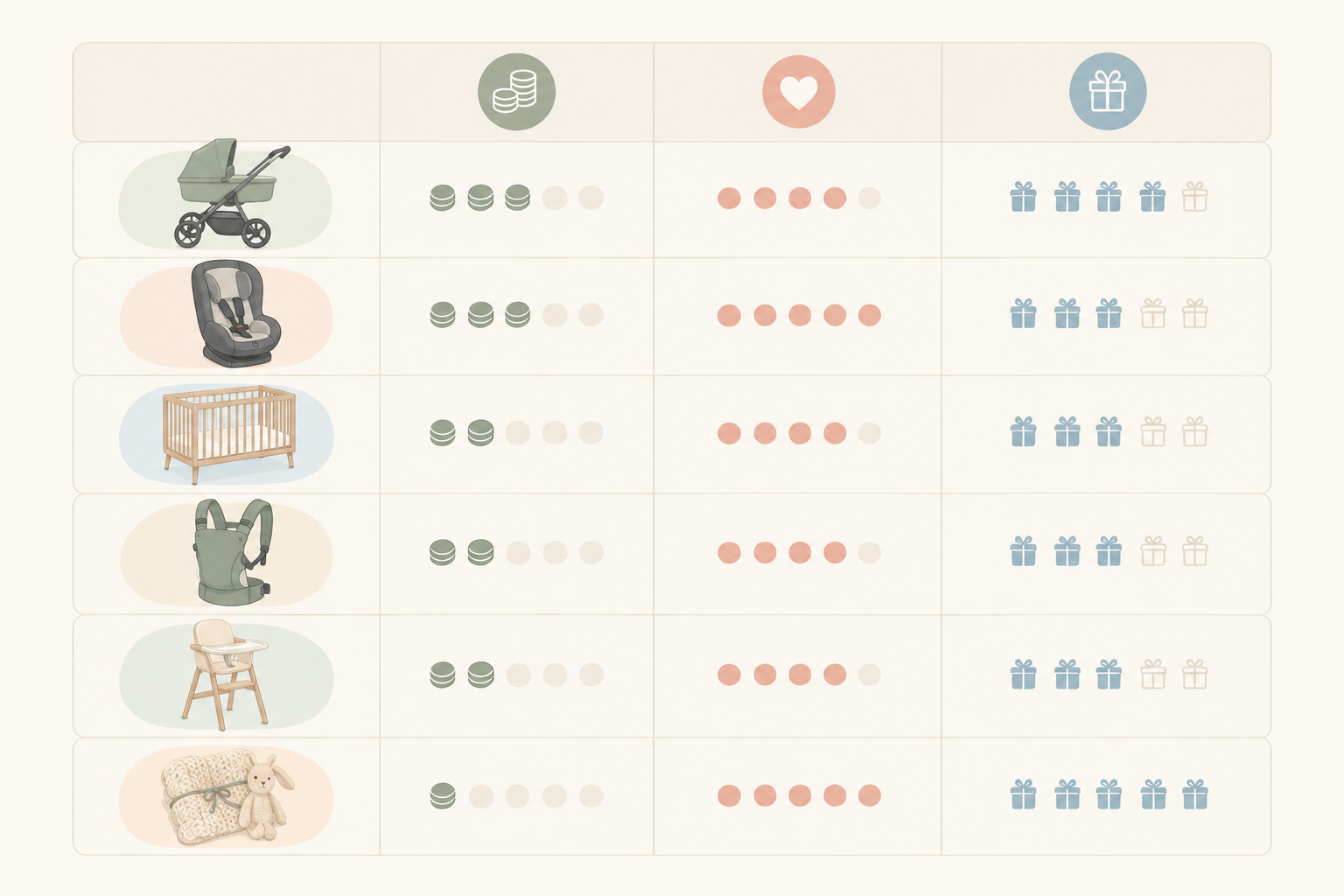
Here's a rough guide. The prices are ballpark figures in rand and will vary by brand and store, so always go by the actual price on the registry.
| Item | Rough price band | How essential | Group gifting fit |
|---|---|---|---|
| Pram or travel system | R3,000 – R12,000 | Very high | Excellent, since it's expensive and highly personal |
| Car seat | R2,000 – R6,000 | Essential (and safety-critical) | Excellent, as long as it's the exact model the parents chose |
| Cot and nursery furniture | R2,500 – R8,000 | Very high | Great, especially for a cot and mattress |
| Baby carrier | R800 – R3,000 | High | Good for a smaller group of 3–4 |
| High chair | R1,200 – R4,000 | Medium, needed from around six months | Good, and a nice 'later on' gift |
| Handmade heirloom piece | R1,000 – R6,000 | Nice to have | Lovely, especially from local artisans |
Car seats and cots are where I'd be most careful. Safety comes before price, and a seat that looks similar to the one on the registry may not fit the parents' car or have the same safety features. Sleep products need to meet current safety guidance too.
That's exactly why these items should come from the parents' own registry. They've done the homework, and you're simply helping them get the model they chose. Please don't swap in a 'similar but cheaper' option to make the maths easier.
Here's the process I'd follow. It isn't complicated, but doing it in order keeps things smooth.
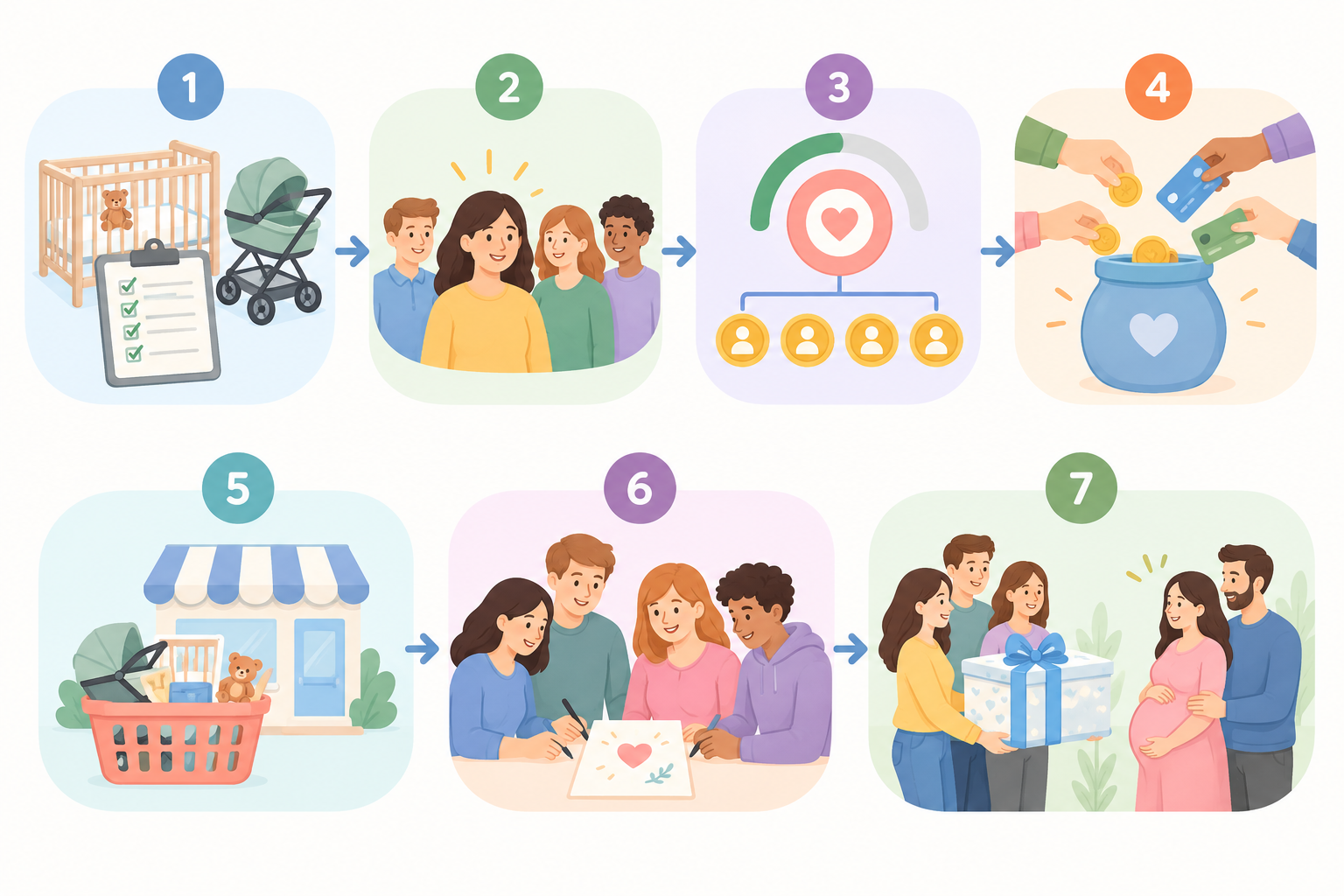
On bababloom, guests purchase directly from each retailer's own website, so there's no built-in pooling tool. Your organiser makes the purchase, and the group settles up with them directly. That keeps things simple, and everyone knows exactly who's holding the money and who's buying.
The parents have built a single, shareable registry with items from local South African stores, so everyone in the group sees the same list and the same availability. That shared view makes organising a group much easier.
If you're using a different registry platform, check how it handles group gifting. Some have their own group gifting features, with different rules around fees, partial contributions and what happens if the target isn't reached. Don't assume every registry works the same way.
The trick to a stress-free group gift is starting small. Don't blast a message to the entire guest list. Begin with a friendly group chat among close friends, or a message to a small circle of colleagues or family who are likely to want to join in.
That's it. Short messages get answered, and long ones get ignored.
Here's one I'd happily send myself:
Hi everyone! 🌸 We're thinking of pooling together for the pram on Thandi and Sipho's registry. It's R4,000 in total, so if eight of us chip in about R500 each, we're sorted. No pressure at all, and any amount helps, whether that's more or less. Could you let me know by Friday the 14th? I'll buy it from the store's site using the registry link and share the receipt once it's done. Here's the link: [registry link]
Notice what it does. It's warm and specific, and it makes joining in feel easy rather than obligatory.
Send one gentle reminder a few days before the deadline. Something like 'Just a quick nudge, the deadline is Friday!' works well. Once the gift is bought, send a thank-you to everyone who joined in.
A couple more etiquette points:
Money and friendship don't always mix easily, but a few simple habits keep things comfortable.

This happens more often than you'd think. Five friends decide to buy a cot for a mutual friend. Someone says 'let's split it', and everyone nods. Nobody says who's buying it, what the total is or when the money is due.
Two weeks later, one friend has bought the cot, another has bought a mattress that doesn't fit it, and a third assumes someone else has it covered. The organiser is out of pocket, the mattress has to go back, and there's a lot of awkward texting.
One short message at the start would have fixed all of it, covering the item, the total, the share, the deadline and who's buying. That's why I keep harping on those five details. They aren't bureaucracy. They're what keeps friendships easy.
Group gifting isn't only for prams and cots. A few guests can combine a couple of smaller registry items into one bundle of newborn essentials, say a set of swaddles, a sleepsuit collection and some soft burp cloths. Check the parents' registry first so you're choosing sizes and quantities they actually need.
bababloom also has a partnership with the Hatch Foundation. Guests can donate a R500 Hatch Bag of newborn essentials to a mother in need. If your group is already pooling, you could split the cost of a Hatch Bag alongside the main gift. It's a way to share the joy with mothers across South Africa who have far less.
It's also a graceful answer to the surplus question. If your pram fund ends up with a spare R500, a Hatch Bag is a meaningful place for it to go. I'd always treat this as a heartfelt extra rather than an obligation, and I'd keep it entirely optional for everyone in the group.
Organising a group gift is much simpler when everyone is looking at the same list. Here's how a curated registry platform helps:
For parents, it also means supporting local South African brands and small businesses, which many of us love to do. For guests, it means less guesswork and far fewer duplicate gifts.
Pick one big item from the parents' registry, choose one person to buy it, suggest a per-person amount and a deadline, and collect contributions by bank transfer or another method everyone is comfortable with. Keep a short group chat going so everyone knows the plan.
Big-ticket essentials that are high on the parents' wish list tend to work best: prams or travel systems, car seats, cots and quality nursery furniture. Choose from the registry so the parents get the exact item they researched.
Send a short, friendly message with the item, the total cost, a suggested share and a deadline, and make clear that any amount is welcome. Keep it to a small group of people who are likely to want to join in, and avoid publicly tracking who has paid.
Yes. Most parents love receiving a big, useful item from a group of people who care about them. The main courtesy is to check that nobody else is already buying the same item and to sign the card from everyone involved.
Agree a fallback in advance. The organiser can top up the difference, you can choose a more modest registry item, or you can scale back and put what you have towards several smaller gifts.
Choose one organised, trusted person to buy the item from the retailer's own website using the registry link. Everyone else sends their share to that person by the deadline, and the organiser shares a receipt so it's clear the money went to the gift.
Pooling for big baby gear is one of the kindest things guests can do, and it doesn't need to be complicated. Choose one item from the registry, appoint one organiser, share a clear message with the price, the suggested share and the deadline, and keep everything flexible and private. Add a Hatch Bag if you'd like to share a little extra kindness.
If you're a parent-to-be reading this, a well-built baby registry with a few big, clearly priced items makes it so much easier for your guests to pool together. And if you're a guest, I hope you now feel ready to start that group chat. 🎁
Building your first baby registry in South Africa? Learn the most common baby registry mistakes, from timing to over-buying clothes, and how one curat

Wondering if it's rude to go off-registry or how much to spend? Our friendly guide to baby registry etiquette answers every baby shower guest question

A practical guide to baby shower planning South Africa hosts can use, with timing, local themes, venue and budget tips, games and registry advice.