Why Publishing Frequency Matters for Organic Growth (And How Often You Should Actually Post)

Why Publishing Frequency Matters for Organic Growth
Publishing frequency matters for organic growth mainly because it increases your opportunities to cover the searches your customers are typing into Google, not because there's a magic number of posts Google requires each week. Brands that publish consistently, rather than in occasional bursts, tend to build stronger organic visibility over time. That's not because search engines reward a rhythm for its own sake. It's because steady output creates more chances to answer real queries, earn links, and connect pages internally. Those opportunities add up when the underlying content is actually useful.
I've spent years watching UK and international e-commerce brands wrestle with this question, and it's rarely about finding a magic number of posts. It's about building a publishing cadence your team can sustain long term, one that gives you a realistic shot at covering your topic area properly and gives your audience a reason to keep coming back. Here's what the evidence shows, along with a practical framework for finding a publishing frequency that works for your business.
How publishing frequency affects organic rankings
It helps to separate four things that often get blurred together: publishing frequency, crawling, indexing, and ranking. They're related, but they're not the same mechanism.
Google has never published a required posting frequency for ranking well. Its own guidance for creators focuses on producing helpful, reliable, people-first content, not hitting a specific number of articles per week (Google Search Central, "Creating Helpful, Reliable, People-First Content"). If you've heard that you need to publish daily to win at SEO, that's not accurate.
What's accurate is narrower: a consistent publishing schedule can make it easier for Google to discover new pages on your site. Sites that update more frequently may get crawled more often, but crawl frequency isn't a ranking signal. It just means new content may get seen and indexed sooner (Google Search Central, crawling documentation). Whether that content then ranks depends on separate factors: relevance, quality, technical accessibility, and how well it matches what people are searching for. Google doesn't "reward" a predictable publishing pattern; it just has more of your pages to potentially match against a query.
When content freshness matters for SEO
Freshness matters most for queries where people expect current information, such as prices, stock availability, seasonal trends, or regulatory changes. UK retailers, for example, often see spikes in demand around January sales, Easter, and Black Friday. Refreshing seasonal content ahead of those periods can be more valuable than publishing something entirely new.
For evergreen topics, simply changing a publish date without meaningfully updating the content won't help. Google has been explicit that cosmetic republishing doesn't move the needle. What helps is new or improved information that's actually worth reading, delivered on a schedule you can sustain.
What the research says about publishing frequency
There's correlational data connecting publishing frequency and results, though it deserves real context rather than a headline number. HubSpot's 2015 analysis of more than 13,500 B2B companies found that businesses publishing 16 or more blog posts a month reported roughly 3.5 times more traffic and 4.5 times more leads than those publishing four or fewer (HubSpot, "How Often Should Companies Blog?"). I'd take that one with a pinch of salt: it's now a decade old, focused specifically on B2B companies rather than e-commerce, and it's correlational rather than causal. The businesses publishing more often may also have had larger marketing teams, stronger existing authority, or bigger budgets, any of which could independently drive traffic. It shouldn't be treated as a direct benchmark for a UK online retailer today.
Orbit Media's annual survey of several thousand bloggers offers a more recent, though still correlational, data point: writers who spend more time per post and publish more consistently tend to report stronger results than those who publish rarely or rush their output (Orbit Media, "Blogging Statistics"). Again, this reflects a pattern in survey responses, not proof that frequency alone causes better outcomes. Time invested per post and consistency may both simply indicate a team that treats content seriously.
The honest caveat is that more than 90% of pages receive zero organic traffic from Google search, according to Ahrefs' analysis of a billion pages (Ahrefs, "We Analyzed 1 Billion Pages"). That statistic largely reflects pages with no backlinks or no real search demand, rather than proving publishing frequency doesn't matter. Still, it's a useful reminder that volume alone guarantees nothing. The brands that see results combine a sustainable publishing rhythm with content built to answer a real question.
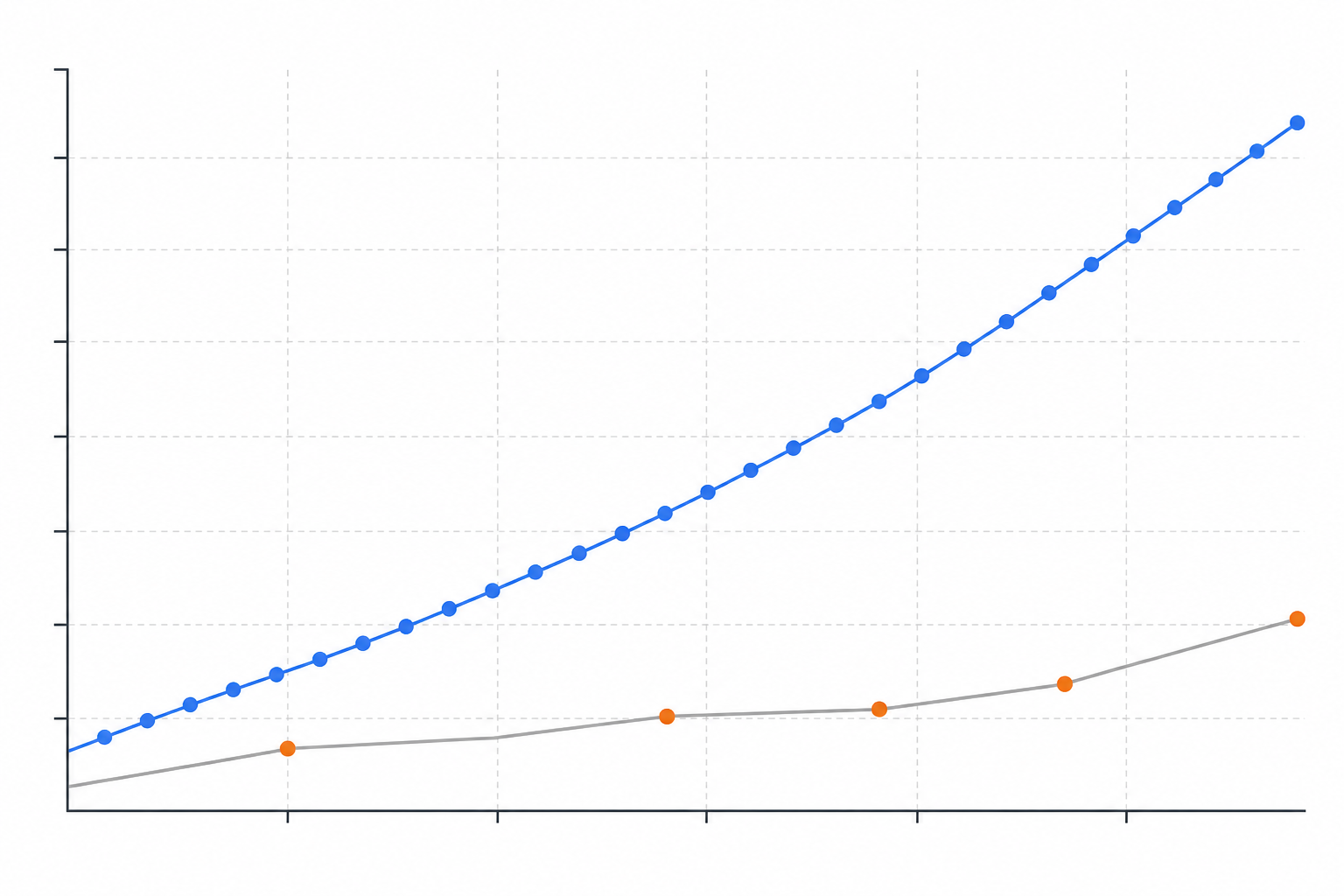
Illustrative example only, not based on real site data, actual results vary by site authority, competition, and content quality.
How often should you publish blog posts for SEO?
There's no universal number, and I'd be cautious of anyone who insists otherwise. The right publishing frequency depends on your site's authority, your competition, your team's capacity to maintain quality, and how much useful ground you still have left to cover. Rather than chasing a fixed target, work through a short decision framework and treat any specific number below, including the ranges, as a starting scenario to test, not an SEO requirement.
Start by asking three questions:
- How many topics can your team research and write to a standard you're proud of each month?
- How much editorial review capacity do you have to check facts, tone, and internal links before content goes live?
- How much genuine search demand exists for your topic area in the UK market?
The answers matter more than any generic benchmark.
| Situation | Practical starting cadence | Why |
|---|---|---|
| New site, limited authority, small team | 1 well-researched post a week | Builds a foundation without outpacing editorial review |
| Established site, existing traffic, dedicated content team | 2–4 posts a week, if quality holds | Provides more capacity to sustain research and editing at pace |
| Highly competitive niche, such as fashion, beauty, or electronics | Fewer but more specific posts, prioritising gaps competitors have not covered | Broad, generic content struggles against larger incumbents |
| Smaller or less competitive niche | Lower, steady cadence | There is less content noise to cut through, so consistency matters more than volume |
| Large existing content library with overlapping or outdated posts | Pause new posts and prioritise consolidation and refreshes | Adding more content risks cannibalisation before existing issues are fixed |
For many growing e-commerce brands, two to four posts a week is a workable range in practice. Not because it's a documented ranking factor, but because it's often the point where teams can maintain both consistency and quality without burning out. A small team with one dedicated writer may do better committing to one excellent post a week than stretching to four. A larger team with a content lead, writer, and editor might comfortably manage four.
New content versus content refreshes
It's also worth factoring in content refreshes and consolidation, not just new blog posts. Updating an existing page with new pricing, updated statistics, or better internal links can sometimes deliver more value than publishing something new from scratch, particularly for pages already ranking on page two of Google, where a meaningful update can be the nudge that moves them higher.
If you've built up hundreds of posts over the years, some of which now overlap or compete with each other for the same terms, merging or pruning that backlog is often more valuable than adding to it. Product and category pages serve a different, more transactional search intent from blog content, so they should be planned and measured separately, even though linking between them can support both.
Once you've settled on a cadence, the returns from simply adding more posts start to diminish unless each new piece earns its place. Publishing five thin, repetitive articles a week will rarely outperform three well-researched posts that properly answer what your customers are searching for.
Content velocity in action: a consistent publishing example
To make this concrete, here's an illustrative scenario, not a verified case study, showing how a shift in content velocity commonly plays out.
Imagine a mid-sized UK homeware retailer that had been publishing sporadically for more than a year: five posts one month, then nothing for the next two. Its organic traffic had flatlined at around 2,000 monthly sessions from blog content. The retailer switched to a consistent schedule of three posts a week, focused on genuine product and buying-guide topics, and paired that with a modest internal linking refresh on its strongest older pages.
| Month | Posts published (cumulative) | Indexed blog pages | Monthly blog sessions (illustrative) |
|---|---|---|---|
| 1 | 12 | 45 | ~2,000 |
| 2 | 24 | 58 | ~2,100 |
| 4 | 48 | 79 | ~3,400 |
| 6 | 72 | 96 | ~5,600 |
These figures are constructed to illustrate a common pattern, not drawn from a single audited account, so treat the shape of the curve as the takeaway rather than the exact numbers. Results took a few months to show up, which is normal. Search engines need time to crawl, index, and evaluate a new pattern of updates, and new content needs time to earn links and prove its usefulness.
By month four, traffic began climbing steadily. By month six, blog-driven sessions had roughly tripled, alongside a noticeable increase in newsletter sign-ups from content pages. Importantly, this wasn't down to publishing frequency alone. The team had also improved internal linking to product pages and refreshed several older posts that had started slipping in rankings. Frequency created the raw material; quality and structure made that material work.
This is the part that trips people up: the early months of a consistent publishing schedule often feel slow and unrewarding. You're doing the work, but the traffic graph looks flat. Then, once you build up a critical mass of indexed content covering your core topics, momentum tends to become visible. It's less like flipping a switch and more like watching a slow-growing habit finally pay off.
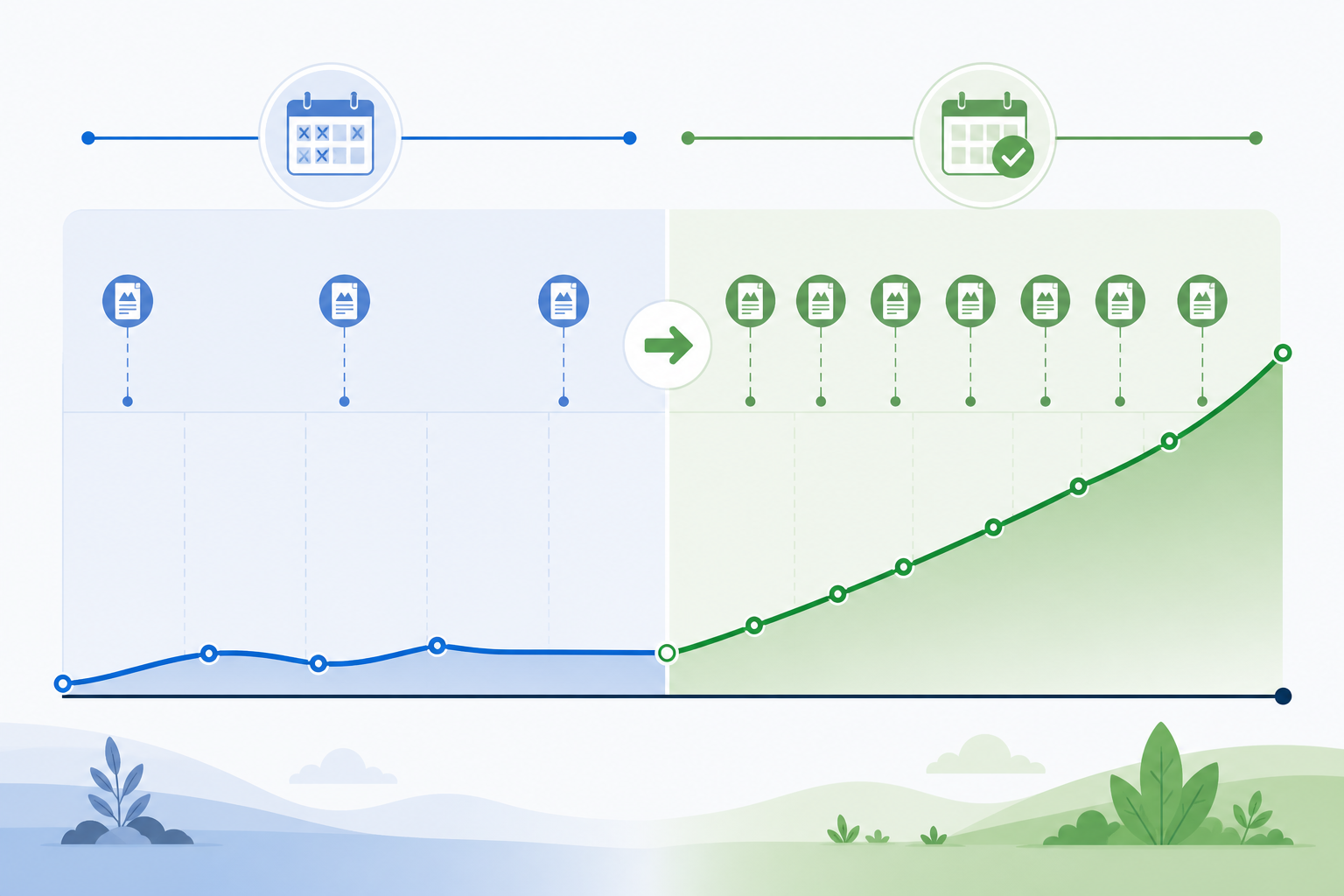
Hypothetical illustration based on common patterns observed across e-commerce accounts generally, not a single verified data source or client.
Balancing content quality and quantity
It's tempting to read "publish more" as a licence to publish anything. But a higher volume of low-quality content can hurt your rankings rather than help them. Thin content, keyword-stuffed pages, and near-duplicate articles create cannibalisation issues, where multiple pages compete against each other for the same search terms and dilute the authority of your strongest content.
The right length for a blog post isn't a fixed word count. It's whatever it takes to complete the search task the reader came for. A quick definitional query might be well served by 400 focused words. A comparison or buying guide competing against detailed competitor content might genuinely need 1,500 words or more. Padding a short answer to hit a word-count target usually hurts more than it helps.
Signs your publishing frequency is too high
Understanding which posts are performing matters before you scale further, not just in raw traffic, but in whether they drive conversions, assisted revenue, or meaningful engagement relative to similar pages on your site. Practical signs that you may be sacrificing quality for volume include:
- Content that doesn't fully answer the search task, regardless of length, leaving readers needing to look elsewhere
- Overlapping topics competing against each other for the same keywords, splitting rather than building authority (a sign it may be time to consolidate rather than add)
- Declining conversion rates on newer content compared with established, better-performing posts
- Search Console data showing impressions without clicks, suggesting your titles or meta descriptions don't match what searchers expect
- A backlog of unedited drafts, indicating that output has outpaced editorial review capacity
Bounce rate and time on page are often cited as quality signals, but they're unreliable on their own. A high bounce rate on a buying guide might simply mean the reader found their answer quickly and left satisfied. Conversion data, rankings for target terms, and direct reader feedback tend to be more trustworthy indicators than generic engagement metrics.
The goal isn't maximum output. It's sustainable output: a cadence you can maintain for a year, not just a sprint you can keep up for a month before burning out your team or compromising quality.
A note on tools: producing enough well-researched content to sustain a consistent weekly cadence is genuinely tough for small teams. This is part of why content and SEO tools have become a normal part of e-commerce workflows. If you're evaluating options, check that any tool supports a genuine editorial workflow, integrates with your CMS, includes an originality or fact-checking step, and provides performance reporting you can act on rather than vanity metrics. These principles apply whether you write everything by hand or use software to support research and drafting.
How to build a sustainable SEO publishing cadence
If you're trying to move from sporadic publishing to a consistent content schedule, follow this practical process.
Audit your current output. Review the last six to twelve months of publishing. Are there long gaps, clusters of activity followed by silence, or overlapping posts competing with one another? Spotting the pattern, or the lack of one, is the first step to fixing it.
Set a realistic cadence based on actual capacity. Be honest about what your team or tools can sustain. Two well-researched posts a week that you can maintain indefinitely beat five posts a week that collapse after a month.
Remove manual bottlenecks with a content calendar or scheduling system. Publishing inconsistency often comes down to friction: nobody owns the calendar, topics aren't planned in advance, or publishing requires too many manual steps. Automated publishing integrations connecting directly to platforms such as Shopify, WordPress, Wix, or Webflow can remove much of that friction for UK retailers managing multiple storefronts.
Run a 90-day test with a defined dashboard. Track indexed page count, organic clicks and impressions by topic cluster, non-brand keyword rankings, and conversions or assisted revenue from content pages. After 90 days, you should have enough signal to judge whether your cadence is working. Rising impressions and clicks on target topics suggest it's worth maintaining or scaling. Flat or declining numbers, or a growing backlog of unedited drafts, suggest you should slow down and fix quality before adding more.
Scale gradually, with a quality gate at each step. Jumping straight from monthly posts to daily publishing is a recipe for quality collapse. Before increasing frequency, confirm your current cadence is meeting your quality bar, producing reasonable rankings and conversions, and not building a backlog of unedited drafts. Then build up incrementally.
Factor in seasonal demand specific to your market. UK e-commerce searches spike around distinct periods, including January sales, Mother's Day, the summer holidays, Black Friday, and the Christmas shopping period. Planning additional capacity or refreshing content around these windows can deliver more value than spreading effort evenly across the year.

Frequently asked questions about publishing frequency and SEO
How often should I publish blog posts for SEO?
There's no fixed number Google requires. What matters more is matching your cadence to your team's actual capacity to maintain quality. A realistic starting point for many growing e-commerce brands is one to four posts a week, chosen based on topic demand and editorial resources rather than an arbitrary target. Consistency over several months matters more than hitting an exact weekly count.
Does posting more often actually increase organic traffic?
Generally, yes, but only up to the point where quality holds steady. More well-optimised, indexed pages create more opportunities to rank for relevant terms. Doubling your output with thin or repetitive content, however, can flatten or reverse gains because search engines are increasingly able to spot low-value content produced at scale.
What is the ideal content velocity for SEO?
There's no single ideal number that applies across all websites. The right content velocity is the fastest pace at which you can produce genuinely useful, well-edited content without a backlog forming. For many small e-commerce teams, that lands somewhere between one and four posts a week. Larger teams with more editorial capacity may be able to publish more.
The better question than "how many posts?" is usually "how much genuine search demand and topic coverage is left to address?" That's what determines whether additional content is likely to find an audience.
Should I focus on new posts or updating existing content?
Both matter, and the right balance depends on how your current content performs. If you have older posts ranking on page two of Google, updating them with fresher information and better internal links can sometimes deliver faster results than creating a new post from zero.
A mixed approach, some new content, scheduled refreshes, and occasional consolidation of overlapping pages, tends to work well for most established websites.
How long does it take to see results from increased publishing frequency?
Timelines vary considerably depending on your starting authority, competition, and content quality. Many brands report noticeable movement within three to six months of consistent publishing, although earlier gains are often modest. The effect can become more visible once you've built up a reasonable body of indexed, well-optimised content covering your core topics. Treat this as a general pattern rather than a guarantee, since results vary by site.
At the end of the day, publishing frequency supports organic growth when it helps you produce more useful content, improve topic coverage, and maintain a reliable editorial process. The best cadence isn't the one with the highest number of posts. It's the one your team can sustain while consistently meeting your audience's needs.
Create content like this automatically
Scribe uses AI to generate high-quality blog posts that engage your audience and drive traffic.