AI vs Human Writers: Finding the Right Content Mix for Your Marketing Team
14 min read
Loading...

Here's the short version: don't pick a side, pick a risk threshold. Low-risk, high-volume content—FAQ pages, routine how-to guides, product updates—can be AI-drafted with a light human check. Anything touching money, health, legal advice or your brand's actual reputation needs a human writing or leading from the start, with AI helping at most with structure. Everything else sits somewhere in between, and where it sits should depend on how much an error would cost you, not on some industry-wide average.
That's roughly how we think about AI vs human content writing at Scribe, and it's also what the research on AI-assisted writing actually supports once you strip out the hype on both sides. AI has closed the gap on a lot of writing tasks. There are still places where a human needs to be in the loop. Knowing which is which, and building a workflow around that distinction rather than a vague policy, is what determines whether your content scales sustainably or just produces a lot of pages nobody, including Google, particularly trusts.
Modern AI writing tools have genuinely changed what's possible for content teams, especially smaller ones without a bench of dedicated writers. Here's where AI content generation consistently earns its place:
That last point comes with a caveat. Strong doesn't mean safe to publish unchecked. A product description with the wrong price, a how-to guide with an outdated step, a comparison post that misstates a competitor's feature — any of these can damage trust, conversions and sometimes compliance. Repeatable formats still need good source material and a human check before they go live. AI earns reliability through solid inputs and review, not by default.

There are jobs AI can't do as well yet, and some it may never do as well on its own. These are the areas where I'd always want a human writer or editor directly involved:
The CNET and Sports Illustrated episodes from 2023 are worth being precise about, because they get flattened into "AI content is bad" more often than they should. In both cases, the confirmed problem was factual errors in published articles combined with unclear or absent disclosure of AI involvement, not that the writing itself was clumsy. The reputational damage followed from that lack of transparency and the errors reaching readers, not from AI having been used at all. That distinction matters: fluent writing isn't the same as trustworthy writing, and disclosure plus verification is what closes the gap.
This is the question I get asked most, and the honest answer depends heavily on what you're measuring.
| Study | Sample | Task | Measured benefit | Limitation |
|---|---|---|---|---|
| Noy & Zhang, Science, 2023 | 453 educated professionals | Short realistic writing tasks (press releases, reports) | ~40% faster completion; ~18% higher grader-rated quality | Controlled, short-form tasks graded by rubric, not published SEO content |
| Dell'Acqua et al., Harvard Business School Working Paper 24-013, 2023 | ~760 BCG consultants | Business problem-solving and writing tasks with GPT-4 | 12.2% more tasks completed, ~25% faster, work rated over 40% higher in quality | Performed worse than unassisted humans on one task designed to sit outside the model's known capabilities |
Both studies measured short, bounded professional tasks under controlled conditions, graded against a rubric, not content competing in a real search market over months. Faster and higher-rated by a grader doesn't automatically mean better for organic traffic, brand trust or conversion. Treat these numbers as solid evidence that AI assistance helps with well-defined writing tasks, not as proof that an AI draft will outperform a human-written post on your own site.
The BCG researchers coined a useful term: the "jagged frontier." AI is excellent within its trained capabilities and prone to confident mistakes the moment a task strays into ambiguous or specialised territory, which is exactly what happened in the one task where AI-assisted consultants did worse. That's the practical shape of AI writing quality: strong on well-defined, repeatable formats, shakier on anything needing judgement, niche expertise or current facts.
A performance-informed workflow narrows this gap on structure and format. It can tell you that shorter introductions earn more click-throughs, or that a certain format ranks better for your audience. What it can't do is verify a fact, sense-check a regulatory claim or catch a subtle brand-voice miss. That's still a human job.
Google's own guidance doesn't penalise content simply for being AI-assisted. The focus is whether content is genuinely helpful, original and produced with real expertise, versus mass-produced content designed to game rankings — a distinction covered by Google's spam policies and ranking systems, not a blanket rule about AI. Method of production isn't the deciding factor; quality and purpose are. "Quality" for search performance and "quality" for emotional resonance with readers aren't always the same thing, though. You typically need both, which is why the hybrid approach exists.
Here's the workflow I'd recommend, regardless of platform:
How Scribe supports this workflow, as one example: Scribe drafts routine content against your risk categories, applies a quality scorecard to flag pieces for closer review and can publish approved pieces to WordPress, Shopify, Wix or Webflow once a human has signed off. I'm describing this as one implementation, not a universal benchmark. The discipline of risk triage, review and approval gates matters more than any specific tool.

Editing is where quality actually gets locked in. Here's a checklist with a named owner and a pass/fail standard for each check:
That last point is underrated. Editing isn't just quality control for one article. It's the input that improves every article that follows, provided someone actually tracks what gets corrected and why.
There's no universal ratio. Here's a practical starting framework, with review depth defined in terms of actual review activity rather than a vague label:
| Content Type | Suggested AI-first Share | Risk Level | Human Involvement |
|---|---|---|---|
| Routine SEO posts, product updates, FAQ pages | 70–80% AI-drafted | Low | Light: single-pass edit, ~15–20 min, no SME |
| Comparison guides, listicles, how-to content | 40–60% AI-drafted | Medium | Moderate: two-pass edit for accuracy and voice, ~30–45 min, spot-checked sources |
| Regulated, YMYL or reputation-sensitive topics (health, finance, legal, safety) | 0–10% AI-drafted (structure only) | High | Heavy: SME or compliance sign-off, every claim fact-checked, 60+ min |
| Thought leadership, case studies, brand storytelling | 0–15% AI-drafted (structure only) | High | Heavy: original insight and voice can't be outsourced; senior writer leads |
Treat these percentages as a hypothesis to test, not a benchmark to hit. The right number depends on your review capacity, the cost of an error in your industry and how much regulatory exposure your content carries. A simple way to calibrate: track error rate and average review time per piece for a month, then increase the AI-first share only once both are trending down. If either is rising, pull the ratio back before it becomes a bigger problem than the time you're saving.
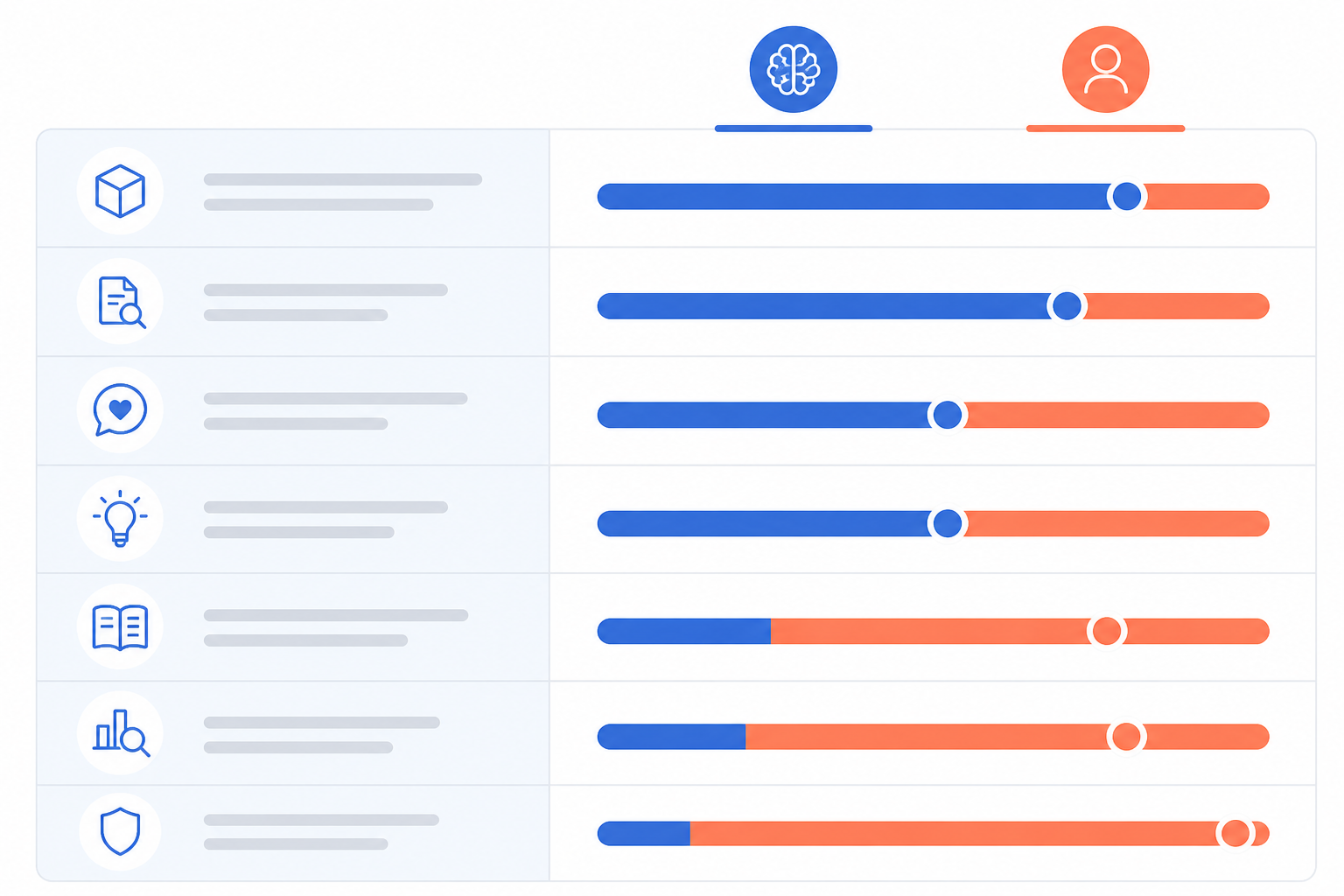
Content teams are shifting time away from writing everything manually and towards editing, strategy and quality control. That's a reallocation of effort towards the parts of the job that need human judgement, not a demotion.
If you're starting from scratch, here's the sequence I'd follow: audit your content by risk level, pilot AI-first drafting on one low-risk category, measure error rate and review time for a month, and only expand the AI-first share once quality holds steady. The teams that build this discipline now, with real approval gates and honest review of what's working, will pull ahead of those that either resist AI entirely or publish drafts unchecked and hope for the best.
Should I use AI or human writers for my blog content?
Most teams don't need to choose one. Triage content by risk first: AI-draft low-risk, high-volume categories with a light human check, and start high-risk or flagship content with a human writer. The right mix depends on your review capacity and how much regulatory or brand exposure each piece carries.
Can AI content really match human writing quality?
On well-defined, bounded tasks, controlled studies show AI assistance improves speed and rubric-graded quality. Those studies didn't measure published SEO content or long-term reader trust, though. AI can match or exceed average output on structure and consistency; human writers still hold the edge on originality, emotional nuance and brand-specific voice.
Does Google penalise AI-generated content in search rankings?
No, not simply for being AI-assisted. Google's guidance focuses on whether content is helpful, original and demonstrates real expertise. Mass-produced, low-value content gets penalised under its spam policies regardless of whether a human or AI wrote it.
Who's responsible for fact-checking AI-generated content?
A named human, every time, written into the workflow rather than left implicit. Someone should verify every statistic, claim, price and link before publishing, with the standard raised further for regulated topics such as health, finance or legal content.
What's the best mix of AI and human content for a small team?
A common starting point is testing 70 to 80% AI-first drafting for routine, low-risk categories, with full human review before publishing. Treat that as a hypothesis: increase it only if error rate and review time are both improving, and reduce it for regulated or reputation-sensitive topics regardless of the general recommendation.
Should we disclose when content is AI-assisted?
There's no single UK legal requirement yet for general blog content, but it's worth deciding a policy rather than leaving it ad hoc. If you publish in a regulated sector, follow your regulator's and publisher's standards on disclosure. For everything else, disclosing AI assistance for factual or advice-driven content tends to build more trust than it costs, especially after episodes like CNET's, where the absence of clear disclosure was part of the damage.
Will AI writing replace human content teams entirely?
Unlikely in the near term. AI is very good at drafting, structuring and scaling content, but strategy, brand judgement, original insight and accountability for accuracy still need human input. The more realistic shift is content teams spending less time on first drafts and more time on editing, verification and strategy.