AI Writing Assistants vs Human Writers: Myths Debunked (UK Bloggers' Guide)
13 min read
Loading...

If you've been putting off AI writing assistants because you're worried about sounding robotic, tanking your SEO, or losing your identity as a writer, here's the short version: those specific fears are largely outdated. AI writing assistants aren't here to replace human writers. They're built to handle drafting and structure so you can focus on strategy, voice, and judgement. But that doesn't mean AI content is automatically safe, good, or ready to publish. AI writing quality still depends on the sources you feed it, the editing you do afterwards, and how honest you are about what it can't do.
I've spent enough time around bloggers who are on the fence about AI tools to know these worries are genuine, not just resistance to change. So let's go through the biggest myths one by one, look at what's actually true, and be honest about where AI still falls short.
This one has some history behind it, which is exactly why it's so persistent. Early AI writing tools genuinely did produce stiff, repetitive text that read like it had been assembled from a template rather than written by anyone with a point of view. If you tried an AI writer in 2021 or early 2022 and swore it off, I understand why. That first impression was rough, and reputations built on bad early experiences tend to outlast the problems that caused them.
Here's what a genuinely generic AI paragraph still looks like, even today, if you don't edit it:
"In today's fast-paced world, blogging has become an essential tool for businesses looking to connect with their audience and drive engagement. It's important to create quality content that resonates with readers."
Now here's the same idea, rewritten with a specific angle, a real detail, and some rhythm variation:
"Most small UK businesses don't fail at blogging because they lack ideas. They fail because they publish three posts, get no traffic, and quietly give up. The businesses that stick with it treat blogging like a monthly habit, not a one-off campaign."
What changed isn't magic. I swapped vague phrases ("fast-paced world", "drive engagement") for a concrete claim I can defend. I varied sentence length instead of writing three same-length sentences in a row. And I added a specific, slightly opinionated observation instead of a safe generality. That's editing, not just better software, though better software makes the starting point stronger.
This is roughly what quality scoring inside a platform like Scribe is trying to do automatically: flag flat, generic phrasing and favour structures that have historically read as more natural, based on published performance data. To be clear about what that means, it's pattern analysis on tone, sentence variety, and structure, not a system with independent judgement or guaranteed accuracy. It narrows the gap between a first draft and a good one. It doesn't remove the need for a human pass.
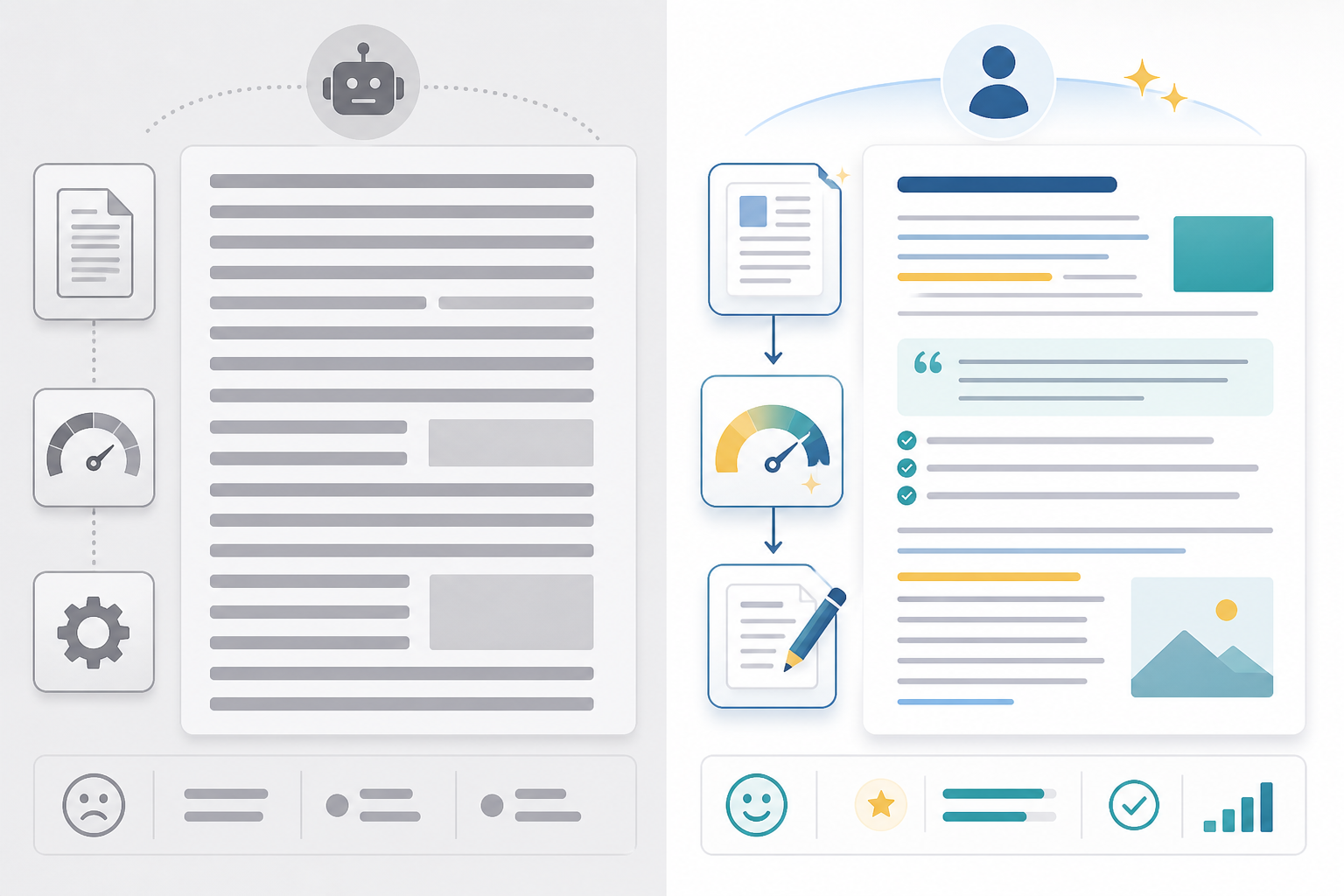
The practical takeaway: "AI writing" isn't one fixed quality level. There's a real difference between a static tool that repeats the same generic paragraph shape every time and a system that's been tuned against real engagement data. But even the better systems still need a human to check the facts, sharpen the point of view, and cut what's still generic. If your only experience with AI content is the flat, templated version, it's worth testing again with proper editing in the loop rather than assuming the tool has nothing more to offer.
This myth causes more anxiety than any other, and I get why. Nobody wants to build a content strategy that quietly tanks their search visibility. But the actual guidance is more specific than "AI bad, human good", and it's worth separating three things that often get lumped together: how Google's core ranking systems evaluate content, its spam policies on scaled content abuse, and manual actions taken against individual sites.
Google's Search Central documentation on AI-generated content states that its ranking systems focus on the quality of content rather than how it was produced, and that using automation, including AI, isn't against its guidelines when it's used responsibly. That's a different claim from "Google doesn't penalise AI content", which is often how it gets repeated. Google's spam policies separately define scaled content abuse: publishing large volumes of pages, by any method, where the primary purpose is manipulating search rankings rather than helping a person. Sites caught doing this can face demotions in ranking or, in more serious or repeated cases, manual action. What matters is purpose and quality, not authorship.
So where's the real risk for an ordinary blogger? It's low-effort, unedited content: the kind that skips fact-checking, presents invented details as first-hand experience, or ignores context your specific readers need. For a UK-focused blog, that might mean quoting US pricing without converting it, citing US regulatory bodies where a UK reader needs the FCA, the ICO, or the NHS instead, or using American spelling and terminology that quietly signals the post wasn't written with a UK audience in mind. Google's Search Quality Evaluator Guidelines put real weight on experience, expertise, authoritativeness, and trustworthiness, often shortened to E-E-A-T, and an AI writing assistant can't supply first-hand experience or accountability on its own. That part still needs a human editor checking the details, adding real context, and standing behind what's published.
Here's the encouraging part: when AI-assisted content is well-structured, accurate, and genuinely useful, ordinary SEO fundamentals still apply. Structure, keyword relevance, and matching search intent matter just as much with AI-assisted content as with fully manual writing. A platform that tracks which structures and headings have performed well in similar published posts can help you make better-informed choices, but it's an input to your judgement, not a guarantee of rankings.
On results: some Scribe users have reported large traffic increases after combining consistent publishing with this kind of performance-based optimisation. I want to be straightforward about that claim rather than treat it as proof. These are self-reported figures from individual accounts, not an independently verified or controlled study, and results depend heavily on niche, starting traffic, and how much editing was done on top of the AI draft. Consistent, well-edited, genuinely helpful content tends to perform well over time, and that holds regardless of which tool produced the first draft.
This myth touches something more personal than SEO or robotic phrasing. It's about identity. If writing is your craft, the idea that a tool could "count" as writing on your behalf can feel uncomfortable.
But consider what writers have always used to get their work done: grammar checkers, style guides, editors who reshape entire drafts, templates for consistent formatting. None of these have ever been treated as a threat to a writer's legitimacy. They're part of the process. AI writing assistants are the next entry in that same toolkit, not a wholesale replacement for judgement, taste, or voice.
Using AI to scale your content output is a strategic decision, not a shortcut that erases your role in the work. If anything, it shifts what your role involves. The real skill change isn't typing fewer words. It's directing ideas, editing for voice, and deciding what's genuinely worth publishing under your name. Those are arguably the harder, more valuable skills anyway. Anyone can produce a draft. Knowing which draft deserves your name on it is a different job entirely.
I don't want this to read as an argument that AI can do everything a human writer can. It can't, and it shouldn't try to. Here's where human judgement remains genuinely irreplaceable:
These aren't small contributions. They're the backbone of content people actually trust and return to. Someone still has to decide what "good" looks like for your brand, and that someone can't be the AI.
It's worth being honest about the limits, too. I'd think twice about leaning on AI drafting for content where the entire value is first-hand testimony: a personal story about illness, a genuine product review after months of use, or commentary on a fast-moving news event where accuracy changes hourly. I'd also be cautious using it for anything regulated, like specific financial or legal advice aimed at a UK audience, without heavy expert review before publishing. AI can still help with structure or a first pass in these cases, but the final judgement calls need to sit entirely with a qualified human.
The most useful mental shift I can suggest is this: stop thinking of AI writing assistants as a replacement for your creative direction, and start thinking of them as a way to handle the groundwork faster. In practice, that looks like a fairly simple loop:
As one example of a platform built around this workflow: I use Scribe, which generates draft blog posts, including images and diagrams, in roughly five minutes. To be clear, that's five minutes to a structured first draft, not a publish-ready piece. Steps three to five above still happen afterwards, and skipping them is exactly how low-quality AI content ends up online.

If you're evaluating any AI writing tool, not just Scribe, it's worth judging it against the same criteria regardless of brand: can you control the sources it draws on, does it support your specific brand voice, does it fit your existing editing workflow, does it flag facts that need checking rather than hiding them, does it integrate with the platforms you actually publish to, how does it handle your data, and does the pricing match how much you'll realistically publish. Scribe's own plans, for reference, run from 10 to 30 articles a month with auto-pilot scheduling and one-click publishing to WordPress, Shopify, Wix, Webflow, or a custom API. That's useful for our workflow, but the underlying criteria matter more than any one platform's feature list, and those features can change over time.
Used this way, AI writing assistants aren't a threat to your craft. They're what let you publish more consistently while spending your limited time on the parts of writing that genuinely require you.
No, in the sense that using AI writing assistants is more like using a grammar checker or a content template than it is like plagiarism. What matters more is disclosure and honesty where it counts. Don't present AI-drafted "first-hand experience" as genuinely lived, and be upfront with readers or clients if your workflow relies heavily on AI drafting. The quality and accuracy of the final piece matter more than exactly how many words you typed yourself.
It can, if you publish AI drafts without fact-checking or without adding anything of your own. Readers and search engines both tend to notice generic, unoriginal content eventually. Used well, with proper editing and real added insight, AI-assisted publishing can support your credibility by helping you stay consistent without cutting corners on accuracy.
Humans win on original opinions, lived experience, emotional nuance, and strategic judgement about what's worth writing in the first place. AI is genuinely useful for structure, research synthesis, and a fast first draft, but it can't replace firsthand insight, and it can't be held accountable for getting something wrong. That responsibility stays with you.
Not simply for being AI-generated, according to Google's own Search Central guidance on AI content. What can hurt your visibility is publishing low-quality, unhelpful, or thin content at scale to try to manipulate rankings, which falls under Google's spam policies regardless of whether a human or an AI drafted it. Well-structured, accurate, genuinely useful AI-assisted content can perform just as well as manually written posts. The editing and fact-checking are what get you there, not the tool itself.