Auto-Pilot Scheduling: How to Keep Your Business Blog Consistent Without Living at Your Laptop

Meta description: Discover how auto-pilot scheduling and automated blog publishing help busy UK business owners keep their blogs consistent, with practical checks for quality, accuracy and brand voice.
Auto-pilot scheduling lets you set your blog topics, keywords and publishing cadence in advance, then let an AI writing assistant handle production while automated blog publishing takes care of getting posts live on your chosen days. Let's be clear about what that does and doesn't mean: it automates the writing and publishing schedule, but it doesn't remove the need to check facts, approve topics and keep an eye on brand voice. You still steer the direction and need to glance over what goes out under your business's name. What changes is that you stop being the bottleneck that makes blogging the first thing dropped when things get busy.
If that sounds like exactly what you need right now, you're not alone. Plenty of small business owners know content marketing works, have seen the traffic numbers, and still haven't published a blog post in two months. It's rarely a knowledge problem. It's a bandwidth problem. Auto-pilot scheduling is one practical fix, provided you go in with realistic expectations about what it can and can't do on its own.
Why business blogging falls to the bottom of the to-do list
Here's the honest truth: blogging almost never feels urgent. An overdue invoice feels urgent. A customer complaint feels urgent. A stock order that needs placing before Friday feels urgent. A blog post that might help someone find you on Google in three months? That feels like a nice-to-have, right up until it becomes the thing you wish you'd kept up with.
Many owners fall into what I'd call the "I'll write it this weekend" trap. Take a UK example: a self-employed electrician in Leeds means to write a post about rewiring costs on a Saturday morning. Then a callout comes in, or the kids need picking up, or he simply needs to switch off after a sixty-hour week. The post doesn't get written. It rolls over to next weekend, which has its own competing demands. This isn't a personal failing. It's just how priorities work when you're running a business single-handedly or with a tiny team.
What inconsistent posting does in the background is worth understanding properly, without overstating it. Search engines don't simply reward regularity in isolation, and gaps in posting don't automatically undo your rankings. What consistent publishing does is keep your site fresh, give you more pages that can match search queries, and build a stronger signal of relevance and expertise over time. When you post three times in a good month and then vanish for six weeks, you're not being penalised outright, but you are missing chances to rank for seasonal queries, losing editorial momentum, and sometimes leaving older posts unchanged while your industry, prices or services move on. That's a real cost, just a quieter and more specific one than "Google punishes you."
And here's the thing that surprises people most: the problem usually isn't a lack of ideas. Most business owners have plenty to say about their industry, their customers and their products. What's missing is a repeatable system that doesn't depend on finding two free hours in an already packed week.
What does auto-pilot scheduling actually mean?
Let's clear up a common misconception first. Auto-pilot scheduling isn't the same as sitting down one Sunday, writing ten blog posts in a marathon session, and dumping them into a queue to trickle out over the following months. That approach still requires you to be the writer, researcher and editor. It just moves the bottleneck earlier rather than removing it.
Real auto-pilot scheduling combines AI content generation with a set publishing calendar, so the writing itself is handled for you, not just the timing. With a tool like Scribe, you define your topics, keywords and posting frequency, and an AI writing assistant produces drafts from there. That's automated blog publishing in the fuller sense: automated writing and automated timing, not just a queue of content you still had to produce yourself.
Here's roughly what that looks like in practice, with the caveats that matter:
- You set your content themes and target keywords for the month or quarter.
- The platform generates draft blog posts, often several hundred to a couple of thousand words, including AI-generated images or diagrams where relevant. Generation speed and word count are conveniences, not quality guarantees; a fast, long draft still needs the same scrutiny as a slow, short one.
- Each draft gets an automated quality score before publishing. This is a useful early filter, not a substitute for a human read-through, especially for anything involving prices, claims or advice.
- Approved posts can publish automatically to platforms like Shopify, WordPress, Wix, Webflow or via a custom API, which does save the manual copy-and-paste step into your CMS. Exact integrations and limits vary by plan, so it's worth checking what's included before you rely on a particular workflow.
- The system tracks how published posts perform and uses that data to inform future topic and structure suggestions.
That last point is worth being precise about. This isn't a fully autonomous brain that "knows" what's good; it's a feedback loop that looks at quality scores and performance metrics, then leans towards patterns that have worked before and away from ones that haven't. It's genuinely useful, but it works within the limits of the data it has, and it won't catch things like a factual error about your own opening hours or a competitor's pricing that's since changed. That's still your job to catch.

This diagram is illustrative of the general workflow; exact steps and integrations depend on the platform and plan you use.
How to set blog topics and keywords in advance
The setup phase is where you have the most input, and it's worth doing properly because it shapes everything that follows. Here's a straightforward way to approach it:
Start with a quarterly theme list, not a weekly one. Rather than scrambling for "what should I write about this week," block out four or five broad themes that matter to your business over the next three months. Think seasonal offers, common customer questions, industry trends or product deep-dives.
Build your keyword list from real signals, not guesswork. Look at the questions customers actually ask you, check Google Search Console for terms you're already getting impressions on, note gaps competitors haven't covered, and think about location modifiers if you serve a specific area, such as "boiler repair Bristol" rather than just "boiler repair." This gives the platform something grounded to work from rather than a vague topic.
Choose a monthly article volume that matches your plan. Whether that's 10 articles a month or 30, pick a pace that's sustainable for your goals rather than the maximum just because it's available. A steady lower volume beats sporadic bursts at a higher one.
Let the platform prioritise keywords using performance data, but sanity-check the output. Data-driven suggestions look at historical performance to flag what's worth targeting next. That's genuinely helpful, but they can't tell you whether a topic fits your actual services or current stock, so a quick human check before approval matters.
Batch-approve topics in one sitting. Instead of making a content decision every single day, which adds up to real mental load, review and approve a batch of upcoming topics in one go. Fifteen minutes once a month replaces dozens of small daily decisions.
This approach front-loads the thinking into a manageable chunk of time, rather than spreading it thin across every week indefinitely.
How much oversight does automated blog publishing need?
One worry I hear a lot is: "If I'm not writing it myself, how do I know it's any good?" Fair question, and the honest answer is that a quality score is a helpful signal, not a guarantee. It can flag things like readability, structure and keyword use, but it can't reliably catch every factual error, verify a statistic, confirm your current prices, or tell you whether the advice actually matches what your business offers. That part stays with you.
Here's what a realistic check-in and review routine looks like:
- A five-minute weekly glance at quality scores, to catch anything that's clearly off before it goes further.
- A proper read of any post involving specific claims, pricing, legal or health-related information or statistics, before it publishes. This is non-negotiable if your industry has compliance considerations, such as financial services, healthcare or trades with safety implications.
- Reviewing analytics periodically to see traffic trends, which post structures are performing best, and which keywords are actually driving visits, rather than guessing what's working.
- Letting the system deprioritise underperforming angles over time, while you keep a light hand on the wheel rather than assuming it will always get this right without any input.
- Knowing when to step in versus when to let it run. If analytics show a particular theme resonating strongly with your audience, that's worth a manual nudge to lean into it further. For most day-to-day fine-tuning, checking in weekly is enough; for anything customer-facing or compliance-sensitive, read it properly first.
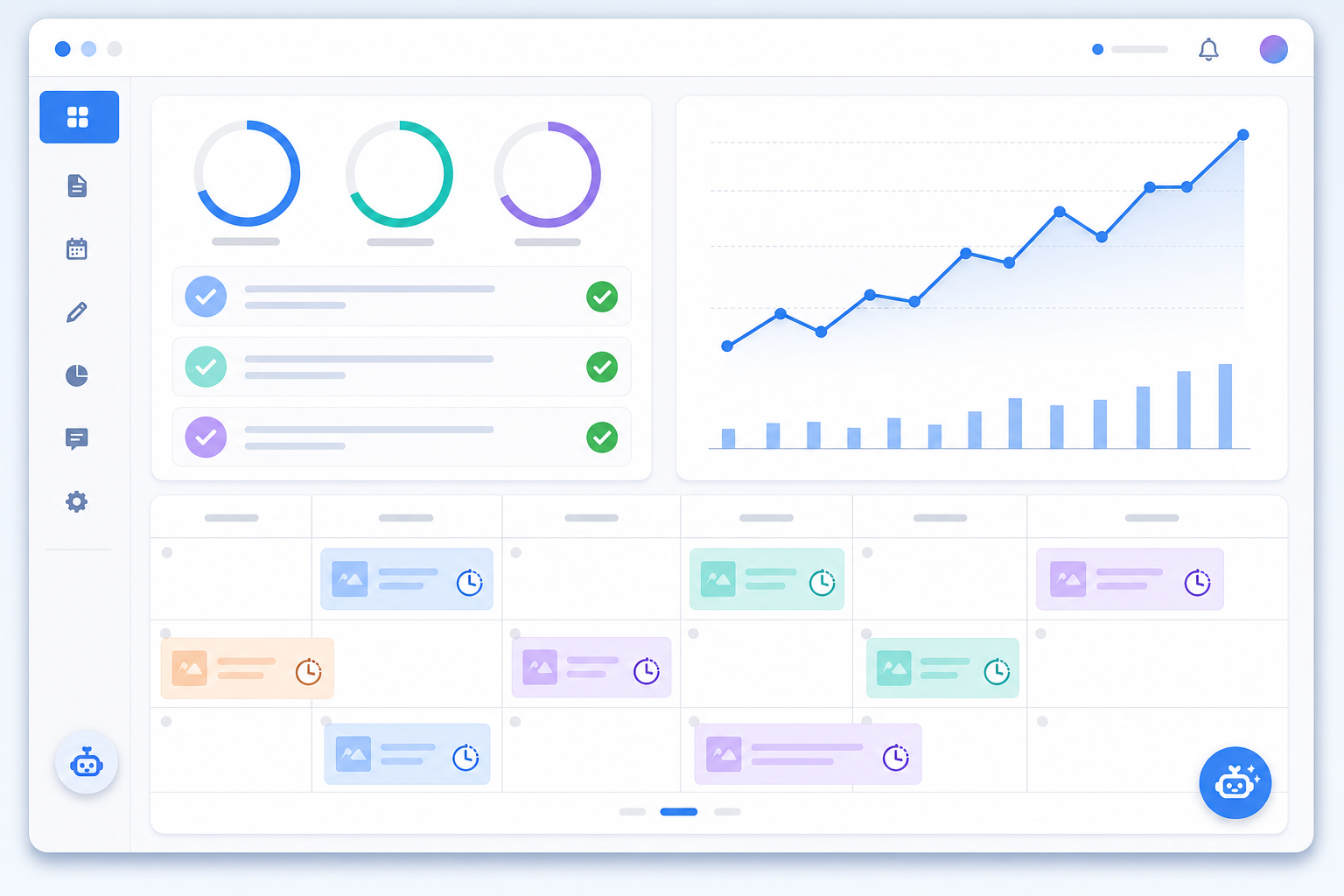
Mockup for illustration; actual dashboard layout and available metrics vary by platform and plan.
The goal here isn't zero involvement. It's proportionate involvement: spending your limited time on strategic decisions and accuracy checks, rather than on typing out full drafts from scratch.
What happens when life gets busy again?
This is the real test, and honestly, it's the part that matters more than the setup phase. Anyone can maintain a blog for a fortnight when things are calm. The question is what happens during the inevitable stretch when a big client project lands, a member of staff is off sick, or the school holidays throw your whole routine out.
With a genuine auto-pilot scheduling system, publishing keeps happening on schedule even when you go quiet for a few weeks. You don't need to remember to write something, log in and manually upload a post, or come back from a hectic month to find an obvious gap in your content calendar.
That said, there are moments when you should actively pause automated blog publishing rather than let it run, and it's worth knowing what they are in advance:
- Price changes. If a scheduled post references old pricing, pause it until it's updated.
- Stock shortages or discontinued products. A post promoting something you can no longer supply does more harm than good.
- Regulatory or legal changes affecting your industry, where outdated advice could be misleading.
- Rebrands or temporary closures, where your usual tone or offer no longer applies.
- Major news events that make a scheduled post look tone-deaf or badly timed.
Beyond those specific triggers, flexibility matters generally, because business life is unpredictable. You should be able to:
- Pause the schedule entirely for a major shift, such as a rebrand or temporary closure.
- Delay specific posts without disrupting everything else queued behind them.
- Adjust topics or frequency if your priorities change, such as doubling down on a new product line.
The point of this flexibility isn't that you'll need it constantly. It's that adjusting the system takes minutes when you do need it, rather than a full afternoon of replanning.
What can consistent blog publishing realistically do for your business?
It's tempting to point to one dramatic traffic chart and call it proof. I'll resist that here, because a single unverified number without a baseline, time frame or context doesn't tell you much, even when it's a genuinely nice result for someone. What's more useful is understanding the mechanism and setting expectations that hold up.
Consistent publishing tends to help in a few concrete, checkable ways over several months: more pages indexed by search engines, more long-tail keyword opportunities being covered, and a steadier flow of organic visits compared with sporadic bursts. Whether that turns into enquiries or sales depends on far more than posting frequency, including the quality and relevance of what you publish, your site's technical health, and how competitive your market is.

Illustrative example only. Actual results vary significantly by industry, starting traffic, competition and content quality, and should not be read as a guaranteed outcome.
Think of it less like a single dramatic win and more like compound interest. Each well-considered, accurate post adds a small amount of relevance and a few more chances to be found. Miss weeks or months at a time and you're restarting some of that build-up from a lower base. Keep it steady, with proper checks along the way, and the gains tend to build in a way that occasional bursts of effort don't.
This is content scaling in a fairly literal sense: growing your blog's output without growing your workload to match, and without necessarily hiring a dedicated writer. For a small business owner already wearing five hats, that's the difference between blogging being a source of guilt and blogging being a steady background asset, provided you keep half an eye on what's actually going out.
Frequently asked questions about auto-pilot scheduling
Can I really set and forget my business blog?
Mostly, but "set and monitor lightly" is the more accurate description. Once you've defined your topics, keywords and publishing frequency, auto-pilot scheduling handles the writing and automated blog publishing on its own. You should still check quality scores weekly and personally read anything involving prices, claims or compliance-sensitive content before it goes live. That's a matter of minutes, not a full content-writing session, but it's not literally zero effort either.
How much oversight does auto-pilot content still need?
In the first few weeks, plan to review most published posts and adjust your keyword or topic settings based on what the quality scoring highlights. After that, the feedback loop takes over much of the fine-tuning around structure and topic selection, but you're still responsible for catching factual errors, outdated details and anything that doesn't match your actual services. Treat the quality score as a first filter, not a final sign-off.
What if I need to pause or adjust scheduled posts?
You can pause your publishing schedule, swap out upcoming topics, or change your monthly article volume at any time, and you should do so immediately for things like price changes, stock issues, regulatory updates or a rebrand. Outside of those triggers, this flexibility exists mainly for peace of mind. The system picks up where you left it, so a busy or disrupted month doesn't mean losing your content momentum entirely, as long as you remember to pause anything that's gone stale in the meantime.
Related Articles

Create content like this automatically
Scribe uses AI to generate high-quality blog posts that engage your audience and drive traffic.