Case Study: How One Brand Grew Traffic 340% With AI Content
13 min read
Loading...

A quick note before we dive in: the brand in this AI content case study asked to remain anonymous, which is common practice when a business shares performance data publicly. What I can share is real: the traffic figures, publishing cadence and timeline, pulled from Google Analytics and Google Search Console over a six-month window and compared with the six months prior.
The brand is a mid-sized UK e-commerce retailer selling home goods, generating a few hundred thousand pounds in annual revenue. Its small in-house marketing team of two people handled everything from email marketing to paid social.
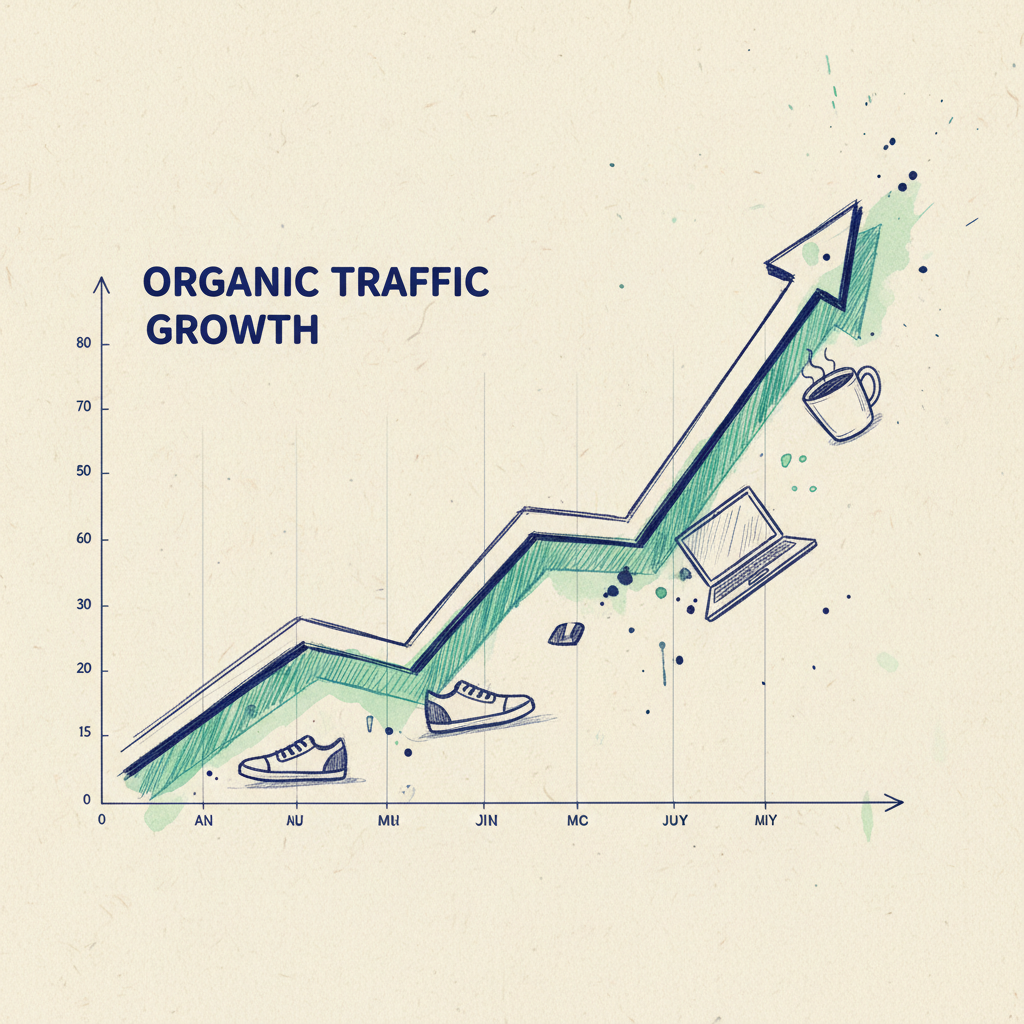
Here's the headline: organic sessions grew 340%, from roughly 1,800 monthly sessions at the start to just over 7,900 by month six. That growth didn't come from a viral post or a lucky algorithm update. It came from switching to an AI-powered content system, publishing consistently every week and letting the system refine its approach based on what was actually ranking and getting clicks.
I want to be upfront about something the marketing world often glosses over: no traffic increase of this size happens in a vacuum. There was no major backlink campaign, site migration or paid promotion running alongside this, and the product catalogue stayed stable throughout. However, seasonality and general market demand for home goods likely played some role too. I'll flag where that matters as we go, because a case study that pretends everything is down to one lever isn't being straight with you.
So let's walk through what actually happened, month by month, including the parts that weren't smooth.
Before the switch, this brand was publishing one to two blog posts a month — about 15 published posts in total over the previous year. None were built around keyword research or buyer intent. The topics were things the team found interesting, not what customers were typing into Google.
Rankings reflected that: almost nothing placed above position 30 for any commercial search term, and the handful of posts that did get traffic were ranking almost entirely for the brand's own name.
Organic sessions had sat flat at around 1,800 a month for over a year. That's the frustrating part for teams in this position: the product-market fit was solid and the business was healthy, but the blog simply wasn't contributing anything beyond branded traffic that would have shown up anyway.
They'd tried hiring freelance writers to fill the gap. That came with its own headaches — inconsistent quality, slow turnaround, often three to four weeks per post, and a day rate that made scaling to even one post a week feel financially unrealistic for a two-person marketing team.
If this sounds familiar, you're not alone. It's a common pattern among growing e-commerce brands: the team knows content matters, they can see competitors ranking for terms they should be winning, but the output needed to compete isn't achievable with the current setup.
The turning point came when the brand stopped trying to solve a production problem with more manual effort. Instead, it adopted an AI writing platform built for scaled blog production, with the marketing lead reviewing and approving every topic before it went into production.
Here's what actually changed, concretely. Instead of the team choosing topics based on instinct, the platform used search volume and competitor ranking data to suggest topics with realistic ranking potential for the brand's domain authority. These included a mix of “best [product] for [use case]” commercial posts and broader buying-guide content.
The marketing lead chose from a shortlist each week rather than starting from a blank page.
Output increased from one or two posts a month to one post every week, averaging more than 2,000 words, with AI-generated images included. None of this added hours to the team's workload. The marketing lead spent roughly two to three hours a week on topic selection and final review, down from the days it used to take to draft a single post.
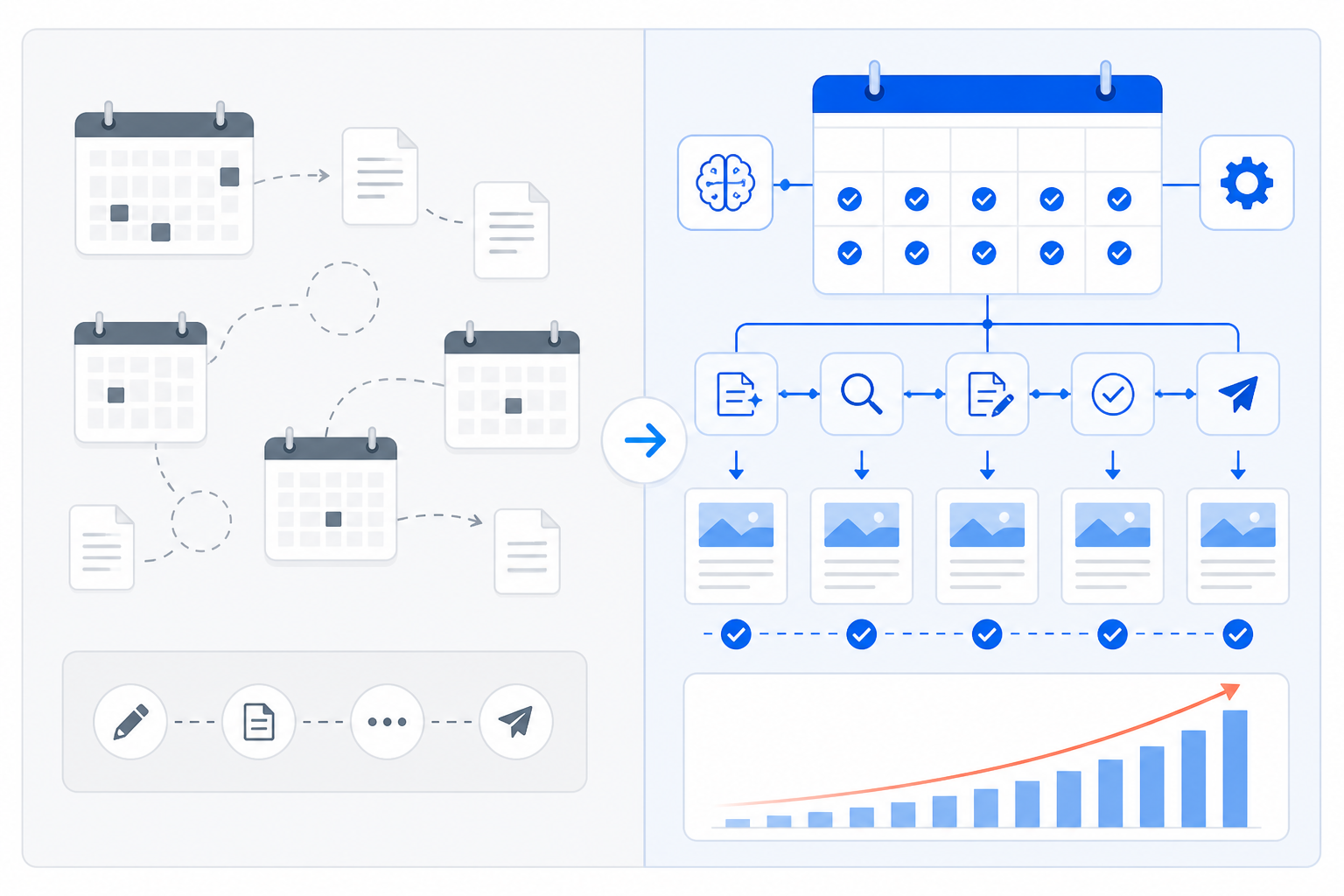
This is the part worth slowing down on, because “self-improving AI” gets thrown around a lot without much explanation. Here's what the feedback loop actually did.
After each post was published, the platform tracked three things over the following weeks:
Those numbers fed into a quality score for each article.
When a topic type consistently scored well — buying guides for mid-price products performed noticeably better than broad “how to choose” articles, for instance — the system weighted similar topics higher in future suggestions. When something underperformed, such as a post targeting a keyword with too much competition for the site's authority, it deprioritised that pattern rather than repeating it.
None of this happened without human oversight. The marketing lead reviewed the weekly quality score report and could override any suggestion, which they did roughly one week in five.
A few other pieces made this sustainable rather than turning it into a short burst of effort:
The strategic thinking — deciding what topics mattered for this brand's positioning — stayed with the team. What changed was that a good strategy could finally be executed at a pace that matched what search visibility actually requires.
Here's the month-by-month picture, because a single 340% headline number hides more than it reveals.
| Month | Posts Published | Organic Sessions | Ranking Keywords (top 20) | Notes |
|---|---|---|---|---|
| 1 | 4 | ~1,950 | 6 | New topics indexing; little movement yet |
| 2 | 4 | ~2,300 | 11 | Modest gains, mostly long-tail terms |
| 3 | 4 | ~3,400 | 19 | First commercial-intent keywords crack top 20 |
| 4 | 4 | ~4,900 | 28 | System starts favouring buying-guide format |
| 5 | 4 | ~6,600 | 37 | Several posts break into top 10 |
| 6 | 5 | ~7,900 | 44 | Non-brand clicks now outnumber branded clicks |
Sessions are rounded and drawn from Google Analytics; ranking keyword counts are from Google Search Console's top-20 query report. A few things stand out from this table that the headline number doesn't tell you on its own:

It's worth repeating: this brand made no major changes to backlinks, site structure or paid spend during this period. However, I can't rule out that broader market demand or a seasonal uptick in home goods searches contributed some portion of the growth.
What the data does show clearly is that the acceleration tracks closely with the point where the AI system had enough performance history to start making sharper topic and structure decisions. That's a reasonable signal, even if it isn't ironclad proof of causation.
A few things stood out from this brand's experience, each tied to something specific that happened rather than a general platitude.
Consistency mattered more than perfection. The month one and two posts weren't the strongest of the batch from a ranking perspective, but publishing them on schedule kept the topic pipeline moving. Holding back for a “perfect” post would have meant fewer data points for the system to learn from, slowing everything else down.
The feedback loop, not the volume, drove the acceleration. Posts published four to six months into the programme outperformed the earlier ones at a similar word count and with similar effort. The system had learned that buying-guide formats worked better for this audience than broad advice posts. Volume alone doesn't explain that; the learning loop does.
Quality scoring gave the team visibility before publishing became a guessing game. Instead of finding out three months later that a topic had flopped, the marketing lead could see a lower predicted score before publication and choose to swap it out.
Not every post was a home run. Roughly one in six posts underperformed its predicted score, usually on topics with more competition than the domain's authority could support at the time. The trend line still moved consistently upwards, which is the metric that matters over a six-month window.
Human review of strategy still mattered. The marketing lead overrode the system's topic suggestions about 20% of the time, usually to keep content aligned with a product launch or seasonal push the AI wouldn't know about. Speed came from the AI; relevance came from keeping a person in the loop.
If you're running an e-commerce brand with sporadic blogging — the occasional post whenever someone finds an afternoon — here's the practical takeaway, independent of any specific tool:
I should be transparent here: the case study above used Scribe, the tool I work on, so treat this section as a product note rather than independent evidence.
Scribe offers plans from 10 to 30 articles a month, with quality scoring and analytics built in so you can see what's working rather than guessing. It also offers one-click publishing to Shopify, WordPress, Wix, Webflow and custom APIs.
For lean teams, that combination of automated production and performance-based learning makes a schedule like the one above achievable without hiring a full content team. However, as this case study shows, the results still depend on someone keeping a hand on strategy.
This case study is one data point, not a universal guarantee. What it does show fairly clearly is that consistent, data-informed publishing compounds in a way that occasional content rarely does — and that's worth weighing if your blog has been stuck at the same traffic level for a while.
In this case, yes: organic sessions grew 340% over six months, verified through Google Analytics and Google Search Console. However, the growth came from combining weekly consistency with a feedback loop that adjusted topics and formats based on real ranking and click data, not from AI writing speed alone.
Other factors, including seasonal demand, may have contributed a smaller share. That's worth acknowledging rather than ignoring.
In this case, every post went through human review before publishing, and the platform's quality scoring flagged likely underperformers before they went live. About one in five topic suggestions was overridden by the marketing lead.
AI content quality holds up best when someone with brand and product knowledge stays in the review loop rather than publishing on autopilot.
No. Roughly one in six posts in this case study underperformed despite going through the same process, usually because the target keyword had more competition than the site's authority could support.
Volume helps generate data and search visibility, but it doesn't override competitive realities for every keyword.
In this case, the first two months showed modest gains — about 28% growth by month two — with the bulk of the increase happening from month three onward. This was when the system had enough performance data to refine its choices.
Generally, expect a full quarter before judging whether a content approach is working, since search engines need time to crawl, index and rank new pages consistently.
Results vary by starting point, industry and how consistently a team publishes. The pattern that holds across most content marketing success stories is that steady publishing combined with performance-based refinement tends to produce compounding growth over several months, rather than a single dramatic spike.
Brands that publish inconsistently, even with AI assistance, tend to see far more modest results.