Generative Engine Optimization for Small Business Owners: A One-Hour-a-Week Guide

Generative Engine Optimization for Small Businesses: A One-Hour-a-Week Guide
Generative engine optimization (GEO) means making your business easy for AI assistants to find, understand and trust enough to recommend. For most small businesses it comes down to five basics: clear service pages, consistent business details, credible reviews, readable site structure and regular monitoring. Once the initial setup is done (budget a few extra hours across the first month), about an hour a week is enough to maintain all five. You do not need to abandon the SEO work you already do. 🦉
I am a data analyst by trade, so I will separate what the evidence supports from what is merely plausible. Nobody can guarantee a mention from ChatGPT, Gemini or Perplexity. What you can do is remove the obstacles that stop an assistant from describing you accurately, then measure whether it is working. For AI search for small business, that is the whole approach: modest, repeatable effort, checked against data.
What is generative engine optimization (GEO)?
GEO means improving how AI assistants (including ChatGPT, Claude, Gemini, Copilot and Perplexity) describe, cite and recommend your business. The term was popularised by a 2023 research paper by Aggarwal and colleagues, 'GEO: Generative Engine Optimization'. It is a close cousin of small business AI SEO, not a replacement for it. The goal is the same, to be found by people who need what you sell, but the interface has changed. Instead of a page of ten links, the customer increasingly gets a written answer that names a handful of businesses.
Take the query 'best emergency plumber in Leeds'. Depending on the product, an assistant may draw on what it absorbed during training, on live retrieval from the web, on third-party sources such as reviews, directories and local press, or on some mix of these. It varies a lot. Some tools search the web for almost every question, others only when asked or when the topic seems to need fresh information, and the same product can behave differently by query type and settings. What they share is this: if your business is described vaguely, inconsistently or not at all across the sources an assistant can reach, it has little to work with and may name someone else.

This changes what we measure. You are no longer competing only for position four on a results page. You are competing for a mention (your name appears), a citation (your site is listed as a source) or a recommendation (you are framed as the right choice). Share of voice, meaning how often you appear compared with named competitors, and soft mentions, where you are referenced without a link, therefore matter more than a rank number.
What should small businesses expect from GEO?
The GEO industry is prone to overclaiming, so I want to flag two cautions.
- AI answers vary. The same question can produce different answers between runs, platforms, locations and phrasings. A single screenshot is an anecdote, and only repeated sampling gives you usable data.
- The evidence is early. The Aggarwal benchmark of 10,000 queries reported that certain content methods, such as adding citations, quotations and statistics, improved visibility in generative responses by up to 40%. That was a research setting with a test engine, and it does not forecast what will happen for a plumbing firm in Leeds. Meanwhile, Google states that its AI features need no special markup or technical optimisation, and points owners back to helpful content and crawlable pages.
On adoption, a Pew Research Center study of the browsing of 900 US adults found Google AI summaries appeared in about 18% of the searches analysed in March 2025. That measures US general search behaviour. It says nothing directly about how UK customers find local businesses, and I have not found UK small-business discovery data I would trust. The direction of travel is clear, but the size of the effect in your market is something to verify, not assume.
Is generative engine optimization worth it for a small business?
It depends, so here is the case on both sides.
The case for:
- Low cost of entry. The core tasks are writing, tidying listings and asking for reviews. You do not need to buy software or hire an agency.
- Early-mover advantage. In many local categories very few competitors have done anything deliberate, so modest effort can make a visible difference.
- Overlap with traditional search. The same fundamentals help Google, Bing and AI assistants at once, which makes this cheap insurance.
The case against:
- Referral traffic is still small. For most UK small firms, visits from AI tools are a minor share of traffic, and attribution is murky because many assistants do not pass clean referrer data.
- Mentions are not clicks. In the same Pew study (68,879 Google searches, US), users clicked a traditional result in 8% of visits when an AI summary appeared, versus 15% when none did, and only about 1% clicked a link inside the summary. Being named is valuable, but it does not automatically produce a website visit.
Here is a simple decision rule. If your customers research before they buy, as with trades, clinics, professional services, hospitality and B2B services, GEO is worth an hour a week. If purchases are purely impulse or walk-in, it is a lower priority. Either way, run a baseline check first (method below) so the decision rests on evidence rather than a hunch.
How does GEO differ from local SEO?
Local SEO helps you appear in map packs and organic results, which Google says are driven mainly by relevance, distance and prominence. GEO aims to make your information understandable and citable inside a generated answer. Neither predicts the other: a business can rank well in the map pack and still go unmentioned in an AI response, or the reverse. Track them separately.
| Local SEO | Generative engine optimization | |
|---|---|---|
| Goal | Rank in map pack and organic results | Be included and favourably framed in a generated answer |
| Key inputs | Google Business Profile, citations, links | Clear descriptions of who you are and what you do, consistent details, third-party mentions, review content, readable pages |
| Where results appear | Maps, local pack, search listings | ChatGPT, Gemini, Perplexity, Copilot, AI Overviews |
| Measurement | Rankings, clicks, calls | Mentions, cited sources, sentiment, position within the answer, share of voice |
| Overlap | Consistent name, address and phone; genuine reviews; quality content | Consistent name, address and phone; genuine reviews; quality content |

The overlap row is the reassuring part, because you do not start from scratch. One more point for UK owners: some assistants retrieve from Bing and other indexes, not only Google, so a Google-only mindset can leave gaps. Claiming your Bing Places listing takes about ten minutes and is worth far more than that.
The five GEO basics that move the needle
None of these is glamorous, and all of them line up with Google's own guidance on helpful, crawlable and accurate content.
- Clear service pages. Create one page per core service and location, with a plain-English description, pricing signals, who the service is for, and direct answers to common questions. A home-repair firm might name the towns it serves, the repairs it handles, the appointment steps and how to request an estimate.
- Consistent business details. Use an identical name, address, phone number, opening hours and service-area wording across your website, Google Business Profile, Bing Places and the directories you use. Inconsistency forces an assistant to guess, and guessing is how wrong details end up in answers.
- Reviews and reputation. Aim for a steady flow of recent, genuine reviews on the platforms relevant to your sector, with a considered reply to each.
- Readable structure. Use sensible headings and accessible text rather than burying key facts in images or PDFs. Structured data (schema) such as LocalBusiness can help machines read the facts you already display, but treat it as an accurate description and not as a way to win citations. Google says AI features need no special markup.
- Monitoring. Track what assistants actually say about you so you can adjust based on data. Most owners skip this step, and it is the one that tells you whether the other four are working.
A 60-minute weekly GEO routine
This assumes setup is done. Expect the first month to need extra time for a first listing audit, claiming profiles and writing your core pages.
| Task | Minutes per week |
|---|---|
| Service pages (improve one page or answer one customer question) | 20 |
| Consistent details (check one listing set, fix drift) | 10 |
| Reviews (request and reply) | 10 |
| Structure (one technical check) | 10 |
| Monitoring (re-run a few questions, log results) | 10 |

The split is a starting point. In a heavily reviewed sector such as trades, move minutes from structure to review requests. Once your pages are in good order, move them towards monitoring.
How to make your website easier for AI to read
I use the term AI legibility for whether automated crawlers can access, parse and interpret your pages. It has nothing to do with design quality or keyword choice. A beautiful site that shows its key facts only through JavaScript, or locks them in a PDF, can be effectively invisible to a machine. These are the checks I would walk any owner through:
- Crawler access. Open yoursite.co.uk/robots.txt and confirm it does not block AI user agents such as GPTBot, ClaudeBot or PerplexityBot unless blocking is your intention. Robots.txt controls crawling, and it does not guarantee exclusion from results.
- Clean headings. Use a logical hierarchy, with each service, process or FAQ in a clearly labelled section.
- Server-rendered text. Essential content should appear in the page source, not only after scripts run.
- A working sitemap and internal links. Link your homepage to each service page, and each service page to pricing, area and booking information.
- Descriptive titles. 'Emergency Plumbing in Leeds | Your Business' tells a machine far more than 'Home'.
- Honest structured data. If you use schema, mark up the address and hours you actually display, and never add claims visitors cannot see.

Write answer-first content for AI search
AI systems extract passages, so lead each page with the direct answer and follow with supporting detail. Give your About and Contact pages particular care. In two or three unambiguous sentences, say who you are, what you do, where and for whom. That short paragraph is often the raw material for how an assistant describes you.
How to check your website for free
View your page source to confirm key text is present, test your robots.txt, and validate any structured data with Google's Rich Results Test. Set up Bing Webmaster Tools too. Microsoft has been adding reporting on AI citations, so look at what is available in your account.
A note on llms.txt, the proposed file that summarises your site for language models. It is an emerging convention, and I am not aware of reliable evidence that it improves citations. Add it if you have spare time, but do not put it ahead of the basics.
Building third-party signals and reviews for GEO
Assistants that draw on the wider web have good reason to prefer corroboration. A business described consistently by several independent sources is easier to recommend with confidence. Your own website is a claim. A Trustpilot review, a Checkatrade profile and a chamber of commerce listing saying the same thing are evidence.
UK platforms worth considering include Google Business Profile, Bing Places, Trustpilot, Checkatrade, Which? Trusted Traders, TrustATrader and Yell, plus relevant industry bodies, local press and chamber of commerce listings. Which of these any given assistant actually uses varies by product and query, so choose the handful that suit your sector and keep them accurate. A few well-kept profiles beat a long list of neglected ones.
A simple review habit for small businesses
BrightLocal's Local Consumer Review Survey 2024 found 75% of consumers always or regularly read reviews for local businesses. That supports prioritising reviews, though it does not prove reviews cause AI visibility. A sustainable routine looks like this:
- Ask every customer after a completed job, using a neutral message that requests honest feedback in their own words.
- Do not suggest particular wording, services or locations for the review, and do not make service or incentives conditional on what it says. Follow each platform's review policy.
- Reply to every review. Thank positive reviewers, answer critical ones professionally with an offer to continue offline, and never disclose private details.
Never offer discounts or gifts in exchange for reviews, and never buy or manufacture them. Google prohibits incentivised and fake reviews, and in the UK the Competition and Markets Authority treats fake reviews as a serious consumer-protection matter. The short-term gain is not worth the penalty risk.
How to earn genuine mentions
Genuine mentions come from local partnerships, supplier pages listing authorised installers, community sponsorships and expert commentary, such as an accountant contributing a short tax-season explainer to a local business newsletter. Check where your competitors are being cited. AI answers often reference forums, directories and review sites, so work out which of those you can realistically join. No platform publishes a formula guaranteeing that reviews or listings yield an AI citation. Treat them as support for a clear, consistent identity, not as a lever you control.
How to measure GEO progress without guesswork
One-off spot checks are unreliable, because answers differ by phrasing, platform, location and time. Good measurement means a fixed set of realistic customer questions, run repeatedly, with the results logged. You can do this free with a spreadsheet:
- List ten questions a customer would ask before choosing a business like yours, including at least two that name your town.
- Pick two or three assistants and run each question at least twice, in fresh conversations, since answers vary between runs.
- Record for each answer whether you were mentioned, whether your site was cited, how you were framed (positive, neutral, caveated) and which competitors appeared.
- Calculate your mention rate (answers naming you divided by total answers) and each competitor's. That gives you a basic share of voice.
- Repeat on the same questions every two to four weeks, and compare after 12 weeks.
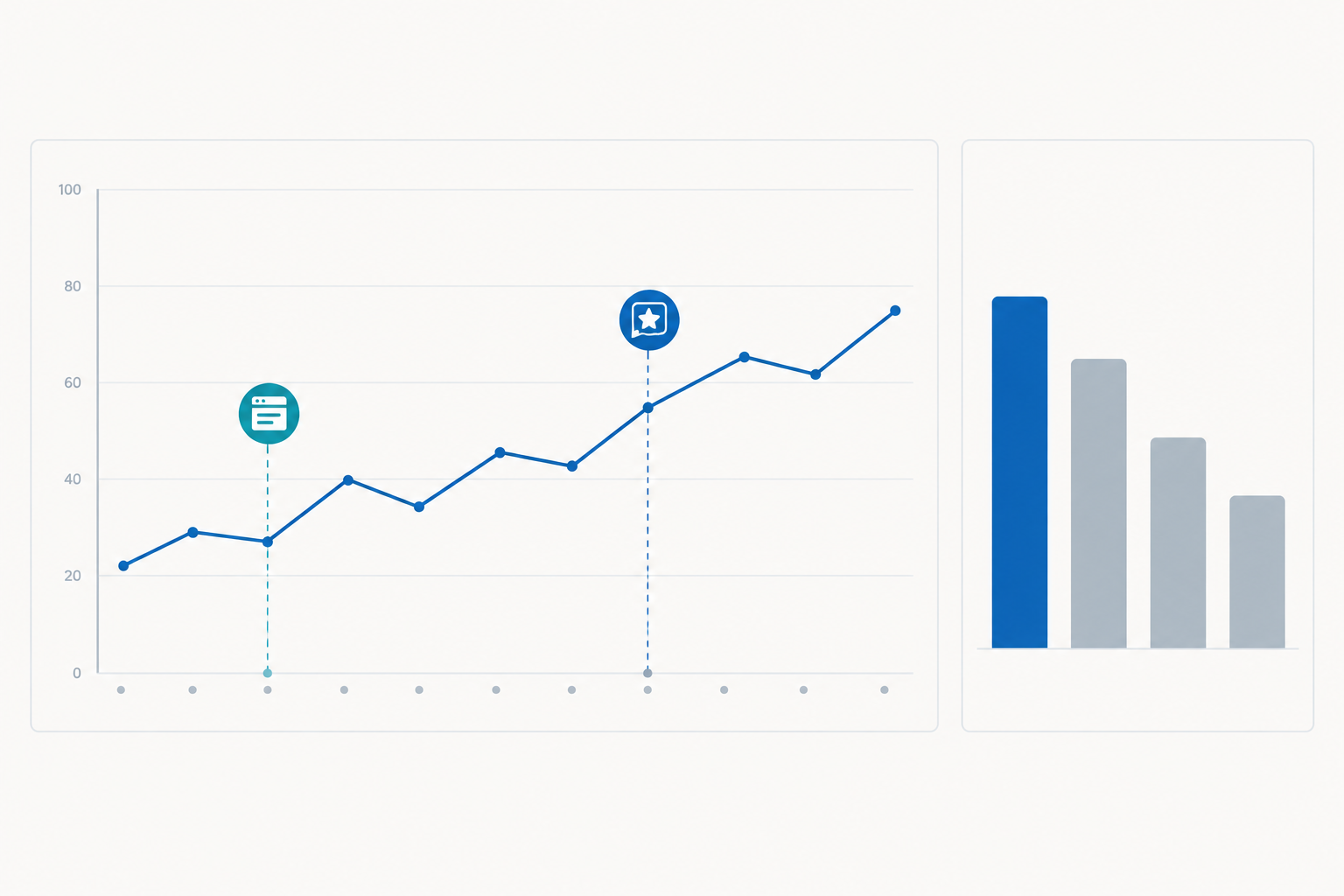
Here is a worked illustration, using invented numbers. A Leeds plumber runs 10 questions across 2 assistants, twice each, giving 40 answers. The firm is named in 6 (15%) while its strongest competitor is named in 22 (55%). It then rewrites its two main service pages and starts asking every customer for a review. Re-running the same set at week 8, it is named in 11 of 40 (28%). That looks encouraging, but with only 40 answers a swing of a few mentions is within normal variation. The sensible conclusion is 'promising, keep going and keep sampling', not 'proven'. Log calls and enquiries alongside, because visibility is not return on investment.
Optional: using an AI visibility monitoring tool
Disclosure: I work on the MentionOwl team, so read this as a vendor example and not an independent recommendation. Tools can automate the spreadsheet method. MentionOwl, for instance, crawls your site, generates customer questions, runs them against several assistants and reports a 0-100 visibility score. That score is a vendor-defined composite of how many questions you appear in, how prominently you are cited, your share of voice and soft mentions. It is not an industry standard, so use it for the direction of the trend and sanity-check it against your own manual sample. Other tools exist, and for a single local business the spreadsheet is a perfectly credible starting point.
Be realistic about timing. Retrieval-based tools may reflect page changes within days or weeks, while model-level changes can take far longer. Gradual gains, such as appearing in more of your tracked questions or moving from soft mentions to citations, are a better expectation than a sudden leap.
What can you do this week? A 60-minute GEO plan
- Minutes 0-15, test your questions. Write down ten customer questions, run them through two or three assistants and note who is named. Treat this as a rough sketch, not a verdict.
- Minutes 15-30, audit your details. Compare your name, address, phone and hours across your website, Google Business Profile and two major directories, and fix any inconsistencies.
- Minutes 30-45, improve one service page. Add a plain description, location, pricing guidance and three genuine customer questions answered. A full rewrite may take longer, so work one page at a time.
- Minutes 45-55, request reviews. Ask five recent customers for honest feedback and reply to any unanswered reviews.
- Minutes 55-60, record your baseline. Put your results from step one into a spreadsheet with the date. Choosing and configuring a tracking tool is a separate, optional task.
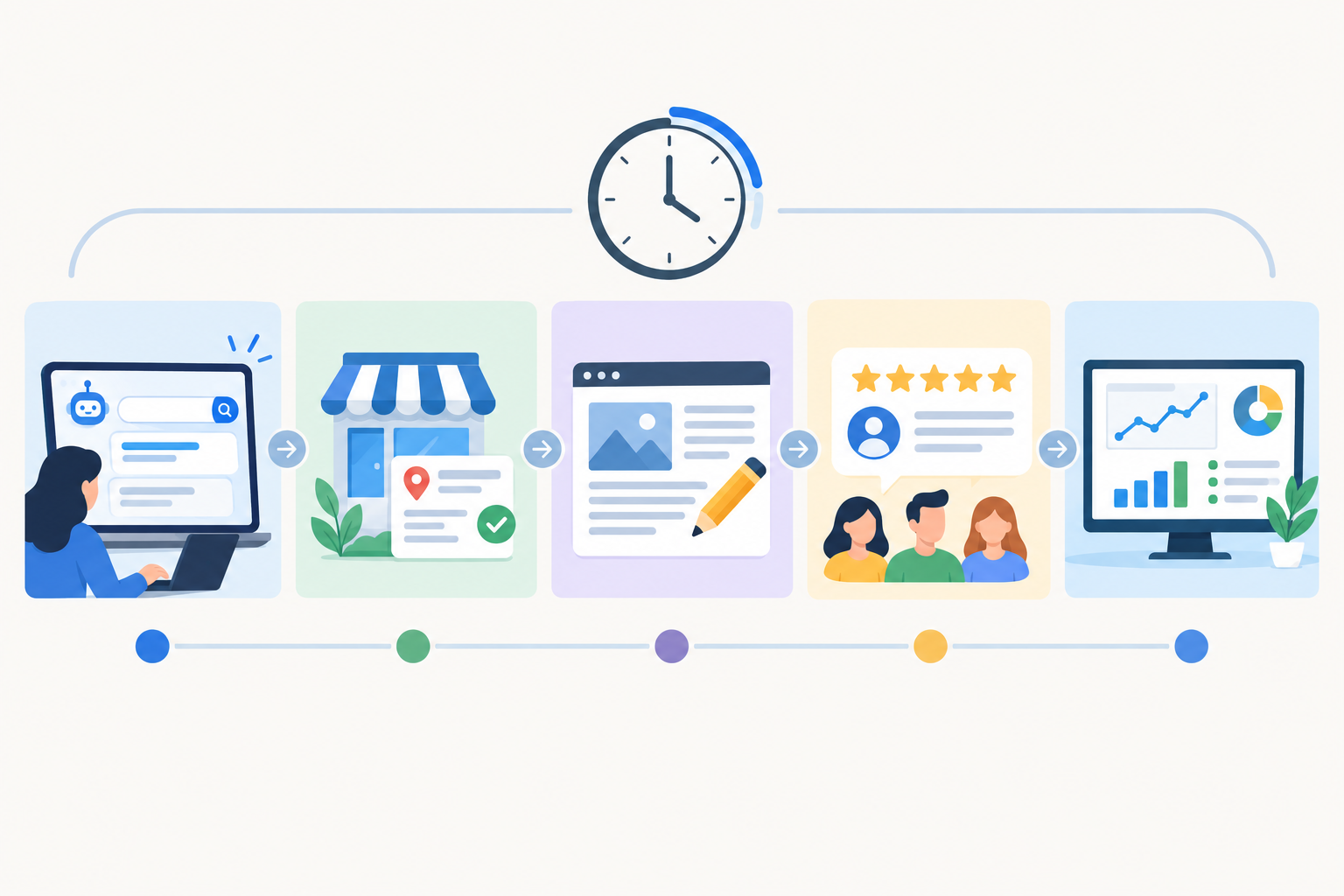
After week one, rotate. Improve a second service page in week two, run one technical check (robots.txt or sitemap) in week three, and in week four review the trend, note which competitors gained ground and pick one outside source to join. At week 12, compare your results and enquiries against the baseline. The habit matters more than any single week.
Frequently asked questions about generative engine optimization
Is generative engine optimization worth it for a small business?
For most businesses where customers research before buying, yes, because the core tasks (clear pages, consistent details, reviews) also support traditional search. Start with a baseline check to see whether AI assistants already mention you or your competitors, then commit to about an hour a week once setup is done.
How is GEO different from local SEO?
Local SEO aims to rank you in map and search results, while GEO aims to get you named, cited and described accurately inside AI-generated answers. They share foundations such as consistent business details and reviews. GEO puts more weight on readable content and third-party corroboration, and it measures mentions rather than rankings.
How long does it take to see GEO results?
Expect weeks to months, not days. Tools that retrieve live web content may pick up changes to your site quickly, whereas model-level changes can take far longer, so review progress over 8 to 12 weeks.
Can I block AI crawlers and still appear in AI answers?
Blocking crawlers can reduce your chances of being cited, particularly in tools that retrieve live web content. If visibility matters to you, check that your robots.txt does not unintentionally block AI user agents.
Do I need technical skills for small business AI SEO?
No. The weekly tasks are mostly writing, listing hygiene and review requests. Any technical items, such as schema, can be handled with plugins or a developer in a single session.
Related Articles

AI SEO vs Traditional SEO: What Actually Changes for Brands
A side-by-side comparison of AI SEO and traditional SEO: goals, metrics, tactics and reporting. See what carries over, what to measure anew, and how t

How to Pitch AI Visibility Monitoring as a New Client Service: A Guide for Agencies
A practical guide for UK agencies on pitching AI visibility monitoring to clients: how to frame the problem, run a free audit, handle ROI objections a

Create content like this automatically
Scribe uses AI to generate high-quality blog posts that engage your audience and drive traffic.