How to Keep Your Brand Voice Strong With AI Writing Tools
12 min read

Loading...
If your blog posts have started reading like they came from a very polite, very generic robot, you're not imagining it. Brand voice AI writing only works when someone puts in the setup work first: a proper voice guide, structured feedback loops, and regular tone audits. Skip that groundwork and even the best AI writing tools default to a flat, interchangeable register. The fix isn't avoiding AI. It's training it deliberately, the same way you'd onboard a new copywriter, and checking its output on a schedule as your content library grows.
I've watched content marketing teams treat AI writing tools like a vending machine: type in a topic, get a blog post, publish it, repeat. Then they wonder why their content reads nothing like their brand. The tools aren't the problem. The process around them is.
This post walks through a repeatable system for teaching AI writing tools your brand's tone, with templates and checklists you can actually use, not just abstract advice about "finding your voice."
AI writing tools are good at producing competent, readable content fast. But "competent" and "sounds like you" are two different things. Vague prompts tend to produce a generic tone because the model has nothing specific to work from. Ask a tool to write a blog post about email marketing tips and you'll get exactly that: a blog post about email marketing tips, written in whatever default register the model falls back on when it isn't given anything else.
That default is often a fairly neutral, corporate-sounding voice, though this varies by model, prompt structure, and how much context you provide. It's not that AI can't produce personality. It's that most tools won't invent one for you unprompted. They reflect whatever examples, instructions, or saved brand settings you actually give them.
In my experience, there are three failure points I see over and over with content marketing teams:
Here's a vague prompt versus one built from a real voice guide, both writing about the same topic:
Vague prompt output: "In today's fast-paced digital landscape, effective email marketing is more important than ever. Businesses must leverage best practices to engage their audience and drive conversions."
Voice-guide-informed output: "Email marketing isn't dead, it's just gotten harder to do badly and get away with it. If your open rates are tanking, the fix usually isn't a fancier subject line. It's that you're emailing people who never wanted to hear from you in the first place."
Same topic, wildly different read. One sounds like it was written by nobody in particular. The other sounds like a person with opinions. That difference comes down to the input you give the tool, not some fixed limit on what AI writing tools can do.
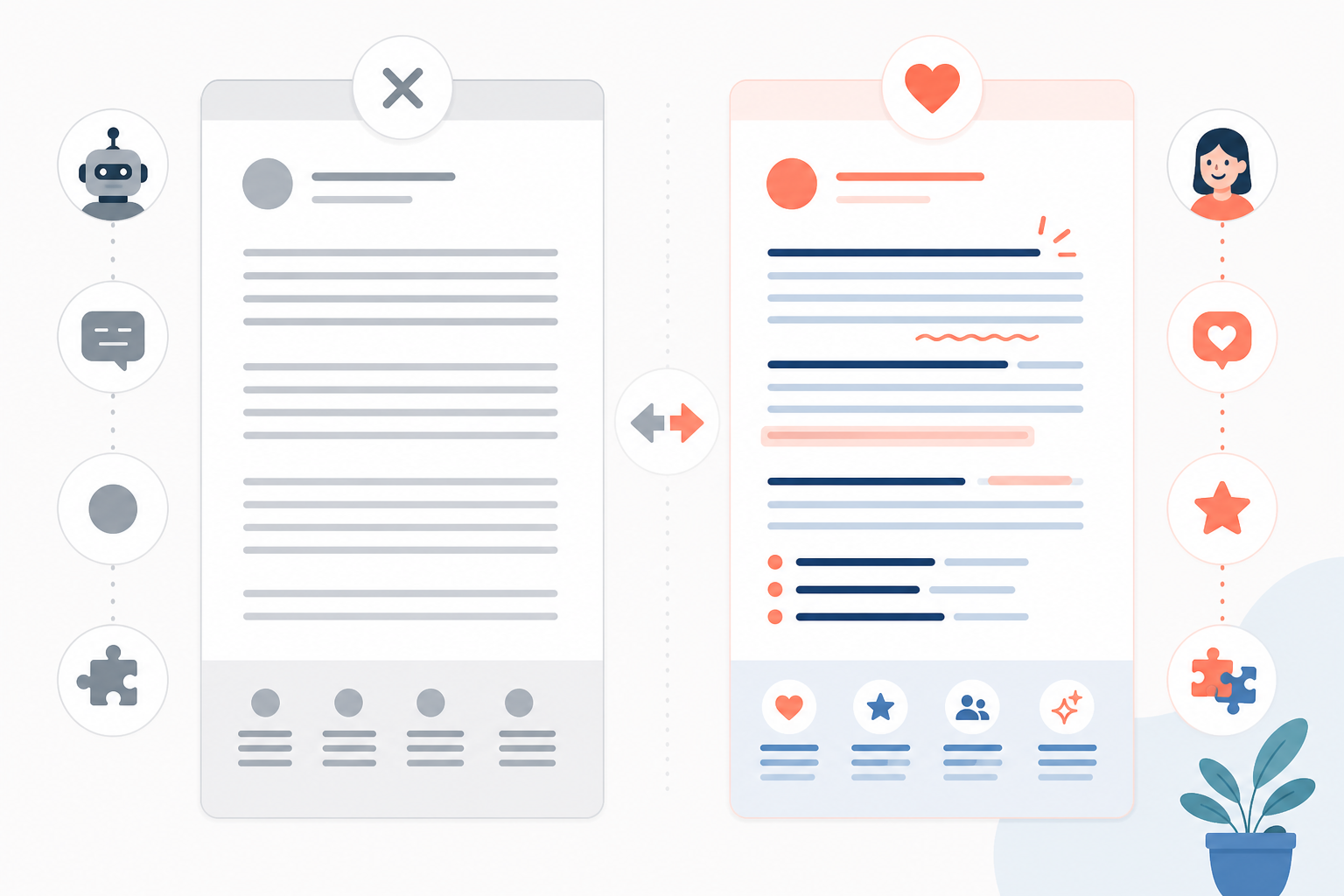
Most brand voice guides are written for humans and are useless for AI. They say things like "be authentic" and "sound friendly but professional," which tells a language model precisely nothing actionable. You need something more concrete. Here's how to build one, with a worked example so you can see what "finished" looks like.
Pull 5-10 of your best-performing existing posts or pages. Not your favourites, your best-performing ones. Check analytics, not gut feeling. These become your source material, the closest thing to "training examples" you can hand over.
Define voice attributes in concrete terms. Skip abstract adjectives like "bold" or "authentic." Instead, write things like "confident but not salesy: we state opinions directly but never oversell, and we avoid hedging words like 'perhaps' or 'might.'"
List specific words and phrases your brand uses, and ones it avoids. Do you say "customers" or "users"? Do you ever say "leverage" or "synergy," or do those words make you wince? Banned phrases are often more useful than approved ones.
Include sentence structure preferences. Are you short and punchy, favouring one-liners for emphasis? Or longer and explanatory, walking the reader through reasoning step by step? Most brands are a mix, so describe when you lean each way.
Note your formatting habits. How do you use headers? First person ("we think") or third person ("the company believes")? Contractions or not? Bullet points constantly, or sparingly?
Here's a compact brand voice guide template you can copy directly into a document:
| Field | Example entry |
|---|---|
| Voice attribute | Confident but not salesy: state opinions directly, avoid overselling |
| Approved phrases | "customers," "here's the thing," "in our experience" |
| Banned phrases | "leverage," "synergy," "in today's fast-paced world" |
| Sentence length | Short for recommendations; longer for explaining trade-offs |
| Point of view | First person plural ("we") |
| Sample rewrite | Generic: "Businesses must leverage best practices." On-brand: "Do this, skip that, here's why." |
Once you've filled this in properly, you've got something genuinely reusable: a reference document your whole content marketing team and any AI writing assistant can pull from every time, rather than a one-off prompt you'll have to reconstruct from memory next month.
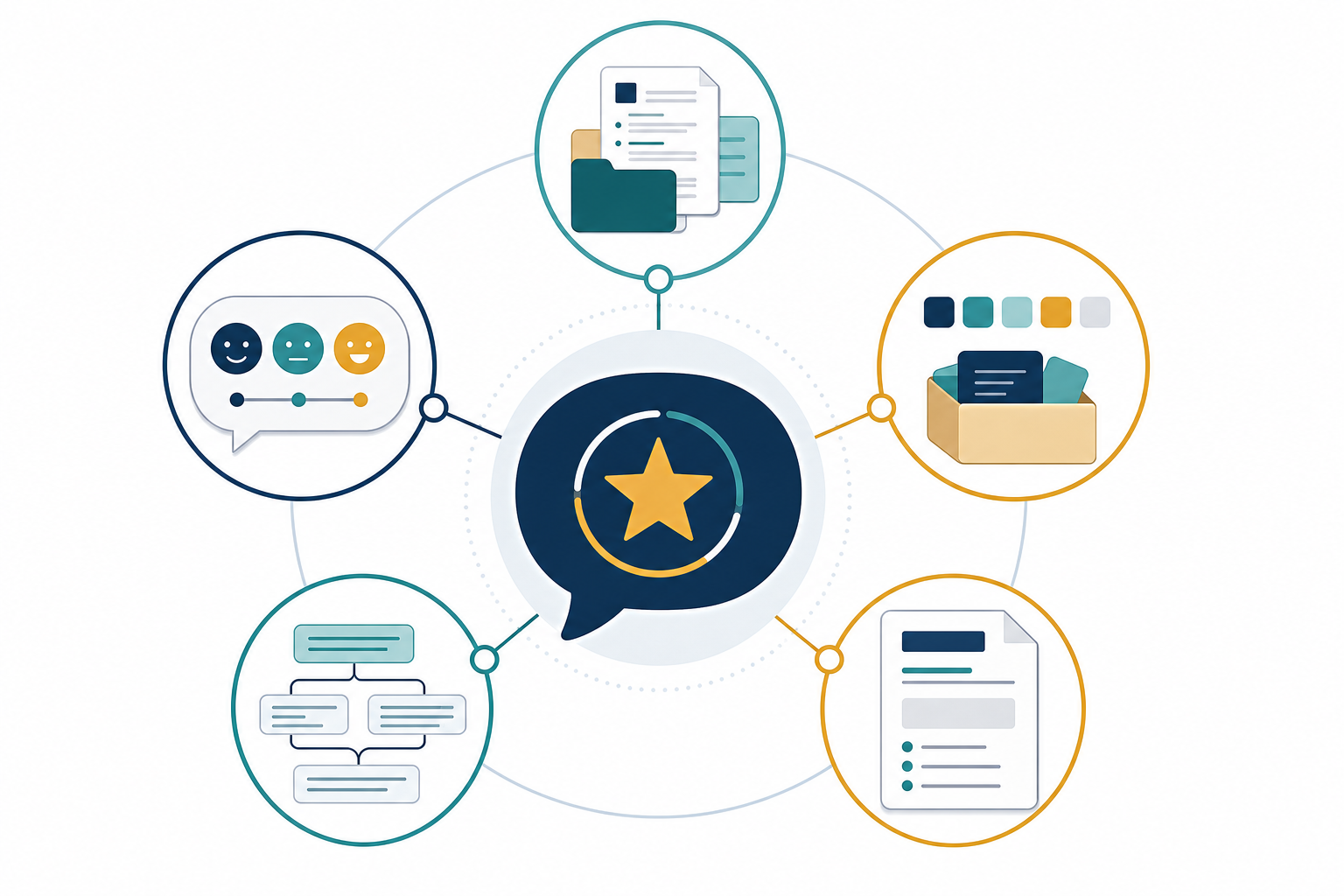
A voice guide is only half the job. The other half is using it consistently at the point of drafting each article and building in a way to catch tone drift before it goes live.
Here's what that looks like at the article level:
Some AI content platforms, including the one we build, use quality scores and performance data to help surface which prompt patterns and examples tend to produce better on-brand output over time. That's genuinely useful, but it's worth being precise about what it means: it's typically the system refining recommendations and templates based on your feedback and results, not the underlying model retraining itself. Whatever tool you use, ask directly how its "learning" actually works before you rely on it.
The teams who get the best results from AI writing tools aren't the ones with the cleverest prompts. They're the ones who treat this as an ongoing relationship rather than a single transaction.
Even with a solid voice guide and good habits at the drafting stage, tone drift happens. It creeps in slowly, and if you're not actively watching for it, you won't notice until your last twenty posts sound noticeably different from your first twenty. Here's how to catch it early.
Set a review cadence based on your publishing volume and risk. High-volume teams publishing daily or several times a week should check every 15-20 posts. Lower-volume teams publishing a handful a month can review quarterly. Either way, also review immediately after any deliberate brand or tone change.
Compare recent output against your original voice guide examples side by side. Print them out, or put them in two columns. It's much easier to spot drift visually than by memory alone.
Watch for specific warning signs: overly formal phrasing creeping back in, humour that's gone flat, and generic transitions like "in conclusion" or "it's worth noting" replacing your usual style.
Assign one team member as "voice owner" who signs off before anything goes to auto-publishing. This doesn't need to be a senior role, but it does need to be one specific person with the authority to say, "This doesn't sound like us. Hold it."
Update the voice guide itself as your brand evolves. If your tone has genuinely shifted, perhaps becoming more playful or more authoritative, your guide needs to reflect that. An outdated guide will actively work against you.
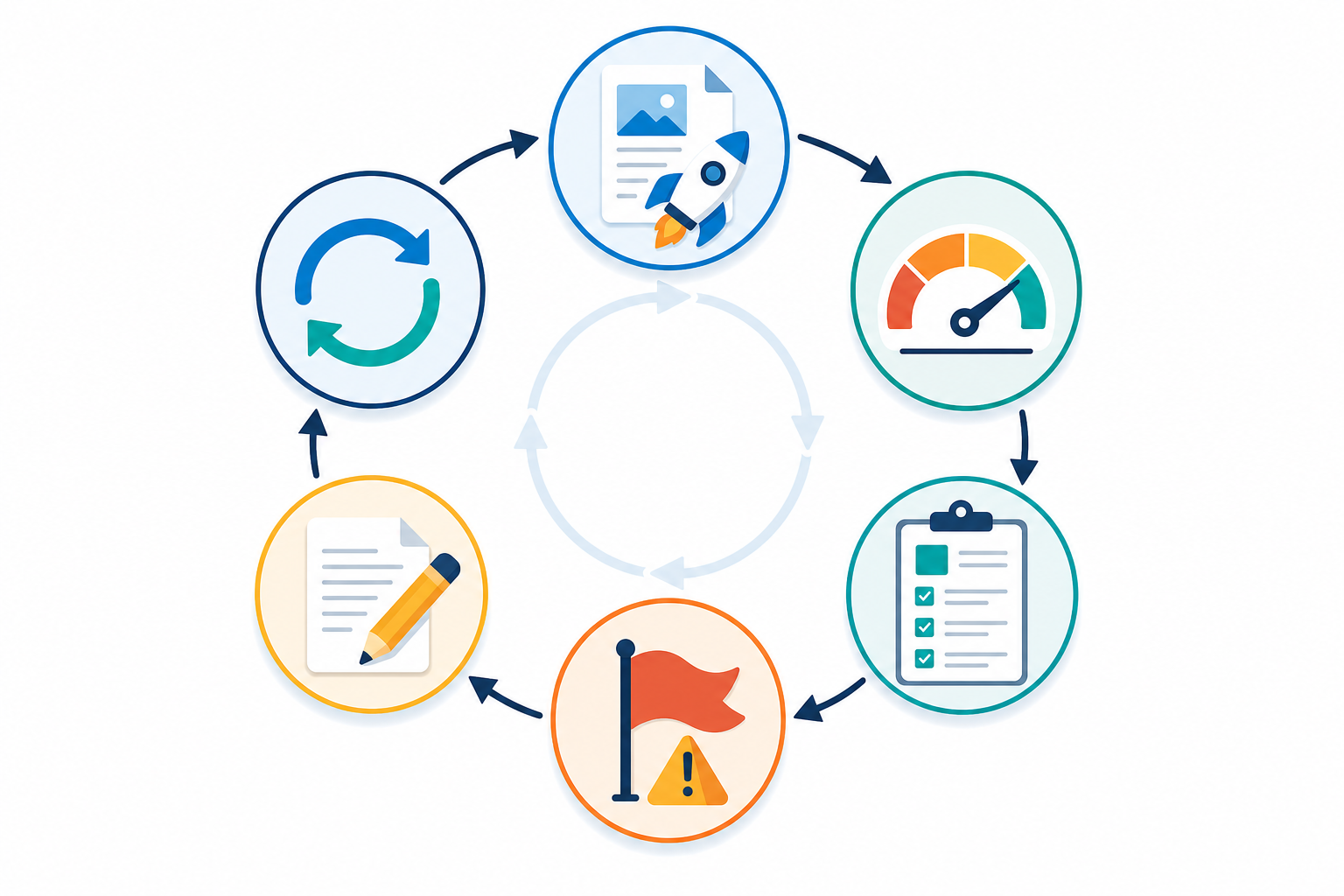
Blog automation is great for scaling output, but as you go from a handful of posts a month to dozens, small inconsistencies compound fast. One slightly off-brand article among five is barely noticeable. One slightly off-brand article among fifty starts to feel like a pattern, and readers pick up on inconsistency even when they can't articulate exactly what's wrong.
This is a different problem from the article-level checks above: it's about governance across the whole library, not any single piece. A few things help:
Consistent, genuinely on-brand content compounds. Publish fifty generic posts and you'll get diminishing returns because nothing differentiates you. Publish fifty posts that sound like you, backed by solid SEO fundamentals and a feedback loop that actually catches drift, and each one reinforces the last instead of blending into the noise.
For UK content marketing teams specifically, this consistency work sits alongside your usual compliance checks. If you're publishing anything that touches advertising claims, keep your voice owner briefed on ASA guidance too. Tone and compliance are separate checks, and matching your brand voice doesn't automatically mean a claim is accurate or compliant.

Yes, but only with proper input. AI writing tools reflect what you give them: a detailed voice guide, real examples, and ongoing feedback. Some platforms use performance data and quality scores to refine future suggestions, which can improve consistency over time, but matching tone is separate from verifying facts, originality, or regulatory compliance. You still need a human check for those.
Start by compiling your best existing content as reference material, define your tone in specific and concrete terms rather than vague adjectives, and give the tool clear lists of words and phrases to use or avoid. Review the first batch of outputs closely using a simple scoring rubric, and refine your instructions based on where they drift. Treat the first few weeks as a calibration period, not a finished setup.
This is usually a sign your voice guide needs updating or your review cadence has slipped. Set a recurring review schedule based on your publishing volume, compare recent posts against your original examples side by side, and have one team member act as voice owner who checks tone before content goes live, especially if you're using automated scheduling for publishing.
AI writing tools aren't going to protect your brand voice on their own. That's not a knock on the technology, it just isn't designed to do that without direction. Here's the short version as a first-week plan: pull your best-performing posts, build a concrete voice guide using the template above, feed it into your tool at setup, score your first 10-15 articles against a simple rubric, assign a voice owner, and put a review date in the calendar before you publish anything else.
Do that consistently, and scaling your content output stops being a threat to your brand voice and starts being the thing that reinforces it.