How to Keep Your Brand Voice Consistent With AI Writing: A Practical Guide for Marketing Teams

How Brand Voice AI Writing Keeps Your Brand Voice Consistent: A Practical Guide for UK Marketing Teams
Meta description: Learn how brand voice AI writing helps UK marketing teams train, review and scale AI content without losing a distinctive, trusted brand identity.
Effective brand voice AI writing comes down to three things: giving your AI writing assistant detailed style guidance upfront, reviewing early output closely against a clear rubric, and choosing a platform that can demonstrably learn from what performs well for your brand. Done properly, AI can produce drafts that sit much closer to your established voice than most teams expect, close enough that casual readers rarely flag a difference, though it takes real work to get there. It isn't magic, and it isn't instant.
That's the practical answer. If you're a marketing team trying to scale content production without diluting your identity, you already know the real question isn't whether AI can write. It's whether it can write like you, consistently, at volume, without a human rewriting every paragraph. Let's get into how to improve AI content consistency, including where the risks are and what a sensible review process actually looks like.
Why brand voice matters more than ever in the age of AI content
Here's a stat worth sitting with: Gartner's 2022 research predicted that by 2025, 30% of outbound marketing messages from large organisations would be synthetically generated, up from less than 2% in 2022. Even allowing for the usual uncertainty in forecasts like this, the direction is unmistakable. When everyone is publishing more, the small stuff (vocabulary choices, sentence rhythm, formatting habits) becomes far more visible across your channels, simply because there's more of it to compare.
Think about it this way: if you're one of the few brands in your space still writing in a distinctive, recognisable voice, that becomes a real competitive advantage rather than a nice-to-have. Generic AI content is easy to spot and easy to scroll past. Brand voice AI writing done well isn't about protecting your identity for its own sake; it directly affects whether people trust and engage with what you publish.
This matters in the UK market too, though I'd be careful not to overstate it as a universal trait. What we do see consistently is that UK audiences notice localisation basics quickly: UK spelling, UK idioms, UK date formats, and phrasing that doesn't read like a direct US-to-UK port. That's a specific, checkable thing, not a broad personality claim about scepticism. Inconsistency across a content library rarely announces itself loudly. It creeps in one slightly-off blog post at a time, until your brand feels less like a person and more like an output pipeline.
The research backs the underlying logic, if not the exact number. Marq's brand consistency research reported that consistent brand presentation can lift revenue by as much as 33%. That's a vendor-reported figure, not an independently audited universal law, so treat it as directional. It lines up with what most of us sense intuitively: brands that sound like themselves, consistently, build recognition faster and keep it longer.
Brand voice AI writing: can AI match your brand's tone and writing style?
Short answer: yes, with the right inputs and the right kind of tool. Not automatically, and not from a single prompt.
An AI writing assistant doesn't inherently know your company's personality, your audience's expectations, or your appetite for risk. Microsoft's Work Trend Index and Google's published guidance on generative AI content both point to the same practical conclusion: tools produce noticeably more consistent, on-brand output when teams give them explicit instructions, approved examples, terminology lists, and clear review criteria. Left to guess, AI defaults to the safest, most generic version of writing it can produce, which is exactly what you're trying to avoid with AI content consistency.
It's worth understanding the actual differences between tool categories here, because the marketing language around 'self-improving AI' gets vague fast:
- Prompt-only tools treat every request as a blank slate. They can nail your tone once and drift the next time, because nothing you approved or rejected carries forward.
- Retrieval-based tools pull from a library of your approved examples and style guide each time they generate content, which improves consistency but still relies on you maintaining that library.
- Feedback-loop tools let editors flag what worked and what didn't, and factor that editorial signal into future drafts.
- Performance-optimised tools go a step further, analysing quality scores and engagement data from published content and using that to influence future generation. Scribe works in this category: it factors in quality scores and performance data from articles you've already published. That's a documented product feature rather than an independently verified benchmark, so it's worth asking any vendor, Scribe included, exactly what data feeds the model, how often it updates, and what happens when performance data and brand accuracy point in different directions, because they won't always agree.
If you're evaluating tools, a short checklist helps: Does it accept a style guide as a persistent input, not just a one-off prompt? Can you see why it made a particular tone choice? Does it distinguish between what performed well and what was simply published a lot? And can a human override its pattern-matching when the pattern is wrong for a specific piece?
Set your expectations accordingly. Most teams find their first batch of AI-generated content needs more editing than later batches, as the inputs, examples, and review feedback accumulate. That's normal, not a sign the tool is failing. Treat the first several weeks as training and calibration, not final output, and you'll avoid the frustration that comes from expecting a finished voice on day one.
How to train AI to write like your team
Think of this as preparing onboarding materials for a new team member, except this one can read far more material, far faster, than any human hire. This step feeds raw inputs into your AI writing assistant; the next section turns those inputs into a reusable, documented specification.
Feed it your best work, not just any work. Give the tool a sample of your strongest, best-performing existing content. Leave out the mediocre stuff. The AI learns from what you give it, so give it your A-material.
Pin down 3-5 adjectives that describe your voice. Warm, direct, witty, no-nonsense, whatever genuinely fits. Vague direction produces vague writing; specific descriptors produce specific results.
Flag your sentence structure preferences. Do you favour short, punchy sentences, or longer explanatory ones with more nuance? What's your typical paragraph length? These details sound small but they're often what makes writing feel recognisably yours.
Note the vocabulary to avoid. Jargon you hate, competitor phrasing you don't want echoed, overly formal language that doesn't sound like you on a bad day. Negative guidance is just as useful as positive examples.
Turn all of the above into a sample prompt you can reuse. Something like: "Write in a warm, direct, no-nonsense tone for a UK audience of small business owners. Use short paragraphs (3-4 sentences), UK spelling and date formats, and avoid corporate jargon like 'synergy' or 'leverage.' Here are two example paragraphs that represent our voice: [paste examples]. Avoid the tone in this example, which is too formal for us: [paste off-brand example]." A concrete template like this does more for consistency than a list of adjectives alone.
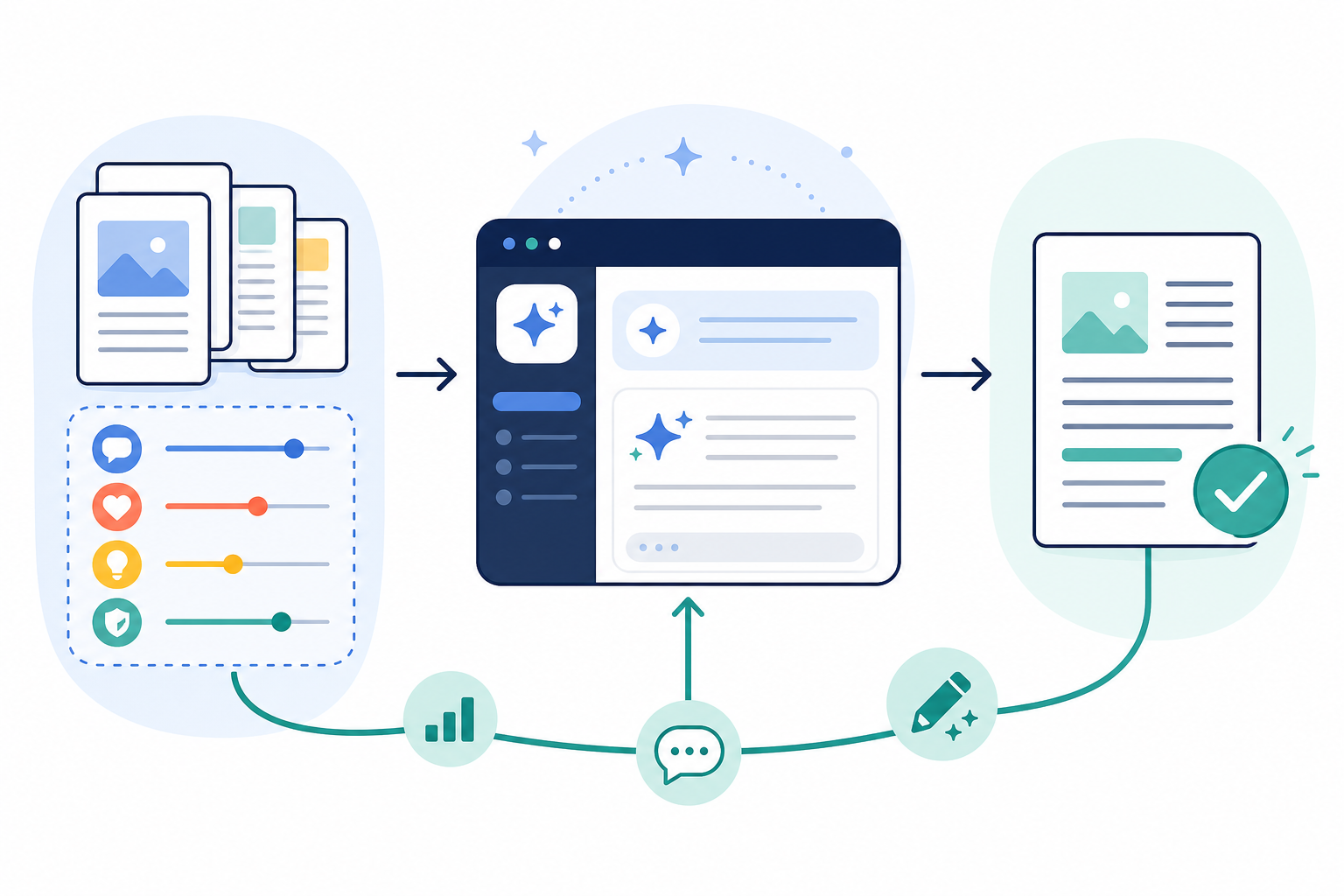
Caption: A basic input-to-output feedback loop for training an AI writing assistant on brand voice. Alt text: Flowchart showing sample content and tone descriptors feeding into an AI tool, producing on-brand output through an editorial feedback loop.
Creating an AI brand voice style guide
If there's one step marketing teams skip and later regret, it's this. Document your brand voice properly, in writing, before you rely on an AI writing assistant at scale. Not a vague mission statement, but an actual working reference document that lives inside your content workflow.
A compact style guide should cover:
- Audience and purpose. Who you're writing for and what you want the content to do.
- Tone range and point of view. First-person plural ("we"), third-person, or direct address ("you")? Formal or conversational? Confident or measured? It's fine to specify a range rather than a single fixed tone.
- Real examples, side by side. On-brand copy next to off-brand copy, with a short note on what makes each one land or miss. This teaches faster than any adjective list.
- Terminology rules. Words you always use, words you never use, and how you handle brand names, product names, and industry jargon.
- Formatting preferences. Header structure, when to use bullet lists versus flowing paragraphs, how you present statistics. Mailchimp's public style guide and GOV.UK's content design guide are both good public examples of this level of specificity, right down to punctuation and reading level.
- Claims and compliance notes. Which claims require a source or sign-off before publishing, and which topics need legal or regulatory review regardless of how confident the draft sounds.
- Accessibility and inclusivity basics. Plain language expectations, alt text requirements, and any terms or framing to avoid.
- Localisation notes. UK spelling, UK idioms, UK date formats, and currency conventions if relevant, rather than a generic English-language default that skews American.
Build this into your actual content workflow as a reusable input, not a document that gets praised in a launch meeting and forgotten by month two. Update it as your brand evolves, and re-share it whenever you do. A style guide nobody opens after week one isn't a style guide, it's a PDF.
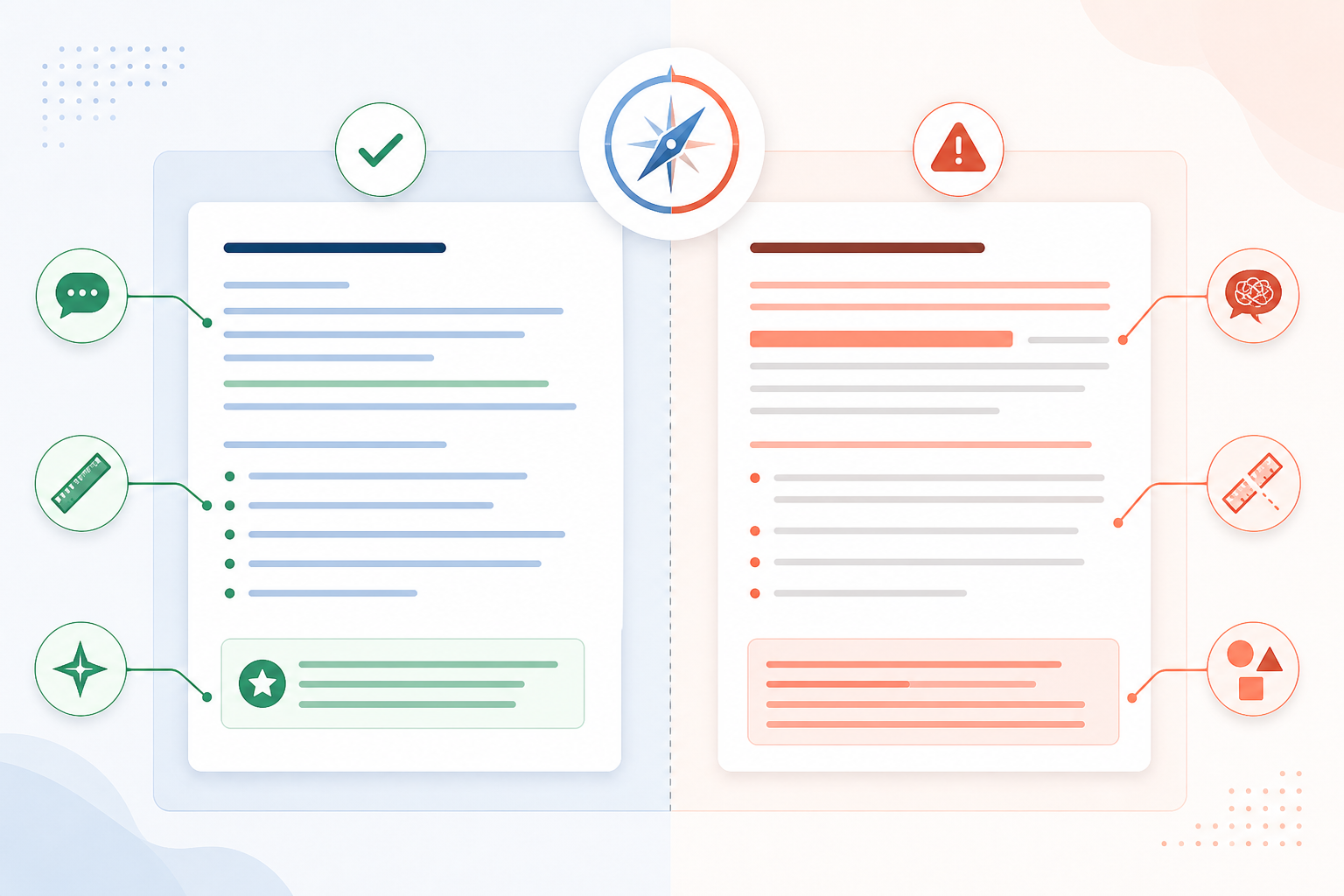
Caption: An example of how to annotate on-brand versus off-brand copy for training material. Alt text: Side-by-side text comparison highlighting tone, sentence length, and vocabulary differences between on-brand and off-brand writing.
How to review AI-generated content for brand consistency
Even with strong inputs, review still matters, and it should evolve in stages rather than staying fixed. NIST's AI Risk Management Framework is direct about this: AI-generated drafts need human review for brand-sensitive and risk-sensitive issues, including unsupported claims, cultural nuance, and unintended shifts in meaning.
Here's a practical, staged approach rather than a single fixed rule:
Stage 1 — first 20-30 published articles: full review. Score every piece against a simple rubric before publishing:
| Criteria | 1-5 score | Notes |
|---|---|---|
| Voice and tone match | ||
| Terminology accuracy | ||
| Factual accuracy / sourced claims | ||
| Structure and formatting | ||
| Audience fit |
Any score below 3 on voice or terminology sends it back for revision. Any failure on factual accuracy or compliance blocks publication outright, no exceptions, regardless of how good the tone sounds.
Stage 2 — once you're consistently hitting 4+ across the board: shift to weekly batch review plus spot-checks. This is the point where full line-by-line editing starts to defeat the purpose of automation. Read openings and closings closely, since voice drift shows up there most obviously, and compare a sample against your style guide.
Stage 3 — ongoing: quarterly audits, regardless of how well things are going. Drift creeps in gradually even after a system has 'earned trust.' A quarterly check catches small slips before they become a pattern across dozens of posts, and it's your safeguard against complacency.
A few risks sit outside tone entirely and deserve their own checks at every stage, not just when volume is low: hallucinated statistics or claims, legal and regulatory wording in regulated industries, accessibility of formatting and alt text, inclusive language, handling of sensitive topics, and whether any confidential source material has been paraphrased too closely or disclosed inappropriately. If your workflow involves AI-generated content at all, it's worth having a written policy on disclosure and sign-off, even if that policy is short.
Best practices for maintaining brand voice with AI content at scale
'Trust the system' isn't a feeling, it's a measurable state. A reasonable bar: a run of 20-30 consecutive articles scoring 4 or higher on voice and terminology, with zero unresolved factual or compliance failures. Once you hit that consistently, these habits keep quality high without slowing you back down:
- Move to weekly batch review, not piece-by-piece, once Stage 2 criteria are met. Full manual review of every article becomes overkill past that point.
- Track what performs best and feed it back into your inputs. Which articles got the most engagement or organic traffic? Feed those patterns back into your prompts and style guide examples, not just into the tool's internal scoring.
- Resist tool-hopping. Any feedback-loop or performance-optimised system needs a consistent run of content to learn from. Switching tools every few months resets that learning curve every time.
- Pair AI content with spot-checks, not full edits, once you've earned that stage. Spot-checks preserve the time savings while still protecting your voice.
- Never skip the factual and compliance layer, no matter how mature the workflow gets. Voice consistency and factual accuracy are separate checks, and one passing doesn't mean the other has.
Example workflow: scaling AI content without losing brand voice
To make this concrete, here's an illustrative scenario based on a common pattern we see with growing marketing teams, not a documented, independently audited case study.
Picture a mid-sized marketing team manually writing four or five blog posts a month. Decent quality, but nowhere near enough volume to compete on search visibility. They adopt an AI writing assistant with a feedback-loop or performance-optimised model and scale to 20-30 articles a month, following the staged review process above: full review for the first month, then weekly batch review with spot-checks once quality holds steady.
The risk is obvious: more content means more chances for voice drift. This is exactly where a system that factors in performance data can help, provided the team keeps the factual and compliance checks in place regardless of how well the tone is landing. As more articles get scored and reviewed, the inputs (approved examples, rejected drafts, terminology corrections) accumulate, and consistency tends to improve rather than degrade, because there's more signal to work from.
On the outcomes side, Scribe has published a customer case reporting a 340% increase in organic traffic over six months. That figure comes directly from the vendor and hasn't been independently audited, so treat it as one data point rather than a guaranteed result. What it does illustrate, directionally, is that voice consistency and SEO performance aren't competing priorities. Content that sounds like a real, consistent brand tends to keep readers around longer, which is generally good for both trust and search performance.

Caption: Illustrative traffic trend based on a vendor-reported customer case; not independently verified. Alt text: Line chart showing an upward organic traffic trend over six months on a marketing analytics dashboard.
Frequently asked questions about brand voice and AI writing
Can AI actually match my brand's tone, or will content always sound generic?
AI can get close, but it depends heavily on the tool category and the inputs you provide. Prompt-only tools that don't retain feedback tend to drift toward generic, average copy over time. Retrieval-based and feedback-loop tools improve consistency by referencing your approved examples and style guide on every generation. Performance-optimised platforms, including Scribe, add published-content data into that mix, though this is a documented product capability rather than an independently benchmarked guarantee, so it's worth verifying with any vendor how that data is used.
How do I train AI to write like my team?
Start with your best existing content, define your tone using specific adjectives and examples, document terminology and formatting rules, and provide clear positive and negative guidance. Then review the first 20-30 articles against a consistent rubric and update the style guide as you identify patterns.
How long does it take for AI to learn my brand voice?
There's no reliable universal number here, and claims of a fixed article count should be treated with scepticism. What we can say is that teams who provide a clear style guide and strong sample content upfront tend to see faster, more visible improvement than teams who skip that step. Track your own rubric scores over your first 20-30 articles rather than relying on a general estimate.
Do I still need a human editor if I'm using AI for content generation?
Yes, at every stage, though the intensity of review should change. Early on, full review against a rubric catches voice and factual issues before they compound. Once you're consistently scoring well, that can shift to weekly batch review and spot-checks. Factual accuracy and compliance checks should never be fully removed, regardless of how mature the workflow becomes.
What's the biggest mistake marketing teams make when trying to keep AI content on-brand?
Skipping the upfront training and documentation step, then expecting the tool to intuit brand voice from a single prompt. A close second is treating performance data as proof of voice accuracy when it really measures engagement, which isn't quite the same thing and needs its own check.
Does using an AI writing assistant create data privacy or disclosure concerns?
It can, depending on what you feed into the tool and whether you disclose AI involvement to readers or regulators in your sector. Avoid feeding confidential or sensitive source material into any tool without confirming its data handling policy, and put a short internal policy in place covering disclosure, sign-off, and what happens if a factual or compliance issue slips through.
Putting AI brand voice best practices into practice
If you're starting from scratch, the order that tends to work is: write the style guide first, feed the tool your best examples and a reusable sample prompt, run full rubric-based review for your first 20-30 articles, then step down to batch review and spot-checks once your scores hold steady. Keep factual, compliance, and accessibility checks in place permanently, no matter how much you trust the tone. Brand voice AI writing isn't a one-time setup; it's a workflow you tune as your brand and your content volume both grow.
Related Articles

How AI Content Tools Are Reshaping Blogging in 2024: What Every Blogger Needs to Know
Explore AI content tools and AI writing assistants in 2024—what UK bloggers need to know about SEO, benefits, risks and the future of blogging.

The Freelancer's Guide to AI-Powered Content Creation: How to Take On More Clients Without Burning Out
Freelancer AI content creation: use an AI writing assistant to scale freelance content marketing, serve more clients and grow income without burnout.
Create content like this automatically
Scribe uses AI to generate high-quality blog posts that engage your audience and drive traffic.