How AI Content Tools Are Reshaping Blogging in 2024: What Every Blogger Needs to Know

AI Content Tools in 2024: What UK Bloggers Need to Know
Meta description: Discover how AI content tools and AI writing assistants are changing blogging in the UK, including benefits, risks, SEO considerations, and tips for choosing the right tool.
AI content tools have moved from novelty to necessity for bloggers who need to publish consistently. The strongest platforms now handle research, SEO structuring, and even image generation in minutes rather than hours. But here's the thing I keep coming back to: the bloggers seeing the biggest wins aren't the ones who've handed over the keys entirely. They're using AI as a scaling partner, not a replacement for their own editorial judgement.
If you've been publishing for a while, you've probably felt the squeeze. Readers expect more content, more often, but your hours in the day haven't changed. That tension is why AI writing assistants have gone from an “interesting experiment” to a core part of the workflow for many content creators this year. In this post, I want to give you something more useful than a trend roundup: a clear picture of what's actually changed, an honest look at the risks nobody talks about enough, and a decision framework for choosing and governing an AI content workflow, whether you're a solo blogger or running content for a small UK team.
One note up front on data: most of the large-scale adoption surveys I'll reference are US-focused or global rather than UK-specific. I'll flag that clearly rather than imply UK adoption mirrors US numbers exactly, because it doesn't always.
The Rise of AI Content Tools in Content Creation
A few years ago, AI in writing meant grammar checkers and the occasional autocomplete suggestion. That's not the landscape anymore. Today's AI content tools can research a topic, draft a structured post, optimise it for search, and generate supporting images. Often, they can do this within the same workflow that used to require a writer, an editor, and a freelance designer.
What pushed this along wasn't just better language models. It was the shift towards tools built specifically for content marketing rather than general-purpose text generation. HubSpot's 2024 State of Marketing report found that 64% of marketers surveyed had used AI in their roles, with 38% of those citing content creation as a primary use case. Worth noting: HubSpot's respondent base is predominantly marketing professionals answering a global survey skewed towards English-speaking markets, so treat this as directional for the UK rather than a precise local benchmark.
Salesforce's State of Marketing research reported that 75% of surveyed marketers said their organisations had adopted AI in some form, and the Content Marketing Institute's B2B survey found 81% of B2B marketers using generative AI somewhere in their content process. OpenAI stated in August 2024 that ChatGPT had passed 200 million weekly active users globally. None of these sources break out UK figures specifically, but taken together they show that AI-assisted writing has become normalised well beyond enterprise teams, including among independent bloggers and small UK businesses.
What “Self-Improving” AI Content Tools Actually Mean
One genuinely different development in 2024 is what vendors call “self-improving” AI systems, and I think this term deserves more precision than it usually gets. In practice, this typically means a platform tracks how published articles perform—things like click-through rate, time on page, and search ranking movement—then feeds that data back into the templates, structures, or prompts it uses for future articles.
That's not the underlying language model retraining itself; it's a feedback loop layered on top of it, closer to automated, continuous A/B testing than to deep learning in the technical sense. It's a meaningful improvement over a static text generator, but it's a product feature, not a fundamentally new kind of intelligence. Ask any vendor exactly what data they track and how quickly it feeds back into the output.
Google’s Guidance on AI-Generated Content
On the regulatory and search side, Google's official position, stated on its Search Central blog, is that AI-generated content isn't automatically against its guidelines. What matters is whether content is helpful, reliable, and created primarily for people rather than to manipulate rankings.
Google's March 2024 spam policy update specifically named “scaled content abuse” as a violation, defining it as mass-producing low-value pages regardless of whether a human or an AI wrote them. For UK bloggers, this sits alongside separate considerations such as the Advertising Standards Authority's disclosure expectations if AI content is used in any promotional context, as well as good practice around transparency with readers.
The lesson either way is straightforward: volume without value is still a losing strategy, whether AI is involved or not.
What Has Actually Changed for UK Bloggers?
So what does this mean practically if you're the person hitting publish? A few genuine shifts have taken place, with some honest caveats attached:
- Publishing frequency can jump substantially. Some bloggers who struggled with weekly posts are now managing daily publishing. This depends heavily on niche complexity and how much review each post genuinely needs; a highly technical or regulated topic will still need more human time than a general lifestyle post.
- Time savings are real but variable. Research, drafting, and formatting that used to take several hours can now happen in minutes for a first draft. As one example, Scribe (a tool I work on, so take this as a disclosed example rather than an independent benchmark) generates a full 2,000-plus-word draft with images in around five minutes. That's a starting point, not a publish-ready final version.
- SEO structuring is often built into the generation process. Instead of manually researching keywords and structuring headers by hand, many modern AI content tools weave search-intent structuring into the draft itself, though the quality varies considerably between platforms.
- Publishing integrations reduce manual formatting. Integrations with platforms such as WordPress, Shopify, Wix, and Webflow mean content can move from draft to live with far less manual reformatting than before.
- Quality scoring can catch weak content before it's public. Some tools flag thin or unclear sections before you publish. This is useful, but it isn't a substitute for human fact-checking.
- Visuals can be generated alongside the text. This removes some of the scramble for a half-matching stock photo, although image provenance and copyright status vary by tool and should be checked before commercial use.
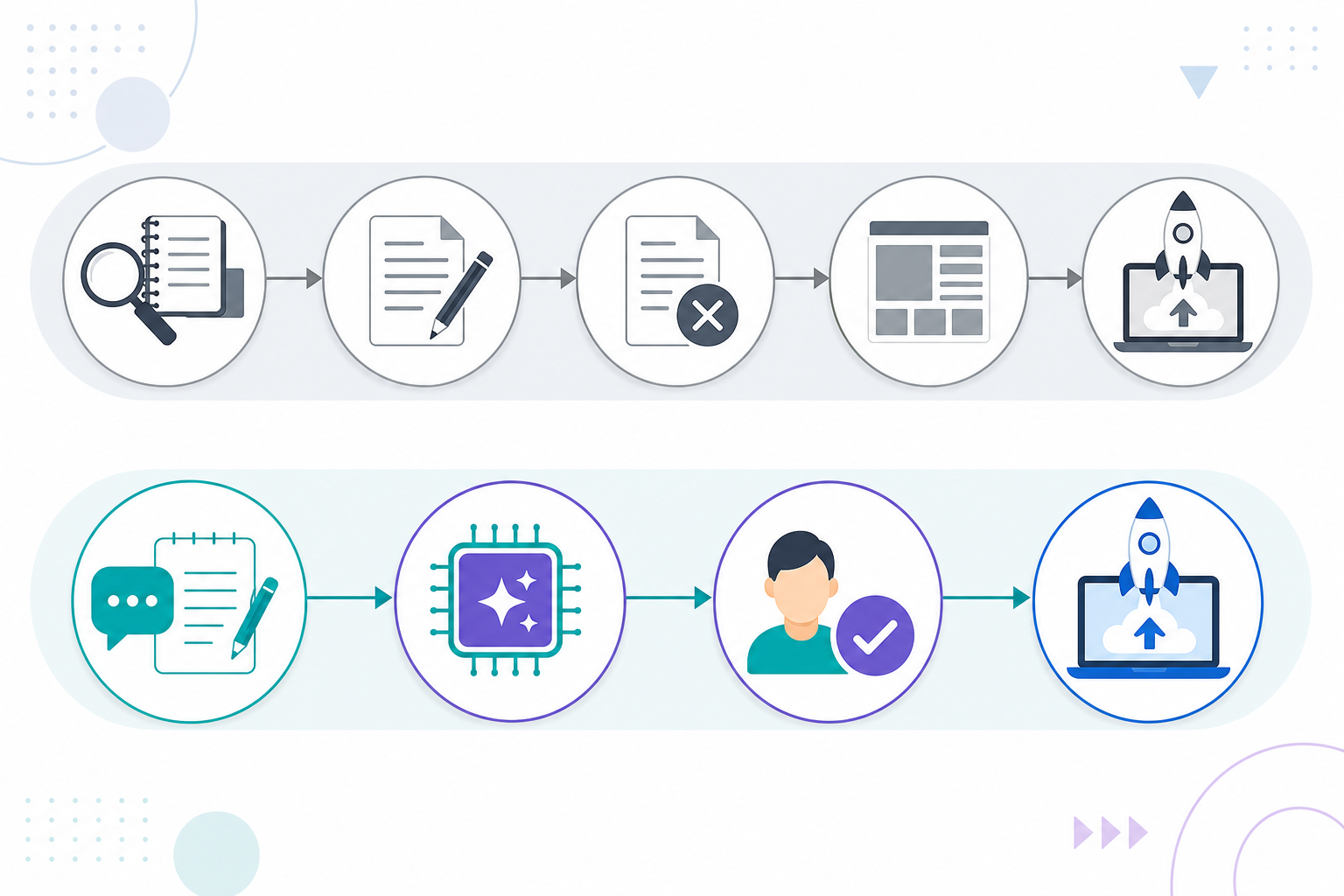
What strikes me about this list is that most of it is about removing friction rather than replacing thinking. The research still needs direction. The final review still matters, arguably more than ever, because a confident-sounding AI draft can hide errors more effectively than a rough human one. The mechanical parts of publishing—the tasks that used to eat entire afternoons—have shrunk down to minutes for the first-draft stage.
Benefits and Limitations of AI Content Tools
AI writing assistants aren't magic, and they're not a menace either. They're tools that are genuinely strong at some things and genuinely weak at others, and knowing the difference matters more than picking a side.
| Benefits of AI content tools | Limitations and risks |
|---|---|
| Speed: first drafts in minutes instead of hours | Brand voice still needs a human editing pass for nuance |
| Consistent structure and search-intent-aware formatting | Original research, interviews, and lived experience are hard to automate |
| Content scaling for teams with limited resources | Can produce fabricated citations or outdated facts without checking |
| Feedback-driven refinement based on published performance data | Doesn't replace fact-checking or editorial accountability |
| Built-in quality scoring flags weak drafts early | Risk of generic language without brand-specific input |
| Fast image generation alongside text | Image copyright, sourcing, and provenance vary by tool and need checking |
| Lower cost per article at scale | Data retention and privacy practices differ; check what happens to text or customer data you upload, especially under UK GDPR |

On the limitations side, I want to be direct because it matters for trust. NIST's AI Risk Management Framework flags factual reliability as a core risk category for generative systems, and real-world examples back that up. CNET pulled and corrected dozens of AI-written finance articles in early 2023 after readers found factual errors and passages closely mirroring existing sources.
The Associated Press's editorial standards, published in 2023, are a reasonable model here: AI tools can support tasks such as transcription or headline drafting, but generative output requires human review before anything is published under the AP's name. That's not an argument against AI content generation. It's a reminder that these tools work best when paired with editorial judgement, not used instead of it.
AI-Assisted Content or AI-Replaced Content?
So where's the line between “AI-assisted” and “AI-replaced” content? I'd put it here: if a human set the direction, reviewed the output, checked the facts, and would put their name behind the accuracy and perspective, it's AI-assisted.
If nobody with subject knowledge looked at the content before it went live, that's a riskier category. Increasingly, both readers and search engines are getting better at spotting content that lacks first-hand expertise, useful detail, or a distinctive editorial point of view.
How to Choose the Right AI Writing Assistant
With so many AI content tools competing for attention, picking the right one can feel overwhelming. Here's a process I'd actually recommend, followed by a way to think about your options based on who you are.
- Define your publishing goals first. Are you trying to move from four posts a month to twenty? Are you writing for a specialised niche where accuracy is non-negotiable? Your volume and quality bar should shape which tool makes sense, not the other way round.
- Check for genuine search-intent structuring, not keyword stuffing. Ask whether the tool structures content around what readers are actually looking for, or whether it simply repeats your target phrase mechanically.
- Look for quality scoring and performance analytics, not just generation. A tool that flags weak content before publishing and shows you how past posts performed gives you far more control than one that produces a draft and moves on.
- Ask about fact-checking and source traceability. Can the tool show you where a claim or statistic came from? Vague sourcing is a red flag, especially for anything factual or numerical.
- Ask about data handling and copyright. What happens to text or data you upload? Is that compliant with UK GDPR if you're pasting in customer information or interview transcripts? Who owns the copyright in generated images?
- Confirm it integrates with your actual publishing platform. Whether you use WordPress, Shopify, Wix, Webflow, or a custom API, one-click publishing only saves time if it connects to where you actually hit publish.
- Test how it improves across multiple articles. Run a handful of posts through the tool and see whether the output becomes more targeted, or whether every article feels like starting from zero.
- Compare pricing against your real article volume, not aspirational volume. Most tiered plans run somewhere between 10 and 30 articles a month at the time of writing. Check current pricing directly with each vendor, as plans and limits change frequently.
Choosing an AI Content Tool by Reader Type
| If you are... | Prioritise | Be cautious about |
|---|---|---|
| A solo blogger | Speed, simplicity, and affordable tiers | Tools that require heavy manual SEO setup on top |
| A small business | Brand-voice controls, publishing integrations, and GDPR-compliant data handling | Generic output that doesn't reflect your niche expertise |
| A content team | Fact-checking workflows, human approval steps, exportability, and source traceability | Tools optimised purely for volume over accuracy |
AI Content Tools Worth Comparing
It's worth comparing several AI content tools rather than taking any single vendor's word for it. Jasper positions itself around brand-voice training for larger marketing teams. Copy.ai leans into broader workflow automation beyond long-form blog content. Frase and Surfer focus more narrowly on SEO briefs and content scoring rather than full end-to-end drafting.
Scribe, which I work on, combines drafting, SEO structuring, image generation, and performance-based refinement in one workflow, with one-click publishing to platforms such as WordPress and Shopify. I'm disclosing that connection because I think it matters. I'd encourage you to trial more than one option against your own content before committing, since pricing and feature sets change frequently and your niche may suit one tool better than the others.
The Future of AI-Assisted Blogging in the UK
Here's what current evidence actually supports, versus where I'm forecasting. Salesforce's research found that 71% of surveyed marketers believe generative AI will let them focus on more strategic work. That's a survey finding, not a certainty, but it points in a direction I find credible for blogging too.
The mechanical writing gets faster; the human role shifts towards strategy, judgement, and original perspective. Feedback-driven tools will likely keep narrowing the gap between a solid AI draft and something an experienced editor would produce. However, I don't think that gap closes entirely, and I'm not sure it should.
That said, there are real risks worth naming rather than glossing over:
- Search algorithms can and do shift, so ranking well today because of AI-assisted structuring is not a guarantee for tomorrow.
- Disclosure expectations are tightening. The ASA and increasingly informed audiences may expect clearer labelling of AI involvement, particularly in commercial content.
- Copyright questions around AI-generated images and text remain genuinely unsettled in UK and EU law.
- Privacy and UK GDPR compliance matter the moment you feed customer data, interview notes, or proprietary research into a third-party tool.
- If every blogger in a niche uses similar tools and training data, content can start to sound the same, undermining the originality that Google's people-first content guidance says it wants to reward.
The Reuters Institute's 2024 Digital News Report, which includes UK-specific breakdowns alongside global figures, found that 28% of surveyed users globally had already used generative AI tools themselves. That means audiences are becoming more AI-literate, not less, and I'd expect that trend to continue in the UK given how central the report's UK panel is to its methodology.
Practically, that means transparency about AI use and demonstrable first-hand expertise will likely matter more over time, not less.
My honest prediction is that bloggers will increasingly become editors and strategists rather than pure writers. That's not a demotion. It's arguably a more interesting job, provided the governance side—fact-checking, disclosure, and data handling—keeps pace with the speed gains.
Frequently Asked Questions About AI Content Tools
What are the best AI content tools in 2024?
There's no single best tool; it depends on your volume needs, niche, and how much fact-checking your content requires. Generally, the strongest platforms combine drafting with search-intent structuring, quality scoring, and direct publishing integrations, rather than offering plain text generation alone.
Tools such as Jasper, Copy.ai, Frase, and Scribe each take a slightly different approach. Scribe (which I work on, disclosed here) focuses on combining drafting, SEO structuring, and performance-based refinement in one workflow. Trial more than one tool against your own content before deciding.
How is AI changing blogging?
AI is changing the economics of blogging by compressing tasks that used to require a researcher, writer, editor, and SEO specialist into a workflow one person can manage. This lets solo creators and small businesses compete on publishing frequency with larger teams.
The trade-off is that human oversight, fact-checking, and editorial judgement matter more, not less, because AI-generated drafts can sound confident while still containing errors.
Will AI replace bloggers?
Unlikely in full. AI is genuinely good at producing structured, well-organised drafts quickly, but it still depends on humans to set direction, verify facts, inject original perspective, and make brand-voice judgement calls.
The bloggers doing well right now tend to use AI for volume and structure while focusing their own time on strategy, original insight, and quality control.
Are AI-written posts as good as human-written ones?
It depends heavily on the tool, the topic, and how much human review happens afterwards. Early AI content was often generic and easy to spot. Modern tools that use performance feedback to refine templates and structure tend to produce more targeted first drafts than earlier generations.
However, “as good as” usually still requires a human editing pass for voice, accuracy, and nuance, especially on anything factual or niche-specific.
Sources
- HubSpot, 2024 State of Marketing Report
- Salesforce, State of Marketing Research
- Content Marketing Institute, B2B Content Marketing Benchmarks survey
- OpenAI, public statement on ChatGPT weekly active users, August 2024
- Google Search Central Blog, guidance on AI-generated content and the March 2024 spam policy update
- NIST, AI Risk Management Framework
- CNET editorial corrections coverage, early 2023, widely reported by Futurism and subsequently addressed by CNET
- Associated Press, editorial standards on generative AI use, 2023
- Reuters Institute for the Study of Journalism, Digital News Report 2024
Disclosure: I'm part of the team behind Scribe, mentioned above as one example among several tools. I've tried to compare it fairly against alternatives, but you should treat any vendor's claims, including ours, as a starting point for your own trial rather than a verified independent benchmark.
Related Articles

How to Keep Your Brand Voice Consistent With AI Writing: A Practical Guide for Marketing Teams
Discover how UK marketing teams use brand voice AI writing, style guides and review workflows to keep AI content consistent and on-brand at scale now.

The Freelancer's Guide to AI-Powered Content Creation: How to Take On More Clients Without Burning Out
Freelancer AI content creation: use an AI writing assistant to scale freelance content marketing, serve more clients and grow income without burnout.
Create content like this automatically
Scribe uses AI to generate high-quality blog posts that engage your audience and drive traffic.