Manual Chatbot Checks vs Automated LLM Monitoring: What a Solo Founder Actually Saves
15 min read
Loading...

Manually checking ChatGPT, Claude, Gemini, Copilot and Perplexity is perfectly feasible for a handful of questions, once. After that it breaks down fast, because AI answers vary from run to run and from platform to platform. A realistic question set takes several hours to work through in a single round, and doing that daily by hand isn't a serious option for anyone running a business alone. Automated LLM monitoring, such as MentionOwl, records the answers, citations, sentiment and competitor mentions for you and condenses them into a single 0-100 AI visibility score. 🦉
Below I quantify the effort, show where the hours go, and set out what automation replaces and what it adds. The time estimates are illustrative arithmetic based on stated assumptions, not measured industry benchmarks, so please substitute your own numbers.
You can, and you should do it once. A manual spot-check gives you a baseline and builds intuition for how AI assistants describe your market, your competitors and, if you're lucky, you. I would never talk a founder out of that exercise.
The limitation is statistical rather than practical. A single answer is a sample, not a measurement. OpenAI's own evaluation guidance notes that model outputs can be nondeterministic and recommends testing across representative cases rather than relying on one example. The same prompt can recommend three suppliers today and four tomorrow, and rephrasing the question can change the shortlist entirely. Platforms also draw on different sources, so a good result on one tells you little about the others.
So the real question is whether manual checking produces trustworthy trend data over weeks and months. That is what AI visibility tracking is for, and it is where the manual approach struggles.
The effort is easy to underestimate until you have done a full round, so here is the workflow. A thorough manual check goes like this:
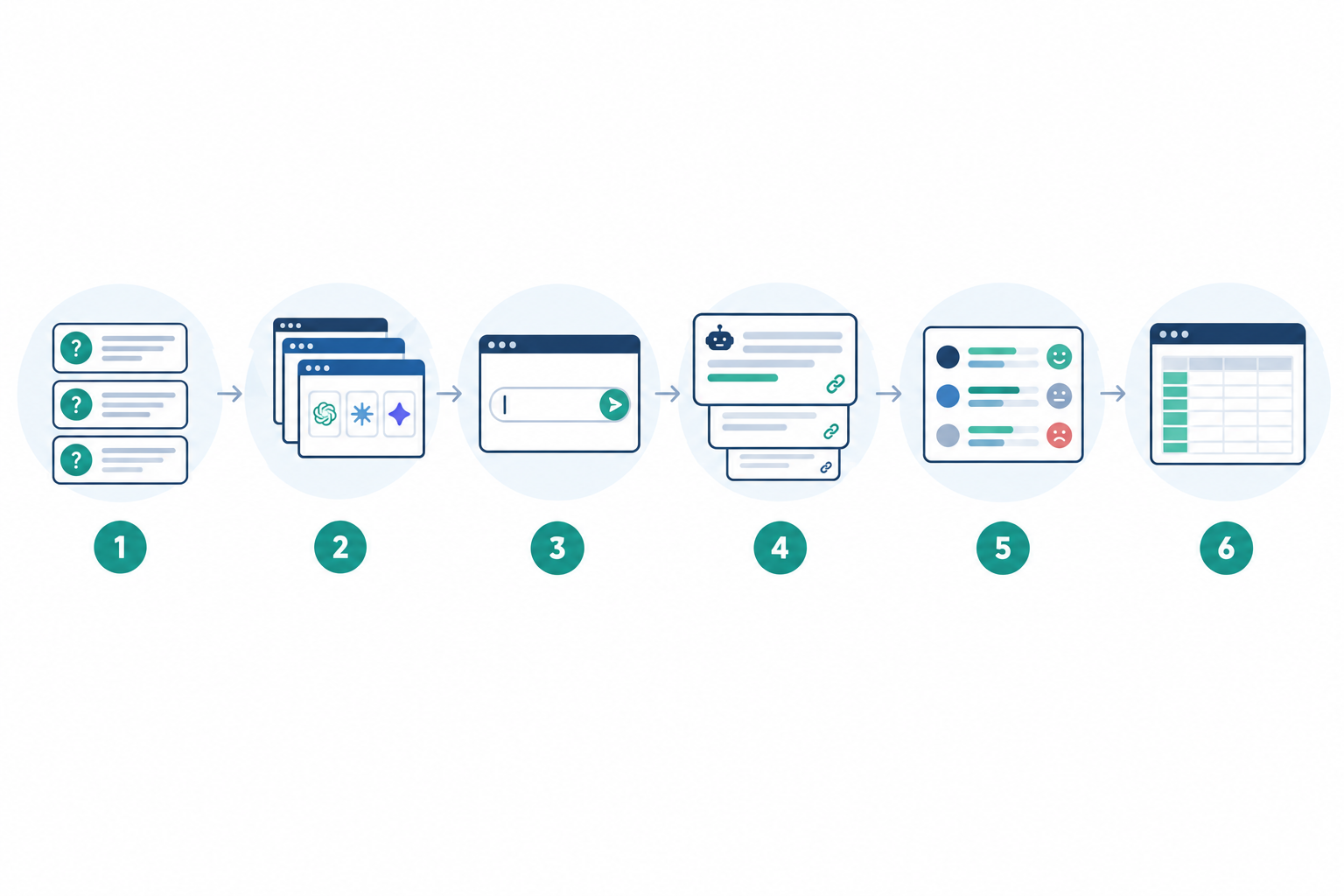
The steps themselves are simple. The friction is in the details.
Here is a worked example. Take 20 customer questions across five platforms, which makes 100 queries per round. If each query takes two to three minutes, including opening a session, reading the answer and logging it, a single round costs roughly 3.3 to 5 hours. That time estimate is an assumption, not a published benchmark, and I'd suggest timing yourself over a handful of queries before trusting any figure, mine included.
The general formula is distinct prompts × platforms × runs per prompt × checks per month × minutes per check. As a simple reference point, 25 prompts on a single platform, checked weekly at two minutes each, comes to about 3 hours 20 minutes in a four-week month. Fifty prompts takes 6 hours 40 minutes, and 100 prompts takes 13 hours 20 minutes, and that is on one platform only.
The table below applies a midpoint of 2.5 minutes per query across all five platforms, assuming a four-week month (28 rounds for daily checking).
| Questions | Queries per round | Hours per round | Weekly (4 rounds) | Twice weekly (8 rounds) | Daily (28 rounds) |
|---|---|---|---|---|---|
| 10 | 50 | ~2.1 | ~8 hrs/month | ~17 hrs/month | ~58 hrs/month |
| 20 | 100 | ~4.2 | ~17 hrs/month | ~33 hrs/month | ~117 hrs/month |
| 50 | 250 | ~10.4 | ~42 hrs/month | ~83 hrs/month | ~292 hrs/month |
| Automated tracking | Same coverage, run daily | Review only | Minutes | Minutes | Minutes |
All manual figures are illustrative estimates based on 2.5 minutes per query, not measured benchmarks.
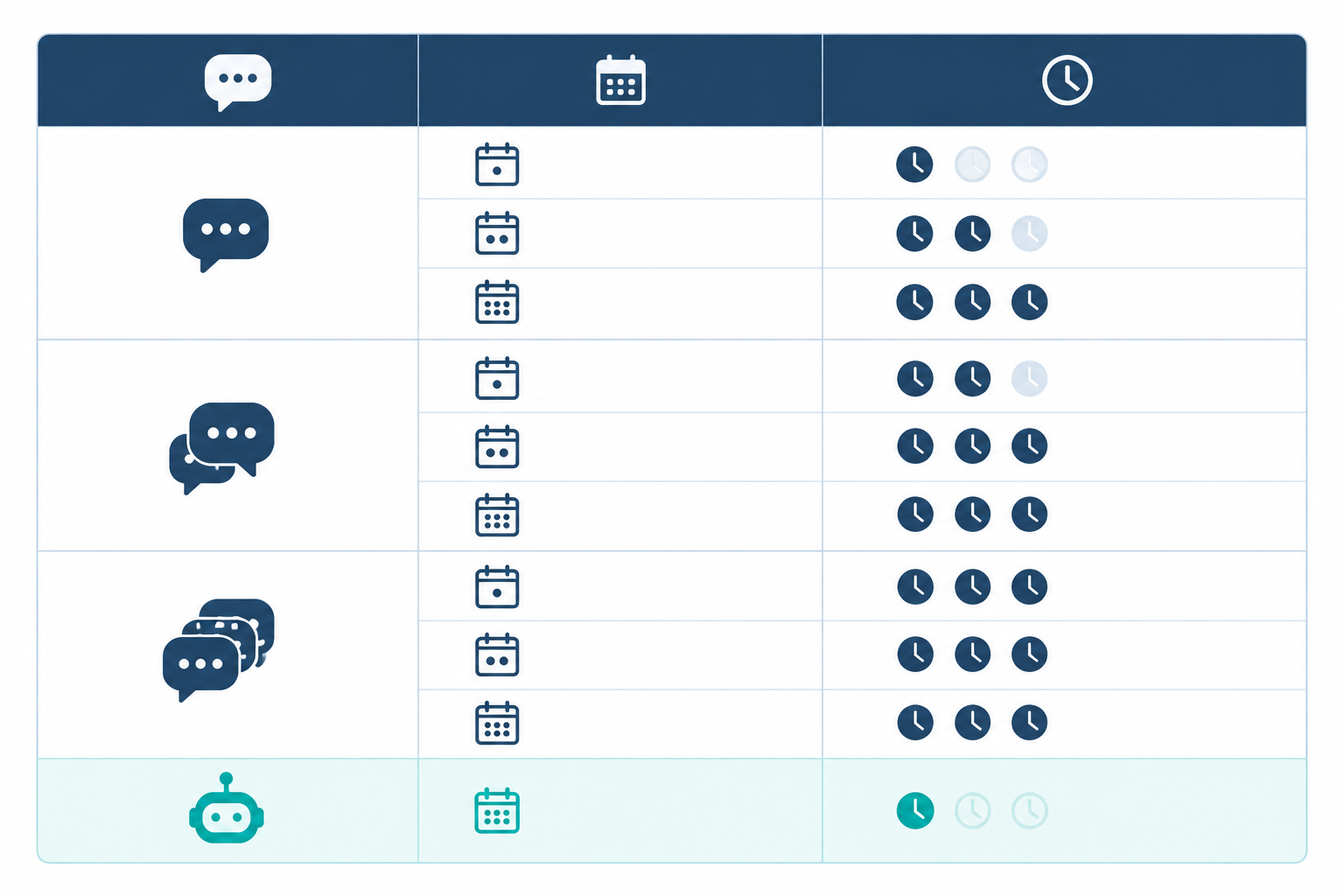
Because answers vary, a careful analyst wouldn't trust one run per query. If you run each query three times to smooth out the variability, every figure in the table triples. Twenty questions checked weekly then costs around 50 hours a month by hand. This is the point at which most manual programmes quietly stop.
An automated tool, by contrast, runs the same coverage daily, and the only founder time required is reviewing the output. I want to be explicit about one caveat: automation doesn't remove the need for judgement. You still decide which questions matter and review notable changes. What it removes is the repetitive collection and logging.
Even if you could find the hours once, sustaining them is another matter. These are the failure points I see most often:
The wider context matters too. Stanford's AI Index reported that 78% of surveyed organisations used AI in at least one business function in 2024, up from 55% the year before. Adobe separately measured a 1,200% increase in generative AI referral traffic to US retail sites between July 2024 and February 2025. Neither figure describes your particular customers, and Adobe's data is US-specific. Still, together they suggest that AI-mediated discovery is growing quickly, which increases the number of places where your brand might be described, accurately or otherwise.
Both NIST's AI Risk Management Framework and OpenAI's evaluation guidance treat monitoring as a recurring activity rather than a one-time test. The same logic applies to brand monitoring: repeatable checks on a fixed question set beat occasional impressions.
Time saved is only half the case. The other half is what manual checking can't realistically capture, however diligent you are.
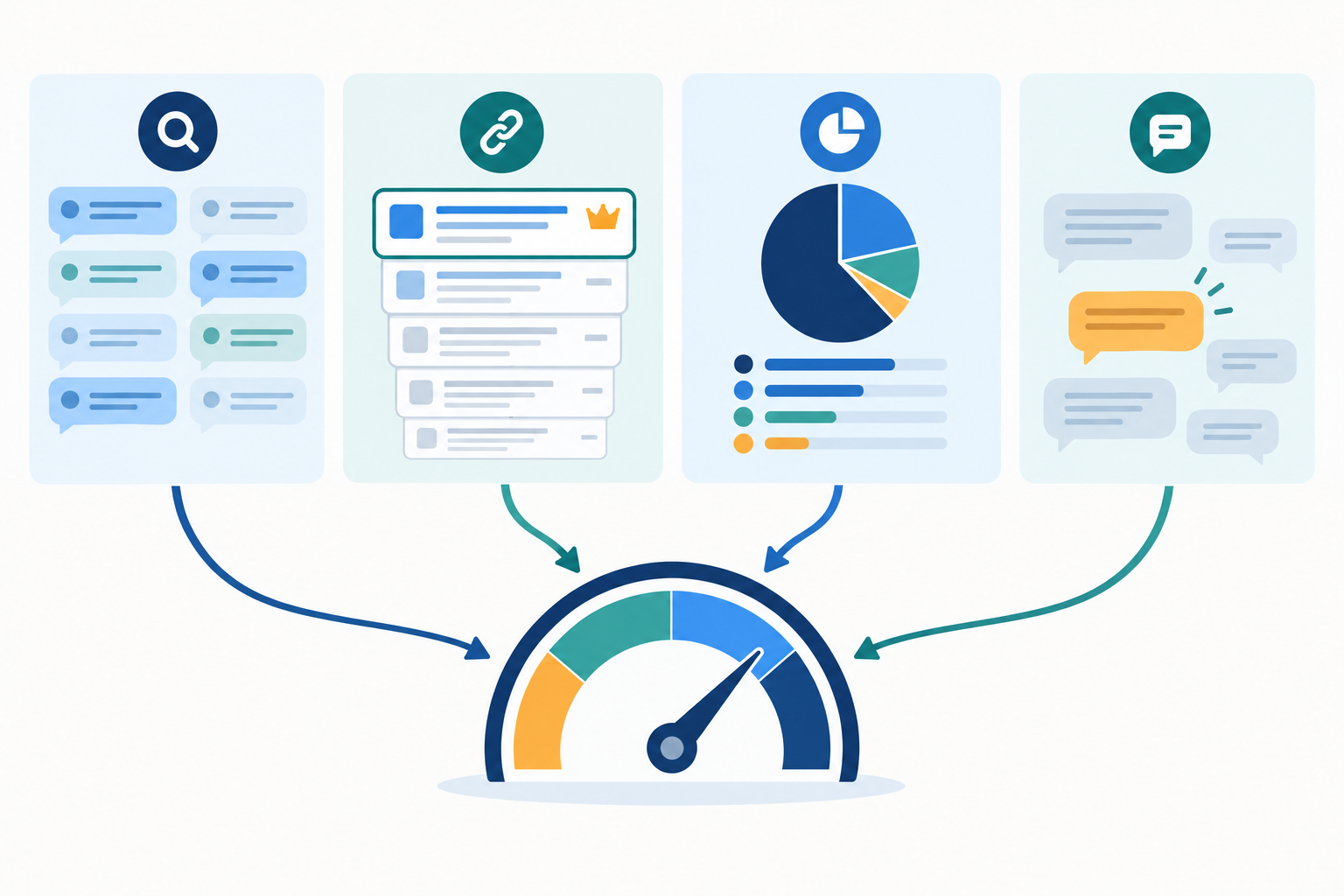
A fair caveat: no monitoring tool, ours included, guarantees comprehensive coverage of every model or every user query, and none can directly correct what a third-party chatbot says. Treat the results as well-structured sampled observations. That is exactly what makes them useful for spotting trends.
| Manual checking | Automated LLM monitoring | |
|---|---|---|
| Setup effort | Low: a spreadsheet and a question list | Low to moderate: crawl, question generation and review |
| Weekly time commitment | Roughly 4+ hours for 20 questions on five platforms (illustrative) | Minutes to read a digest |
| Platform coverage | Whatever you have time to open | ChatGPT, Claude, Gemini, Copilot, Perplexity |
| Frequency | Weekly at best | Daily |
| Question generation | Your own assumptions | Auto-generated from your website |
| Citation capture | Copied by hand, patchy | Recorded systematically |
| Competitor tracking | Ad hoc | Continuous share of voice |
| Sentiment consistency | Subjective | Applied uniformly |
| Trend reporting | Whatever your log supports | Built in, with a 0-100 score |
| Cost | Free in cash, heavy in hours | Subscription, near-zero ongoing time |
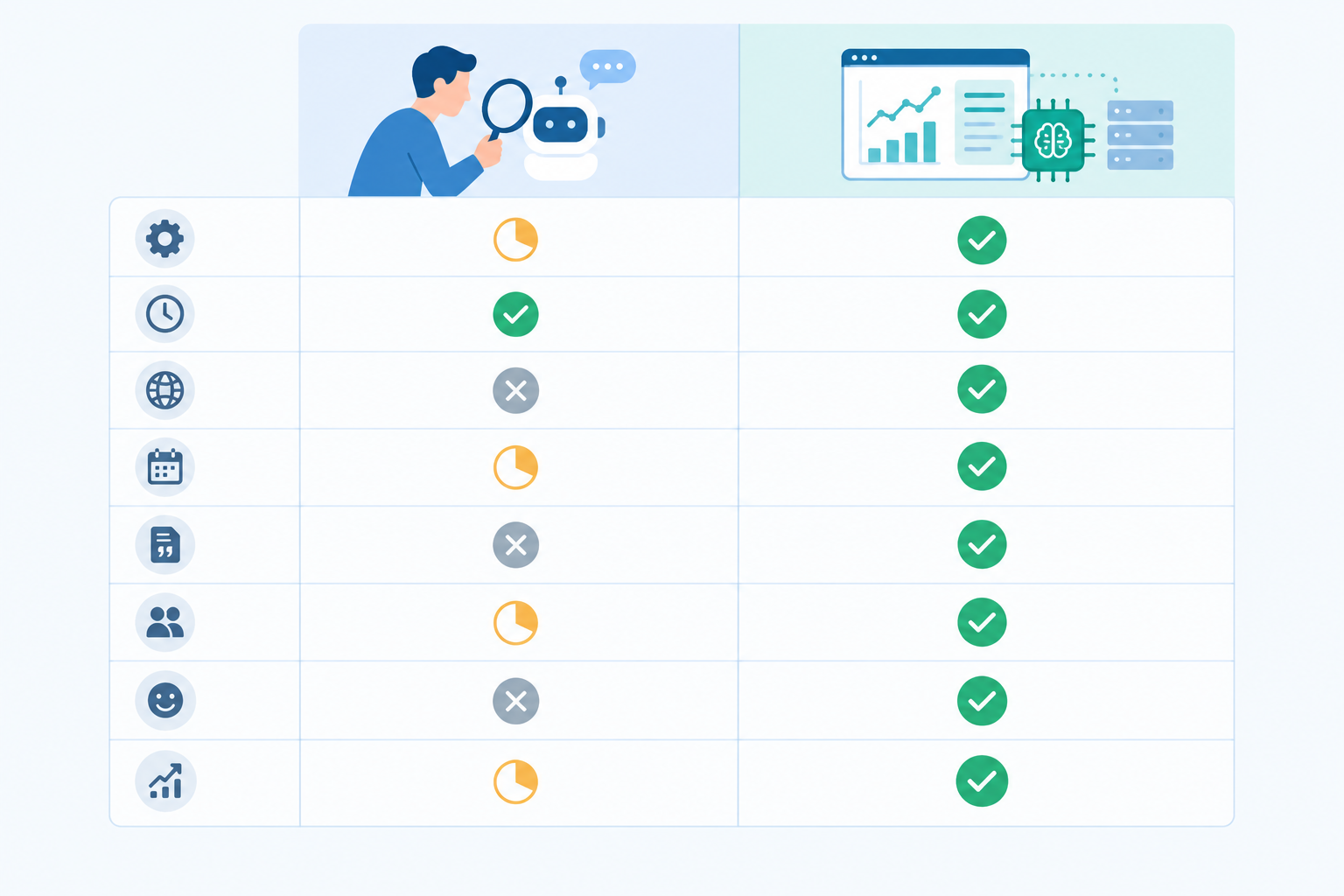
I want to be fair here. Manual checking costs nothing in cash, and it remains an excellent way to build intuition for how AI describes your market. For a one-off sanity check, it is hard to beat.
The two approaches complement each other. Use a manual check to understand the problem, then automate to measure it. NIST's guidance also stresses human oversight alongside automated monitoring, so I would keep an occasional manual spot-check even once automation is running, to catch blind spots in your question set.
Let's translate the arithmetic into hours. Take a modest scenario: 20 questions across five platforms, checked weekly, at 2.5 minutes per query. That is about 4.2 hours per round and roughly 17 hours a month. Now suppose the automated alternative costs you ten minutes each week reading a digest, about 40 minutes a month. The reclaimed time is around 16 hours a month, or roughly 200 hours a year. (A separate illustrative calculation from our research, 20 prompts across three services at three minutes each, gives a 3-hour round, reduced to a 30-minute review, saving about 2.5 hours per round. The principle holds even when the inputs differ.)
Put a value on it using your own rate. At £40 an hour, 16 hours is £640 a month. Substitute your own number, and subtract the cost of whichever tool you choose. These are scenario figures based on assumptions, and your real saving depends on your question count, frequency and how much of the output you want to verify personally.
Picture a UK freelance consultant, or a small e-commerce owner, weighing three hours a week of spreadsheet logging against a ten-minute digest. The manual route gives you a lumpy, incomplete record. The automated route gives you a daily record and leaves nearly three hours for client work, product pages or content.
The real shift is from data collection to decision-making. Reading a weekly digest takes minutes, which leaves time to act on it. You can fix a legibility issue, publish a page that answers a question where a competitor is cited, or tighten how you describe your service. That is where the value of LLM monitoring and brand monitoring really sits.
Not for everyone. A simple break-even test: (manual minutes per run minus review minutes) × runs per month ÷ 60, multiplied by your hourly value, minus the tool cost. If the result is clearly positive, automate.
It is probably worth it if:
It is probably not worth it yet if:
Here is a decision test I find useful: if you wouldn't keep up a weekly manual log for three months, automation is the more honest option.
There is also a UK angle. Buyers here often phrase questions differently ("accountant near me", "best value", "VAT-registered") and local suppliers feature in answers, so monitoring should reflect how UK customers actually ask. Check that your question set includes that phrasing and local context.
You don't need to commit heavily to find out whether this is useful.
Change one thing at a time. If you alter five things at once, you won't know which one moved the score.
You can, and it is a good way to get a first impression. However, AI answers vary between sessions, phrasing and platforms, so a single weekly check gives you an anecdote rather than a reliable trend. Automated LLM monitoring runs a consistent question set daily and records the results in a comparable format.
A meaningful set is often 20 or more customer questions across five AI platforms, which is 100 queries per round. At a few minutes each including logging, that is several hours per round, before you repeat checks to account for variability.
Mainly consistency and context: daily coverage, citation tracking, share of voice against competitors, uniform sentiment scoring, and technical checks on whether your site is legible to AI systems. These are hard to capture reliably by hand.
It is worth it if your customers use AI assistants to compare suppliers and you want evidence of whether your efforts are working without giving up hours each week. If you only want a one-off look, a manual check may be enough.
MentionOwl monitors ChatGPT, Claude, Gemini, Copilot and Perplexity, recording answers, citations, sentiment and competitor mentions.
Learn how to track ChatGPT brand mentions with daily LLM monitoring, automate customer-style questions, and measure answers, citations, sentiment and competitors.
ChatGPT answers change with prompts, models and context. Learn how LLM monitoring, repeated sampling and daily AI visibility tracking reveal reliable trends.

A practical guide for UK agencies on pitching AI visibility monitoring to clients: how to frame the problem, run a free audit, handle ROI objections a