How to Optimise Product Pages So AI Assistants Recommend Them

AI SEO for E-commerce: How to Optimise Product Pages So AI Assistants Recommend Them

AI SEO for e-commerce comes down to one principle: AI shopping assistants are more likely to recommend products whose details they can parse, verify and summarise with confidence. Complete Product schema, specific and factual descriptions, consistent specifications and credible reviews all raise your odds of inclusion. I treat this as an evidence problem rather than a copywriting one. The clearer and more corroborated your product data, the easier it is for a model to justify naming you. Then measure the results, because without tracking AI visibility across real purchase questions you cannot tell whether any of it worked. 🦉
The commercial case for AI SEO is growing. Adobe Analytics reported that traffic to US retail websites from generative AI sources rose 1,300% over the 2024 holiday season compared with 2023. That is a channel-level figure for US retail, so it does not tell us how often any given product is recommended, and it does not prove that a particular optimisation caused the increase. What it does suggest is that AI-assisted discovery is becoming a real route to purchase. UK retailers missing from AI-generated shortlists may be losing demand they never see in their analytics.
This guide sets out the product page changes I would prioritise, the reasoning behind each, and how to measure whether they have shifted your AI visibility. I separate three kinds of statement throughout: documented (stated in official guidance or published research), hypothesis (plausible, but not publicly proven for AI assistants) and our observation (what we see when monitoring AI answers). Much of the advice circulating under the banner of generative engine optimization (GEO) is stated with more certainty than the public evidence supports, and I would rather you could tell which is which.
What AI Shopping Assistants Look for on Product Pages
AI search does not simply return a ranked list of links. It compiles a shortlist and then justifies it in prose. A model asked for 'the best waterproof walking boots for wide feet' has to decide which products to name and what to say about each one. In my view, pages whose facts are easy to extract and corroborate are better placed to be described accurately, so a page needs to be easy to pull facts from, not merely easy to rank. Retrieval methods, training data and behaviour differ between platforms, so treat this as a working model rather than a law.
How AI SEO and generative engine optimization differ from traditional SEO
AI SEO and generative engine optimization (GEO) overlap heavily with traditional SEO. Crawlability, topical authority and clear content matter in both. The difference is in the output: classic SEO aims to earn a click from a results page, whereas GEO aims to get your product cited or named inside a synthesised answer. In that setting, factual clarity and independent corroboration plausibly carry extra weight, because the model is assembling an argument and needs evidence for each claim.
Here is what is documented. Google's guidance on AI features in Search does not call for special AI-specific schema or separate markup. The foundation remains eligibility for Search, helpful content and sound technical SEO. No assistant publishes a formula for product recommendations, so everything below is best practice grounded in how product data is documented, not a guaranteed ranking recipe.
The product data signals AI assistants appear to weigh
Based on Google's product data documentation and what we observe when monitoring AI answers, these inputs appear to matter most:
- Explicit attributes (documented as good practice): product name, brand, variants (such as size or colour), materials, dimensions and intended use, stated in text rather than implied by images.
- Price and availability (documented): current, consistent and visible, with delivery and returns information easy to find.
- Third-party corroboration (hypothesis): reviews, retailer listings, press coverage and forum discussion that confirm what your page claims. We often see independent sources shape how assistants describe products, but we cannot show that they outweigh your own page.
- Review sentiment (our observation): themes that recur in customer feedback sometimes surface in AI summaries.
- Brand consistency (hypothesis): using the same product names, specifications and prices across your site, marketplaces and retail partners should reduce the contradictions a model has to resolve.

Check AI crawler access before optimising product pages
None of this matters if AI crawlers cannot reach the page. Before touching copy, check three things. Your robots.txt should not block the bots you want to be visible to. Key product facts should not be locked behind JavaScript that a crawler may never execute. And no firewall or bot-protection rule should be quietly refusing legitimate requests. Run this check first, whether you use a tool or a manual checklist. (Our own product, MentionOwl, includes a 16-point AI legibility audit covering these access and rendering issues, though a manual checklist works just as well.)
Set realistic expectations for AI recommendations
Large language models are non-deterministic: ask the same question twice and the shortlist may differ. The realistic goal is a better likelihood of inclusion across many runs of many questions, not guaranteed placement on any single one.
Structured Data That Improves Product Legibility
Does product schema affect AI recommendations? It is not a proven direct lever. Google states that correct markup creates eligibility for certain search features, not a guarantee of them, and there is no public evidence that schema alone triggers an AI recommendation. What it does is reduce ambiguity, and it supports the data feeds and search indexes that many assistants draw upon. I treat it as a foundation. For context, Google's structured data case studies report that Nestlé measured an 82% higher click-through rate on pages shown as rich results than on pages that were not. That is one company's observed result in traditional search, not a controlled test, and it does not predict AI recommendation performance for your site.
Here is the sequence I would follow:
- Implement baseline Product schema. Include name, description, brand, image, SKU and, where they genuinely apply, GTIN and MPN. Google advises against inventing identifiers or substituting your own SKU for a manufacturer's code, since accurate identifiers are what distinguish your product from similar items. For products with sizes or colours, use ProductGroup markup with variesBy and hasVariant so crawlers understand which pages are variants of one base product.
- Add complete Offer details. Mark up price, priceCurrency (GBP), availability and itemCondition using supported values. Include shipping and returns information relevant to UK buyers, such as delivery times, costs and your returns window. These answer common purchase questions directly.
- Mark up reviews only where they are genuine. Use AggregateRating and Review markup only when it reflects real reviews visibly displayed on the page. Google's review snippet policies are explicit that markup must describe visible content, and misuse risks both eligibility and trust.
- Keep schema in sync with the visible page. If your markup says a product is in stock at £89 while the page shows £99 or 'out of stock', you have created a contradiction that undermines confidence in both sources. Where prices change through promotions or personalisation, test that markup updates at the same moment.
- Validate your schema and align product feeds. Run pages through Google's Rich Results Test and the Schema.org validator, then confirm that your Merchant Center feed carries the same title, price, availability and identifiers. Google recommends combining on-page structured data with a feed where possible.
One implementation detail deserves emphasis: render schema server-side wherever possible, so it is present in the initial HTML. Crawlers that do not execute JavaScript will otherwise see none of it, and schema injected late by a tag manager is a common reason audits find 'implemented' markup that machines cannot read.
Writing Product Descriptions AI Can Summarise Well
What makes a product description AI-friendly? In my view, it is specific, self-contained and factual, with answers to likely buyer questions stated plainly. These are practical formatting recommendations rather than published selection rules, but the logic is simple: the more cleanly a fact sits on your page, the easier it is for any reader, human or machine, to repeat it correctly.
The principles I apply:
- Lead with a one or two sentence summary stating what the product is, who it suits and its main differentiator. Shoppers and machines alike find key facts fastest when they come first.
- Replace vague claims with measurable ones. 'Premium quality' tells a reader nothing, while materials, dimensions, capacity, battery life and certifications give them something to verify.
- Write for the questions customers actually ask, such as 'best waterproof walking boots for wide feet', and address use cases, limitations and comparisons honestly.
- Use descriptive headings, short paragraphs and consistent terminology, so that a passage keeps its meaning when lifted out of context. Calling the same feature three different names across a page invites confusion.
- State who the product is not for. Balanced detail makes a recommendation more credible and reduces mismatches, which in turn reduces returns.
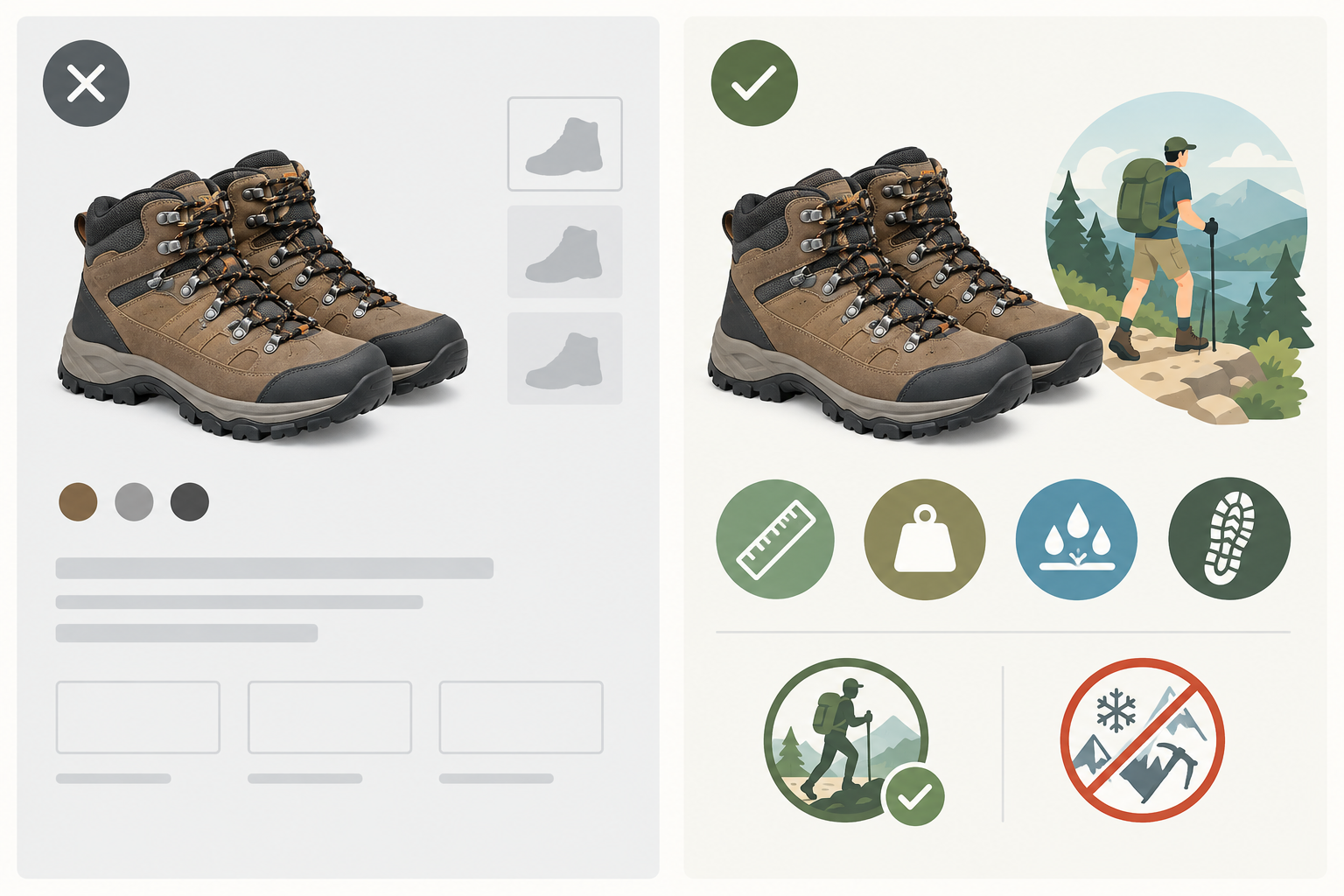
Before-and-after example of an AI-friendly product description
Before: 'Our premium walking boots are built for adventure. Superior comfort and outstanding quality for every trail.'
After: 'The Fellrunner Waterproof Walking Boot is a full-grain leather boot for day walks and multi-day hikes on UK hill and moorland paths. It is available in standard and wide fits (UK sizes 6 to 13), uses a Gore-Tex membrane, weighs 890g per boot and has a Vibram outsole. It suits walkers who need ankle support and a wider toe box. It is not designed for technical scrambling or for temperatures well below freezing. Delivery is free over £50, with 30-day returns.'
The second version is longer, but every sentence carries a verifiable fact, and it answers 'who is it for?' and 'who is it not for?' without prompting. (The product and figures are illustrative.) For large catalogues, a leaner template works: one summary sentence, a specification table, a 'best for' line and a 'not suited to' line.
Reviews and Specs That Influence AI Product Recommendations
Do customer reviews matter for AI shopping picks? I need to be careful here. Neither Google's documentation nor the wider public record establishes that a particular review count or star rating directly causes an assistant to recommend a product. What the evidence does show is that reviews strongly shape human purchase decisions. PowerReviews' consumer research found that 99.9% of surveyed shoppers read reviews at least sometimes, and 98% described them as an essential resource. When an assistant draws on review content, as we sometimes see in the descriptions it generates, reviews can become source material for what it says about you. That is a reasonable mechanism, not a proven universal effect.
The Spiegel Research Center found that displaying reviews was associated with a 270% increase in purchase likelihood, rising to 380% for higher-priced products. It also found that purchase likelihood generally peaked between 4.0 and 4.7 stars rather than at a perfect 5.0, since flawless scores can look less credible. That research concerns shopper behaviour, not AI behaviour, but I suspect one lesson carries over: authentic, mixed evidence is more persuasive than polished perfection.
Where product specs, reviews and third-party sources contribute
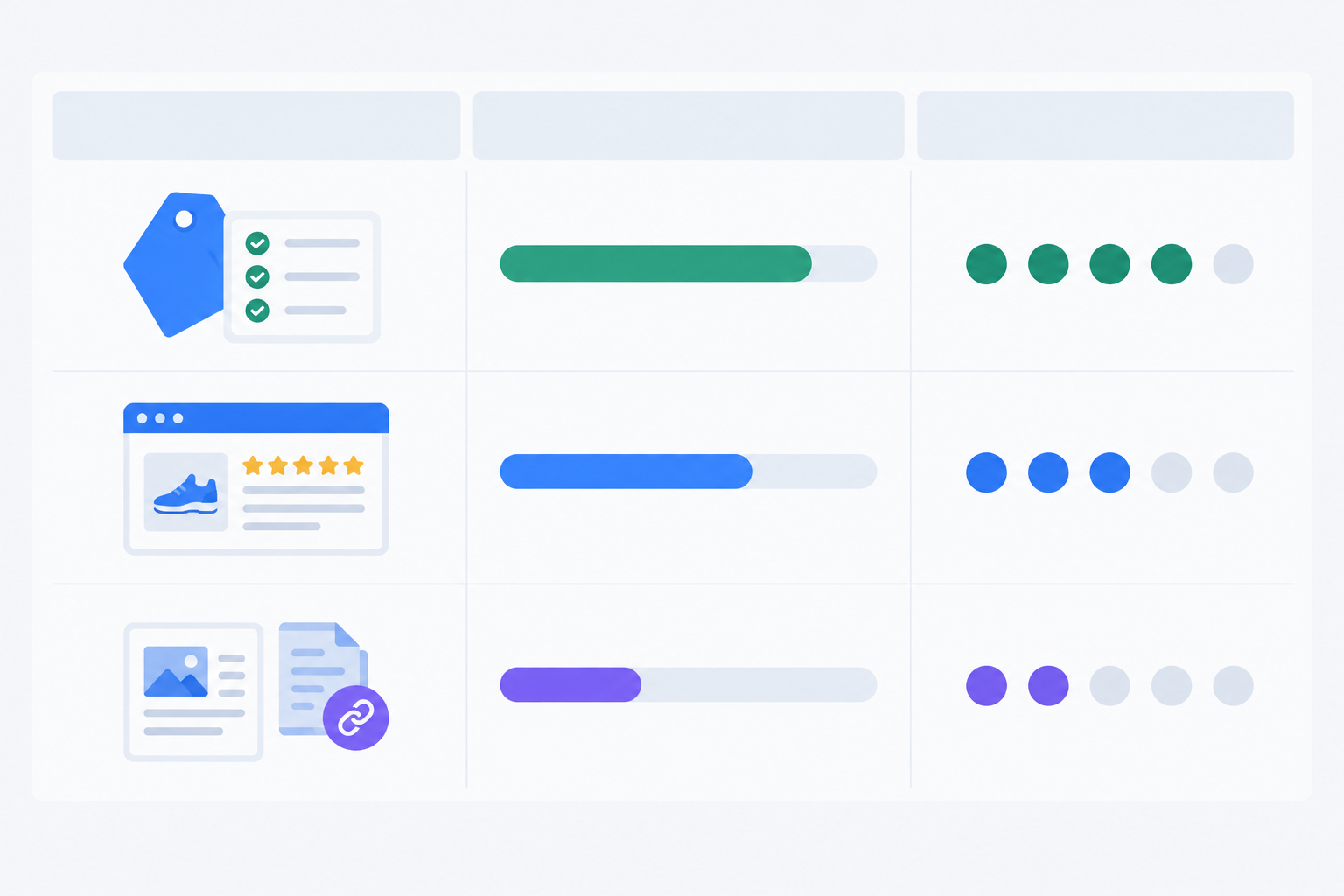
| Source | What it contributes | Your control | Plausible influence on AI picks (hypothesis) |
|---|---|---|---|
| On-page specs | Explicit, comparable attributes with units | High | Helps match a query to your product |
| First-party reviews | Experience-based detail, volume and recency on your own site | Medium (you collect, but cannot edit) | Useful, particularly when marked up honestly and visible |
| Third-party sources (review sites, forums, press, marketplaces) | Independent corroboration and sentiment | Low | May carry substantial weight as outside validation, though this is not publicly proven |
In practice, you control the first row completely, influence the second, and can only earn the third. A sound strategy invests in all three.
Present product specifications consistently
Use a clean table with units and consistent naming across variants. State battery capacity and estimated runtime separately instead of writing 'long-lasting battery', and include model or variant, compatibility, dimensions, materials, included accessories and relevant limitations. If the 500ml variant is called 'Large' in one place and '0.5L' in another, you are making any reader's job harder.
How to earn more useful customer reviews
- Prompt for specifics. Ask reviewers about use case, fit and durability, not just a star rating. A review saying 'wore these for a week on the Pennine Way, no rubbing on a wide foot' is far more useful than 'Great boots, 5 stars'.
- Respond to negative reviews constructively. Recurring complaints can surface in AI summaries, so acknowledging and resolving them matters.
- Stay on the right side of the rules. The US FTC's Consumer Reviews and Testimonials Rule, effective 21 October 2024, prohibits fake reviews and conditioning incentives on sentiment. UK consumer law, strengthened by the Digital Markets, Competition and Consumers Act, takes a similarly firm line. Manipulated ratings are a legal risk and an unreliable strategy.
- Keep your brand consistent. Use the same product name, specifications and pricing across your site, retailers and marketplaces, so every source tells the same story.
Tracking Whether Product Page Changes Improve AI Visibility
How do you know whether your changes worked? Conventional rank trackers cannot tell you, because there is no fixed results page to rank on. You have to monitor the AI answers themselves, and because those answers vary, method matters more than tooling.
- Build a fixed set of real purchase-intent questions. Cover your category, individual product types and competitor comparisons, phrased as customers would phrase them. Keep the wording identical from run to run so results are comparable.
- Standardise recording conditions. Answers can differ by platform, model version, logged-in account, personalisation, location and whether web search is enabled. Record these settings, use the same ones each time, and test from UK locations since that is your market.
- Run each question multiple times. Because the same prompt can return different shortlists, run each one at least five times per platform per measurement period and report a rate (for example, 'named in 6 of 10 runs') rather than a yes or no. Platforms to cover include ChatGPT, Gemini, Perplexity, Copilot and Claude.
- Record a baseline over two to four weeks before changing anything. This shows you how much your visibility moves naturally, which is the yardstick for judging any later change.
- Log the right fields. A simple spreadsheet is enough to start:
| Prompt | Platform | Run date | Run no. | Brand named? | Position in answer | URL cited | Source type | Sentiment |
|---|---|---|---|---|---|---|---|---|
| Best waterproof walking boots for wide feet | Perplexity | 3 Mar | 1 | Yes | 2nd of 4 | Our product page | First-party | Positive |
| Best waterproof walking boots for wide feet | Perplexity | 3 Mar | 2 | No | n/a | n/a | n/a | n/a |
(Illustrative rows.) Add share of voice against named competitors by counting how often each brand appears across all runs.
- Change one variable group at a time, and hold some products back. Update schema first, then descriptions, then reviews, allowing time for re-crawling between each. Better still, leave a comparable set of products unchanged as a control group. Even then, sequencing does not prove causation. Platforms update models, retrieval sources and answer behaviour without notice, and seasonality or competitor activity can move results too. If the changed products improve while the controls do not, across several weeks, you have reasonable (not conclusive) evidence.
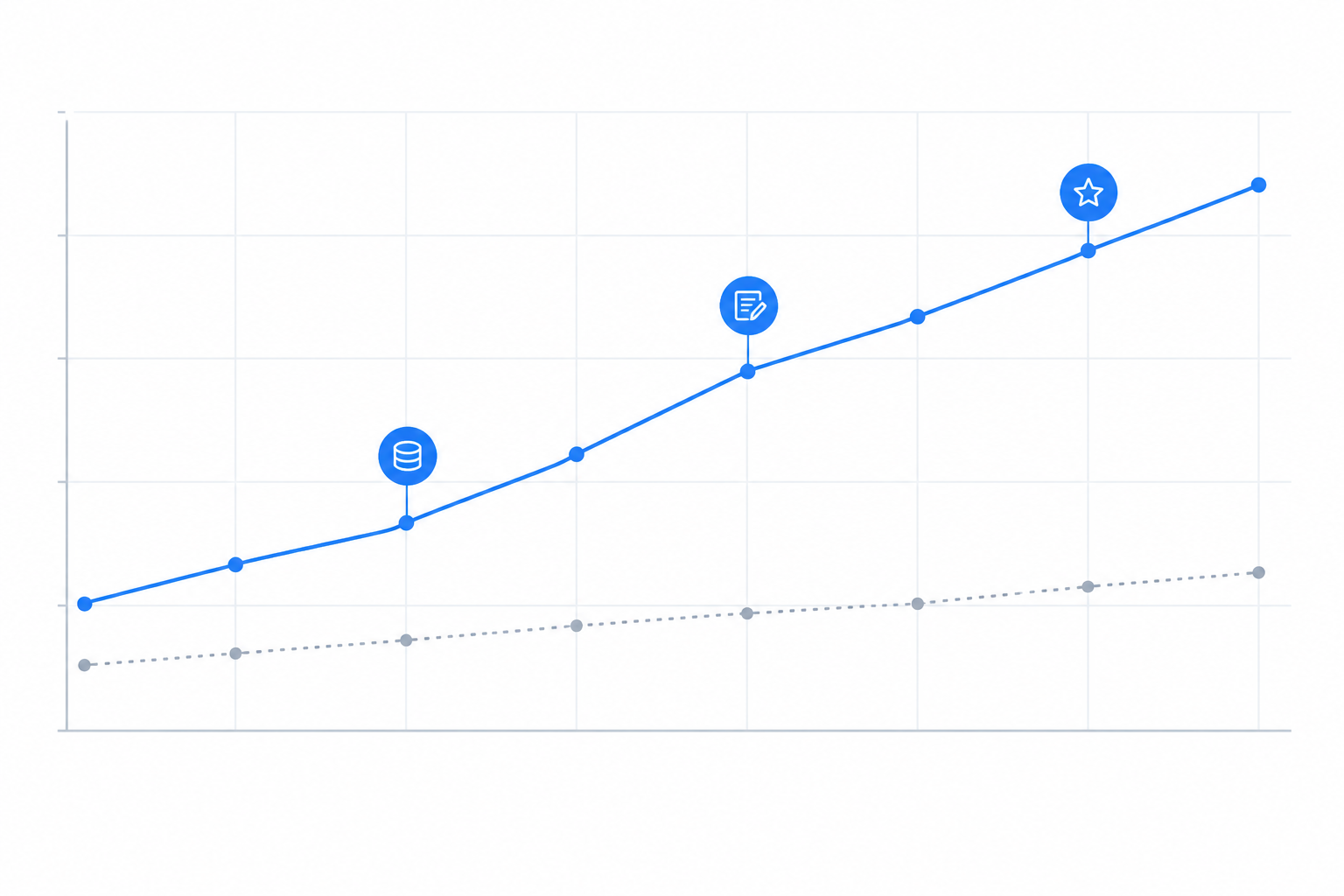
How to track AI SEO at scale
Doing this by hand across five platforms is laborious, which is the problem we built MentionOwl to solve (disclosure: it is our product, so weigh this section accordingly). It crawls your website, generates customer-style questions from it, runs them on a schedule against major AI platforms and records the answers, citations, sentiment and competitor mentions. It condenses these into a 0 to 100 visibility score built from query coverage, position-weighted citations, share of voice and soft mentions. That score is a descriptive index of how visible you are across the questions tested. It does not show why visibility changed, and it is only as representative as the question set behind it. Its cookieless AI traffic analytics aim to show whether visibility is turning into visits, which is the question your finance director will ask. You can read the full methodology on the MentionOwl site. Whether you use a tool or a spreadsheet, the same discipline applies.
The same monitoring doubles as competitor tracking. Seeing which rivals appear in answers where you do not, and what assistants say about them, can point you to the attribute, review theme or third-party source you are missing.
A Prioritised 30-Day AI SEO Checklist for E-commerce
Trying to fix an entire catalogue at once is a reliable way to learn nothing. I recommend starting with your ten highest-revenue products:
- Week 1, audit access and markup: check crawler access, rendering and schema validity on your top ten products, and start your baseline logging across the five assistants.
- Week 2, rewrite content: rewrite descriptions and build specification tables for those products, following the structure above.
- Week 3, strengthen corroboration: improve review collection prompts, build your presence on third-party sources, and align feeds and marketplace listings so names, specifications and prices match.
- Week 4, compare and decide: compare against your baseline and any control products, note which changes coincided with movement, and decide what to roll out catalogue-wide. Thirty days is short for a clean reading, so keep logging for several more weeks before drawing firm conclusions.
There is a measured argument for acting now. AI search is still forming its habits about which sources it cites, and brands that publish clear, corroborated product data early may be better placed. I cannot promise that advantage will hold. But the work involved (accurate data, honest copy, genuine reviews) also helps conventional search and human shoppers, so the downside is small.
Key takeaways for AI SEO product pages
- Make sure AI crawlers can access and render your product pages before anything else.
- Use accurate, server-rendered Product and Offer schema that matches the visible page. It is a foundation, not a guaranteed lever.
- Write specific, measurable descriptions that state who the product is and is not for.
- Collect detailed, genuine reviews and keep product data consistent across every channel.
- Measure with a fixed prompt set, repeated runs, a baseline and control products, and judge trends over weeks.
Frequently Asked Questions About AI SEO for Product Pages
Does my product schema affect AI recommendations?
There is no public evidence that schema alone triggers a recommendation. Accurate Product, Offer and Review markup does remove ambiguity, though, and it lines up with the structured sources and indexes many assistants rely on. Treat it as a foundation rather than a guarantee.
What makes a product description AI-friendly?
Specific, factual and self-contained: a clear opening summary, measurable attributes, consistent terminology, and honest statements about who the product suits and who it does not. This is best practice rather than a published rule.
Do customer reviews matter for AI shopping picks?
They may. When an assistant draws on review content, reviews can inform how it describes or compares products, and detailed reviews that mention specific use cases give it more to work with. Public evidence does not establish a universal or direct effect of review count or rating on recommendations, however. Treat reviews as useful source material and a proven driver of human purchase decisions, not a guaranteed ranking factor.
How do I know if my changes worked?
Track a fixed set of purchase-intent questions across platforms, run each several times, and compare against a pre-change baseline and unchanged control products. Judge trends over weeks rather than single answers.
How long does it take for product page changes to show up in AI answers?
It varies by platform. Assistants with live retrieval, such as Perplexity, can reflect changes within days, while others depend on re-crawling or model updates. Track results over several weeks and compare against your baseline.
Is generative engine optimization different from traditional SEO?
They overlap considerably, since both reward crawlable, authoritative and clear content. The difference is that generative engine optimization focuses on being cited or named inside a synthesised answer, so factual clarity and third-party corroboration plausibly carry extra weight.
Related Articles

A Technical Guide to AI Legibility Audits for SaaS Sites
Learn how to run an AI legibility audit on your SaaS site. Fix SPA rendering, gated docs and structured data so AI crawlers can read your product and

Simple Ways Small Businesses Can Improve AI Recommendations: A Practical UK Guide
Wondering if ChatGPT or Gemini recommends you over local rivals? Here are five low-effort, non-technical ways UK small businesses can improve their AI

Create content like this automatically
Scribe uses AI to generate high-quality blog posts that engage your audience and drive traffic.