Preparing Your E-commerce Support Team for Holiday Traffic: A Complete Checklist
20 min read
Loading...

I say a version of this every year around this time, and it holds up every single time: the brands that survive the holiday rush without losing their minds (or their best support agents) are the ones who started planning eight to ten weeks before their first major promotion, not the week of Black Friday.
Here's the short version: preparing for holiday customer support means forecasting your volume increase early, staffing up without per-seat pricing penalties, prepping canned responses for repetitive questions, and optimising live chat coverage during peak hours. The brands that come out ahead every December aren't the ones with the biggest teams—they're the ones who planned ahead, built in a buffer for the unexpected, and chose tools flexible enough to add seasonal help without a renegotiation.
Before we get into the detail, here's the whole plan on one screen. Bookmark this bit—and note that each phase has an owner and a deadline in your own calendar, not just a rough week.
8–10 weeks out
4–6 weeks out
1–2 weeks out
Post-holiday (January)
Now let's walk through each piece properly.
Forecasting isn't the most exciting part of holiday prep, but it's genuinely the foundation everything else sits on. Get this wrong, and no amount of canned responses or extra agents will save you.
Start with your own history. Pull last year's ticket volume broken down by week, and pay attention to your actual peak days: Black Friday, Cyber Monday, and whatever your final "order by this date" shipping cutoff was. These are distinct demand spikes that behave differently from one another, so treat them as separate events rather than lumping them into one big "holiday season" number.
A useful starting point: forecast contacts = forecast orders × your expected contact rate. Say you typically get one support ticket for every 20 orders, and marketing is projecting 3x your normal order volume for Black Friday weekend. That gives you a rough starting estimate of 3x your normal ticket volume too. But don't stop there—this simple formula misses several things that matter a lot in practice:
Here's a rough worked example for a UK-based shop: say you normally get 40 weekly tickets, run at a 1-in-20 contact rate, and expect Black Friday week orders to triple. That's roughly 120 tickets for the week as a baseline—but add in the new-customer effect, a promo code that's slightly confusing, and a contingency buffer, and you might reasonably plan for 150–160 tickets instead. That's the kind of adjustment a flat multiplication misses.
On industry-wide numbers: you'll sometimes see e-commerce ticket volume estimated at 2 to 4 times normal baseline during major sales weekends. Treat that as a loose, illustrative range to sanity-check your own numbers against—it isn't a guarantee, and I haven't seen a single authoritative source that applies evenly across store sizes and sectors. Your actual multiplier depends heavily on your promotions, your typical customer base, and how smoothly your fulfilment holds up. Your own historical data is always the better source of truth.
Knowing your expected ticket count only gets you halfway there. The real question is how many agent hours that translates into, and that depends on average handling time and how much of each shift agents can realistically spend on tickets (their "occupancy"—nobody works at 100% productive capacity for eight straight hours).
A workable formula: required agent hours = forecast contacts × average handling time ÷ productive occupancy.
Say you're expecting 160 email tickets for the week, each taking an average of 8 minutes to resolve, and you plan for agents to spend about 75% of their shift actively working tickets (the rest goes to breaks, training, and admin). That's 160 × 8 minutes = 1,280 minutes, or about 21.3 hours of pure handling time. Divide by 0.75 occupancy and you need roughly 28.4 agent hours that week just for email—call it four agents on standard shifts, with some room to spare.
Do this separately for each channel. Live chat behaves differently because agents can often run two or three conversations at once (concurrency), which changes the maths, and because customers expect a much faster first response—commonly within a few minutes rather than hours. If you're setting a service-level target (say, respond to 80% of chats within 3 minutes), build your chat staffing around that target specifically, not just a raw ticket count. Email can tolerate slower response times, but even there, a growing backlog compounds fast if you're consistently understaffed by even one person.
And here's the part that catches people off guard every year: your support surge doesn't end when the shopping does. Returns, exchanges, delivery-status questions, and damaged-order claims create a second wave that often peaks well into January. Don't build a forecast that stops at Cyber Monday and calls it done.
A few more things worth factoring in:
If you're a UK-based or cross-border store, don't just borrow a US holiday calendar and apply it blindly. A few things worth building into your plan specifically:
Use your own history first, then layer in broader market trends and courier announcements as a sanity check, not the main input.
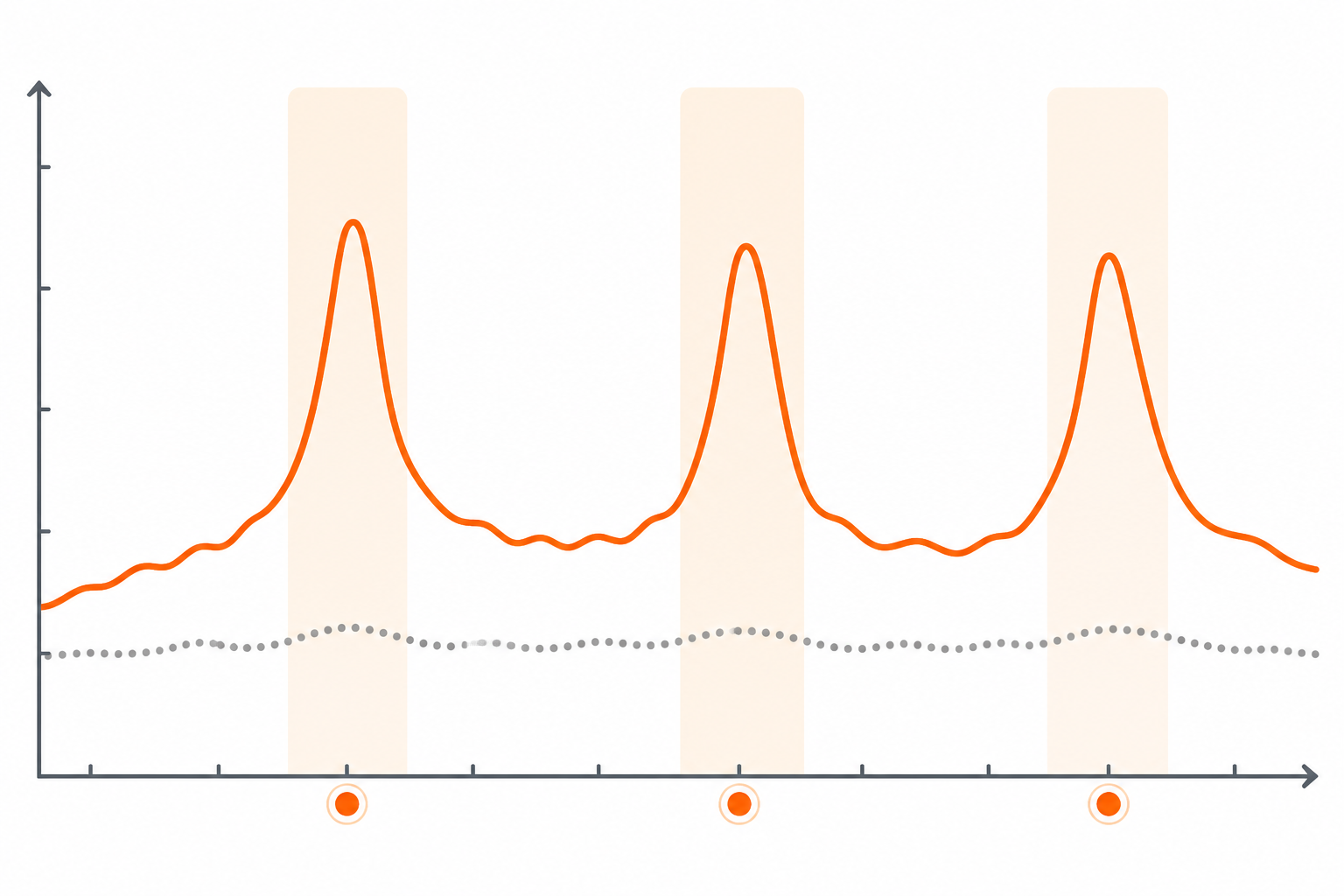
Here's a genuine frustration for a lot of e-commerce teams: many help desk tools charge per seat. So right at the moment you need more hands on deck, your software bill jumps too.
Think about it practically. You need five extra people to handle the Black Friday rush. With per-seat pricing, that's five new licences, and depending on the provider and plan tier, those costs add up fast—enough that a "quick seasonal fix" can turn into a line item finance wants to talk about. Always check current pricing directly with any vendor you're considering, since plans and tiers change.
Flat-rate pricing is one way some teams sidestep this specific cost. Tools like Sonny offer a fixed monthly fee for unlimited agents and unlimited conversations, so the price doesn't move whether you have three people answering tickets or twenty. Other help desks offer similar flat-rate or generous-tier structures, so it's worth comparing a few options against your actual seasonal needs rather than assuming one model fits everyone. Whichever route you go, seat cost is only one part of the total cost of seasonal staffing—you'll still need to budget time and money for recruiting, training, scheduling, and supervising whoever you bring on.
When you're comparing tools for this specific use case, a few questions matter more than the pricing page:
So what does adding seasonal support actually look like in practice? A few common approaches:
A quick checklist for onboarding a seasonal agent, regardless of which tool you use:
Worth being clear: unlimited seats don't automatically mean unlimited capacity. You still need to think through training time, permissions, and quality control. Adding agents solves the headcount problem, not the "are they answering correctly, and are they authorised to do what they're doing" problem—both matter, and the checklist above covers the second one.
Once you know roughly how many agents you'll need, the next question is: what will they actually be answering, over and over again? It's usually the same handful of questions, repeated hundreds or thousands of times.
The holiday questions that show up like clockwork every year:
Build your saved reply library before any of this hits, not mid-crisis. Here are a few starter templates you can adapt (fill in the bracketed fields)—and note where a template should stop short of a promise an agent can't actually guarantee:
Shipping deadline: "Thanks for reaching out! To arrive by [date], your order needs to be placed by [cutoff date/time, UK time]. We're using [courier] for delivery, and you can track your order here: [tracking link]." (Only confirm a delivery date you can actually stand behind based on current courier performance—if couriers are running behind, soften this to an estimate.)
Delayed order: "I'm sorry for the delay—[courier] is experiencing higher-than-usual volume this time of year. Your latest tracking update shows [status]. If it hasn't moved by [date], please reply here and we'll investigate directly." (Escalate to [escalation contact] if there's no movement after [X] days.)
Return after Christmas: "No problem at all. Items purchased between [start date] and [end date] can be returned until [extended return date]. Here's how to start your return: [link]."
Promo code issue: "Sorry about that! Could you confirm the exact code and the items in your basket? A few common reasons codes don't apply are [expired date / excluded items / minimum spend]." (Agents should only apply a manual discount up to [authorised limit]—anything above that goes to [escalation contact].)
Tag these by category (shipping, returns, promotions, gifts) and by authority level, so every agent—whether they've been with you for years or started yesterday—knows both what to say and what they're allowed to actually do about it.
This is also where a knowledge base pays off. If customers can self-serve answers to "where's my order" or "what's your return policy" without opening a ticket, that deflects volume before it hits your inbox at all. Make sure your holiday-specific content covers delivery dates, tracking, returns, exchanges, cancellations, promotions, and gift cards—generic FAQ pages tend to miss the seasonal specifics customers actually search for in November and December, including UK-specific details like extended Christmas return windows and courier cutoff times.
Here's something that trips up a lot of teams: they staff live chat during normal business hours, but holiday shoppers don't shop on a 9-to-5 schedule. Look at your own historical data and you'll likely find peak hours skew toward evenings and weekends, especially during big sales events when people are browsing after work or scrolling deals on a Saturday morning.
Once you know your real peak windows, staff around those instead of your usual hours. This might mean shifting a couple of agents to an evening shift for the two weeks around Black Friday and Cyber Monday, even if that feels unusual for your normal operation. A reasonable starting target: aim for a first response within 2–3 minutes during your peak chat windows, and have a clear offline message with an email fallback for hours you can't cover live.
Build in an overflow plan for when chat volume exceeds what your staffed agents can handle in real time—a queue message that sets an honest wait-time expectation, a threshold at which new chats route to a callback or email form instead, and a clear rule for when someone gets pulled in from another channel to help. Without this, your best-case scenario (fast responses) can collapse into your worst-case scenario (long queues with no communication) the moment traffic spikes past your forecast.
A well-staffed live chat widget may also help reduce cart abandonment, since a shopper who's unsure about sizing, shipping timing, or a promo code might simply leave if there's no quick way to ask. That's a reasonable hypothesis, not a guaranteed outcome—the effect varies by store, traffic source, and price point. If you want to test it properly, compare conversion rates on sessions where a chat was initiated versus similar sessions where it wasn't, over the same time period, and see what your own data actually shows.
During your highest-traffic windows, proactive chat messages help set expectations too. Something as simple as "Thanks for shopping with us today! Response times may be a bit longer than usual due to high order volume" manages customer patience before frustration sets in.
And because holiday shifts often mean agents handing off mid-conversation—someone starts a chat at 5pm and the evening person picks it up at 8pm—internal notes and team collaboration features become genuinely useful. A quick internal note like "customer asked about delayed shipment, already offered 10% discount" saves the next agent from asking the customer to repeat themselves, which makes a noticeable difference in how professional your support feels during a hectic season.

Once the dust settles—usually sometime in January when the returns wave finally slows down—resist the urge to just move on. This step is easy to skip when everyone's exhausted, but it's where next year's plan actually gets built.
For each metric below, don't just record the number—compare it to what you forecast, work out the variance, note the likely root cause, and write down one concrete action for next year. A simple table works well: Metric | Forecast | Actual | Variance | Root cause | Next-year action.
A few more things worth doing while it's fresh:
The brands that get noticeably better at holiday support each year aren't reinventing their approach from scratch every autumn. They're building on real data from the year before, tweaking their forecasts, refining their canned responses, and adjusting their staffing calendar based on actual bottlenecks rather than guesswork.
The strongest teams work backwards from a timeline: forecasting starts 8–10 weeks before their first major promotion, staffing and canned responses get finalised 4–6 weeks out, and live chat coverage gets locked in during the final 1–2 weeks. The common thread is that none of it happens the week of Black Friday—it's spread out deliberately, with sign-offs and deadlines at each stage, so no single week becomes a scramble.
Seat cost and total staffing cost aren't the same thing. Flat-rate pricing (a fixed monthly fee for unlimited agents, offered by some help desk tools) removes the per-seat penalty specifically, so bringing on five or ten seasonal helpers doesn't necessarily change your software bill—check the specific plan you're on, since terms vary by provider. Either way, you'll still have real costs around recruiting, training, and managing those agents, so flat-rate pricing solves one part of the seasonal staffing puzzle, not the whole thing.
Shipping deadlines top the list, followed by order tracking once delays start happening. Returns and exchanges spike right after the holidays—UK retailers should also expect a possible Boxing Day bump on top of the broader January wave, though the size varies by category. Gift-related questions and promo code troubleshooting round out the list throughout the sales period.
There's no single reliable industry figure here—you'll sometimes see ranges like 2 to 4 times normal baseline cited as a rough planning benchmark, but treat that as a loose sanity check rather than a forecast. The more reliable approach is to calculate it yourself: take your own historical contact rate (tickets per order), multiply by your expected order volume for the period, then adjust upward for new-customer effects, promotion complexity, and a contingency buffer sized to how confident you are in the underlying numbers.
Getting ready for holiday customer support isn't about predicting the future perfectly—it's about building enough flexibility into your team, your permissions, and your tools that whatever happens, you can adjust without panic. Forecast early, staff smart, prep your responses with clear authority limits, and pick tools that let you scale up without your costs—or your risk—scaling right alongside them. Your December self will thank you. 🎄

Managing support for multiple storefronts? Learn how to set up a multi-brand shared inbox with proper routing, separate reporting, and easy scaling —

Per-agent pricing quietly discourages hiring and hurts customer experience as you scale. See real cost comparisons and learn what to look for instead.

Learn how customer support software helps e-commerce teams cut response times with tagging, canned replies and AI—without hiring more agents.