AI Mentions Aren't Enough: Why Sentiment Determines Whether AI Recommends Your Business

AI Mentions vs AI Visibility: Why Being Named Isn't Being Recommended
A mention isn't the same as an endorsement, and treating the two as interchangeable is the most common measurement mistake I see UK small businesses make when they start tracking AI mentions and AI visibility. Being named by ChatGPT, Gemini or Perplexity tells you that you exist in a model's answer. It tells you nothing about whether that answer actually moves someone toward choosing you.
In plain terms: a business can appear in every relevant AI answer for its sector and still be losing the comparison, because the language surrounding that mention is doing quiet, cumulative damage. This post breaks down why that happens, how to tell the difference between an AI mention and a genuine recommendation, and how to monitor your visibility without turning the exercise into guesswork.
A note on the data behind this piece: Several claims below draw from an internal review of 412 AI-generated answers across 94 MentionOwl client accounts, collected between March and September 2024 — roughly 40% home services, 35% professional services and 25% hospitality, mostly UK regional markets (Leeds, Bristol, Manchester, Cardiff, Edinburgh). Two human reviewers classified each answer against a working rubric, with inter-rater agreement of roughly 82% on a spot-check sample; disagreements went to a third reviewer. The same business or query could appear more than once in the dataset, so this isn't a randomised, one-entry-per-business sample, and it isn't independently peer-reviewed. I'm also writing this from inside MentionOwl, so treat the data as a transparent internal signal rather than neutral third-party research. Roughly a third of the mentions we logged were neutral or negative rather than genuinely favourable — a pattern worth taking seriously, not a universal statistic.
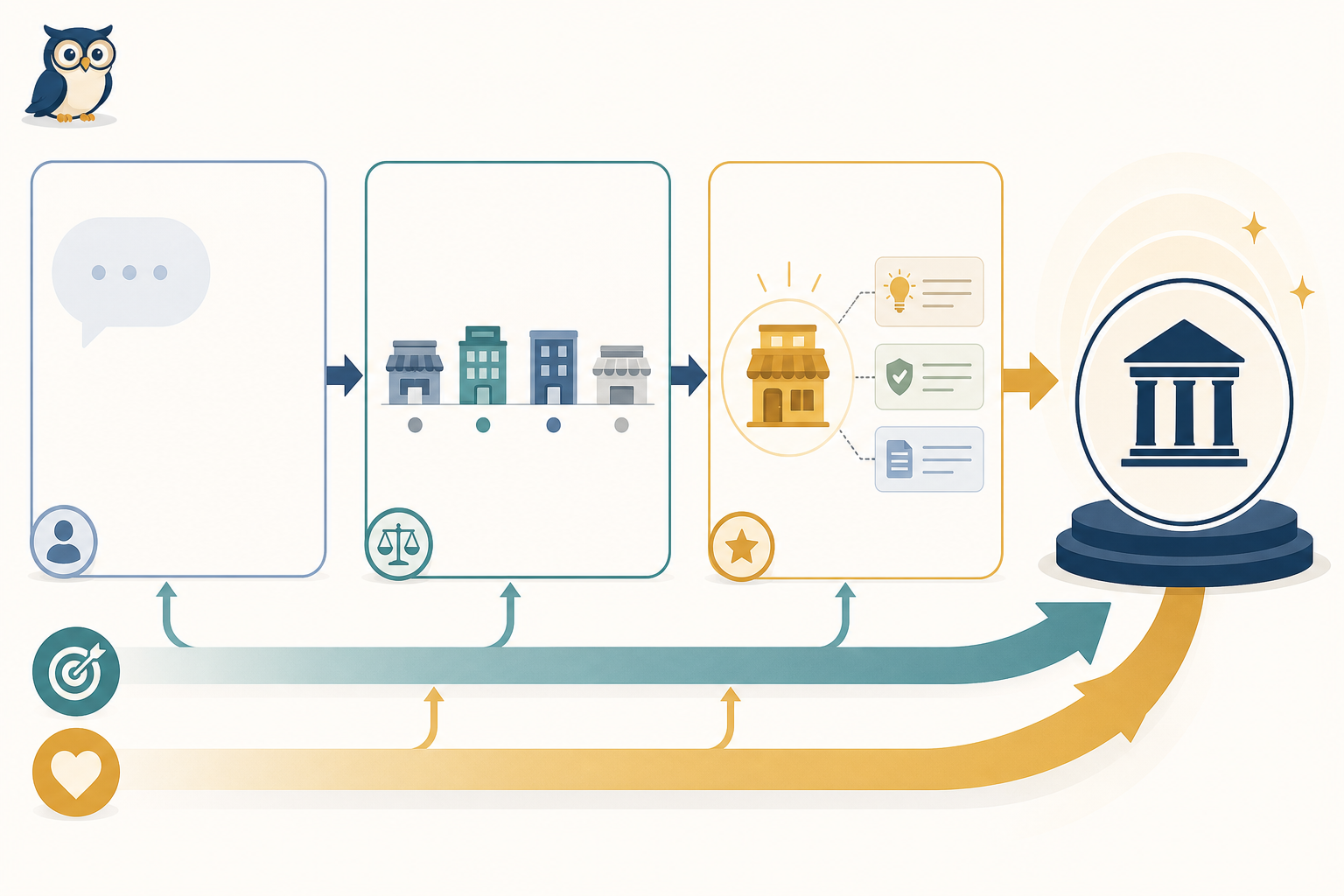
Before going further, it's worth separating five things that get blurred together constantly in this space, because collapsing them into a single “mentioned or not” judgement is exactly how businesses miss what's actually happening:
- Presence — are you named at all.
- Position — where you appear relative to competitors.
- Framing (sentiment) — the tone of the language used to describe you: favourable, neutral, hedged or negative.
- Source/citation quality — whether the AI's claim is backed by an identifiable source (a review platform, your website, a specific stat) or is an unsupported assertion with nothing behind it.
- Recommendation strength — whether the AI gives a specific, concrete reason to choose you, independent of how warm the tone sounds.
None of these five is a stand-in for the others. A business can score well on presence and citation quality while scoring badly on framing and recommendation strength — and that gap is exactly what this post is about.
AI Mentions vs AI Recommendations: What's the Difference?
There's a meaningful difference between an AI assistant listing your business as one of several options and an AI assistant favouring you with specific, positive reasoning. Owners conflate the two because both outcomes look identical at a glance — your name is there, job done.
It isn't job done. An AI mention places you in the conversation; specific, favourable framing with a concrete reason attached is what moves a reader toward you.
- Soft mentions are passive inclusions — “options include X, Y and Z” — with no reasoning attached.
- Explanatory favourable mentions are active and specific: the AI explains why your business fits the query, often pulling detail from your website or reviews. I'd stop short of calling these “endorsements” — confident-sounding AI language isn't independent proof of quality, and outputs are probabilistic enough that the same query can return a different framing on a different run.
Position adds a second layer on top of framing. This isn't guesswork: it echoes decades of documented position bias in traditional search, where industry click-through-rate research (Advanced Web Ranking's ongoing CTR studies are among the most widely cited) has long shown the first organic result capturing several times the click share of a result sitting fourth or fifth. There's no equivalent published research yet for generative AI answers specifically, but our own position-weighted citation tracking across client queries shows a directionally similar pattern: businesses named first or second in a comparative answer tend to read as more credible than those named fourth or fifth, even with near-identical wording. That's an internal observation, not a claim about how any model ranks results internally — but it's consistent enough across our client data to take seriously.
How AI Tone and Sentiment Affect Buyer Trust
Whether people extend more trust to an AI-generated answer than to a page of search results is genuinely still an open question. There isn't robust UK-specific research that settles it, and I'd treat any strong claim here — including my own — with caution. Pew Research Center's ongoing work on public trust in AI systems and Edelman's Trust Barometer research on institutional trust both suggest a public still forming its view, rather than one that's already decided AI answers deserve more weight than a search results page. What we do see in client engagement data is consistent with the idea that conversational answers, when they read as a synthesised verdict rather than a list of links, carry more implicit authority than the evidence behind them always justifies — but that's a pattern, not proof of a psychological mechanism.
What's easier to demonstrate is that hedging language does measurable damage regardless of how strong the underlying trust effect turns out to be. Phrases like “some customers report mixed experiences” or “it's worth checking recent reviews before deciding” are technically neutral — they're not accusations — but they plant doubt at exactly the moment a reader is deciding whether to act. In our sentiment data, a business named with a hedge attached consistently sits behind a competitor named with confident, unqualified language, even when nothing in the hedge is a specific criticism.
This is also where the citation-quality and recommendation-strength distinction matters most. An AI answer can cite a specific source (good citation quality) while still giving a weak reason to choose you (low recommendation strength) — “according to recent reviews, Firm B has some negative feedback” is a sourced claim that hurts you. Equally, an answer can sound warm and specific with no verifiable source behind it at all. Optimising for AI visibility means getting cited and getting cited with confident, sourced, specific reasoning — not just increasing how often your name appears.
Examples of Negative Framing in AI Answers
These are illustrative examples based on the patterns in our client review, not verbatim outputs from a specific live query — treat them as representative rather than reproducible on demand, since model outputs vary run to run.
For the query “best independent electrician in Bristol,” three businesses might get three different treatments:
- Positive framing: “Firm A is a well-reviewed local electrician known for same-day callouts and NICEIC certification.” Specific, sourced, favourable.
- Neutral/soft framing: “Other options in Bristol include Firm B and Firm C.” No reasoning attached.
- Negative framing: “Firm D has mixed reviews but may work for smaller budgets.” A backhanded mention that positions the business as a compromise.
Beyond that example, here are the patterns that recur most often when a business is named but not recommended:
- “X has mixed reviews but may work for smaller budgets.” Acknowledges you exist, then qualifies your relevance downward.
- “Limited recent information is available about X.” Signals staleness even when untrue — usually a content or crawlability problem, worth checking against your Google Business Profile and website copy before assuming it's a reputation issue.
- “X is mentioned occasionally but Y is more commonly recommended.” A share-of-voice disadvantage stated as if observed fact.
- “Some users have reported issues with X's customer service.” Often pulled from older reviews on Trustpilot, Yell or Checkatrade; a resolved issue can resurface in AI summaries well after the fact because the underlying source data hasn't caught up.
- Omission of differentiators competitors get credited for. No explicit criticism at all — your offering just looks thinner because a competitor was credited with specific strengths (faster response times, a named certification) and you weren't.
Before acting on any of these, verify the claim against your current reviews and primary sources — some reflect stale data, and the fix for that is different from the fix for a genuine service problem.
How to Monitor AI Sentiment and Visibility Over Time
Sentiment drifts, sometimes gradually and sometimes sharply after a trigger event, so monitoring AI visibility needs to be ongoing rather than a one-off audit. Use a rubric with four categories, not three — an “uncertain” bucket keeps you from forcing ambiguous answers into positive or negative:
- Positive: specific, sourced, favourable reasoning, no material caveats.
- Neutral: named without reasoning, or named with factual caveats that don't undermine credibility.
- Negative: named with hedging, unresolved complaints, or unfavourable named comparison.
- Uncertain/unverified: the claim behind the framing can't be confirmed either way from current information — flag it rather than classify it, and check again next cycle.
Every negative classification should carry the exact quoted line as evidence, not a paraphrase — otherwise sentiment tracking drifts into subjective impression rather than a checkable log. A simple tracking structure:
| Query | Platform | Presence | Position | Framing | Recommendation strength | Source quality | Evidence quote | Confidence | Action |
|---|---|---|---|---|---|---|---|---|---|
| “best electrician in Bristol” | ChatGPT | Yes | 3rd of 4 | Negative | Low | Unsourced | “mixed reviews but may work for smaller budgets” | High | Check recent reviews; correct if stale |
| “conveyancer Leeds” | Gemini | Yes | 1st of 3 | Positive | High | Sourced (cites reviews) | “known for fast turnaround and clear communication” | High | None — monitor for drift |
A minimum viable workflow, if running this across five platforms weekly isn't realistic for your business: pick two platforms (ChatGPT and Gemini cover the largest share of consumer use) and check monthly using three fixed questions. Expand to Claude, Copilot and Perplexity, and to weekly checks, only once you've confirmed the monthly cadence is catching real movement rather than noise.
The fuller version of the process:
- Run the same core purchase-decision questions repeatedly. “Who's the best [service] in [town]?”, “is [business] good for [use case]?” — on a recurring schedule, not a single check you assume stays valid.
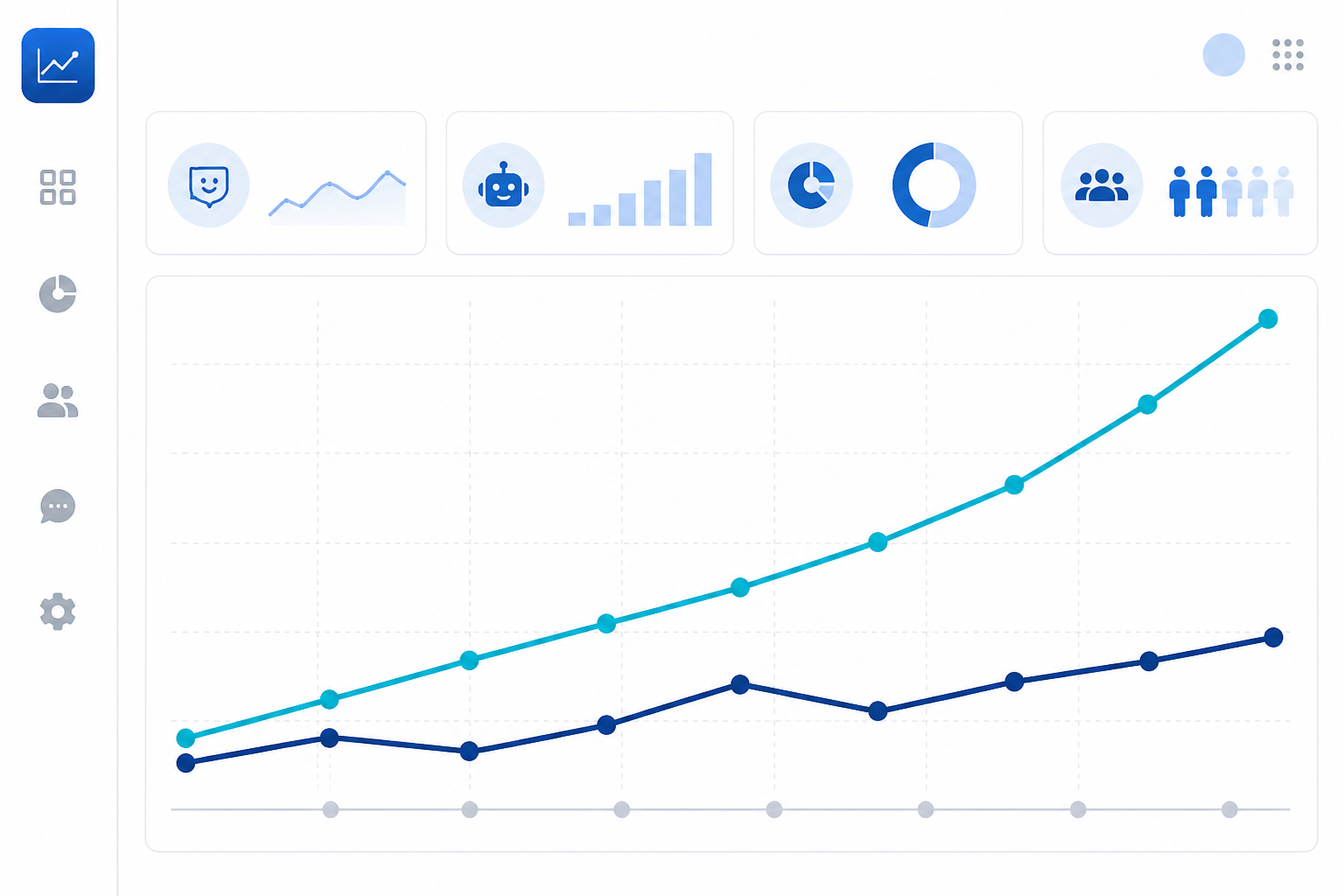
- Track framing separately from citation frequency and position. A rising mention count paired with declining sentiment is a warning sign dressed up as good news.
- Watch for drift after specific events — a website redesign, a spike in third-party negative reviews, a competitor's PR push. The lag before that shows up in AI answers varies by platform: some retrieve live web data, others lean on training data that can be months old, so don't assume a fixed delay.
- Compare your trend against named competitors. Trending positive matters less if a named competitor is trending more positive still.
- Set cadence to query volume, not habit. Weekly for fast-moving sectors (hospitality, trades); monthly for slower B2B services. Run any single query two or three times before drawing a conclusion, since outputs vary run to run.
How to Respond to Negative AI Sentiment
Once you've identified hedged, negative or comparatively weak framing, the response needs to be diagnostic before it's corrective — and it needs to stay anchored to fact-correction, not wording management. The goal is never to talk an AI model into sounding nicer; it's to make sure the model has accurate, current, well-structured information to draw from.
- Factual error or stale source → publish current, specific, verifiable information (updated service pages, current certifications, recent case studies) and recheck in a few weeks once it's likely to have been picked up.
- Missing business information → thin content, weak schema markup or a vague about page gives the model little to work with. A technical legibility review often resolves hedging that has nothing to do with your actual reputation.
- Genuine complaint pattern → recurring, current negative reviews. Fix the underlying service issue first and encourage satisfied customers to leave honest, current reviews. No amount of content polishing holds up against a real, recent pattern of complaints, because models increasingly draw from recent, credible sources.
- Competitor comparison gap → a competitor is credited with a strength you also have but haven't stated clearly. Publish content that accurately documents that strength — response times, coverage area, named certifications — rather than language crafted purely to counter what a competitor's answer said. The line matters: correcting an inaccurate or incomplete picture of your business is legitimate; writing content specifically to argue with an AI's phrasing isn't, and it tends not to work anyway since models mirror what's genuinely published and indexed, not what's written defensively.
Whichever cause applies, recheck sentiment using the same tracked questions after making changes. Skipping that step means you're optimising on faith rather than evidence, which defeats the point of monitoring in the first place.
A Seven-Day AI Visibility Starting Checklist
- Pick three realistic customer questions for your business and location.
- Run each one across ChatGPT and Gemini at minimum, and save the full answers with the date.
- For each answer, log presence, position, framing, recommendation strength and source quality using the definitions above — quote the exact line, don't paraphrase.
- Check whether any negative or hedged language traces back to stale content, thin website information, or a genuine unresolved complaint. Assign a confidence level to that judgement.
- Fix the highest-confidence issue first, then re-run the same three questions in two to four weeks and compare against your logged baseline.
That's the whole discipline: measure the five dimensions separately, act on the documented cause rather than the surface symptom, and verify with the same questions rather than assume the fix worked.
Frequently Asked Questions About AI Mentions and Visibility
Can AI mentions hurt my reputation even if they mention me?
Yes. A neutral-to-negative mention sitting next to a competitor's confident, sourced framing can do more damage than not appearing at all, because the reader sees both side by side and draws a conclusion — even when that conclusion isn't based on current or accurate information.
How do I check the tone of AI responses about my business?
Ask the same realistic customer questions across ChatGPT, Gemini and at least one other platform, repeatedly, and log presence, position, framing, recommendation strength and source quality separately for each answer. Treat any single answer as one data point, not a verdict, since outputs vary run to run. Monitoring tools can automate the repetition and scoring, which mainly helps by turning occasional spot-checks into a consistent trend line.
Why does ChatGPT describe my business differently from Google?
Search engines rank pages; generative models synthesise a single answer from whatever sources they've retrieved or were trained on, which can lag behind your current website or reviews by weeks or months depending on the platform. Thin structured data, an outdated about page, or reviews from a year ago can all shape an AI's framing long after they've stopped reflecting your actual business.
What causes negative sentiment in AI answers?
Stale or unverified information from older reviews or forum posts, thin website content that leaves the model uncertain and prone to hedging, genuinely negative recent reviews, and simply being described in relative terms against a competitor with clearer online content. Technical gaps — missing schema markup, unclear service pages — contribute more often than businesses expect, largely because they leave the model with little specific to say about you.
Can I fix negative sentiment once it appears, and how do I correct inaccurate AI information?
Usually, yes, though it takes time since models don't update instantly and freshness varies by platform. Correct the factual record first — updated website content, accurate schema, resolved service issues, legitimate current reviews — rather than writing content aimed at countering an AI's specific phrasing. Then recheck with the same tracked questions afterward; that's the step that actually confirms whether it worked, rather than leaving you guessing.
Related Articles

How to Pitch AI Visibility Monitoring as a New Client Service: A Guide for Agencies
A practical guide for UK agencies on pitching AI visibility monitoring to clients: how to frame the problem, run a free audit, handle ROI objections a
AI Citations vs Backlinks: What Actually Builds Authority for SaaS and DTC Brands
Learn how backlinks, third-party mentions and clear content shape ChatGPT citations, and how SaaS marketers can measure AI visibility and shift author
Create content like this automatically
Scribe uses AI to generate high-quality blog posts that engage your audience and drive traffic.