Traditional Gift List vs Online Baby Registry: Which Wins for South African Parents?
13 min read
Loading...

For many UK families, an online baby registry is the easier choice, especially if guests live in different towns or countries. Everyone gets one link to follow, and it can cut down on duplicate baby shower gifts. It isn't magic, though, and a simple handwritten gift list still works well for a small, close-knit shower. Here's how I'd work out which one suits your family and your guest list. 💛
A quick note on who I am: I'm part of the team at bababloom, a registry platform built for South African families. Our service is designed around South African retailers and rand pricing, so it isn't the right fit for guests shopping in the UK. I've kept this comparison general, so it applies whichever baby registry platform you look at.
Picture this. There's a half-finished list stuck to your fridge, scribbled in between a grocery reminder and a scan appointment. Meanwhile, three different group chats are asking, 'So what do you actually need?' And somewhere at the back of your mind is the quiet worry that you'll end up with five identical baby blankets.
I've heard some version of this story from nearly every parent-to-be I know. The good news is that there are really only two ways to tackle it.
Which one is better depends on your guest list, your budget and how you like to organise. By the end of this post you'll know which fits your baby shower gifts, and where a plain old list is perfectly fine.
Traditional gift lists come in more forms than you'd think. There's the handwritten list passed around at a shower, the PDF sent by email, the WhatsApp message forwarded from person to person, or the list left with a family member who fields all the questions.
There's a hidden workload too. You become the unofficial project manager of your own baby shower, answering the same questions, updating the list and quietly smoothing over awkward overlaps. That's a lot to carry while you're growing a human.
A friend of mine ended up with three sets of newborn onesies, all in the same size. Her cousin saw the list on Monday, her colleague saw an older version on Wednesday, and her neighbour just grabbed something cute. Nobody did anything wrong. The list simply couldn't keep up.
The basic idea is simple, though the details differ from one platform to the next. Here's how it typically goes:

This is the question I'd ask any platform before you commit. There are broadly three approaches:
If a guest checks out on an external retailer's site and the platform can't verify the sale, the list relies on guests remembering to confirm. That's still better than a paper list, but it isn't foolproof. Ask the platform which method it uses.
Registries aren't all alike, so here's a short checklist worth running through:
Let's look at it from your guests' side, because their experience matters just as much as yours.
| Traditional gift list | Online baby registry | |
|---|---|---|
| Finding the list | Easy in person; others need it sent or described | One link, usually works on any phone |
| Choosing a gift | Pick from the list, often confirm with the coordinator | Browse items and, on most platforms, see what's still available |
| Paying | Wherever they choose to shop | Usually the retailer's checkout; some need an account or entering details more than once |
| Delivery | Guest carries or arranges it themselves | Often sent to the address you choose; costs and timing depend on the retailer |
| Knowing what's bought | Relies on messages and memory | Depends on the platform: automatic, guest-confirmed or parent-updated |
| Wrapping and personal touches | Easy to wrap and hand over in person | Add a card or note; wrapping depends on the retailer |
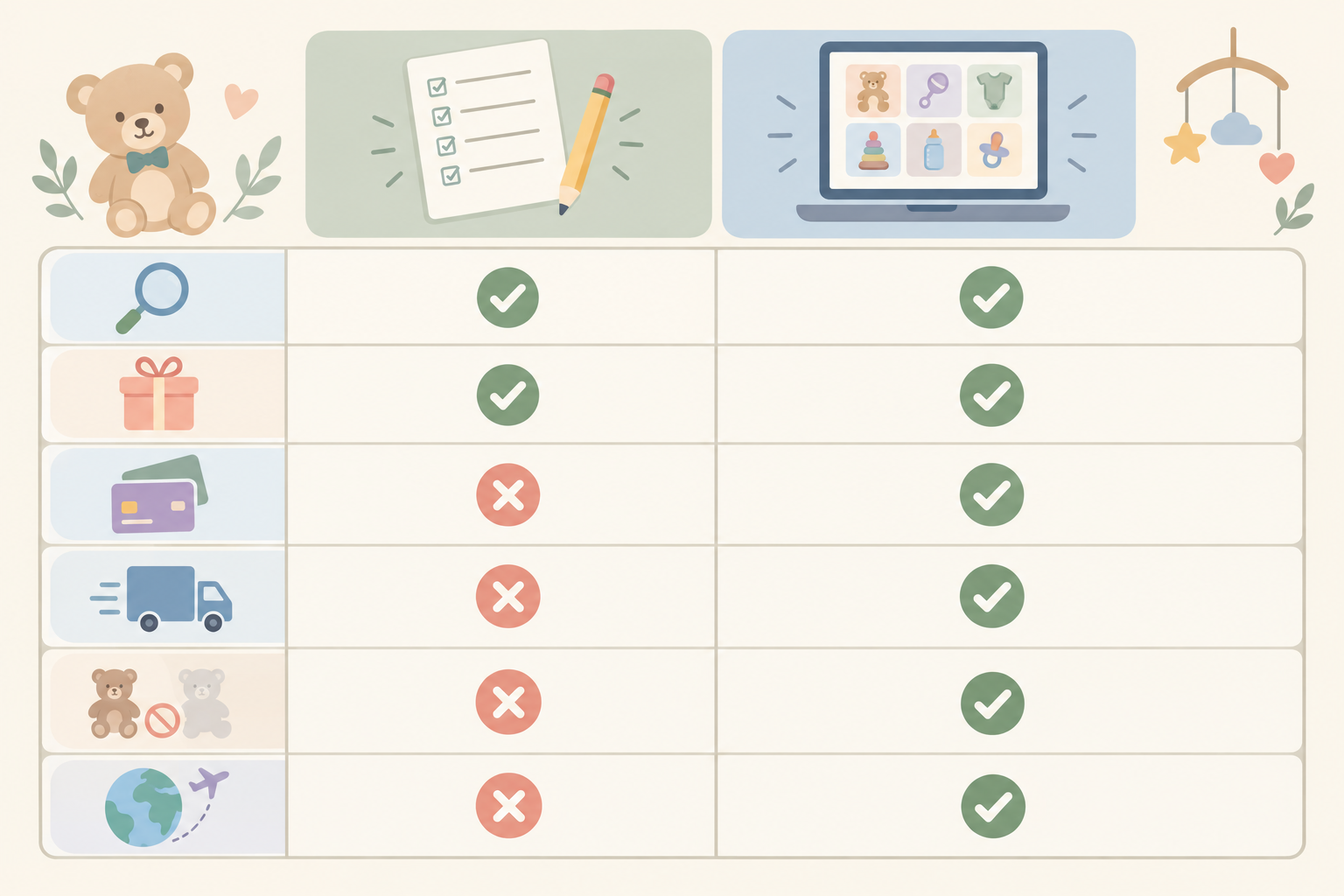
For guests who are at the shower, a handwritten list is easy. They can see it, tick it off and chat about it. Some older relatives genuinely prefer browsing a shop, choosing something in person and handing it over with a hug. That's lovely, and an online option can sit happily alongside it.
The moment someone lives in another city or another country, the paper list falls over. They have to phone around, or rely on someone else to buy for them. With an online registry, they open one link, pick something and have it delivered to you.
Usually, yes, and a tiny bit of guidance makes it smoother. I'd send the link with a short, friendly message, something like: 'Click the link, pick anything that's still available, and check out on the shop's website. It'll be delivered to us.' Tell them whether they need to confirm their purchase on the registry, and point less tech-confident relatives to one person they can phone if they get stuck.
There are a few trade-offs to be honest about. Delivery charges can add up if a guest buys from several shops. Overseas guests may face extra postage or customs delays. And if an item sells out, they may need to choose again.
Now for the part that affects you most.
Online registries reduce duplicates in a simple way. Once an item is marked as purchased, the next guest can see it's taken and choose something else. How reliably that works depends on how the platform tracks purchases, as we covered above. If it relies on guests confirming, a few gifts may slip through.
Traditional lists try to do the same job by hand. Someone ticks things off, a coordinator keeps track, or guests message first. That can work beautifully for twelve people in one living room. It breaks down when the guest list is bigger or scattered, because information gets out of sync, and suddenly there are two identical sleep suits.
No system is foolproof. Guests sometimes buy off-list because they saw something adorable and couldn't resist. A friendly line on your invitation helps: 'We've put together a little registry. Please have a peek before you buy so we don't end up with twelve muslin cloths!'
When guests are spread across different places, an online registry usually wins on duplicates, as long as purchases are tracked reliably. For a small, local shower, a well-run handwritten list does the job just as well.
If guests buy directly from a retailer, returns and exchanges generally go through that shop's usual process. Policies, time limits and whether gift receipts are included vary from shop to shop, so check the ones you expect guests to use most.
Choose a traditional gift list if:
Choose an online baby registry if:
Consider a hybrid:

There's no wrong answer here. What you want is a shower that feels easy and joyful, for you and for the people who love you. Whichever route you take, run through the checklist above and try it out before you commit. 🌿
For many families, yes, particularly when guests live far apart. It's easy to share with anyone and can cut down on duplicate gifts. A handwritten list can still work well for a small, local shower where everyone can chat about who is buying what.
They mark an item as purchased so other guests can see it's taken. How that happens depends on the platform. Some update automatically, some ask guests to confirm their purchase, and some rely on you to update the list. It reduces duplicates, but it can't rule out guests who buy off-list.
Usually, yes. They only need your link, and they can choose a gift and pay without being in the same room. Delivery costs, stock levels and account requirements vary by retailer, so a short message explaining the steps helps.
It depends on the platform and the retailer. Some flag unavailable items, and others leave it to you to update. Checking your registry every so often saves guests from disappointment.
Not always. Some platforms are free, while others charge a fee, so compare the cost with your guest numbers and how much coordinating you'd rather avoid.
Discover Pretoria baby stores worth knowing: handmade baby products, nursery decor and baby shower gifts under R500, plus how to add them to one regis

Discover Durban baby stores, handmade baby products and thoughtful baby shower gifts from KZN makers—with tips for UK shoppers and delivery.

Wondering if it's rude to go off-registry or how much to spend? Our friendly guide to baby registry etiquette answers every baby shower guest question