Understanding Your AI Visibility Score: A Founder's Guide to What It Actually Measures
AI Visibility Score: What It Means and How to Improve It
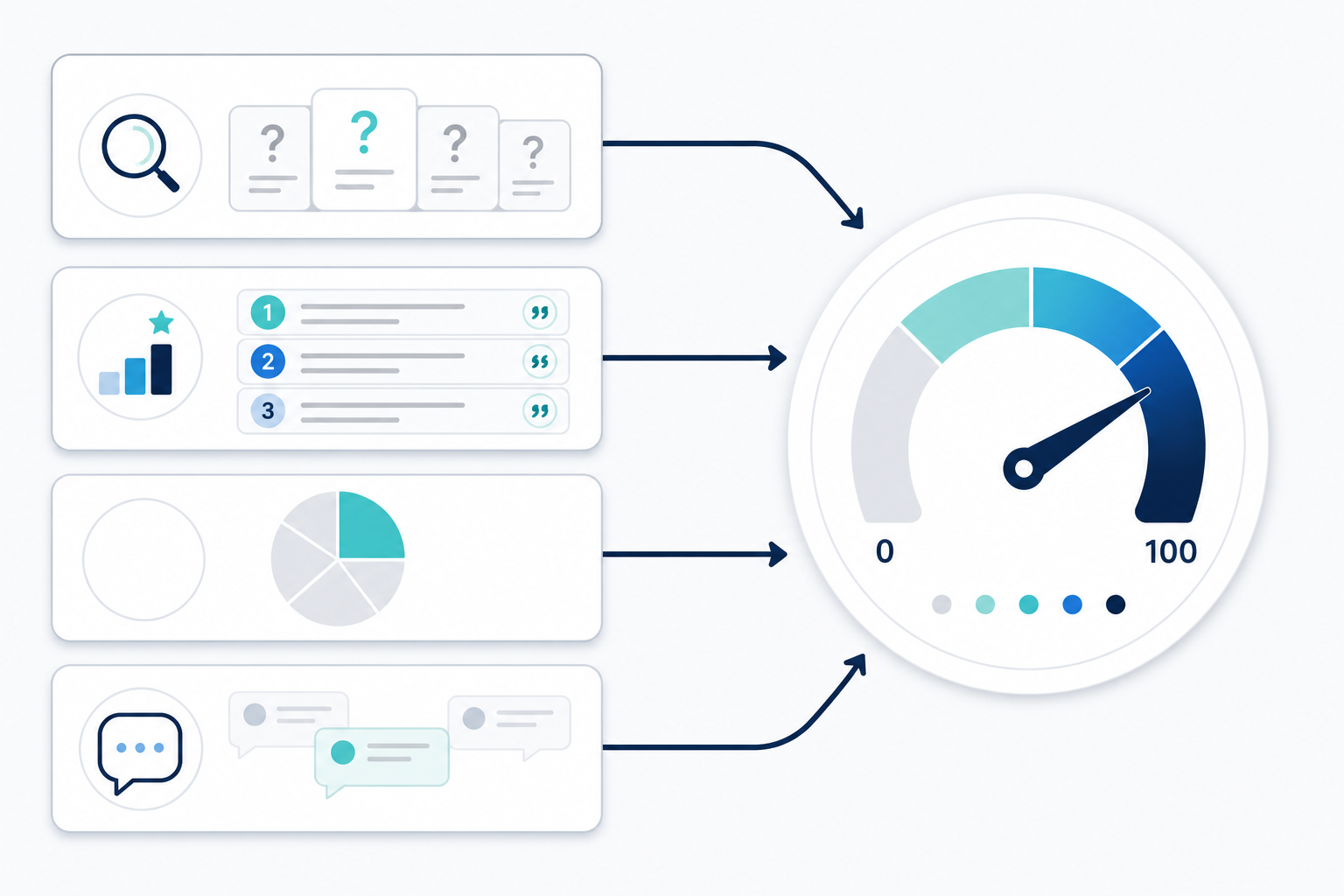
Your AI visibility score is a 0–100 composite built from four measurable inputs: query coverage (how many relevant customer questions mention you at all), position-weighted citations (how prominently you're cited when you do appear), share of voice (your mentions relative to competitors), and soft mentions (indirect references without a direct citation). Most founders fixate on the single number, but I've found the real value sits in the breakdown. Each component points to a different, specific fix.
That distinction matters more than it sounds. A score of 48 caused by weak query coverage requires a completely different response than a score of 48 caused by strong coverage but terrible citation positioning. Think of the composite number as a smoke alarm and the four inputs as the fire department's incident report. The alarm tells you something's happening; the report tells you where to point the hose.
What Goes Into an AI Visibility Score?
There's no universally accepted formula for an AI visibility score the way there is for, say, a credit score. Different platforms measure different combinations of brand mentions, citation frequency, answer position, sentiment, and competitor presence, and I'd rather say that plainly than pretend there's a tidy industry standard. Research from Princeton, Georgia Tech, the Allen Institute for AI, and IIT Delhi (published as the "GEO: Generative Engine Optimization" paper at KDD 2024) found that a defensible visibility measurement needs a fixed prompt set, repeated over time, scored across multiple dimensions rather than collapsed into a single pass/fail check.
At MentionOwl, we build that fixed prompt set automatically. The system crawls your website, infers the kinds of questions a real customer would ask before buying, and runs those questions daily against ChatGPT, Claude, Gemini, Copilot, and Perplexity. From those runs, four pillars get calculated:
- Query coverage: what percentage of relevant questions mention you at all
- Position-weighted citations: how prominently you appear when you do get mentioned
- Share of voice: your mentions relative to the competitors we're tracking against the same prompts
- Soft mentions: indirect references where you're implied but not directly cited
It's worth explaining why this differs fundamentally from traditional SEO scoring. There's no backlink profile here, no keyword density calculation, no domain authority metric borrowed from a crawler index. AI visibility is behavioural: it measures what a language model actually says when asked a buying question, not what a static algorithm calculates about your page structure. That's a meaningfully different discipline, which is why generative engine optimisation has emerged as its own practice rather than a subset of conventional AI SEO.
What Is Query Coverage?
Query coverage is the simplest pillar conceptually, and usually the first one worth checking.
Here's the definition: the percentage of relevant customer questions where your brand appears in the AI's answer at all, not necessarily first, not necessarily cited, just present.
For a SaaS founder running an invoicing tool, that might include questions like:
- "Best invoicing tool for freelancers UK"
- "How do I automate VAT invoicing for a small business"
- "Invoicing software alternatives to FreshBooks"
Notice these are niche, long-tail, purchase-decision queries rather than broad category terms like "accounting software." Pew Research Center's 2025 analysis found that AI summaries appeared for roughly 53% of searches phrased as actual questions, compared with only about 8% of searches using a question word without question phrasing. That gap tells me prompt mix matters enormously. If your tracked questions skew too broad or too generic, your coverage score will look artificially low or high depending on how competitive that broad category is, rather than reflecting your actual discoverability for the decisions customers are genuinely making.
Why Is Query Coverage Low?
A few common culprits show up again and again:
- Thin website content that doesn't directly answer the specific question a customer would ask
- No comparison pages — AI engines lean heavily on "X vs Y" and "alternatives to" content when constructing recommendation answers
- Missing FAQ schema or structured Q&A content that makes your answerable claims easy for a model to extract
Your weekly digest breaks coverage down query-by-query, so you're never guessing which specific questions you're missing. You can see exactly which prompts returned zero mention of your brand and start there.
Why Position-Weighted Citations Matter for AI Visibility
Being mentioned and being cited prominently are not the same achievement, and conflating them is probably the single most common misreading of an AI visibility score I run into.
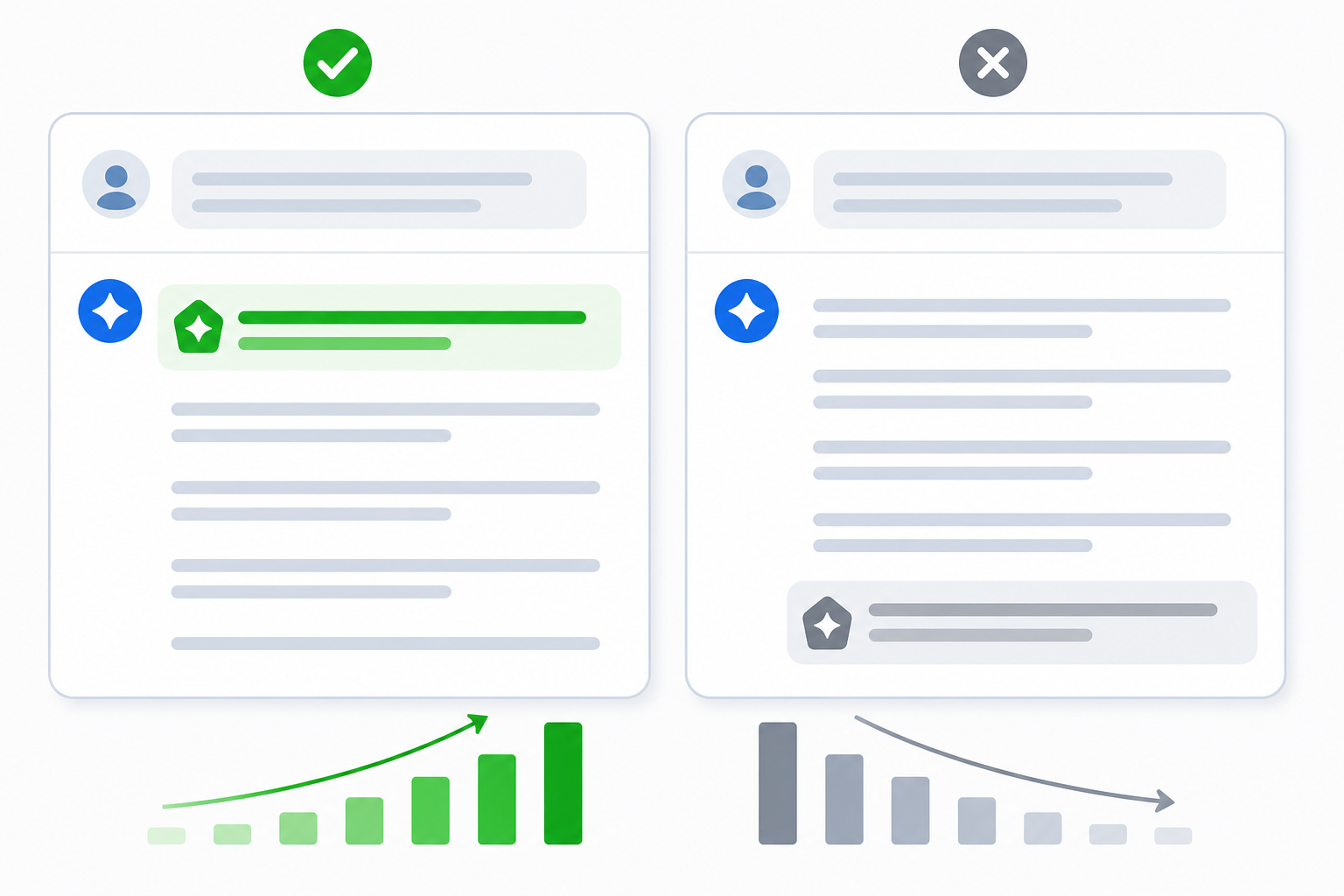
A position-weighted citation score assigns more value to a mention appearing in the first sentence or the opening recommendation than to one buried fourth or fifth in a list, or tucked into a closing "other options include" clause. This isn't just intuition. The GEO research found that optimisation methods targeting content presentation and structure could improve generative-engine visibility by up to 40% in controlled experiments, with the gains concentrated specifically in how prominently a brand appeared rather than merely whether it appeared.
It's also worth understanding that ChatGPT citations behave differently from Perplexity's source-linking style. ChatGPT often names a brand within the flow of an answer without a corresponding clickable source, while Perplexity tends to attach explicit linked citations to specific claims. That means a brand can have strong mention presence on one platform and strong linked-citation presence on another, and a composite score needs to account for both patterns rather than assuming all platforms cite the same way.
What Influences Citation Position?
What actually influences citation position? AI legibility, a term I use deliberately in parallel with SEO's technical audits. Structured data, clear heading hierarchies, and page sections written to directly answer a specific question all make it easier for a model to extract your content as a confident, early answer rather than a hedged, late mention. This is exactly why MentionOwl's legibility audit runs 16 separate technical checks against your site: citation position is influenced by machine-readability in ways that are fixable, often within a single content sprint.
How Does Share of Voice Fit Into an AI Visibility Score?
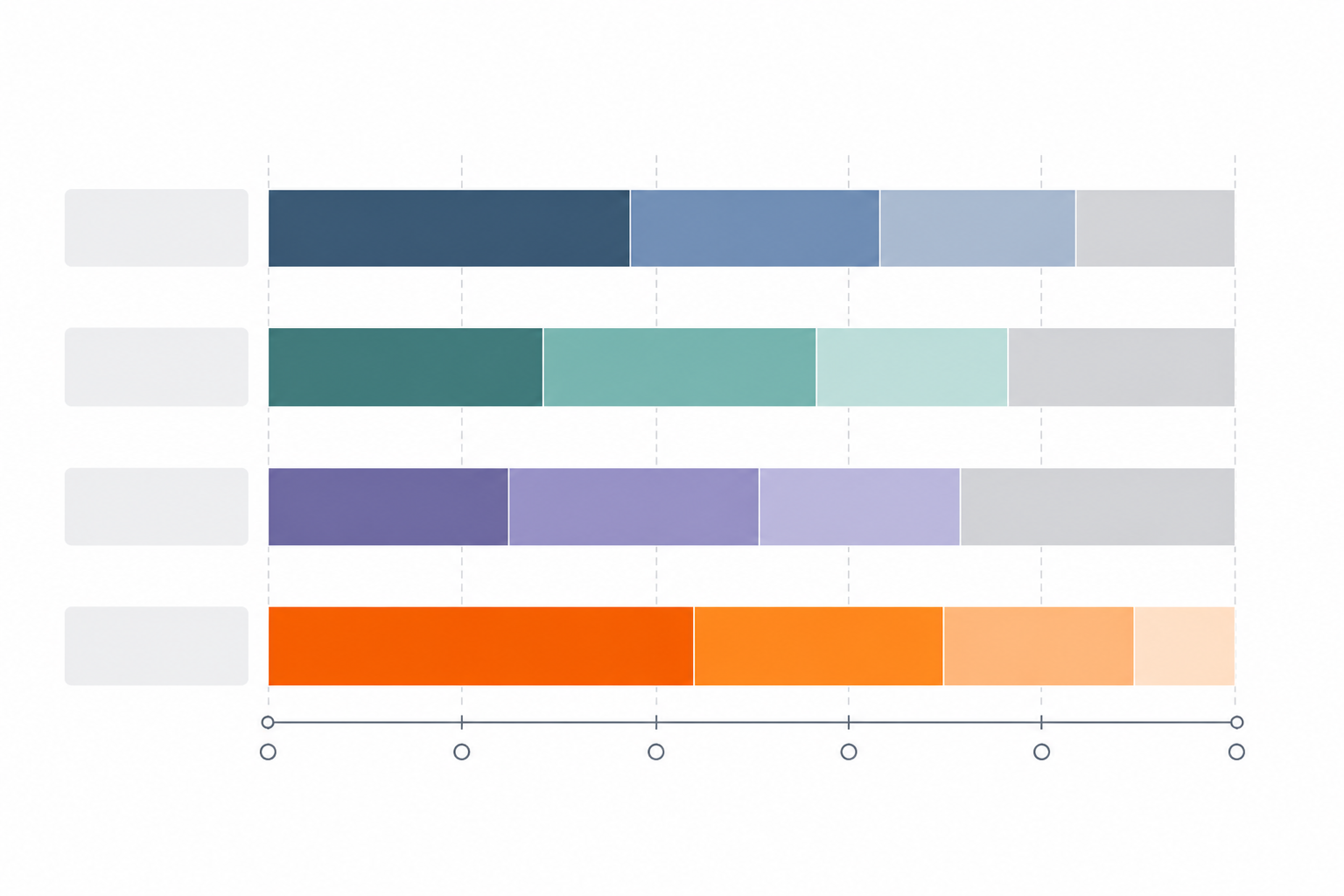
Share of voice measures your mention frequency relative to the total mentions of you plus your tracked competitors across the same prompt set. It's a comparative metric, not an absolute one, and that distinction changes how you should read it.
Here's the part that surprises most founders: a 40 out of 100 share-of-voice component can still mean you're winning decisively, if your two closest competitors are scoring 15 and 20 on the same prompts. Share of voice is only meaningful relative to a defined competitive set. It is not market share, and it is not a percentage of all possible AI answers in your category.
Competitor tracking inside MentionOwl exists precisely to surface this context. Rather than just telling you your share dropped, it shows you which competitor is gaining ground on which specific queries and, critically, what content or claims they're using that you aren't. That's usually far more actionable than the raw percentage alone.
Share of Voice and Sentiment
One layer I'd urge you not to skip: sentiment sits on top of share of voice, and the two can tell very different stories. Being mentioned frequently but negatively is a fundamentally different problem than not being mentioned at all. A brand with high mention frequency and poor sentiment needs a messaging and accuracy fix on existing pages; a brand with low mention frequency needs net-new content. Solve the wrong one and you've wasted a content cycle.
What Is a Good AI Visibility Score?
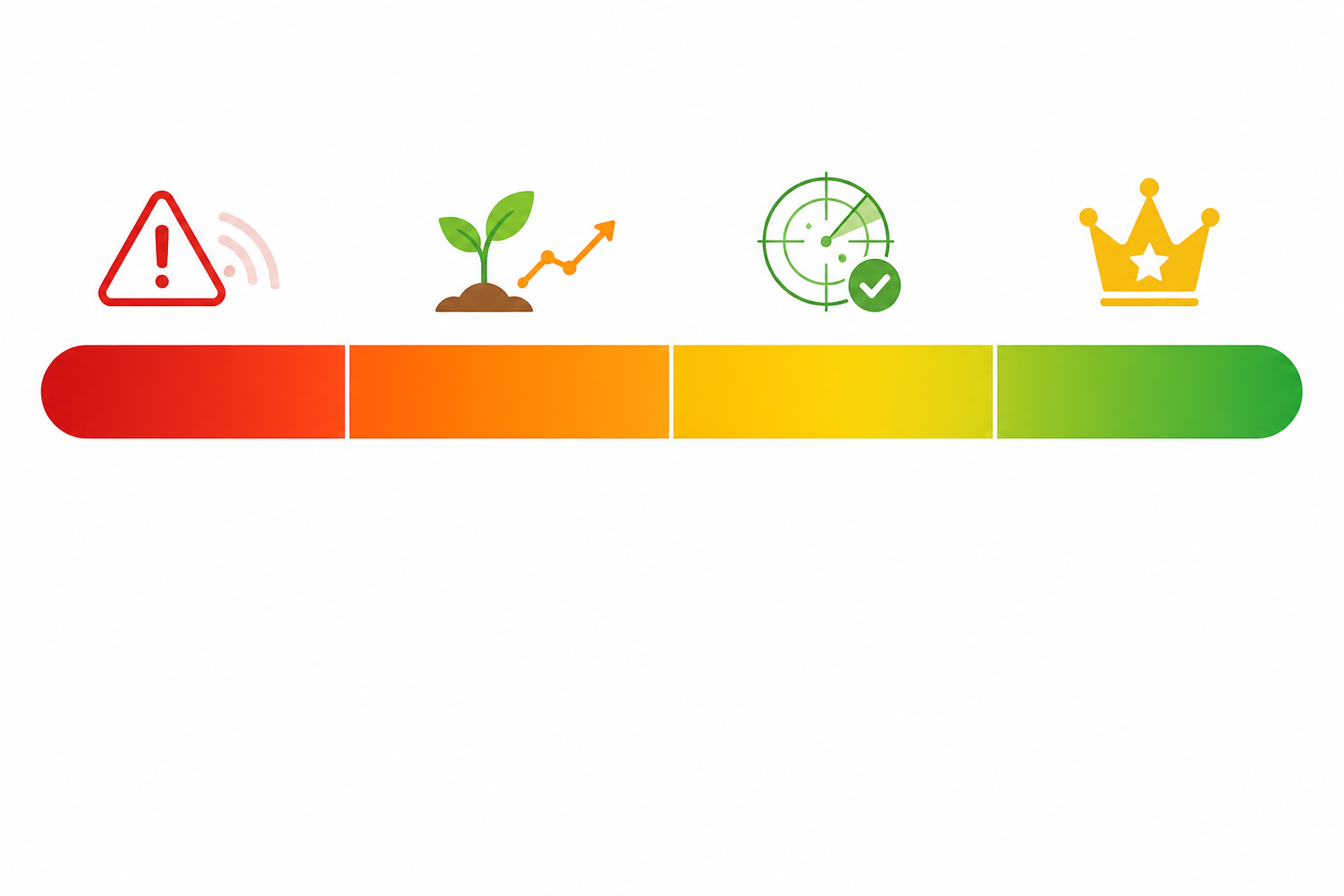
I want to be direct about something: there is no single "good" AI visibility score, because the number only means something relative to your competitive set and your prompt mix. That said, founders consistently ask for bands, so here's the general framework I use when reviewing dashboards:
| Score Band | What It Typically Indicates |
|---|---|
| 0–30 | Largely absent from AI answers for relevant customer questions; needs foundational content and legibility work |
| 31–55 | Developing presence; shows up inconsistently, often only for branded or very specific queries |
| 56–75 | Solid, consistent presence across most relevant prompts, generally cited though not always first |
| 76–100 | Category leader status; a default or near-default recommendation across the prompt set |
A realistic benchmark for a solo founder competing in a crowded niche looks very different from a category leader's benchmark. An early-stage SaaS company might sit at a 6% share of voice against an established competitor's 31%. That's not automatically a failing score; it's a starting point. The more useful comparison, in nearly every case, is your own score against your own history. A brand moving from 22 to 34 over two months is demonstrating real progress even if 34 still sounds modest in isolation.
It's also worth knowing that scores can shift independent of anything you've changed. Model updates, seasonal query patterns, and shifts in how a platform indexes fresh content can all move your number. That's exactly why a trend line matters more than any single reading.
How to Use Your AI Visibility Score to Prioritise Next Steps
Once you understand the four pillars, prioritisation becomes mechanical rather than guesswork:
- Check query coverage first. If it's low, you have a content gap problem, not a positioning problem. No amount of technical polish fixes a question your site simply never answers.
- If coverage is solid but position-weighted citations are weak, run an AI legibility audit to find structural blockers: unclear headings, missing structured data, or answer sections that are too diffuse for a model to cite confidently.
- If citations are strong but share of voice is low, study your competitor tracking data to see which pages or claims competitors are using that you aren't. This usually points to a comparison page or a specific claim you haven't made explicitly.
- Re-run the same query set after making changes, rather than switching to new questions. You're measuring whether your fix worked, not whether a different question produces a different answer.
- Set a weekly digest review habit rather than checking daily. AI answers shift gradually enough that daily obsession mostly produces anxiety rather than insight.
How Often Should You Check Your AI Visibility Score?
Daily crawling matters enormously for data accuracy. It's how MentionOwl catches a sudden sentiment drop or a new competitor citation the moment it happens. But daily crawling for data accuracy and daily checking for founder decision-making are two different things, and conflating them is a fast route to burnout.
I recommend a weekly digest review as the practical cadence for solo founders. Between full reviews, the things genuinely worth a mid-week glance are sudden sentiment drops or the appearance of a new competitor citation on a query you previously owned. Everything else can wait for the weekly cycle.
Volatility also isn't uniform across platforms. Perplexity and Gemini tend to shift faster than ChatGPT because of differences in how aggressively they re-index fresh web content, so a single-day swing on one platform isn't necessarily a signal, while a sustained multi-week shift across several platforms usually is.
Frequently Asked Questions About AI Visibility
What is a good AI visibility score?
There's no universal "good" number because it depends heavily on your competitive set and niche. I generally tell founders that anything above 55-60 means you're consistently showing up in the conversation, while scores above 75 suggest you're a default recommendation in your category. More important than the absolute number is your trend over time and your score relative to the two or three competitors you actually compete against for customers.
How is the AI visibility score calculated?
MentionOwl auto-generates realistic customer questions from your website content, runs them daily against ChatGPT, Claude, Gemini, Copilot, and Perplexity, then scores the results across four weighted inputs: query coverage, position-weighted citations, share of voice against tracked competitors, and soft mentions where your brand is implied but not directly named. These combine into the single 0-100 figure you see on your dashboard.
Can I improve my AI visibility score quickly?
Some fixes move fast. Correcting technical legibility issues like missing structured data or unclear page headings can shift citation position within a week or two, since AI engines re-crawl frequently. Query coverage gaps take longer because they usually require new content. I'd be cautious of anyone promising an overnight jump; genuine share of voice gains against established competitors typically show up over four to eight weeks of consistent content and technical work.
How often should I check my AI visibility score?
I recommend a weekly review using the digest rather than logging in daily. The underlying data refreshes daily so nothing is missed, but AI model behaviour doesn't typically shift dramatically day to day, so weekly is frequent enough to catch real trends without creating noise or false urgency.
Related Articles
Why Being Mentioned by AI Isn't Enough: How Sentiment Shapes Your Real AI Visibility Score
Mention counts tell leadership nothing about brand perception. Learn how sentiment analysis across ChatGPT, Gemini, and Perplexity reveals whether AI
Case Study: How a Local Brand Quietly Lost Ground in AI Answers (And What the Data Finally Showed)
A real-world case study on AI visibility decline: how a UK small business lost customers to a competitor in ChatGPT and Gemini answers—and the data th
Create content like this automatically
Scribe uses AI to generate high-quality blog posts that engage your audience and drive traffic.